









هذا التقرير متاح أيضًا بـ العربية
Financial settlements reached by the Committee to Combat Illicit Gains with businessmen linked to Syria’s former regime have sparked debate over the legal basis for its handling of their funds and assets, particularly its authority to reach settlements with individuals in the private sector.
On 4 May 2025, Syrian President Ahmed al-Sharaa issued Presidential Decree No. 13 of 2025, establishing the committee to trace, manage and investigate funds classified as illicit gains. Its aim is to safeguard public money and protect the public interest pending verification of whether those funds were lawfully acquired.
Questions about the committee’s jurisdiction and whether its measures comply with the legal framework governing its work have raised a further issue: can these settlements be challenged? If they are invalidated, the consequences could include demands for the return of funds transferred to the state under the agreements.
Private-sector entities on the asset-freeze list
In recent months, a leaked list obtained by NoonPost has circulated, naming individuals, companies and commercial establishments whose assets were frozen by the committee, including private-sector companies.
The list names 3,463 individuals and 68 companies and commercial establishments. Asset freezes remain in place for 3,293 individuals and have been lifted for the other 170. Among the companies and commercial establishments, 47 remain subject to freezes, while freezes have been lifted for the other 21.
The list has prompted controversy over whether the committee’s measures fall within the jurisdiction set out in its founding decree. The decree’s text covers officeholders and employees in civilian and military posts, while Article 3 grants the committee full powers and flexibility to carry out its work, including taking precautionary measures.
Settlements beyond the committee’s authority?
In posts on his Facebook page, economic expert Mohammed al-Olabi noted that the leaked list does not explain why asset seizures were lifted for most members of a separate group previously subject to those measures. He suggested that some may have reached settlements with the committee, although no information about the terms or amounts paid is publicly available.
Al-Olabi also noted that several businessmen known for their ties to the former regime were absent from the list, including Mohammad Hamsho, Samer Foz and Yassar Ibrahim. Other absent figures, he said, were close to Maher al-Assad and Asma al-Akhras, the wife of deposed President Bashar al-Assad.
He said their absence raises questions about whether they reached settlements or whether decisions were made not to seize their assets. There is insufficient information to establish what happened. He identified Tarif al-Akhras as the most notable exception among these figures: asset seizures against him and members of his family had been lifted.
Based on his reading of the founding decree, al-Olabi believes the committee exceeded its legal authority by reaching settlements with private-sector businessmen who supported the former regime.
On that interpretation, he considers the committee’s decisions and settlements in this area open to challenge before the Council of State. He also questions their constitutionality, stressing that, if it existed, the Constitutional Court could have examined whether they were compatible with the constitutional declaration.
Al-Olabi criticised the lack of transparency over the value of the funds covered by the settlements, what has happened to them and how they are managed. He argued that this weakens the prospects for accountability and oversight of public money.
He believes the more appropriate legal approach would have been to take precautionary measures against the funds and assets, then refer each case separately to the ordinary courts, rather than reach settlements through the committee, given that transitional justice institutions, parliament and the Supreme Constitutional Court have not yet been fully established, as he put it.
Were the powers later amended?
By contrast, subsequent official clarifications of the founding decree, reported by the Syrian Arab News Agency (SANA) in February 2026, describe a broader remit. This includes partners and other involved parties linked to financial networks, as well as powers to reach settlements and recover assets.
According to SANA, committee head Basel al-Suwaidan said its work is based on Decree No. 13 of 2025. The statement did not mention any subsequent amendment or cite new legislation that would explain this expansion.
The discrepancy raises questions about whether the committee’s powers were expanded through an amendment that was never announced or published, or whether the published clarifications reflect its interpretation of the existing decree.
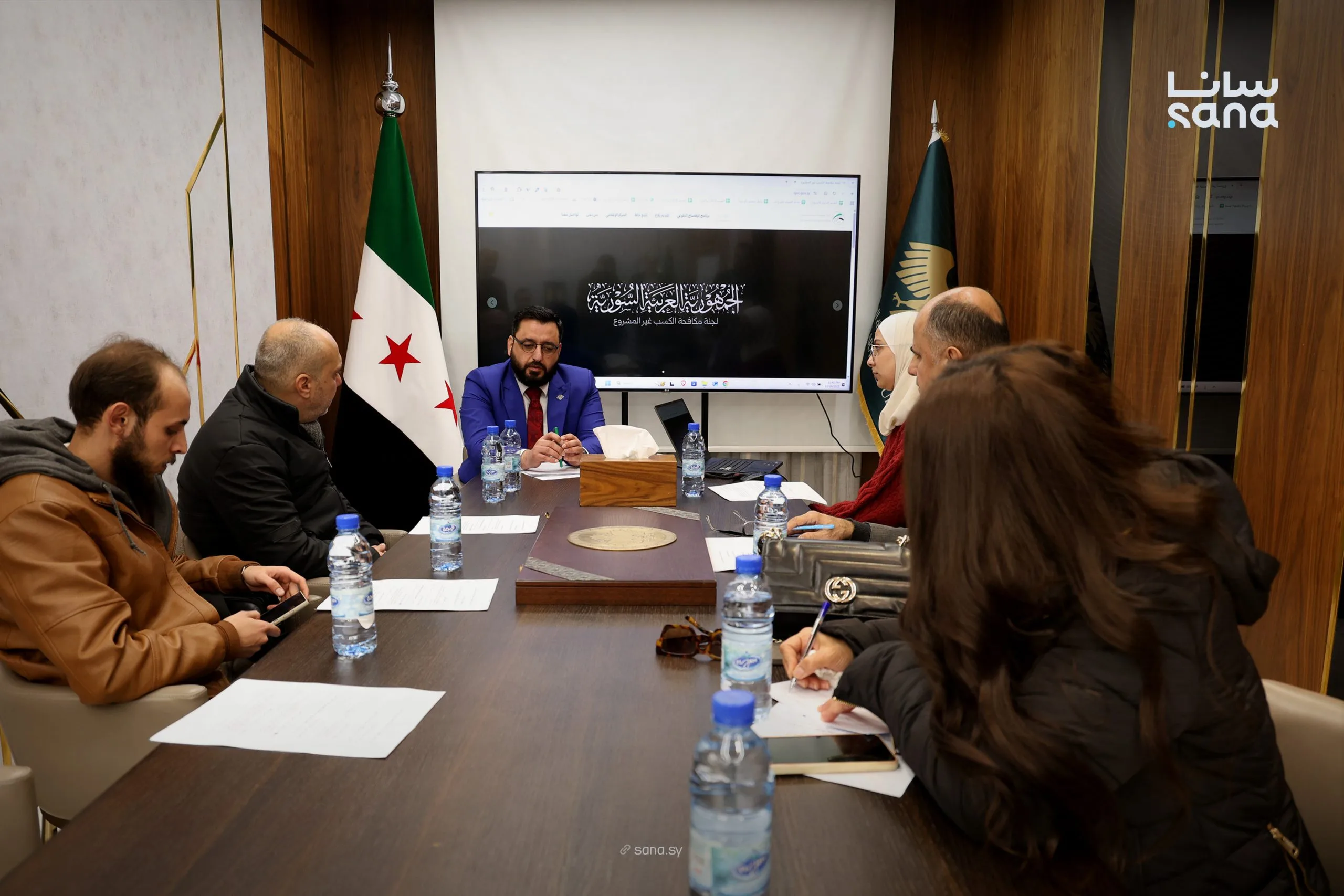
The powers described by al-Suwaidan are set out in detail on the committee’s website. They include reviewing documents, information and records held by public and private entities, and requesting precautionary measures, including asset freezes and travel bans, in coordination with the relevant legal and executive authorities.
They also include cooperating with judicial, oversight and financial bodies inside and outside Syria; requesting the lifting of banking secrecy within the law; reaching settlement agreements and recovering funds for the public treasury; and referring cases to the public prosecution or the relevant authorities when grounds for suspicion of criminal activity have been established.
According to the same website, the committee’s jurisdiction extends to officeholders, civilian and military employees, and state workers in the categories specified in the Economic Penal Code and its amendments. These include workers in the public and mixed sectors, with the exception of judges.
Its jurisdiction also covers partners and other involved parties who fall outside those categories, anyone assigned to a public service, and any citizen the committee deems it necessary to bring within its remit.
An investigative body
In statements to the newspaper Al-Watan on 26 September 2026, al-Suwaidan discussed how the committee handles cases involving businessmen linked to the former regime and how it recovers funds.
He said the committee examines each case according to the nature of the businessman’s relationship with the former regime and the source of the funds. The process may lead to an investigation, voluntary disclosure or a settlement.
He added that, in some complex cases, the committee may take precautionary measures against available funds and assets, particularly when money has been transferred abroad, until the state has received what it is entitled to or the case has been resolved under the approved procedures.
An explanatory video published by the Committee to Combat Illicit Gains on its website
Al-Suwaidan explained that funds and assets outside Syria covered by settlements with the committee had been recovered for the state in accordance with the decisions made in each case. He stressed that a settlement comes only after the state’s entitlement to unlawfully acquired funds has been determined and the money collected through due process.
On disputes over asset ownership, al-Suwaidan stressed that the committee is an investigative body and has no authority to make a final ruling on whether a buyer acted in good faith. That decision, he emphasised, rests with the judiciary.
He added that, when substantive facts emerge about ownership transferred under a judicial ruling, they are referred back to the relevant court.
‘The committee is administrative, not judicial’
Ahmed Korbi, a researcher specialising in public law, said the published decree establishing the Committee to Combat Illicit Gains does not give it jurisdiction over private-sector assets. Under the text, he explained, its powers relate to the public sector. He added, however, that the decree appears to have been amended later to cover both sectors, although, according to the information available to him, the amendment was never published.
Korbi said the committee’s powers cover all matters relating to illicit gains during the former regime, including those connected to the formation of militias and other issues. He explained that the committee is administrative, not judicial, and reaches administrative settlements. Its work closely resembles that of a committee established in Tunisia with similar powers, which handled financial settlements with companies affiliated with Ben Ali’s regime.
Asked about the legal basis for seizing or freezing private-sector assets, Korbi said his interpretation was that the committee’s powers had been amended, but that the amendment had not been published.
He said he had looked into the matter but did not currently have confirmed information. In principle, he explained, under the published founding decree, the committee’s jurisdiction is limited to reaching administrative and financial settlements with public-sector companies linked to the Assad regime or those in that sector that committed violations.
On whether such measures require judicial intervention, Korbi reiterated that the committee is an administrative body, comparing its work to that of the Central Authority for Control and Inspection. Its decisions are administrative rather than judicial, he said, because it is neither a judicial body nor part of the judicial branch.
Can the settlements be challenged?
Asked about legal or procedural loopholes that asset owners might use to challenge seizure decisions or settlements, Korbi said a settlement is consensual and closer to a reconciliation process. It resembles settlements usually reached after violations have been committed. He therefore does not believe that, in this case, the settlement contains loopholes on which interested parties could rely.
Korbi stressed that the most important point is that such a settlement does not bind the judiciary or absolve the person of liability to those harmed or to rights holders.
He explained that the settlement is between the administrative body and those who committed violations. It does not give those individuals immunity from other claims: anyone with a right or interest retains the right to pursue it.
On what would happen to funds and assets transferred to the state if seizure or settlement procedures were later invalidated, Korbi said the administrative decision could be subject to judicial review. The judiciary is the highest authority in a dispute and can annul an administrative decision and restore the previous position.
He noted, however, that this may not always be possible. If a person relinquished property and buildings were subsequently erected on it, returning it to its previous state may be impossible, leaving compensation as the available remedy.
Korbi stressed that the judiciary can annul a decision it finds unlawful. As the highest authority for resolving disputes, it is not bound by measures taken by the administration.
The legal question, then, is what basis the Committee to Combat Illicit Gains relies on when taking action against private-sector funds and assets, whether through seizure and freezing or through financial settlements and transfers of ownership to the state.
