










هذا التقرير متاح أيضًا بـ العربية
As the 27 October vote approaches, the prospect of a deadlock in which neither Netanyahu nor his opponents can form a government is growing in Israel. Gadi Eisenkot and his Yashar party lead in some polls, but his camp still lacks the majority needed to govern. The Arab parties remain outside the declared coalition plans, despite their ability to tip the balance.
A Maariv poll gave Eisenkot’s party 21 seats to Likud’s 18. But a poll by public broadcaster Kan gave his bloc 50 seats, compared with 53 for Netanyahu’s coalition and 13 for the Arab parties. Zman Yisrael put the two camps at 54 and 49 seats respectively, summarising polling expert Shmuel Rosner’s assessment by saying that either side’s chances of reaching 61 seats appeared very slim.
The opposition therefore faces the challenge of turning electoral gains into a governing alternative. Failure to form a coalition could send Israel back into the cycle of elections it experienced between 2019 and 2022, leaving Netanyahu at the head of a caretaker government until the balance shifts or his rivals’ camp breaks apart. As this prospect grows, debate is widening over a minority government, the limits of Arab support and whether opposition leaders can overcome their differences over coalition partners and the premiership.
Could a minority government work?
A July poll by the Midgam Institute found that 44 per cent of opposition voters would prefer a government with outside support from an Arab party if a majority could not be secured. That gives the option a base of support within the camp, despite most of its leaders’ reservations.
A minority government is a coalition with fewer than 61 lawmakers that passes an investiture vote with support or abstentions from parties outside the coalition. Confidence in a new government is decided by a majority of those voting, theoretically allowing it to take office without an absolute majority in the Knesset.
Once sworn in, it has some protection under the “constructive no-confidence vote” mechanism. Removing it requires 61 lawmakers to back an alternative government, including its proposed prime minister, ministers and broad policy guidelines. Assaf Shapira, a researcher at the Israel Democracy Institute, describes this mechanism as among the strictest in the world because it requires the government’s opponents to agree on an alternative ready to take office.
The same inability to assemble a majority may therefore prevent the government’s removal. Passing the budget remains its main vulnerability, however, because failure to do so within the statutory deadlines leads to the Knesset’s dissolution. Its survival thus depends on those who support it, especially in budget votes. This gives small blocs, and even individual lawmakers, leverage to pressure the government by threatening its survival, regardless of the protection afforded by the constructive no-confidence mechanism.
The most prominent precedent for a minority government is Yitzhak Rabin’s second administration. After Shas withdrew in the summer of 1993, it became a minority government of 56 lawmakers, relying on five lawmakers from the Democratic Front and the Arab Democratic Party. Their understanding was that they would prevent the right from bringing it down as long as it pursued peace and advanced equality for Arabs. It lasted until Rabin’s assassination in November 1995, after which Shimon Peres’ government followed the same formula.
“Israel” has had other minority governments, including the Sharon and Bennett-Lapid administrations. But these began with a majority and subsequently lost it, whereas the current debate concerns a government that would be in a minority from its first day.
Eisenkot came close to endorsing this option when he spoke of forming a government with 58 seats, without explicitly backing reliance on Arab parties. He was later quoted as saying he would not allow another election even if his camp failed to secure a majority. Political science professor Gayil Talshir sees the proposal as opening the possibility of an understanding with Ra’am that would allow his government to take office without the party joining the coalition.

But Benny Gantz, whose party falls below the electoral threshold in opinion polls yet who is still counted among the opposition’s leaders, rejected the idea, arguing that it had become less realistic since 7 October. Avigdor Lieberman rejected any minority government, even for a transitional period, while Naftali Bennett joined him in rejecting reliance on Arab parties.
This exposes the gap between Eisenkot’s need to keep a route to power open and his partners’ electoral calculations and ambitions to become prime minister. Eisenkot needs to avoid declaring that he would rely on Arab parties so as not to lose centrist and right-wing voters. Bennett and Lieberman’s pre-emptive rejection, meanwhile, gives them leverage in negotiations over who would lead the government and which parties it would include. Rejecting a transitional minority government also denies the opposition an opportunity to control the ministries and the Knesset during the crucial first months after the election.
A minority government could also rely on outside support from non-Arab parties. Maariv reported that United Torah Judaism might offer Eisenkot conditional support in exchange for a conscription arrangement, although there were no formal negotiations. The new “Haredi Public” party also announced its readiness to support a broad national government.
The Hendel-Zelekha party is another potential partner. Its joining the opposition is seen as easier because of Netanyahu’s alliance with the Haredim and reservists’ resentment over the Haredim’s exemption from service. There are also hopes of defections by Likud lawmakers.
Yet an understanding with the Haredim runs up against Bennett and Lieberman’s positions, while defections remain a gamble with insufficient public evidence to support it. A minority government therefore appears numerically possible, but opposition parties’ conditions stand in the way before negotiations to form it have even begun.
Arab parties: outside support or participation?
The distinction between providing a safety net and joining a government lies in the level of responsibility and influence. The former means support from outside the coalition, through votes in favour or abstentions, without ministerial portfolios. The latter means formally entering government and accepting the obligations that come with it. This distinguishes Rabin’s experience from the United Arab List’s entry into the Bennett-Lapid coalition in 2021. Today’s two Arab lists take these different approaches: the Joint List offers outside support, while the United Arab List seeks partnership.
Joint List leader Yousef Jabareen announced that his slate was ready to provide a safety net for an alternative government to Netanyahu in exchange for meeting demands that include combating crime, halting home demolitions, preparing master plans, providing land for young couples and recognising the unrecognised villages in the Negev.
Channel 12 also reported a condition that Eisenkot must not transfer the mandate to form a government to Bennett or Lieberman. This ties support to the identity of the government’s leader and recalls the precedent of Yair Lapid ceding the premiership to Bennett. The Joint List thus distinguishes between backing an Eisenkot-led government and supporting a leader who has already rejected relying on it and takes positions towards it that are even further to the right.
Jabareen also announced his support for a law barring criminal defendants from forming a government. The Joint List reaffirmed its positions on the war, settlements and Palestinian rights, while proposing a future diplomatic track as part of its conditions for support.
This approach marks a shift from positions within the Joint List that described support for the Bennett-Lapid government in 2022 as “political suicide,” after the United Arab List split from it over the decision to join a governing coalition. But agreement on the priority of removing Netanyahu does not erase the rivalry between the two lists, as the United Arab List’s attack on Jabareen’s announcement and the Joint List’s response made clear.
Beyond this parliamentary rivalry, Louay Khatib, a member of the Abnaa al-Balad movement’s political bureau, criticised both lists. He argued that concessions made without clear political demands would bring no gains for Palestinians inside Israel or in the West Bank, describing the developments as a retreat from previous political discourse and the Palestinian people’s aspirations.
Mansour Abbas remains committed to exerting influence from within government. He rules out a Netanyahu-led coalition and is aiming for seven seats that would make the United Arab List the pivotal bloc in a government of change. He seeks a return to government with responsibility for combating crime and has placed Yoav Segalovich, a Jewish former police officer and former Yesh Atid lawmaker, second on his slate.

Analyst Shalom Yerushalmi suggests that the United Arab List would enter government in two stages: its lawmakers would abstain in the investiture vote, with the exception of Segalovich, and the party would then join later in exchange for portfolios and positions. Under this scenario, outside support would become a temporary arrangement to reduce the political cost of participation for coalition members.
But national issues remain a source of tension. When Mansour Abbas called for an end to the occupation and affirmed his support for a Palestinian state, Eisenkot rejected his remarks, while Netanyahu used them to attack his rivals. Seeking a government role in combating crime does not insulate the party from coalition decisions on the West Bank, Gaza and Jerusalem — issues that directly affect its constituency and political identity. The United Arab List’s decision to suspend support for the Bennett government following the Al-Aqsa Mosque clashes in 2022 illustrates the limits of separating civil demands from policy towards the Palestinians.
While 77.2 per cent of Arab respondents in a study by the Konrad Adenauer Program at Tel Aviv University supported an Arab party joining the next coalition, reflecting the importance of bread-and-butter and security demands, 70 per cent of Jewish respondents oppose including an Arab party in government. Opposition leaders, with the exception of Yair Golan, have translated this rejection into declared positions: Eisenkot makes participation conditional on recognising Israel as a Jewish state; Lapid rules out another coalition with the United Arab List; and Lieberman’s party backed disqualifying both lists in the Central Elections Committee before the Supreme Court unanimously overturned the decision. Netanyahu has exploited this public opposition to attack Eisenkot and insist that he cannot form a government without Arab parties, raising the electoral cost of any openly declared understanding with them.
Opposition divisions and the limits of consensus
At the beginning of the month, Eisenkot, Bennett, Lieberman and Golan agreed to stop attacking one another and expand their bloc, without settling how to choose its candidate for prime minister. Their dispute combines competition for leadership with differences over which partners they would accept.
Eisenkot has remained ambiguous about a minority government while stressing his aim of securing more than 61 Zionist seats. He has urged those who want Netanyahu gone to ignore what he described as misinformation about his plans. Bennett has put forward a programme beginning with an official commission of inquiry into 7 October and an eight-year term limit for the prime minister, alongside a universal conscription law that reduces the prospects of an understanding with the Haredim. Golan, meanwhile, has left the door open to Arabs and the Haredim, provided Likud, Religious Zionism and Otzma Yehudit are excluded.
Lieberman, by contrast, closed off most options on 15 October by rejecting a minority government, excluding Ra’am, the Joint List, Shas and United Torah Judaism from any coalition, and refusing to sit with Likud while Netanyahu leads it. Together, these conditions leave only two routes: a majority for the Zionist opposition alone, or a partnership with Likud without Netanyahu.
In the first scenario, he is counting on 75 per cent turnout among his bloc’s supporters, abstention by Haredi voters and a shift away from Likud among voters in the periphery and displaced residents of the north. These expectations go beyond what the polls suggest. In the second, he is relying on Likud lawmakers whom he says are ready to join an alternative coalition, although no visible split has emerged to support that expectation.
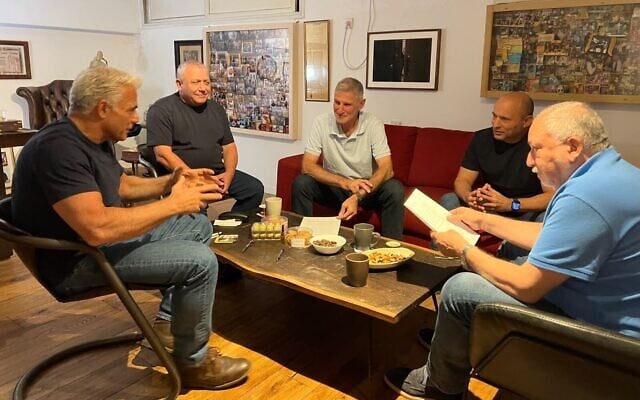
Even so, Lieberman accuses Eisenkot of secretly seeking a government with Netanyahu, describes him as “Gantz 2,” and accuses him of being lenient on Haredi conscription. He argues that a minority government is merely a bargaining tool in negotiations with Likud. The attack came despite the agreement to stop campaigning against one another, showing how difficult it is to contain competition within the camp even before coalition talks begin. It may also reflect rivalry over who will lead the political arrangements after Netanyahu, particularly in light of Yerushalmi’s assessment that Lieberman aspires to return to Likud and run for its leadership. He managed the party between 1993 and 1996 before founding Yisrael Beiteinu in 1999.
His positions also sit uneasily with his service as finance minister in the Bennett-Lapid government, which relied on Ra’am. They recall his role in 2019, when a conscription dispute led him to deny Netanyahu the support of his party’s five seats, depriving him of a majority and triggering four more elections over three and a half years. Amit Segal believes Lieberman’s current hard line is intended to secure an agreement to rotate the premiership, allowing him, one way or another, to join the ranks of “prime ministers,” while people close to Netanyahu expect him to back down after the vote.
With roughly nine seats, Lieberman remains a partner the opposition can scarcely do without. His conditions have turned unity of purpose into a dispute over how to achieve it. Agreement on removing Netanyahu cannot produce a governing majority while each side excludes the partners the other needs.
Limited options and the prospect of renewed deadlock
The opposition has parliamentary tools it could use before a government is formed. These include, most notably, Lieberman’s proposal to replace Knesset Speaker Amir Ohana and pass a law barring criminal defendants from serving as prime minister, alongside Bennett’s proposal to limit terms in office. But these steps also require a majority, and the opposition may have to seek Arab support. Legislation seen as targeting Netanyahu personally could also face legal challenges.
Replacing the Knesset speaker would allow the opposition to control the agenda and pass its legislation before the next government’s composition is settled. Yet using these powers still depends on coordination, for which no stable arrangement has emerged. While they could narrow Netanyahu’s room for manoeuvre, they do not guarantee that an alternative government can be formed.
The principal options are a minority government with Arab support, which would require Lieberman to back down or his seats to be made up elsewhere, and a government with Likud but without Netanyahu, which would require Netanyahu to withdraw or a significant bloc to defect from him. At the same time, according to Maariv, Likud is discussing bringing in Bennett without Yair Lapid. Benny Gantz, meanwhile, proposes a unity government including Netanyahu and the opposition if his party clears the electoral threshold.
The difference between these two routes is that a minority government requires compromise among existing parties with which negotiations are possible. A partnership with Likud without Netanyahu depends on a change within the party whose prospects remain unclear. Even if the first route produces a government, it would not resolve disagreements over conscription, Arab rights and policy towards the Palestinians. Passing the budget would remain a test capable of threatening its survival.
The electoral outcome remains subject to change. A Kan poll found that 30 per cent had yet to make up their minds, while parties are hovering around the electoral threshold. Mobilisation and turnout could therefore shift the balance by a seat or two.
Rosner describes the contest as more a battle to mobilise voters than to persuade them, while Netanyahu acknowledges that a small shift in turnout could decide victory or defeat. But the opposition’s gains at the ballot box will remain incomplete unless it agrees on a prime minister and a basis for partnership. Its disagreements could then give Netanyahu a chance to remain in power and pave the way for another election ,a contest he has extensive experience of managing.
