





هذا التقرير متاح أيضًا بـ العربية
Before clay became part of his artistic language, Palestinian visual artist Suleiman Mansour knew it through his grandmother’s hands. As a child in Birzeit, he watched her mix earth with water and straw to build beehives and ovens and repair cracks in the house. He helped her, playing with the clay left in his hands.
Decades passed before that memory returned to his studio at the height of the First Intifada. Buying paints and art supplies from the Israeli market had become a political question for Palestinian artists, and Mansour turned instead to the land itself.
In a 2018 interview with the German cultural website Qantara, he said that “clay came from my childhood memories.” At first, he tried to repair its cracks; later, they became part of the work’s meaning.
Between the child who played with clay and the man who returned to it lay almost an entire Palestinian lifetime. Mansour lived through the 1967 war, the occupation, the two intifadas, Oslo and Israel’s wars on Gaza. Each Palestinian turning point left its mark on his imagery and the materials he used.
Suleiman Mansour died in Jerusalem on the evening of 24 August 2026, aged 79, just days after an event in the holy city to launch his memoir, “On the Path of the Ghoul”. Researcher Rana Anani compiled the book from lengthy interviews she recorded with him between 2020 and 2023.
From Birzeit to Jerusalem: the making of an artist
Suleiman Mansour was born in Birzeit in 1947, the fourth of six children. His father died when he was three or four, leaving his mother to support the family by sewing.
He and some of his siblings were sent to a school run by the Lutheran Church in Bethlehem. There, German teacher Felix Theis noticed his talent, gave him drawing materials and encouraged him to enter an international competition linked to the United Nations.
In a May 2017 interview with the Palestinian cultural magazine Rumman, Mansour recalled winning first prize. His drawing appeared on the cover of the competition catalogue, and he received $200. The award changed how the school, his family and the village viewed his talent, giving him greater confidence to pursue art.
Reviews of “On the Path of the Ghoul” also recount memories of hunger, some harsh teachers and strict discipline, revealing the hardships of his boarding school years.
Birzeit and its countryside remained a source of visual memories: stone terraces, olive trees, figs and almonds, the light over the hills and the irrigation pools where children swam in summer. These details later reappeared in his paintings.
Home and church also shaped his early visual sensibility. In 1965, he painted a portrait of his grandfather, the Orthodox priest Boulos Khoury. Christian icons and images of mother and child remained a presence in his work.
The memoir also recalls his other grandfather, Jiries Mansour, who headed a Lutheran school in Jerusalem. Fluent in classical Arabic and German, he worked with German researchers collecting Palestinian folk tales. Suleiman described him as “Palestinian in belonging, German in education,” a combination he also recognised in himself: the European culture he encountered early in life and Palestine, which became central to his experience.
Before 1967, Mansour had planned to travel to the US to study art, but the war changed his plans. He recalled seeing the dead near Birzeit and joining townspeople to bury three Egyptian fighters killed after a clash with an Israeli force. He then enrolled at the Bezalel Academy of Arts, in the same year that Israel occupied East Jerusalem and the West Bank.
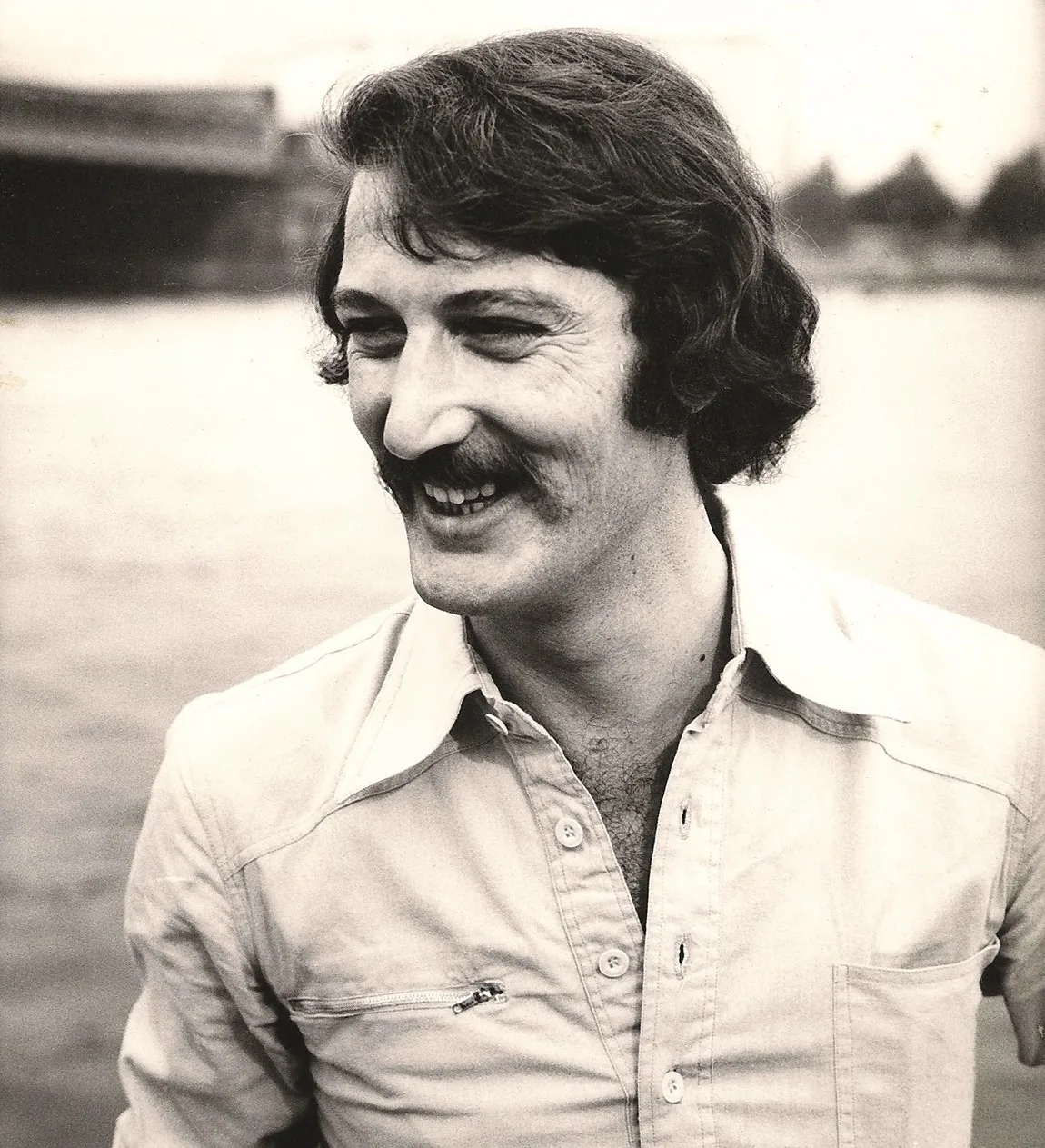
He was 20 when he entered the Israeli institution. The academy was shaped by prevailing Western movements, particularly abstract expressionism, while his own attention remained fixed on people, the village and what was happening beyond it.
Mansour spent three years at Bezalel, leaving before his fourth year after being asked to pay outstanding tuition fees. His relationship with the academy had already been shaken by a fire in its library. At the time, he felt that students and professors regarded him with suspicion, as though he were responsible for an “act of sabotage,” before it became clear that an electrical short circuit had caused the fire. He said afterwards that something “broke” inside him following the incident. With the tuition difficulties, his time at the academy came to an end in 1970.
After Bezalel, Mansour moved towards a symbolic realism that combined influences from European and Mexican art, Christian icons and the Palestinian countryside. His most prominent symbols took shape during the 1970s. He linked oranges to the memory of the coast and the Nakba of 1948, and olives to the land occupied since 1967. The dress represented identity, while women evoked the mother, the homeland and the revolution.
The Mathaf Encyclopedia, affiliated with the Arab Museum of Modern Art in Doha, links these elements to the development of a modern Palestinian visual vocabulary, with Mansour among its foremost creators.
In the early 1980s, Mansour worked with visual artist Nabil Anani, one of his closest companions in the Palestinian art movement, to collect and study old Palestinian dresses from different regions. They later collaborated on an embroidery guide for a Family Development Association project.
From “Jamal al-mahamel” to a bond with the land
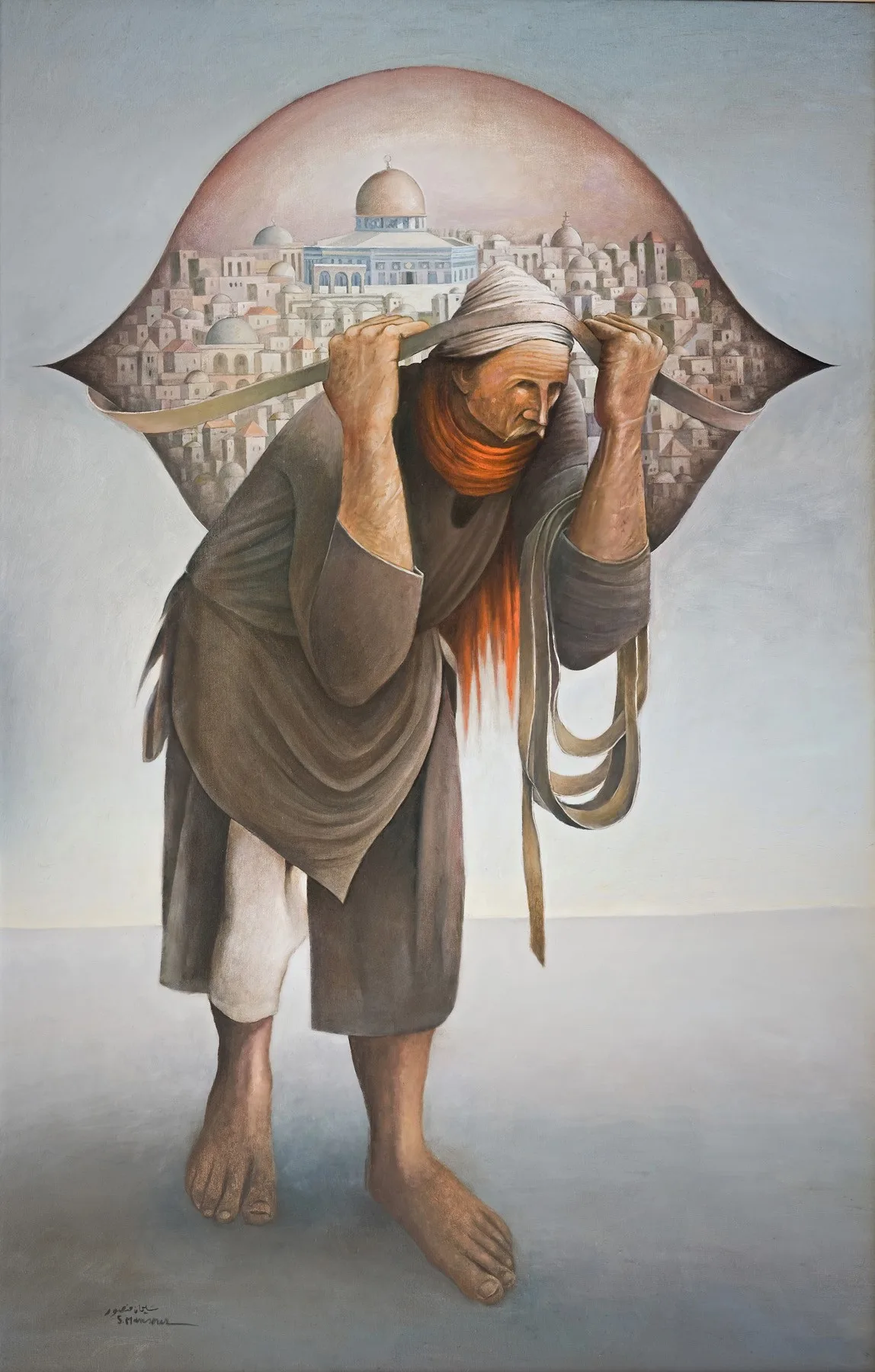
The idea for his most famous work, “Jamal al-mahamel”, grew from an everyday scene in Jerusalem. It first came to him in 1969, when he watched porters carrying bags, appliances and heavy belongings. The image evolved in his mind over several years, until the everyday load disappeared and the holy city took its place.
In 1973, he painted a thin, elderly man bent beneath a rope securing a mass that contained Jerusalem and the Dome of the Rock. The figure was almost alone in a space that heightened the sense of weight. Palestinian writer Emile Habibi later suggested the title “Jamal al-mahamel”.
In 1975, the painting was reproduced as a poster that spread through homes, camps, offices, cafes and taxis. The memoir recounts how the posters were printed with limited resources and distributed amid confiscations and pursuit, until the printed image became better known than the original painting.
The original’s fate remained unclear for years. In 2015, the international auction house Christie’s revisited the work’s history with Mansour, revealing that he had painted three versions.
The 1973 original surfaced in the possession of a collector in London. A second version, painted in the mid-1970s, reached the deposed Libyan leader Moammar Gadhafi and is believed to have been lost in the US bombing of Tripoli in 1986.
Mansour painted the third version in 2005, making some modifications. It sold at a Christie’s auction in Dubai in 2015 and entered the Dalloul Art Foundation’s collection in Beirut.
In 1976, he painted “Bride of the Homeland”, about Lina al-Nabulsi, the Palestinian student shot dead by an Israeli soldier during student protests in Nablus. Mansour said he decided to paint her after photographs taken of her following her killing were confiscated.
That year, he also painted “Steadfastness and Hope”, followed by “Daughter of Jerusalem” in 1978 and “Woman Carrying Jerusalem” in 1979, with the city moving from the exhausted man’s back to a woman who carries it on her head or holds it against her body. In 1982, he completed “The Prison” and “Sabra and Shatila”, followed by “Journey to Egypt” in 1984 and “Mother Palestine” and “Barbed Wire” in 1986.
In 1979, Mansour joined Nabil Anani and Kamel al-Mughanni to found Gallery 79 in Ramallah. It became a permanent exhibition space for Palestinian art before the occupation authorities closed it the following year.
In an interview published by the US arts website Hyperallergic in December 2023, Mansour recalled being arrested and interrogated. He also spoke of works being confiscated and exhibitions closed.
At a meeting after one such incident, an Israeli officer warned the artists against combining red, green, black and white. Mansour’s colleague, artist Issam Badr, asked what would happen if those colours appeared in a flower or a watermelon. He was told that these, too, would be confiscated. The story later became part of the history of the watermelon as a Palestinian symbol.
With the First Intifada, the boycott extended to painting materials. Mansour and his colleagues Nabil Anani, Vera Tamari and Tayseer Barakat found that buying Israeli materials conflicted with the prevailing calls for boycott and local self-sufficiency. This gave rise to “Towards Experimentation and Creativity”, an initiative that began in 1987 and took organisational form in 1990.
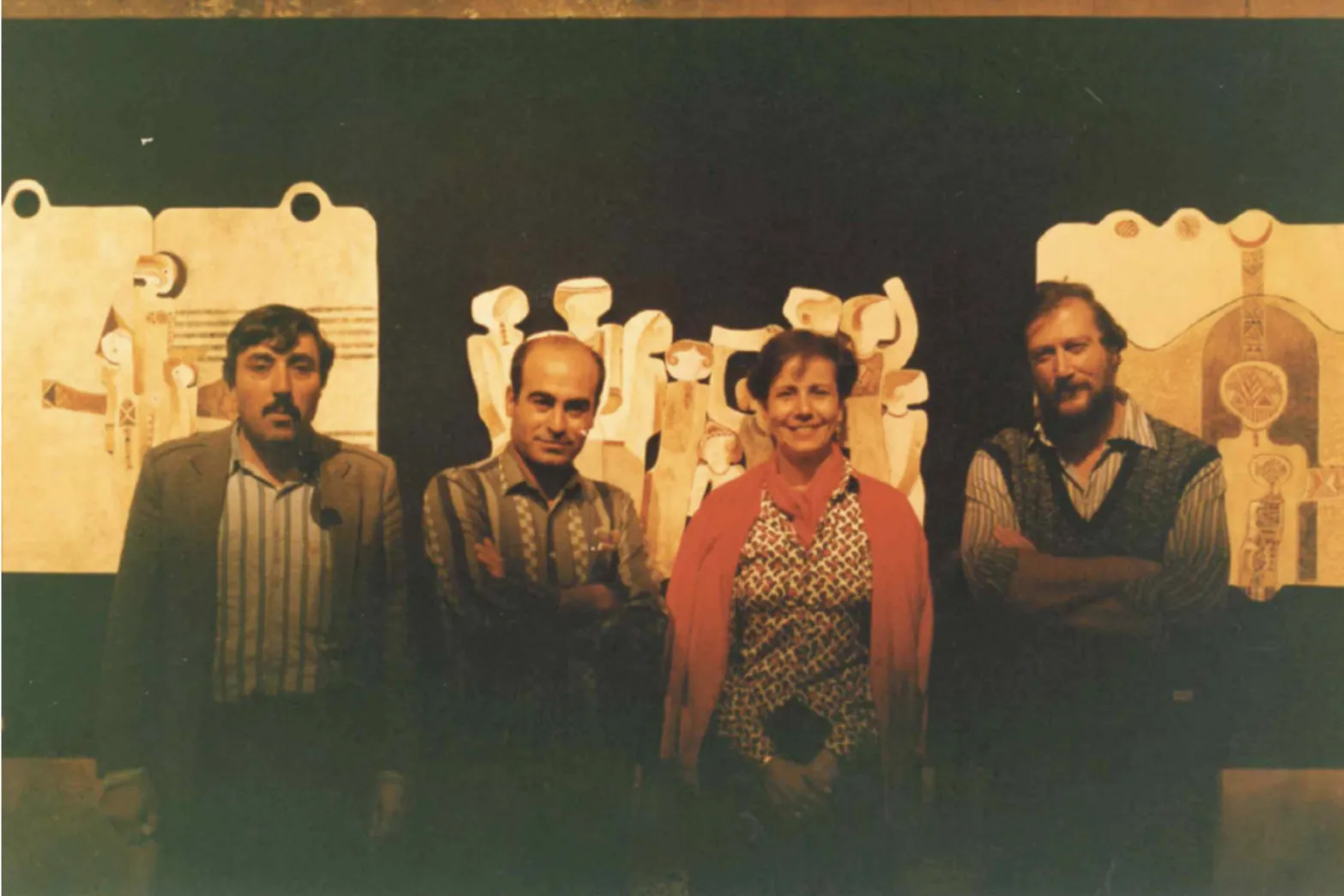
Mansour turned to clay, straw and wood, while his companions experimented with henna, leather, natural pigments and other local materials. In his May 2017 interview with Rumman, he said the initiative came as “an urgent necessity,” describing it as the product of a historical moment that compelled them to find another way of working.
At first, Mansour tried to fill and repair the cracks in the clay. He then began to treat them as part of the work itself, seeing in them echoes of fragmented Palestinian geography, the body and time. In 2018, he said that “clay also reflects the fate of human beings.”
This shift was evident in “The Village” in 1990, made from clay on wood, and then in “Shrinking Body” in 1996. In the latter, he used drying, cracking clay to mirror the shrinking and fragmentation of Palestinian land.
That same year, he began the “I Am Ishmael” series, inspired by the story of the Prophet Ishmael and its themes of departure, uprooting and attachment to the land. Mansour shaped clay figures that resembled ancient traces or markers, linking the story to the Palestinian experience of loss and exile.
The series won the Nile Grand Prize at the Seventh Cairo Biennale in 1998. In 2001, he brought together roughly a decade of experiments with clay in the exhibition “Ten Years in Clay”.
In time, he returned to oils, charcoal and acrylics, and painted landscapes. “Memory of Places” and “Uncertain Landscape 1” appeared in 2009, followed by the orange grove triptych and “Gaza” in 2014, then “And the Caravan Moves On” in 2016.
Art historian Gannit Ankori interpreted Mansour’s work through what she called the “poetics of sumud,” in which cracked earth or a quiet village can convey political meaning through everyday life and persistence in remaining in place. Researcher Tina Sherwell, meanwhile, linked his landscapes to the memory of place and the changes and losses it undergoes.
In early 2026, Mansour described his approach differently, saying in an interview: “I have not worked, nor do I work, to document history. Perhaps I document states that the Palestinian people go through.” He painted sorrow, anger, hope and love. In his landscapes, he reshaped the village as he remembered it, repairing a stone wall, restoring greenery to a dry tree and removing what he regarded as distortions of the scene.
Within the Palestinian art scene, Ismail Shammout’s work became associated with the Nakba, exile and return, while Tamam al-Akhal revisited Jaffa, women and the memory of uprooting. Mustafa al-Hallaj turned towards engraving, graphic art and a world that evoked myth and history, while Tayseer Barakat moved further towards abstraction and mixed media.
Nabil Anani was Mansour’s closest counterpart, both in collaborative work and in his interest in the village and heritage. Mansour continued to ground his experiments in people and place, until clay and its cracks became defining features of this new phase of his work.
From painting to building the art movement
Mansour also helped build the institutions that supported the art movement. He co-founded the Palestinian Artists Association in the 1970s and later served as its president. In 1994, he helped establish the Al-Wasiti Art Center in Jerusalem, directing it from 1996 to 2003.
His work extended to education. He worked at the Teachers Training Center in al-Tira from 1974 to 1983, then on a crafts project at Birzeit University from 1983 to 1985, and taught at Al-Quds University from 2000 to 2014. He also helped found the International Academy of Art Palestine, launched in 2006, and served as its acting executive director in 2006 and 2007. His efforts to establish Palestinian academic art education had begun in the 1980s.
Photographs capture another side of that period. In an image taken in Deir Ghassaneh in 1984, Mansour speaks to children during Tayseer Barakat’s first exhibition in the West Bank. In another, he stands with Nabil Anani and children in front of the exhibition. The images show the artists’ presence in villages, schools and small spaces at the time.
In “On the Path of the Ghoul”, Rana Anani recalls the balcony of her father Nabil’s house in al-Bireh, where she watched the artists’ meetings as a child, before returning decades later to record the interviews with Mansour that formed the basis of the book.
Between 1981 and 1993, Mansour drew political cartoons for the English-language weekly Al-Fajr. He favoured images that could convey an idea in as few words as possible. He also contributed to “Both Sides of Peace”, a book about Israeli and Palestinian political poster art.
From the 1980s onwards, his work was exhibited more widely outside Palestine. He took part in the Arab World Institute’s inaugural exhibition in Paris in 1987 and the “Roots” exhibition at UN headquarters in New York in 1992. He presented “I Am Ishmael” in Cairo in 1998 and received the Palestine Prize for Visual Arts that year.
A retrospective of his work, “Topography of Belonging”, was held in Jerusalem in 2011. In 2021, his works appeared in “Abstraction and Calligraphy: Toward a Universal Language” at Louvre Abu Dhabi, an exhibition held in collaboration with the Pompidou Centre. In 2019, the United Nations Educational, Scientific and Cultural Organization awarded him the UNESCO-Sharjah Prize for Arab Culture.
His works entered the collections of the British Museum in London, Mathaf in Doha, the Barjeel Art Foundation, the Dalloul Foundation and the Palestinian Museum. At auction, the third version of “Jamal al-mahamel” sold for about $257,000 in Dubai in 2015, with part of the proceeds allocated to initiatives supporting artists in the region. It subsequently entered the Dalloul Foundation’s collection.
Yet one of the clearest expressions of his relationship with the land came far from museums. Detailed reviews of “On the Path of the Ghoul” report that he inherited a plot in the al-Saqi area of Birzeit, then used proceeds from painting sales to buy additional plots from family members and expatriates to preserve the land.
The memoir also recounts how his brother offered to buy him a taxi to guarantee a steady income. The story places the internationally known artist amid a Palestinian family’s practical concerns about land, work and stability.
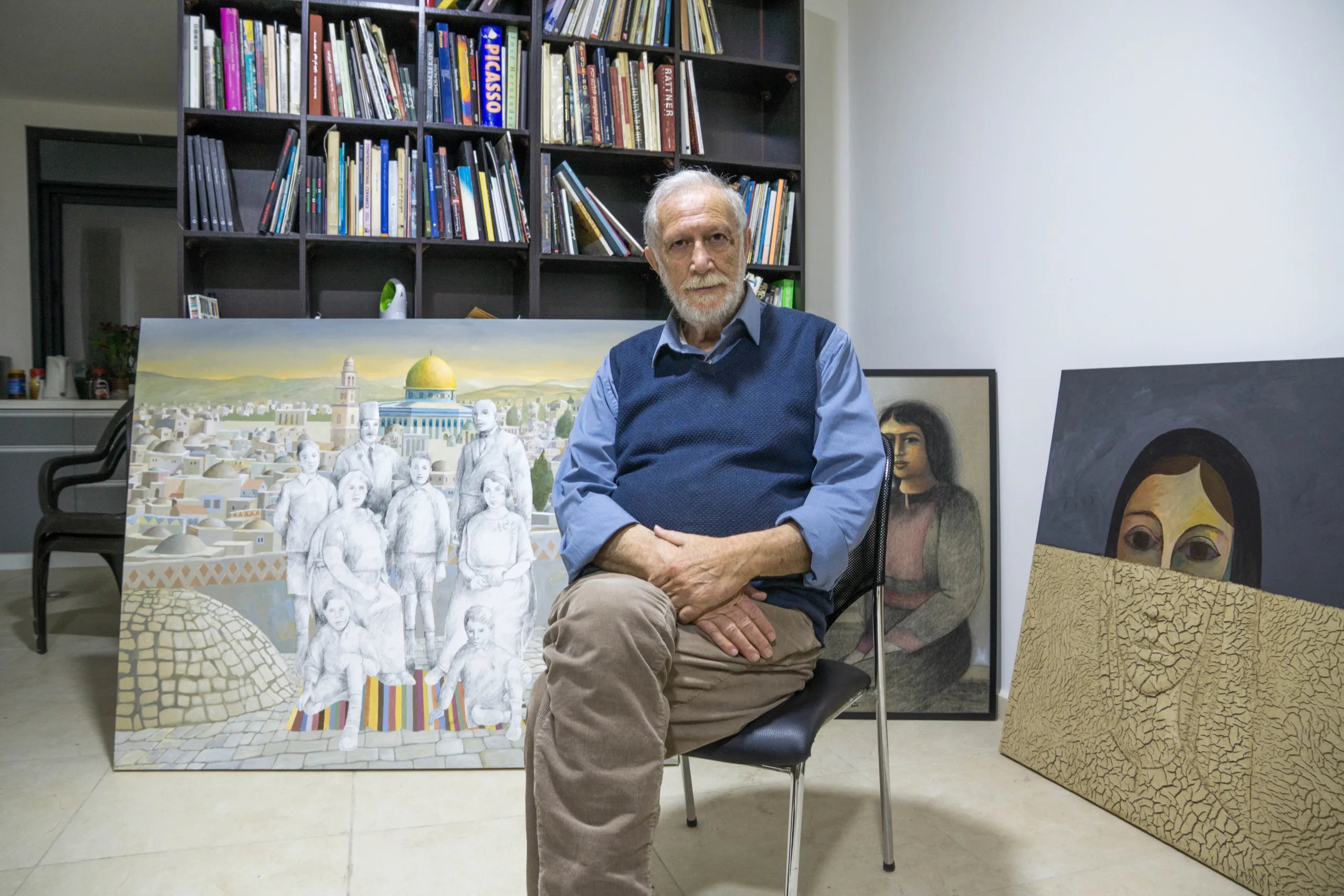
In his later years, Mansour’s home was in Jerusalem and his studio in Ramallah, with a checkpoint between them. In a 2018 interview with Qantara, he explained that staying in the holy city was tied to retaining his Jerusalem residency status, despite his deeper personal attachment to Ramallah and Birzeit. He suffered a stroke in 2021 but continued going to the studio whenever he could, sometimes driven by his son Fares through the Hizma checkpoint.
The image of the elderly Mansour travelling to Ramallah to keep working echoes the man he painted in his youth carrying Jerusalem on his back. The city that inspired his most famous painting remained part of his daily life into old age.
Israel’s assault on Gaza then prompted him to change his approach once again. In an interview on 24 December 2023, he explained that his work usually began with an idea, followed by a preparatory drawing. But the images of war drove him to paint directly on canvas, letting the colours flow freely.
He found himself returning to the abstract expressionism he had hated in his youth. Of the images lodged in his mind, he said: “I can only get them out through drawing.” In February 2024, he said that “our battle is to reclaim our humanity,” and in May that year he spoke about the role of art and culture in confronting the dehumanisation of Palestinians.
In December 2024, clay returned in one of his largest projects. The Palestinian Museum unveiled “On an Angel’s Wing”, a mural 12 metres long and six metres high, made with clay, straw and henna and centred on Jerusalem. Mansour completed it with the participation of artist al-Aziz Atef and volunteers from Birzeit University’s College of Art, Music and Design.
The four companions from “Towards Experimentation and Creativity” — Mansour, Nabil Anani, Vera Tamari and Tayseer Barakat — also returned to making permanent murals nearly 35 years after their shared experiment.
In his final year, the Institute for Palestine Studies published the 263-page “On the Path of the Ghoul”, based on Rana Anani’s extensive interviews with Mansour between 2020 and 2023.
The book revisits his childhood, education, the art movement, the intifada, institutions, friendships and clashes. It reveals his frustration with rivalries in the art world and with people he felt drained the artist in the name of fame or service to Palestine. Its title draws on the folk tale of a dangerous road full of obstacles to describe the hardships of an artist’s journey.
On 12 August 2026, 12 days before his death, the cultural newsletter The Culture List published an interview in which Mansour said his medical condition and pain had become the greatest distractions from his work. After his death, his companion Nabil Anani said they had lived through “long years of friendship, work, and art,” sharing many milestones and memories. He described Mansour as “an exceptional artist and an unforgettable human being and companion.”
Until his final years, Mansour kept changing his tools as Palestine changed around him, while people and the land remained at the heart of his work. When he died, he left behind images that had become part of Palestinian memory, alongside spaces and institutions that helped other generations create images of their own.