









هذا التقرير متاح أيضًا بـ العربية
Syria’s transitional phase represents a profound internal shift, opening the door to redefining one of the most complex relationships in the Arab world: the Syrian-Lebanese relationship. The questions are no longer about whether the previous model of governance and relations will continue, but about what model will replace it, and whether the two countries are capable of moving from managing influence to managing interests.
President Ahmed al-Sharaa affirmed his desire to make this transition from the very first moment of his rule, and that was perhaps the main basis for thinking about moving toward a positive model of managing interests — in other words, a “win-win” approach — alongside the more important transformation represented by the end of the political model that governed this relationship for decades.
Even before that, the fall of the Assad regime helped bring an end to the political and sovereign framework that had shaped the nature of interaction between the two countries since the 1970s, when the relationship was managed more through considerations of regional influence and security control than as a normal relationship between two independent states, to be settled and discussed through the management of balance and interests, given that the security of both countries runs through both Damascus and Beirut, without reducing one to the other.
Over the past decades, Syrian policy toward Lebanon was tied to the idea of expanding the former regime’s sphere of influence in Syria, which made the Lebanese arena an integral part of Damascus’ regional policy calculations. Meanwhile, the Lebanese state, because of its internal divisions and the entanglement of external influences, was unable to confront this unstable tide of influence in a way that would build a stable and balanced relationship with Syria.
As a result, the bilateral relationship remained largely subject to the balances of the regime’s individual pragmatic calculations meaning that calculations related to Lebanon as a state were part of Bashar al-Assad’s personal regime-survival calculations, rather than stemming from Syrian or Lebanese national interests and therefore being subject to shared national interests.
Lebanese forces also benefited from this form of relationship in ways that granted them influence and presence.
With the outbreak of the Syrian revolution in 2011-2024, this relationship entered a new phase marked by an unprecedented overlap between the Syrian and Lebanese arenas, especially with actors outside state institutions becoming involved in managing relations between the two countries.
The official presence of the former Syrian regime in Lebanon receded, while the influence of Lebanese forces inside the Syrian scene expanded, reinforcing the security and military character of the relationship at the expense of diplomatic and institutional channels that had been absent for decades, as diplomacy in Lebanon had passed exclusively through the former regime.
After liberation, Syria’s transitional phase produced a different equation. From the outset, the new Syrian government announced that its priorities were to consolidate internal stability, rebuild state institutions, achieve economic recovery, and adopt a foreign policy based on balanced openness and noninvolvement in regional conflicts. It even went so far as to speak of the possibility of political settlements, including with Hezbollah.
This means Syrian policy no longer views Lebanon as an arena of influence, but as a neighboring state with which it shares a long border and common security, economic, and humanitarian files that require sustained institutional cooperation, in a way that is reflected in the management of gains. At the same time, Lebanon has also changed.
The accumulated economic and political crises, along with recent regional shifts particularly the waning of Iranian influence following the 2024 pager bombings have heightened the need to rebuild state institutions and strengthen sovereignty, imposing a different approach to relations with Damascus based on mutual respect, noninterference in internal affairs, and the management of shared interests through official institutions.
Accordingly, rebuilding Syrian-Lebanese relations is no longer merely a political option tied to changes in government. It has become a necessity imposed by the structural transformations witnessed by both countries and the region as a whole, because the previous model built on managing influence and overlapping arenas has lost the structural and political foundations necessary for its continuation.
What emerges today is the challenge of building a new model based on the sovereignty of both states, the activation of institutions, and the transformation of contentious files into areas of cooperation, opening the way to a more stable and sustainable relationship and practically shifting the relationship from a model of influence to a model of statehood.
Rebuilding it in this way is tied not only to the change in the political system in Damascus, but also to the emergence of a new philosophy based on the principle that official contacts take place exclusively through sovereign official channels, producing new tools for managing the relationship, foremost among them cooperation between the two defense ministries.
Security and regional security as a necessity for rebuilding the relationship
Security is the first test of the relationship, as it is the gateway to politics and the economy. Syria and Lebanon share a long border, making security the central determinant in addressing the relationship and its unresolved files: border stability, preventing smuggling, pursuing armed groups, controlling the movement of weapons, and dealing with the detainees file are all issues that cannot be postponed until after political questions are resolved. Rather, they are a prerequisite for building trust between the two states.
The Jeddah Agreement served as the entry point for that, as an unprecedented negotiating framework between the Syrian and Lebanese defense ministries in 2025. The two sides agreed on the need to demarcate the border between the two countries to enhance security and stability.
They also signed an agreement stipulating the formation of legal and specialized committees to address outstanding issues and activate security and military coordination mechanisms, particularly with regard to developments along the border, as part of Syria’s new policy based on managing sovereign balance and respecting relations with its neighbors, as well as cooperation and coordination through the exclusive use of official channels, especially since the border demarcation file is subject to longstanding complications.
This was later reinforced by the actual formation of technical committees, particularly between the two countries’ defense ministries, which helped address security files in a different way from what happened after Hezbollah members abducted three members of the elite forces in Brigade 103 of the Syrian army; this incident was perhaps the main driver behind renewed coordination in security relations.
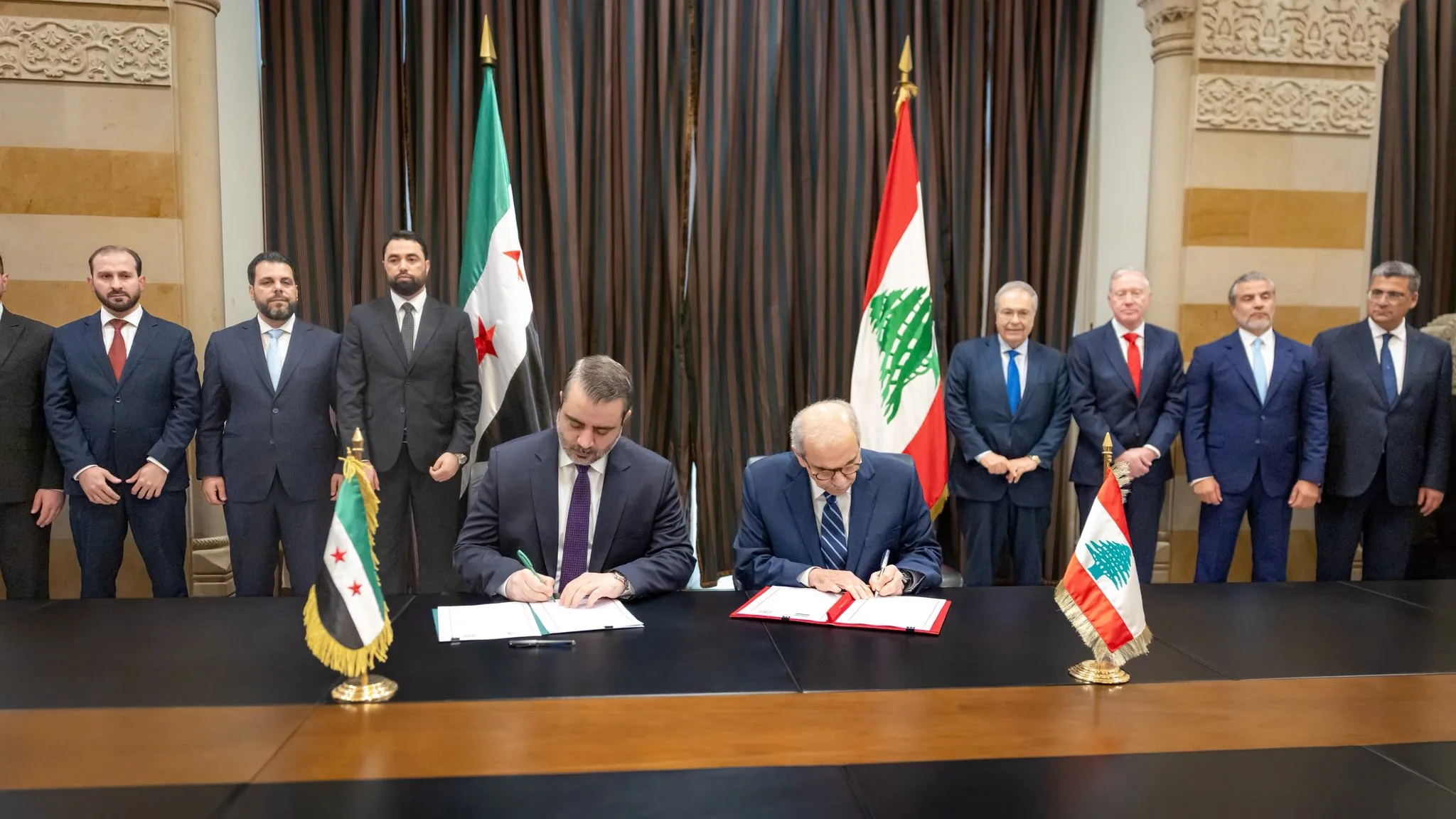
The importance of these mechanisms lies not only in their ability to address border incidents, but also in the fact that they reflect a shift in the philosophy of managing relations between the two countries. Instead of relying on unofficial security channels or actors outside the state, the two military institutions have become the main framework for coordination, reinforcing the principle that the state alone holds the exclusive right to use force and giving both governments greater capacity to contain crises before they turn into political or military confrontations, while gradually moving toward addressing other unresolved files that are no less urgent.
In this sense, security has become the first field in which Damascus and Beirut’s ability to move from the logic of influence to the logic of institutions is being tested.
Along the 375-kilometer Syrian-Lebanese border, thousands of tons of goods and weapons disappear every day behind mountains and valleys, while local residents pay the price of the ongoing chaos. Systematic smuggling leaves a heavy mark on the lives of ordinary people living between a collapsed economy and threatened security.
To read… pic.twitter.com/RZZOVfDveg
— Noon Syria (@NoonPostSY) June 29, 2026
Even so, building a joint security system still faces structural challenges, foremost among them the complex nature of the extended border amid Hezbollah’s control of numerous positions along it, the continued activity of smuggling networks controlled by groups from the party, and the impact of regional developments on the border file, amid growing talk of the need for Syrian intervention in Lebanon to eliminate the party, which would mean the return of Hezbollah’s cross-border effectiveness, given its accumulated security experience in producing chaos.
Therefore, the success of security coordination will not be measured by the number of meetings, signed agreements, or formed committees, but by its ability to produce permanent mechanisms for crisis management and prevent border incidents from turning into political crises between the two countries, and to deal with political events and study their effects in light of a fragile security environment along the border.
It is difficult to speak of a stable economic or political partnership amid an unstable border or recurring security incidents, because any uncontrolled security incident could undermine the process of rebuilding trust between the two governments and return the relationship to a logic of mutual escalation rather than institutional cooperation.
From influence to partnership
Syrian-Lebanese relations are entering a phase different from the one that governed them over past decades, not only as a result of the change of power in Damascus, but also because of the structural transformations witnessed by both countries and the region as a whole. The model based on overlapping arenas, managing influence, and using unofficial security tools has largely lost the justifications for its continuation, while an opportunity now emerges to rebuild the relationship on more nationally pragmatic foundations based on the sovereignty of both states, exclusive communication through official institutions, and the management of shared files according to the logic of mutual interests.
But the success of this transformation still depends on the ability of both sides to turn agreements and joint committees into sustainable policies, and not leave room for sub-state actors or regional tensions — foremost among them the Israeli file — to reproduce previous patterns of relations, however convincing the structural reasons may be.
Lebanese Prime Minister Nawaf Salam: I signed with the Syrian foreign minister a decision to establish a joint higher council to develop relations between the two countries. pic.twitter.com/W72mDKqdMg
— Noon Syria (@NoonPostSY) July 2, 2026
The unresolved files from border demarcation and security coordination to humanitarian and economic issues do not represent separate challenges, but rather constitute a real test of Damascus and Beirut’s ability to build a new model for the relationship. The success of the next phase will not be measured by the degree of political rapprochement, but by the two countries’ ability to produce a stable institutional relationship based on the existence of a genuine vision on both sides and the treatment of sources of risk.
Turning the border into a space for cooperation rather than tension and transforming shared interests into a pillar of stability, thereby ensuring that Syrian-Lebanese relations move from a legacy of influence and conflict to a partnership based on sovereignty, mutual respect, and shared development.