







هذا التقرير متاح أيضًا بـ العربية
Syrian agriculture has begun moving, after the fall of the Assad regime, as one of the fastest gateways for the country’s economic return. But so far it is proceeding cautiously, marked by frequent visits, forums and statements of intent, with irrigation and agricultural infrastructure projects advancing ahead of large-scale land deals.
External interest in the sector is currently concentrated in four countries — the UAE, Saudi Arabia, Türkiye and Jordan — with clear differences in how mature their moves are and in the nature of the projects being proposed.
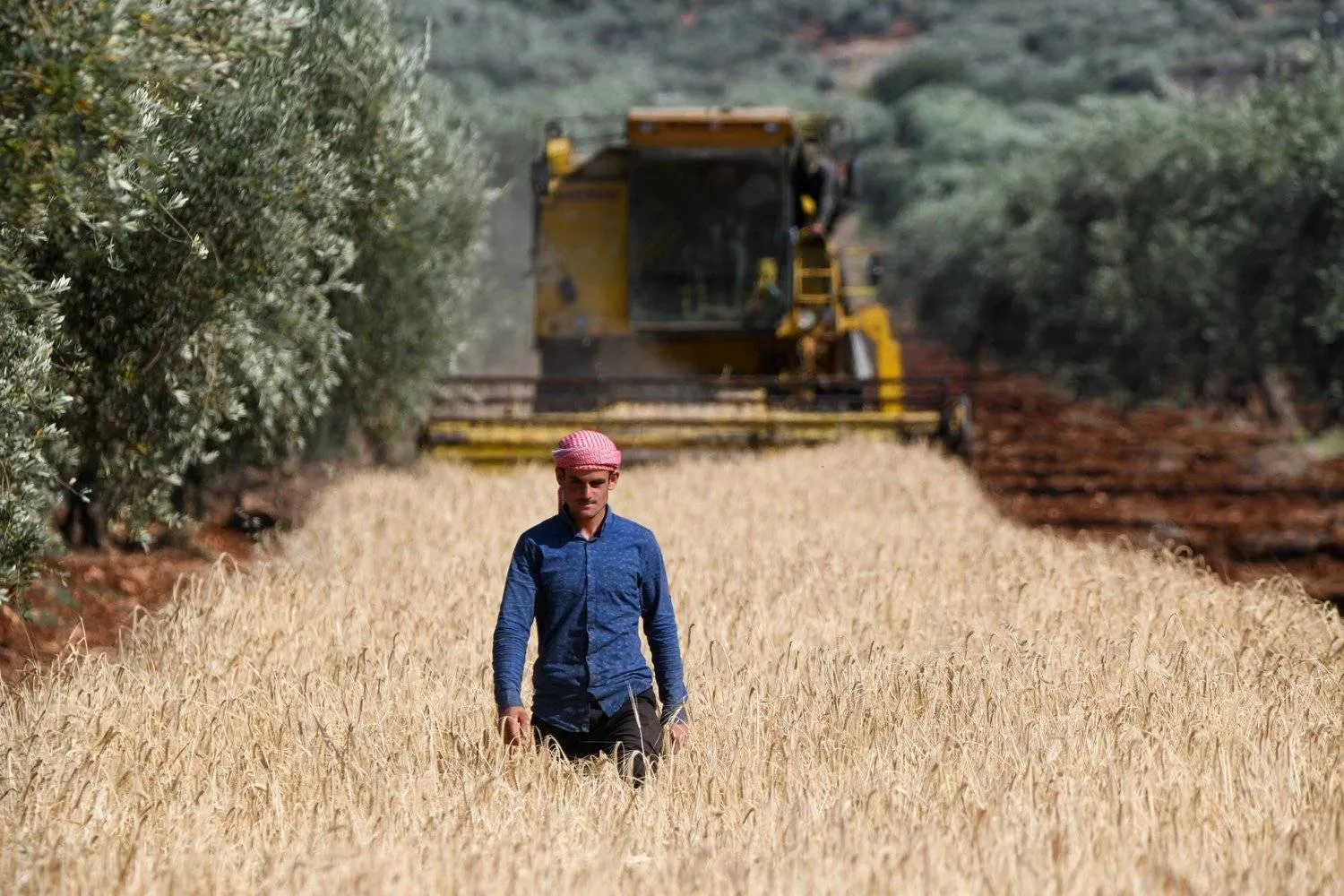
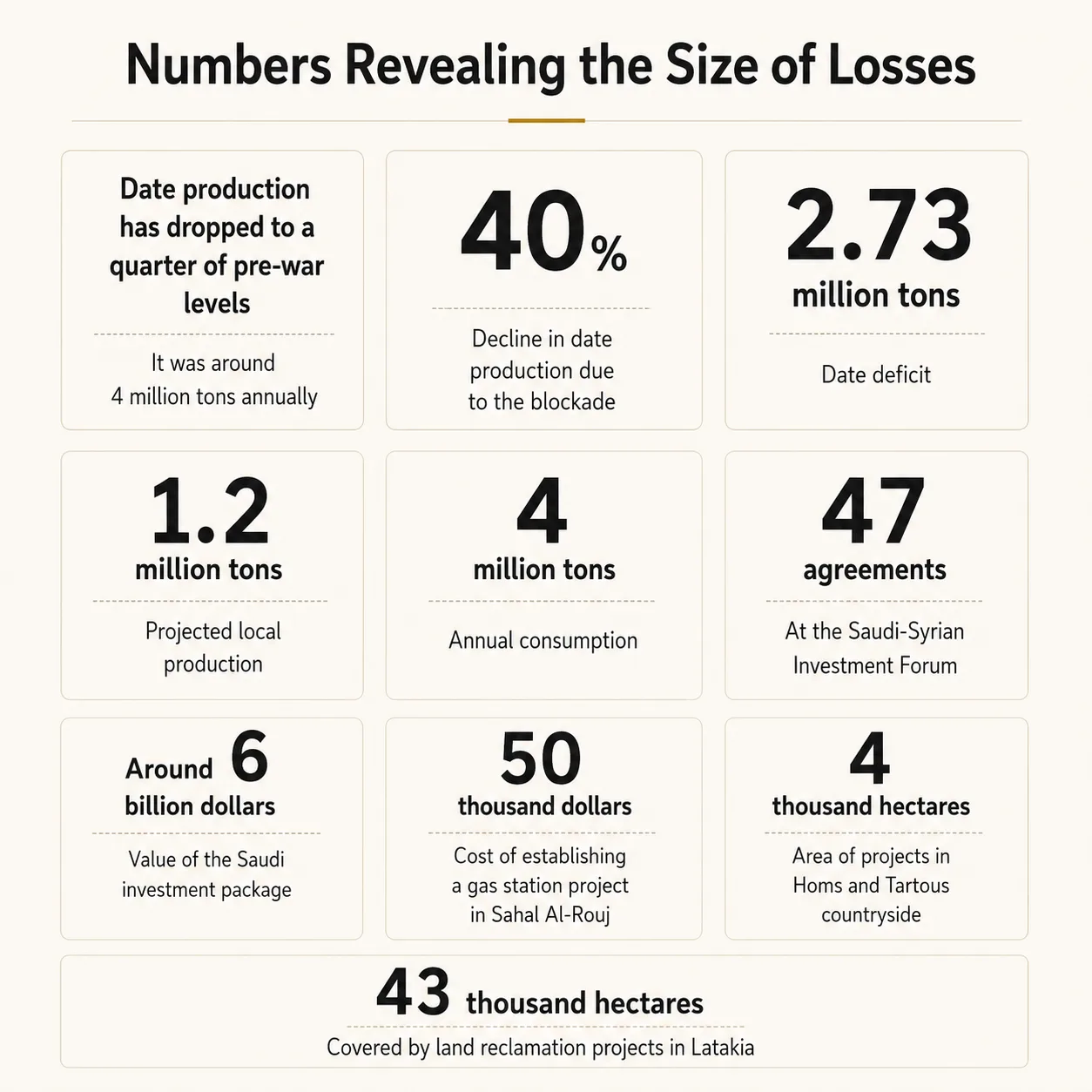
These countries are entering an agricultural sector that emerged from the war weighed down by deep production and structural losses, during which output fell to record lows, while wheat production alone dropped to a quarter of its pre-uprising level, when it stood at around 4 million tons annually.
In August 2025, estimated the UN Food and Agriculture Organization, FAO, that drought had reduced wheat production by about 40 percent, and that Syria was facing a wheat deficit of 2.73 million tons, with expected domestic output not exceeding 1.2 million tons in a country that consumes around 4 million tons a year.
In response to this decline, launched Syria in mid-February 2026 the Syrian agricultural strategy for 2026-2030, establishing an official framework for improved seeds, raising crop productivity, developing value chains and expanding investment in irrigation, equipment and services.
A map of land, water and crops
A geographic reading begins in the east and northeast, where Hasakah, Raqqa, Deir Ezzor and eastern rural Aleppo form a belt of grains, fodder, cotton and irrigated vegetables.
In Hasakah, summer vegetables, cotton and grains are among the main crops. With the rehabilitation of a number of wheat storage silos in the province beginning in late April 2026, and the preparation of the silos in the town of Sabah al-Khair in May, an effort emerged to restore part of the province’s capacity to receive and store the harvest ahead of the wheat season.
FAO data, through its GIEWS early warning and food security monitoring system, indicate that the northeast remained among the areas most affected by the 2025 drought despite improved rainfall in 2026. That makes investment there tied as much to irrigation, fuel, silos and mills as to grain cultivation itself.
In Raqqa and Deir Ezzor, the agricultural opportunity is linked to the return of the Euphrates and irrigation networks to regular operation. In Raqqa, 2026 saw maintenance and rehabilitation work on irrigation networks and repairs to canals and gates, while Deir Ezzor saw measures to protect fields and equipment from rising Euphrates water levels.
The Euphrates provinces and the northeast are suitable for grains, fodder, vegetables, dates, pumping stations and agricultural services, with a clear need for a model based on rehabilitation and operation. Land near the river is highly fertile, but at the same time exposed to flooding and damage to canals and farm roads.
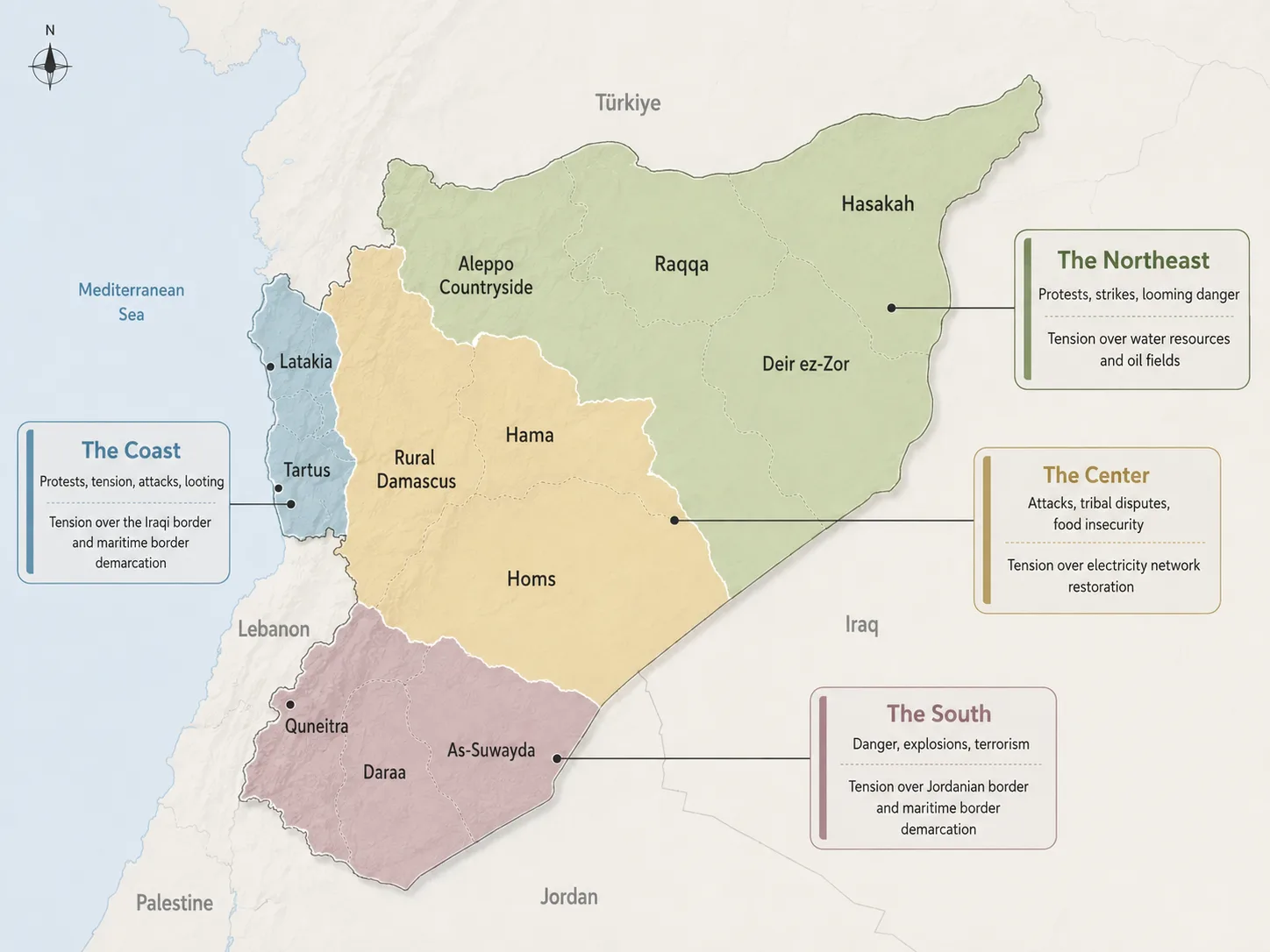
Aleppo and Idlib present a different picture within the north. In eastern rural Aleppo, wide areas depend on state irrigation projects linked to the Euphrates and the canals of the Maskanah project. Improved rainfall and the resumption of work at some irrigation facilities have helped raise the area’s suitability for grains, vegetables, fodder and food processing, provided canals and energy supplies remain stable.
Idlib appears stronger in olives, vegetables and nurseries, supported by projects to dredge drainage channels and culverts and rehabilitate the al-Bala’a station in the al-Rouj Plain to irrigate 50,000 dunams. Its opportunities therefore lean more toward pressing, pickling, packaging and the production of agricultural seedlings than toward broad, water-intensive cultivation.
In central Syria, Homs and Hama appear to form a belt capable of regaining its role as irrigation projects advance. The Homs-Hama irrigation project and the Talhoush project, which irrigates about 4,000 hectares in the countryside of Homs and Tartous, show that the opportunity in the two provinces is tied to restarting irrigation networks that make fodder, livestock, medium-intensity farming and food processing more feasible.
In Hama, the al-Ghab Plain and its associated irrigation and drainage networks remain a central factor in any investment assessment for grains, fodder and midstream agricultural industries. But these canals and operating services need upgrading before the opportunity can turn into stable production.
The coast and the south, meanwhile, offer a different kind of opportunity: the former through citrus, olives, packaging, cooling and ports, and the latter through the logic of the Jordanian market and overland exports.
In Latakia, irrigation figures point to a relatively more ready agricultural base, with irrigation cycles covering 43,000 hectares, alongside the rehabilitation of Mashqita Dam and the al-Shallafatiya station for pumping irrigation water, boosting prospects for citrus, juices, cooling and maritime exports.
In Tartous, citrus, olives and fruit seedlings, together with proximity to the port and the link between part of its countryside and the Talhoush irrigation project, create opportunities in sorting, packaging, juices and cold chains.
Daraa, meanwhile, appears suitable for tomatoes, watermelon, grapes, irrigated vegetables, tomato paste, drying and exports through Jordan. Sweida and Quneitra, for their part, face problems such as drought, security sensitivities and seasonal dependence on water.
Who is entering the Syrian agricultural market?
The UAE appears to have the most developed path in turning agriculture into a platform for food and exports. On April 2, 2026, a Syrian-Emirati meeting was held to discuss an agricultural project, processing industries and strengthening the presence of Syrian goods in the Emirati market. Then the first Syrian-Emirati investment forum on May 12 placed agriculture, food security and logistics within a broader basket of partnerships.
On June 22, discussed Syrian Agriculture Minister Basel Hafez al-Suwaidan with a delegation from the UAE’s Salal agricultural food group opportunities for agricultural investment and preparations for signing agreements on cooperation, investment and exports, giving the Emirati move an advanced character within the value chain, from production to market.
The Saudi track appears larger in its political and financial framework than in the details of its publicly announced agricultural plans. At the Syrian-Saudi investment forum, a package of 47 agreements and investments worth nearly $6 billion was presented across multiple sectors, with agriculture included among the fields of specialized projects, model farms and processing industries.
A March 8 meeting between the Syrian agriculture minister and a delegation from Saudi company KDC gave cotton a more specific place within this track, through discussions on investment in its production, manufacturing and marketing.
Türkiye, for its part, is moving in a less noisy way and one more closely tied to day-to-day operations. The Turkish Ministry of Agriculture and Forestry announced on Sept. 14, 2025, the signing of a letter of intent to strengthen agricultural cooperation with Syria, then in March 2026 presented a technical cooperation program covering agricultural data production, registration systems, modern farming practices, and methods for collecting wheat and olive data.
On April 7, 2026, held the first meeting of the Syrian-Turkish Joint Economic and Trade Committee, JETCO, which produced technical understandings on standards, customs, measurement and technical compliance.
In practical terms, these files pave the way for Turkish companies to enter agricultural inputs, equipment, irrigation, mills, storage and border trade, especially in the north and northeast.
Jordan is moving more from the position of neighbor and trade corridor than that of an investor seeking vast tracts of land. On April 26, 2026, discussed Syrian Agriculture Minister Basel Hafez al-Suwaidan with Jordan Chamber of Commerce President Khalil al-Haj Tawfiq the preparation of an agricultural memorandum of understanding and the formation of joint working teams, with Jordan focusing on supporting food processing and linking Syrian products to the Jordanian market and export corridors.
A day later, the Amman Chamber of Commerce and the Syrian side discussed facilitating import and export movement and unifying some technical and administrative procedures at border crossings. Then on April 28, the Jordan Chamber of Commerce and the Federation of Syrian Chambers of Commerce discussed turning the understandings into practical projects and forming a joint business council. In this sense, Daraa and southern Syria become a natural space for production, processing and overland export tied to the Jordanian and Gulf markets.
The value chain: From seeds to export
The most attractive opportunity in Syria’s new agricultural landscape lies in the chain that begins before planting and ends after harvest. The Syrian agricultural strategy for 2026-2030 focuses on improved high-yield varieties resistant to drought and disease and on raising seed multiplication capacity. This is a practical entry point for Turkish and Gulf input companies, because it requires less capital than land deals and carries lower ownership risks.
In a country emerging from a long war and severe drought, seeds, fertilizers, saplings, seedlings, extension services and agricultural digitization can become a faster investment than large-farm projects.
Irrigation and energy are the link that determines the viability of everything that follows. Most measurable implementation in 2026 appears in projects to maintain canals, pumping stations and gates, from Homs-Hama to Maskanah, Raqqa, Latakia, Quneitra and Talhoush, with a clear FAO presence in rehabilitating irrigation networks.
That is why investment in a pumping station, solar power for pumps, or operation and maintenance management appears closer to an executable project than a declaration of intent to cultivate thousands of hectares.
After irrigation comes contract farming, in which the investor enters as a financier of inputs, a guarantor for purchasing the crop, or a partner in managing harvest and supply. This is a model suited to grains, fodder, cotton and vegetables because it links local farmers to a broader market, then transfers value to storage, processing and export.
Food processing gives foreign capital a less sensitive entry point than direct landholding, because it shifts investment to the post-harvest stage, where tomatoes can be turned into paste, citrus into juices, and olives into oil and packaged products, in addition to frozen goods, drying, and medicinal and aromatic extracts.
In this sense, value lies as much in the factory, packaging center and cold chain as in the field, making this path suitable for the UAE, Jordan and some Saudi companies seeking production that can be marketed and exported.
Storage, cooling and border-crossing facilities come at the end of the chain that will determine who profits from agriculture. The coast needs sorting, packaging and cooling centers and refrigerated trucks for citrus and fruit; the south needs a fast overland route through Jordan; and the east needs silos, mills, drying facilities and safe roads.
The first markets appear to be the Gulf, Jordan, Iraq and Türkiye, while Europe becomes a later route contingent on laboratories, certifications, packaging and quality standards.
The knots awaiting investors
The first obstacle facing the investment map is mines and war remnants. The United Nations, through its programs in Syria, has warned that land contamination by unexploded ordnance limits safe movement and disrupts return and recovery.
Mine-clearance projects in 2026 are focused on areas near agricultural land in Aleppo, Hama and Idlib, and their continued presence imposes a direct cost on land, roads, canals and any large agricultural project.
Water comes as a second obstacle. The 2025 drought exposed the fragility of Syrian production, especially in the northeast and Sweida, and despite improved rainfall in 2026, recovery remained incomplete.
Hence the risks of water-intensive farming rise in the driest provinces, while the value of modern irrigation, water storage, solar power for pumps and maintenance projects that ensure water reaches fields increases.
The third obstacle concerns ownership and financing. The new investment law expands the space for investor entry, but property ownership, the rights of returnees, documentation and local disputes make the model of buying or holding land highly risky.
The Middle East Institute, MEI, warned in its reading of the new investment law of the return of “state-mediated market access” and of ambiguity surrounding implementation details. This is a sensitive point in the Syrian countryside, where foreign investment can turn into tension if it precedes the settlement of ownership issues or ignores local farmers.
The knot is compounded by electricity, fuel and standards. Operating irrigation, silos, cooling, mills and factories requires stable energy, while financing, banking compliance and insurance limit the speed of investor entry despite an improved sanctions environment after American and European steps in 2025.
The Syrian Standards and Metrology Organization stresses packaging, storage and transport as conditions for obtaining quality certificates in export markets requirements that will determine the Syrian product’s ability to move from nearby markets to the Gulf or Europe.
The map concludes that agricultural investment in the new Syria is distributed across distinct belts: the east and the Euphrates carry the weight of grains, fodder and cotton; the center is betting on the return of irrigation and agro-industry; while the coast and the south offer a faster opportunity in fruit, vegetables, cooling and exports through ports and crossings.
The test of this map begins with the ability of investors and the state to turn promises into infrastructure that actually works from water reaching the fields, to a crop finding a buyer, to storage, cooling and crossing facilities capable of moving Syrian production from a deferred opportunity into a commodity that reaches the market.