








هذا التقرير متاح أيضًا بـ العربية
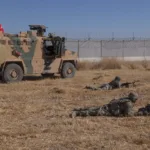
In his military uniform adorned with medals, standing atop an open military vehicle, and in an enormous ceremonial procession rarely seen even in many major world capitals, Egyptian President Abdel Fattah el-Sisi on Saturday, July 4, inaugurated the new Strategic Command headquarters in the New Administrative Capital, known as the “Octagon” (an eight-sided building), amid extensive media fanfare and major official celebration.
Sisi said the purpose of the headquarters is to achieve “integrated planning and coordination among all branches of the Armed Forces, enhance combat capabilities, and maintain constant readiness to confront challenges effectively and efficiently, using the latest advanced technological systems, in a way that fulfills the state’s strategic objectives and helps secure its resources.”
Despite the celebratory atmosphere surrounding the opening of the “Octagon,” and its portrayal by some media voices as a historic achievement, the January revolution loomed large in the background of the scene not as a passing political memory, but as a revealing symbolic indication of the nature of the transformation that drove the state to relocate its sovereign and government headquarters away from the heart of Cairo to the New Administrative Capital.
In terms that left no room for interpretation, Sisi explicitly declared that one of the main motives behind establishing this headquarters and moving ministries and sensitive institutions outside Cairo goes back to what happened in January 2011, when protesters surrounded some official buildings, placing direct pressure on the authorities at the time.
He stressed that what happened then will not happen again today, and that the siege of ministries and sovereign institutions is now a thing of the past, after the government and its sensitive headquarters were moved to a new administrative and security space outside the traditional capital.
Sisi never tires, with every major event or political occasion, of invoking the January revolution not as a historic moment that changed the course of the Egyptian state and opened the way for transformations that ultimately brought him himself to power, but as a permanent scapegoat to justify failure at every level, and a political bogeyman used to rationalize the regime’s survival despite its inability to meet even the minimum aspirations of Egyptians.
With every incident or episode in which Sisi is the central figure, the same question imposes itself on everyone’s lips: Why does January, nearly 15 years later, remain so heavily present in the rhetoric of power? And why does it still appear, despite the decline of its momentum on the ground, as a political nightmare haunting the regime in Egypt?
Demonizing January: a never-ending series
Since his first year in power, Sisi has adopted a dual speech toward the January revolution: At times he describes it as a pivotal moment in the history of the Egyptian state, but he quickly reverses that characterization through a long series of statements blaming the revolution for the political, economic and security crises the country has reached.
Sisi has found in January a ready-made explanation for mounting failures, chief among them the current economic crisis. He has attributed the deterioration of the Egyptian pound, and the rise of the dollar from about 6 pounds in 2011 to nearly 50 pounds today, to what happened in January, ignoring the fact that the major leap in the exchange rate came after the 2016 flotation decision, and that the currency’s decline was also tied to economic policies centered on expansive borrowing, which raised external debt from about $35 billion in 2011 to more than $160 billion in recent years.
#السيسي: الدولار كان بـ6 جنيهات.. والنهارده بـ50 جنيهًا بسبب أحداث يناير 2011 #مزيد pic.twitter.com/LYWI3tWJK3
— مزيد – Mazid (@MazidNews) July 4, 2026
The narrative of blaming January did not stop at the economy; it also extended to the Grand Ethiopian Renaissance Dam. Although the dam had not been completed at the time of the revolution, and although the 2015 Declaration of Principles granted Addis Ababa political and legal recognition of the construction track, official rhetoric has continued to link the crisis to what happened in 2011.
Even as the dam’s reservoir has been filled more than once during the current regime’s tenure, January has remained, in the rhetoric of power, the easiest and most ever-present culprit.
The same applies to the issue of Egypt’s economic decision-making becoming dependent on Gulf investment flows and the sale of state assets to regional investors. According to the official narrative, January appears as the primary cause of this trajectory, even though the turn to asset sales came in the context of a deep financial crisis produced by debt policies, interest burdens and a shortage of hard currency, to the point that the state began searching for urgent exits, even if that meant giving up strategic assets in the energy, ports, agriculture, pharmaceuticals and real estate sectors.
What is striking is that the files Sisi insists on attributing to January are known to all and sundry to be the direct product of the current regime’s policies and its economic and political choices over the past decade. Hence, this insistence on repeatedly invoking the revolution and bearing the cost of the crises raises broad questions about the nature of official rhetoric, its view of the scene, and its real approach amid this exposed contradiction.
The Octagon: the fortified citadel
According to Sisi’s own account, the concentration of state institutions in the heart of Cairo, and their proximity to open and vital squares such as Tahrir Square, made the state highly vulnerable to crowds, sit-ins and the street’s ability to paralyze sovereign facilities. From this perspective, one of the most important lessons the current authorities drew from the January revolution appears to be that place itself has become an element of national security.
Under this view, the danger of January did not lie only in the number of protesters, but in their ability to exercise symbolic and practical control over the heart of the capital where Tahrir Square, the area around the Cabinet headquarters, the Interior Ministry, Parliament, Maspero, and a number of vital points in downtown Cairo are located. The political geography of the capital thus became a direct source of threat to the authorities after it proved that crowds were capable of turning public squares from open spaces into tools of political pressure.
From there, the authorities began dismantling this relationship between the street and the centers of power, starting with Tahrir Square itself by erasing its revolutionary identity and stripping it of its political symbolism whether through constant security cordons, altering its urban and structural features, removing spaces that had allowed citizens to gather, or tightening control over the entire downtown district.
السيسي يقول إن الدولة خرجت بمؤسساتها من القاهرة إلى العاصمة الإدارية منعًا لتكرار وقائع حصار المحكمة الدستورية ومجلس الوزراء وغيرها التي وقعت منذ سنوات حفاظًا على هيبتها ومنع الضغط عليها أثناء الأزمات pic.twitter.com/FLnj3R7jrt
— الجزيرة مصر (@AJA_Egypt) July 4, 2026
But these measures, it seems, were not enough to reassure the authorities, especially amid mounting living pressures, the widening gap between the state’s promises and citizens’ aspirations, and the constant fear of a social explosion or popular uprising driven by harsh economic conditions. The fear here is not only about the memory of January, but about the possibility of repeating a moment of collective anger that would be difficult to control.
From this standpoint came the idea of moving far from traditional Cairo by building a new center of power in the New Administrative Capital that would house sovereign, governmental and military institutions in a more tightly controlled space, farther from direct popular pressure.
In this sense, the “Octagon” and the New Administrative Capital do not appear to be merely an urban or administrative project, but rather a political and security re-engineering of space aimed at depriving any future movement of the leverage of surrounding sensitive headquarters, and at erecting a symbolic and literal wall between the authorities and any potential public anger.
A message of deterrence — inward more than outward
The inauguration of the new Strategic Command headquarters, with all the military symbolism and lavish ceremonial display surrounding it, clearly reflects the entrenchment of a military identity within the structure of the Egyptian state. The scene was not limited to the opening of a new Armed Forces headquarters; in its broader implications, it appeared to express a shift in the administrative and sovereign center of gravity to a space whose rhythm and details are controlled by the military establishment from the government and sovereign bodies to constitutional institutions amid a symbolic concentration around the “Octagon” as the administrative, informational and strategic brain of the state.
This entrenchment of military identity, accompanied by displays of force and hard-edged messaging, carries a deterrent dimension that extends beyond the outside world to the domestic arena. The scene seemed like a message directed at anyone who might think of reviving the January model or repeating a moment of popular mobilization around institutions of power. Here, Sisi — intentionally or not — fell into a notable political predicament when he appeared to link the “evil ones” to the January movement, after that label had generally been confined in official rhetoric to the Muslim Brotherhood. That broadens the circle of internal hostility to include wider segments of opponents and dissenters, placing them in the category of threat rather than political difference.
Although official media presented the new command headquarters as a deterrent message aimed at Egypt’s external adversaries amid a turbulent regional environment and escalating security challenges, the deeper significance appears, in the view of many observers, to be directed inward above all. The military display here cannot be separated from the authorities’ obsession with the street, nor from the attempt to redefine the relationship between state and society on the basis of control and fortification rather than participation and trust.
From this perspective, observers warn of the danger of turning the angry citizen or political opponent into a potential enemy of the state, as that opens the door to catastrophic political and social repercussions.
In the end, when a building of this scale and this level of spending is erected in a country suffering acute economic suffocation and drowning in debt that consumes more than two-thirds of its budget, the matter goes beyond the idea of a “strong state” or deterrent messages directed abroad. Real strength is not measured by the largest building, the biggest command headquarters, the tallest flagpole, or the largest mosque or church, but by the state’s ability to protect its citizens, meet their needs, safeguard their dignity, and build legitimacy based on consent rather than spectacle and force.
Accordingly, the fanfare surrounding the opening of the “Octagon” cannot be separated from the memory of January and the deep imprint it left within the structure of power. That movement, as a moment that broke fear and shifted the street into the center of political action, appears to remain present as a constant obsession that resurfaces with every crisis, and is repeatedly invoked whenever the authorities need to explain anxiety, justify fortification, or reproduce the rhetoric of fear of chaos.
Yet the lessons of history indicate that the stability of states is not made by fortresses, no matter how impregnable, nor by walls, no matter how high, nor by technology, no matter how advanced. It is made by the ability to respond to people’s demands, ease their burdens, and open space for them to participate in determining their own fate. When the gap between authority and society widens, and the pace of tension intensifies, walls are not enough to isolate anger, and fortified headquarters are not enough to create security.
The true compass for the survival of states lies not in shielding power from the people, but in building a state that the people feel is theirs, not one imposed upon them. Will the authorities in Egypt grasp the lesson before it is too late?