







هذا التقرير متاح أيضًا بـ العربية
The Syrian Oil Company has signed a contract with US company ConocoPhillips and Novatara Energy to develop existing onshore gas fields and explore new ones. The agreement is another sign of Western investment returning to Syria’s energy sector after years of war and sanctions.
It follows a series of energy agreements and high-level meetings in Damascus during 2025 and 2026. Yet damaged infrastructure, the effects of past sanctions and an uncertain economic environment raise questions about how quickly the project can deliver gas — and whether greater production will mean more electricity for Syrians.
The deal also raises broader questions about why major US companies are entering Syria now, what their investments might mean for daily life, and whether energy cooperation could help reshape the country’s regional and international relationships.
Three areas of development
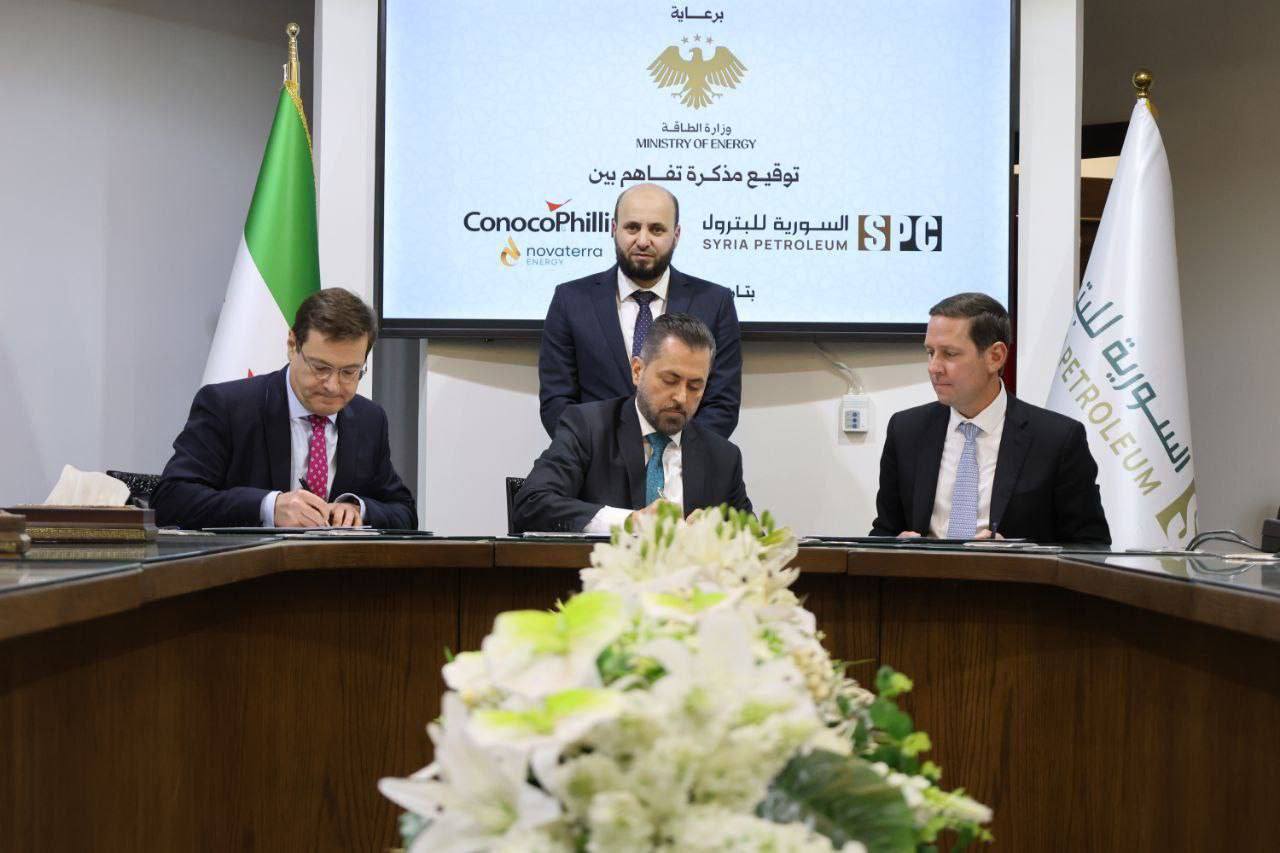
On 16 June, the Syrian Oil Company signed what it called a “strategic” contract with ConocoPhillips and Novatara Energy under the auspices of the Ministry of Energy. Technical and legal discussions before the signing established a framework for carrying out the project.
Energy Minister Mohammad al-Bashir said the agreement was an important milestone, reflecting renewed international confidence in Syria’s energy sector and supporting efforts to increase production and stabilise energy supplies.
The fields covered by the agreement have not been officially named. A map on Novatara’s website, however, shows three main development areas in Syria: Tabyyah near Deir Ezzor, Bilaas north of Palmyra, and a block north of Damascus.
Bilaas lies in the Syrian desert north of Palmyra and is classified as a major onshore gas field within an exploration and development area. Tabyyah is a gas field in the Deir Ezzor countryside associated with major facilities in eastern Syria, sometimes referred to as the Conoco gas facilities or Conoco gas plant.
The northern Damascus block lies in an exploration area in the Damascus countryside. On 28 January 2025, the Syrian Petroleum Company drilled at a previously discovered well in Tuwani, within the block. The well was expected to produce about 200,000 cubic metres of gas a day.
The agreement aims to develop existing fields and rehabilitate their infrastructure to increase production and improve efficiency. It also provides for technical cooperation to assess the fields, introduce new expertise and technology, and identify where work is most urgently needed, the Syrian Oil Company’s media directorate told NoonPost.
The directorate said the main goals were to increase domestic gas production, supply electricity generation and other essential sectors, and gradually reduce reliance on imports. It described the agreement as a means of attracting international investment and expertise to rehabilitate the energy sector.
Work will proceed in technical and operational phases. The initial plan calls for the first processing unit to arrive in October and for additional gas to enter production in December, followed by further increases each quarter during the following year. The effect on electricity supply will depend on the condition of generating plants and the transmission and distribution networks, as well as the volume of gas produced.
The challenge of rebuilding
According to the media directorate, years of inadequate investment and maintenance have left the fields and their infrastructure in need of detailed assessment. Facilities must be rehabilitated, processing units developed and equipment secured, while operational efficiency and safety must improve.
Increasing production will require work at each stage: assessing the fields, preparing surface infrastructure, processing the gas and connecting it to the transport and distribution system. The directorate said international partners and Syrian personnel would work through a phased implementation plan.
It said the Syrian Petroleum Company was responsible for managing the process in coordination with the Ministry of Energy and international partners. Its work includes technical and operational supervision, setting priorities, monitoring each phase and ensuring the project serves the energy sector’s needs.
The company is also expected to train Syrian personnel and transfer knowledge through the project. The aim, the directorate said, is to build domestic capacity to manage and develop the gas sector over the coming years as well as increase production.
Any improvement in Syrians’ daily lives will be gradual, it added. More domestic gas could support electricity generation and reduce the cost of imports. More reliable energy supplies could, in turn, help factories, services and other businesses operate.
The directorate said Syrian workers would be given priority for direct employment and training. It pointed to plans for training programmes and centres in the project areas, particularly central Syria and Deir Ezzor, to transfer expertise and technology to young people and local personnel.
Syria’s Energy Giants Post-Liberation: A Map of Investing Nations and Companies Following the Lifting of Sanctions.. pic.twitter.com/hBjVfh2BL1
— (@NoonPostSY) June 17, 2026
Why the timing matters
The agreement comes amid changes in Syria’s relations with international companies and markets following US and European sanctions relief.
Washington announced a waiver under the Caesar Act in May 2025. US President Donald Trump subsequently signed an executive order ending the sanctions programme on Syria, while Congress moved towards repealing the law entirely. That legislative process has yet to be completed.
Energy consultant Dr Shadi Kalash told NoonPost that the agreement’s initial production volumes were relatively modest. Its greater significance, he argued, was as a political and economic signal.
ConocoPhillips is one of the world’s largest independent exploration and production companies, rather than an oilfield services provider or subcontractor, and has a market value exceeding $130bn. Kalash described its return as the first major entry by a US oil and gas company into Syria in two decades and the first contract of its kind with the new administration in Damascus.
He identified three reasons why the timing matters. First, sanctions had made financing, insurance and shipping difficult for companies dealing with Syria’s vital sectors. In his assessment, sanctions relief created conditions in which a company listed on the New York Stock Exchange could commit capital with less exposure to secondary sanctions.
Second is the “first mover” advantage. Companies entering before market arrangements are settled and the most attractive assets allocated may be better placed to negotiate larger contracts later.
Third, the project is tied to the electricity crisis. Gas produced under the agreement is intended to fuel power plants rather than be exported. Kalash argued that the hours of electricity people receive will be a direct measure of the government’s performance.
He described the deal’s value as “foundational-symbolic” rather than chiefly quantitative. In his view, each major contract could reduce the extra return investors demand to compensate for the perceived risks of operating in Syria, making projects that recently could not attract financing more viable.
ConocoPhillips’ signature, he argued, signals to other investors that those risks may have become “manageable and insurable”. But the fields available for development differ considerably. Some are near pipelines and processing plants; others are damaged, remote or difficult to control and operate. Companies will seek assets they can develop quickly and at relatively low cost, he said, giving an early entrant such as ConocoPhillips a wider choice of opportunities.
Kalash also placed the onshore contract in a sequence: a memorandum of understanding in October 2025, the company’s involvement in May 2026 in an offshore project at “Block 3” off Latakia with TotalEnergies and QatarEnergy, and the onshore agreement in June. He interpreted this as a “foothold” strategy, in which an onshore project that can be carried out relatively quickly helps establish relationships and gather information for larger, longer-term offshore investment. As he put it, “whoever reads the agreement as a standalone deal misjudges its weight; in reality, it is a gateway into an entire system.”
He cautioned, however, against “overinterpreting politically.” The gas targeted for the first year amounts to roughly half the gap between current production and the grid’s needs, he said: a significant contribution, but no complete solution.
The immediate risk, in his view, is that the signing will be understood as a promise that electricity supplies will recover within months. Rehabilitating damaged fields, idle wells and worn-out networks could take years. The first test will be whether expectations can be managed while that work proceeds.
After years of stagnation and sanctions, Syrian gas is back in the spotlight thanks to a new agreement with the US company ConocoPhillips. Can a single contract alter the course of Syria’s electricity crisis?pic.twitter.com/kijYc0YZD7
—(@NoonPostSY) June 16, 2026
Why is ConocoPhillips entering Syria now?
Kalash also pointed to what he called the “validation effect” of a company of ConocoPhillips’ size signing a Syrian contract. While the project’s direct effect may be limited at first, he argued that the company’s legal and financial checks could give banks, insurers and reinsurers greater confidence to consider entering the market.
He sees energy investment as central to reconstruction: industry, agriculture and health services all depend on electricity, and electricity generation depends in part on gas. On that basis, he argued, spending that raises gas production could benefit other parts of the economy.
The presence of US companies also has a political dimension. Alongside ConocoPhillips, Chevron has pursued opportunities in Syrian waters, while Baker Hughes and Hunt Energy have appeared in discussions about sector planning and projects in the northeast.
Syrian Energy Minister Mohammed al-Bashir visited Washington, D.C., where he discussed with U.S. officials opportunities for cooperation in the energy sector and the expansion of foreign corporate participation in oil, gas, and infrastructure projects. What could this visit mean for Syria, and how might it impact the lives of its citizens?
—(@NoonPostSY) June 11, 2026
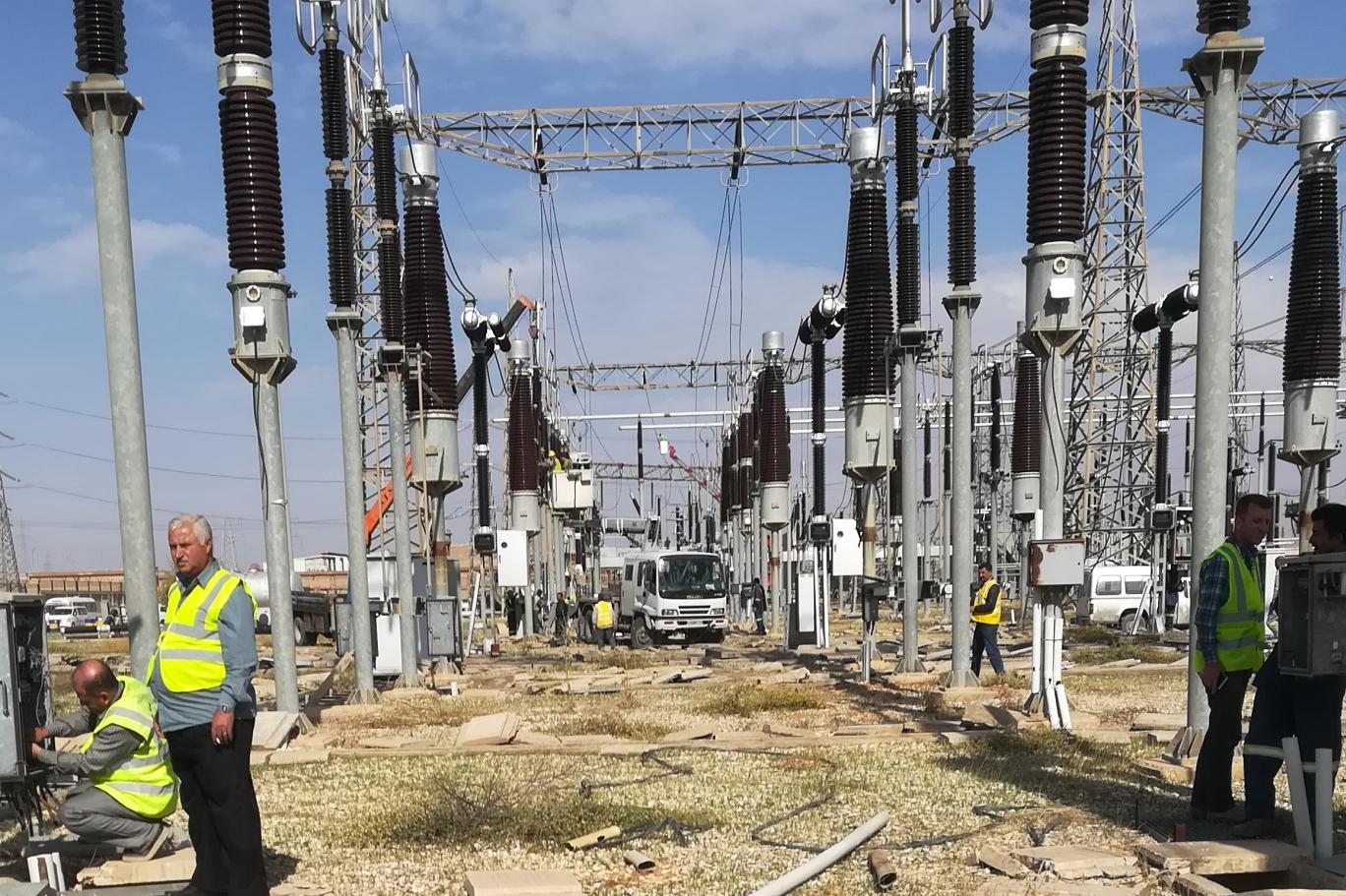
For Kalash, the agreement’s economic value depends on more than the gas produced. Electricity networks remain a major obstacle: transmission and distribution losses reached about 32 per cent in 2023, roughly twice their prewar level. Even a rapid increase in gas production would therefore leave a substantial share of the electricity generated lost before it reached consumers.
He said the return on the ConocoPhillips project would depend on investment in generating plants — including Qatari-led projects with a combined capacity exceeding 5,000 megawatts — and repairs to transmission and distribution networks and meters.
Kalash also raised the possible longer-term risks of “Dutch disease” and the “resource curse”. He warned that an inflow of foreign currency associated with energy contracts could raise the Syrian pound’s exchange rate and make industry and agriculture less competitive. Concentrating resource revenues in the state, he added, could weaken incentives to develop a more diverse economy. He proposed a transparent framework for managing those revenues, such as a sovereign fund or a rule governing public spending, to prevent them being absorbed by day-to-day expenditure or patronage networks.
The agreement’s effect should also be judged by how much investment reaches Syrian workers and businesses, he said: through jobs for engineers and technicians, knowledge transfer, local maintenance and service suppliers, and training in universities and technical institutes.
Novatara has said it will provide training and access to advanced software and technology. Kalash argued that, if these commitments are written into binding contract terms, the skills they leave behind could prove more valuable over time than the project’s production share.
How will ConocoPhillips and Novatara work together?
Novatara Energy says on its website that it develops and rehabilitates Syrian oil and gas resources to support domestic gas supplies, improve the energy system and contribute to economic recovery. It describes work across exploration, development and production, including restarting existing fields, developing earlier discoveries and exploring for new resources. The company also says it intends to develop local expertise.
Novatara is owned by Syrian-British businessman Ayman Asfari, its chairman and the former CEO of oilfield services company Petrofac. Its work on the project is led by Alex MacDonald, who has more than 35 years’ experience in the upstream sector.
Kalash described the partnership as a familiar arrangement in oil and gas: a major company works with an operating partner to share security, operational and reputational risks, and to draw on local knowledge when rehabilitating damaged fields. He also said a partner rooted in Syria could help manage relationships with the new administration.
According to Kalash, ConocoPhillips provides the “overall framework for developing and exploring a portfolio of gas assets”, along with capital, technical resources and credibility with financiers. Novatara, by its own account, focuses on implementation, training, access to software and technology, and establishing operations on the ground.
Kalash called the division of labour “intelligent and entirely logical”. In his assessment, Novatara offers local knowledge and access, while ConocoPhillips brings financial and technical resources that could reassure lenders. Neither company, he argued, would bring the same combination to the project alone.
Expected economic effects
Economic expert Abdel Hakim al-Masri told NoonPost that Syria currently produces about 4.5 million cubic metres of gas a day. He expects production to rise gradually to 13 million cubic metres a day over the coming years.
Estimated daily demand is about 18 million cubic metres, he said. He projected that the shortfall would fall from about 8.5 million to roughly five million cubic metres a day as production increases. Before the revolution, he added, Syria produced about 30 million cubic metres a day.
Al-Masri also put current annual state production at about three billion cubic metres. He expects it to reach between 5.5 billion and six billion cubic metres under the agreement, which he said would meet about 80 per cent of Syria’s daily gas needs across all sectors, not only electricity.
Higher domestic production would reduce reliance on imported gas from Azerbaijan and Qatar to run power plants, he said. Electricity supplies improved after the beginning of what he called the liberation, but rationing remains in place.
Al-Masri also put current annual state production at about three billion cubic metres. He expects it to reach between 5.5 billion and six billion cubic metres under the agreement, which he said would meet about 80 per cent of Syria’s daily gas needs across all sectors, not only electricity.
Higher domestic production would reduce reliance on imported gas from Azerbaijan and Qatar to run power plants, he said. Electricity supplies improved after the beginning of what he called the liberation, but rationing remains in place.
Al-Masri said lower gas imports could improve the trade balance, ease pressure on foreign currency reserves and reduce demand for foreign currency. Increased domestic gas output could also contribute to GDP.
He said the state currently lacks the machinery and drilling rigs needed for exploration, leaving oil fields idle. The agreement, in his view, could provide access to technology for gas exploration and development.
The project could create some jobs, particularly for local workers in its exploration areas, although companies might bring senior technicians and engineers from abroad, he said. He expected foreign firms to employ Syrians in general and medium-skilled roles.
Al-Masri believes the agreement could affect daily life relatively quickly, but said damaged infrastructure may delay the results. Before the liberation, he said, no more than about 30 per cent of the relevant fields were operating. Wells, pipelines, machinery and equipment will need rehabilitation and maintenance.
How long that takes will depend on the contract’s timetable. Once the work is completed, Al-Masri expects a marked increase in the hours of electricity supplied and said electricity prices could fall.
Some additional gas could also go to industry. Al-Masri cited cement and fertiliser production and bakeries as sectors that depend heavily on energy. Lower production costs could eventually affect the prices consumers pay.
He also viewed the entry of a US company after sanctions relief as a signal that could attract other investors to facilities and fields beyond the scope of the present agreements. He said the proportion of fields operating after the company’s entry had reached about 65 per cent, leaving roughly 35 per cent undeveloped or out of operation. Other companies could help bring those fields online, in gas or oil.
More domestic energy production could lower costs, he said, and might eventually create the possibility of exports. He also pointed to the wider effect of oil prices on transport, shipping and manufacturing. When oil cost about $110 a barrel, those costs rose; with the price at around $75–$77, closer to its level before the period of regional tensions, he expects some costs to ease. Price reductions tend to reach the market more slowly than increases, he said.
Taken together, Al-Masri expects these developments to improve living conditions gradually and bring down some costs.
Energy as a foreign policy tool
After the contract signing, Syrian President Ahmad al-Sharaa met ConocoPhillips CEO Ryan Lance, Novatara Energy CEO Alex MacDonald and Ayman Asfari. Foreign and Expatriates Minister Asaad al-Shaibani, Energy Minister Mohammad al-Bashir and Syrian Petroleum Company CEO Youssef Qablawi also attended. The meeting showed the place energy investment now occupies in Syria’s economic diplomacy.
The contract is one of several agreements and discussions involving international companies. Chevron signed a memorandum of understanding in February 2026 to assess exploration opportunities in Syrian waters. In May, Damascus announced the designation of its first deepwater offshore block and preparations for technical work.
ConocoPhillips has also joined TotalEnergies and QatarEnergy in reviewing an offshore block near Latakia. Meanwhile, service and consulting companies including Baker Hughes, Hunt Energy and Argent LNG have been involved in proposals for a master plan for Syria’s energy sector. Discussions later expanded to possible partnerships with Saudi companies on exploration and development in the northeast, although these have not led to final contracts or work on the ground.
Political researcher Wael Alwan told NoonPost that energy agreements form part of Syria’s effort to attract investment for recovery and reconstruction. He said the country’s gas resources remained underdeveloped and required exploration and infrastructure capable of bringing them into production.
Alwan sees the partnerships as part of a broader shift from isolation and sanctions towards gradual participation in the global economy, including energy markets and supply chains. He described “energy diplomacy” as a means of developing regional and international relationships after the conflict, with potential cooperation extending beyond the sector itself. He pointed to understandings involving Algeria, Gulf states, Western countries and international companies.
In his view, the involvement of US and other Western companies also indicates a change in how those actors engage with Syria amid sanctions relief. He said their operations must fit within US policy, making their participation especially significant given the effects of US sanctions on Syria’s economy.
Alwan cautioned that energy agreements alone could not deliver a broader regional and international opening. He called for bilateral political agreements and international treaties, the completion of the People’s Assembly’s formation, investment legislation and stronger domestic and external security. Together, he argued, those steps would establish more favourable conditions for Syria’s economic and political engagement.