







هذا التقرير متاح أيضًا بـ العربية
Attention is turning on July 7 and 8 to the Turkish capital, Ankara, which is hosting the 36th NATO summit at the Bestepe Presidential Complex. It is the second time Türkiye has hosted a NATO summit after the 2004 Istanbul summit. But the most notable Arab development is not on the alliance’s traditional agenda, weighed down by the files of Ukraine and defense spending alongside the war with Iran, but rather in the attendance of delegations from four Gulf states — Qatar, Kuwait, the UAE and Bahrain — at the Atlantic summit.
Rarely has a NATO summit carried this much symbolism before it even convened. The Ankara summit is not merely a routine meeting in the alliance’s record, but an implicit referendum on Türkiye’s place within the Atlantic system, and on NATO’s own ability to remain cohesive at a moment when the ongoing war in Ukraine intersects with a Middle East war ignited by the joint US-Israeli attack on Iran, alongside internal fractures over defense spending and burden-sharing unlike anything the alliance has seen in decades.
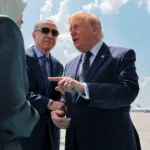
Perhaps the clearest testimony to the weight of this summit came from Washington. During his meeting with NATO Secretary-General Mark Rutte at the White House on June 25, US President Donald Trump announced his intention to attend in Ankara “out of respect for President Erdogan,” saying in his familiar style of turning politics into personal relationships: “If the summit were not being held in Türkiye, and at his invitation, I would not have attended.”
Whatever portion of courtesy the remark contained, it encapsulates a strategic reality: The US president, who has never hidden his irritation and impatience with the alliance’s commitments and institutions, finds in Ankara specifically — and in his personal relationship with Erdogan — something worth the trip and summit participation, hinting at the possibility of a major defense offer to Türkiye that could include F-35 fighter jets.
The war with Iran strengthened Türkiye’s standing
Erdogan’s standing with Trump is no passing detail in the calculations surrounding this summit. Türkiye emerged from the past months of war with Iran in a uniquely complex position: a NATO member with the alliance’s second-largest army, a regional mediator that kept lines of communication open with Tehran at the height of the confrontation, and a rising defense-industrial power whose drones are now fighting across three continents.
From precisely this position, Ankara presents itself at the summit as a bridge between the alliance and its inflamed southern neighborhood, while pushing for a larger role in European defense initiatives and capitalizing on a rare moment in which both Washington and European capitals need its services.
At the heart of this Turkish engineering of the summit lies the Gulf presence mentioned above. Inviting the leaders of Qatar, Kuwait, the UAE and Bahrain to Ankara is inseparable from Erdogan’s efforts to expand the alliance’s reach southward through his own gateway, and from NATO’s need for partners with energy, money and geography at a moment when global supply routes stand exposed. Here arises the question driving this report: What are Arabs doing at an Atlantic table, and what do they want from it?
Naturally, Türkiye is betting that the participation of the four Gulf leaders will not be merely a protocol courtesy to a host eager to showcase his weight inside the alliance, but rather a pivotal moment in a relationship that for more than two decades remained confined to symbolic frameworks.
The 36th NATO summit, returning to Turkish soil 22 years after the 2004 Istanbul summit, is expected to bring together the leaders of the 32 member states alongside senior officials from the Gulf and the Asia-Pacific region, according to what was reported by Al Jazeera Net on June 30.
Qatar, the UAE, Kuwait and Bahrain are participating in the NATO summit as members of the Istanbul Cooperation Initiative launched by the alliance in 2004, while Saudi Arabia and Oman remain outside it. Media reports revealed that Ankara held consultations with its allies to extend invitations to the initiative’s member states, at a time when President Recep Tayyip Erdogan described the summit as “a defining moment in the alliance’s future.”
Doha, meanwhile, confirmed through Foreign Ministry spokesperson Majed Al-Ansari that its participation comes within the framework of the country’s “major defense partnerships.”
According to an earlier report by Bloomberg, the purpose of inviting Gulf states to the Ankara summit is to coordinate security and confront shared regional threats. The report noted that, for the first time, the invitation was extended at the level of the foreign ministers of Qatar, the UAE, Bahrain and Kuwait in order to strengthen partnerships in the Middle East and secure shipping lanes.
What gives this presence its real significance, however, is its timing. The summit is being held amid the most dangerous security crisis the region has seen in decades following the US-Israeli war on Iran on Feb. 28, 2026, and the effective closure of the Strait of Hormuz and the missile and drone attacks that followed, targeting US bases and Gulf states.
By force of geography, the Gulf states have moved from being tactical partners that buy weapons and host bases to becoming parties demanding a seat in the architecture of regional security itself. This shift from symbolic partnership to hard security is what the Ankara table is really about.
Qatar and Kuwait seek guarantees, not escorts
Energy and maritime security unquestionably top the Gulf side’s agenda, led in particular by Doha and Kuwait. Both are hostage to the Strait of Hormuz, through which about 20 percent of the world’s seaborne oil trade passes, in addition to the largest share of Qatari liquefied natural gas exports.
Both capitals were harmed by the recent war. Tehran closed the strait from the end of February and laid naval mines, according to US military intelligence sources on March 10, before Washington launched on March 19 a air and naval campaign to reopen it. But despite the air intensity and the use of US naval force under “Project Freedom,” the campaign faced decisive field obstacles in the form of Iran’s deployment of naval mines and its use of speedboats and missiles to launch counterattacks on bases and commercial vessels, prompting shipping companies to avoid the passage.
This led the administration of President Trump to realize that the cost of persisting with the war option would be extremely high for the global economy and energy market. The result was a ceasefire on April 8 and a US-Iran memorandum of understanding that later entered into force.
Despite the signing of the memorandum, navigation remains fragile and conditional. Multiple reports have said clearing the strait of mines could take between 21 and 53 days in complex minefields, and that Paris and London proposed forming a European naval coalition for mine-clearing. Meanwhile, Al Jazeera Net quoted Tehran as speaking of “a mechanism with Oman” to manage the strait, while threatening countermeasures if Washington and Tel Aviv did not honor their commitments.
By contrast, ambassadors of alliance member states, according to a text seen by Reuters on July 3, agreed that leaders in Ankara would declare that Iran must show “full respect for freedom of navigation in the Strait of Hormuz” and must never possess a nuclear weapon.
Accordingly, what Doha and Kuwait are seeking in Ankara goes beyond temporary naval escort operations toward permanent arrangements that include expanding maritime surveillance, early warning and information-sharing programs within the initiative’s frameworks, and linking the security of Gulf gas and oil flows to the Atlantic security system as part of the broader international security order, as the alliance itself now classifies it.
This direction is reinforced by NATO’s internal divisions over burden-sharing, with public US complaints about allies’ reluctance to participate in reopening the strait, making Gulf energy a negotiating card rather than merely a commodity in need of protection.
From a state searching for gateways of passage to a partner shaping defense strategies and threat assessments … what does the anticipated NATO summit in Ankara reflect, and what messages is the Turkish state sending?
📍More details in a report by @ZaidEsleem 👇https://t.co/7EZPT721Z0 pic.twitter.com/YMUL1ZY9yk
— NoonPost (@NoonPost) June 30, 2026
Bahrain and the UAE: A missile shield without a break with Tehran
For Abu Dhabi and Manama, the February 2026 war was an existential test for air defense systems. The Iranian missile and drone response extended to US bases and Gulf states, and Bahrain — host to the US Fifth Fleet — was among the foremost Iranian targets, to the point that on April 2, 2026, it called on the UN Security Council to adopt a resolution authorizing the use of all necessary means to open the Strait of Hormuz, a move opposed by Russia, China and France.
The Gulf participation in Ankara also comes as NATO Secretary-General Mark Rutte seeks to project a unified position toward what he described as “cross-border Iranian ballistic threats,” noting that the expansion of Iran’s missile capabilities poses a direct danger, with the issue constituting one of the main pillars of the alliance’s strategy for dealing with tensions in the Middle East.
Manama has a relatively advanced partnership structure with the alliance, represented by the Individual Partnership and Cooperation Program since 2016, and by joining the Defense Systems Interoperability Platform in 2017, a platform that ensures operational compatibility with alliance forces within the framework of close strategic relations with the United States and its allies. This contributes to building integrated regional defense networks, enhancing information-sharing and unifying communication procedures to confront shared threats.
Accordingly, the Emirati-Bahraini ambition at the summit is to build on these frameworks toward an integrated air defense network compatible with alliance standards, linking radars and interception systems to NATO early-warning capabilities in order to deter drones and ballistic missiles.
But the Gulf paradox lies in the political ceiling of this ambition. The four capitals remain keen to avoid any collective defense arrangements that could be interpreted as directed against a specific regional party, in order to preserve a margin of independence in their security decisions. The UAE, which wants an Atlantic missile shield, is the same state that maintains open economic channels with Tehran, while Bahrain, which sought a UN mandate for force, understands that its geography cannot bear an open war.
Thus, what the Gulf wants is a delicate equation: tangible, material Atlantic deterrence while keeping Gulf diplomacy free to move along de-escalation tracks. It is the same equation that leaves Oman and Saudi Arabia outside the room.
From purchasing to localizing military industries
Behind the summit’s political language, negotiations of an explicitly commercial-industrial nature are underway. On drones, the UAE had already signed a contract in 2023 to purchase 120 aircraft of the Bayraktar TB2 model, receiving more than 20 of them that same year, before taking delivery of its first heavy Akinci drones in December 2024, according to announcements by Türkiye’s Baykar.
As for Kuwait, it contracted in June 2023 for Bayraktar TB2 drones worth $367 million, according to its Defense Ministry. This suggests that Kuwait and the UAE may enter the Ankara summit having moved beyond the logic of pure purchasing toward considering the establishment of local assembly and maintenance stations, along the lines of the model Ankara granted Indonesia in May 2026, when a deal for Kizilelma stealth drones included the creation of technical support centers on Indonesian territory, according to Defense Arabia.
In this in-depth piece, we try to trace the path of the aviation project in the Gulf states and Türkiye: how it began, what it carried within it alongside its economic feasibility, and what it achieved up to the moment of the US-Israeli war on Iran, among other details.https://t.co/aAkxG05Jsj pic.twitter.com/FWF3bOpxwV
— NoonPost (@NoonPost) May 25, 2026
The same trajectory extends to something deeper than platforms, namely technical integration. NATO’s Defense Systems Interoperability Platform — which Bahrain has joined — already provides an institutional channel for integrating Gulf electronic warfare and air defense systems into Atlantic command-and-control networks, an integration that is shifting from an option to a necessity if the desired missile shield is actually to function.
Doha is also playing its most valuable card at a different table. As the largest pivotal supplier of liquefied natural gas to Europe, which needs it more than ever after the Hormuz crisis, Qatar possesses a bargaining tool to extract what money alone cannot easily buy: digital defense software and military artificial intelligence applications from Atlantic companies. These are technologies that Türkiye itself is now offering, as shown by the official unveiling in May 2026 by the Turkish company HAVELSAN of its new ADVENT-AI system, the upgraded AI-supported version of its AI-enhanced naval combat management system.
As for Manama, its priority is more urgent. Iranian speedboats and suicide drones in Gulf waters — which prompted Washington to deploy attack aircraft and helicopters dedicated to hunting these targets during the attempt to reopen the strait — may push Bahrain toward deals for coastal radars and short-range interceptor missiles to protect its territorial waters and vital facilities, including the Fifth Fleet headquarters itself, without waiting for larger regional umbrellas.
Scenarios after participation in the Ankara summit
The possible outcomes of Gulf participation in the summit fall into two main scenarios. The first is the drafting of an institutionalized defense charter between the alliance and the four Gulf states that rises to the level of mutual commitments and permanently redraws the map of regional security.
This is a scenario pushed by Ankara, which seeks a larger role in shaping European and regional defense architecture. But current indicators do not support it: neither an alliance divided over spending and Ukraine is prepared to extend the Article 5 umbrella southward, nor are the Gulf capitals themselves willing to enter a collective commitment that would provoke Tehran, as the reports cited above indicate.
The second scenario — and, in our assessment, the more likely one — is to settle for a package of separate tactical understandings, such as a summit statement containing firm language on freedom of navigation in Hormuz and the Iranian nuclear file, updated individual partnership programs, and bilateral arms and localization contracts in which Türkiye advances as a Gulf gateway to the Atlantic defense market, without any written collective defense commitment. This scenario resembles a reactivation of the Istanbul Initiative more than the birth of a new alliance.
But there is another gain that may be more important than any text the summit produces. The mere fact that the foreign ministers of the four states are sitting at the NATO table, at the alliance’s own invitation, gives them a political leverage card in the West. Anti-Gulf lobbies in Washington and Europe, which have long portrayed some Gulf states as enemies of Western interests or as incubators of its adversaries, will find it difficult to convince anyone of that while the alliance is dealing with them as direct security partners on the most dangerous issues of the moment.
Thus, the most valuable thing Gulf ministers may bring back from Ankara may be neither a deal nor an agreement, but rather Atlantic recognition that they are part of the solution equation, not a problem to be managed.