




هذا التقرير متاح أيضًا بـ العربية
“The Institute for Monitoring Peace and Cultural Tolerance in School Education (IMPACT-se) is an international research and policy organization that monitors and analyzes education around the world. We use international standards for peace, tolerance and non-violence, as derived from UNESCO declarations and resolutions, to determine compliance and advocate for change where necessary.”
On the “About Us” page of impact-se.org, the organization lays out its role, tools and goals, which appear global at first glance. But a closer look reveals another framework: one that strips legitimacy from national identities and categorizes forms of knowledge and education in ways that suit a specific ideological trajectory the organization has made the benchmark for evaluating curricula around the world.
Despite the clarity of that benchmark and the bluntness of its intrusion into national identities, it has expanded into international and global forums, especially those that tie funding to Westernization. Its reports have gained attention and influence, particularly in Arab and Palestinian contexts, from the organization’s founding through Oct. 7 and beyond.
So how did IMPACT-se begin? Through what lens does it examine and evaluate? How did it manage to “declare itself an expert on curricula and have the world believe it”? What kind of curricula does it seek to use to change minds and societies? Why does the Emirati curriculum hold particular importance in its reports? And has the UAE really succeeded in winning complete approval for its curricula and educational pathways?
“Who gave it this right?”
At the beginning of last June, Fatima and Rana Dajani, two education researchers, launched an intensive inquiry into organizations that evaluate school curricula, and came across the website of IMPACT-se, which at first appeared legitimate and disconnected from any funding links or involvement with U.N. humanitarian or educational bodies.
But deeper research later revealed an organization that reviews curricula in more than 30 countries around the world, including Pakistan, Jordan, Iraq, Saudi Arabia, Nigeria, Sweden, Hungary, France, Ireland, Greece, Yemen, Qatar and the UAE, through a careful methodology overseen by trained experts and linguists.
Under this methodology, once the country of the curriculum is identified, the organization analyzes a large number of textbooks and teachers’ guides for grades 1 through 12, using international standards based on UNESCO and U.N. declarations, as well as other international recommendations and documents related to peace and tolerance education and linked to subjects such as history, religion and civics.
Individual examples are then selected based on their relevance to the research and analyzed as they are, without interpretation or paraphrasing, in terms of their content and educational significance, in order to generalize a conclusion that may be framed as the curriculum’s “degree of compliance (or non-compliance) with international standards for peace and tolerance education.”
The broadness of the target categories, and UNESCO standards derived from peace, tolerance, non-violence and mutual respect among peoples, were little more than a distraction from the organization’s main purpose. It was founded in 1998 under the name Center for Monitoring the Impact of Peace, or CMIP, following the shadow of Oslo in the new Palestinian curricula and asking whether “peace between Israel and the Authority had been positively reflected in the education of Palestinian children.”

The organization was launched at the time by Yohanan Manor, a French Jew, lecturer in the political science department at the Hebrew University and founder in 1984 of the campaign to “repeal the U.N. General Assembly resolution equating Zionism with racism.” Less than four years later, that campaign helped produce a U.N. reversal of the resolution in a move aimed at appeasing “Israel” so it would attend the Madrid peace rounds with Arab states.
As soon as Manor wrote his first report in 1998 on the Palestinian Authority’s curricula, it drew “Israeli” political attention, leading to the creation of a trilateral committee made up of American, “Israeli” and Palestinian members to combat incitement, whose work was approved in the Wye Plantation agreement at the end of 1998.
According to the organization’s archives, within a single decade it had become an active player through its reports in the “Israeli” Knesset, the U.S. Congress and the European Parliament, as a result of its close alignment with the “Israeli” political field. Its vision quickly passed to Itamar Marcus, a member of the trilateral committee appointed directly by the “Israeli” government and a resident of the Efrat settlement in the occupied West Bank.
Within two years, Marcus had managed to target the American political audience by presenting the first report to members of Congress and the Clinton administration, before withdrawing from the organization and founding his own group specializing in monitoring Palestinian media, Palestinian Media Watch.
At that stage, the organization’s team — still CMIP at the time — had taken shape, from executive director Marcus Sheff, a major in the occupation army, enlisted in the spokesperson’s unit of the Israel Defense Forces, an editor at The Jerusalem Post and executive director of The Israel Project, to Arik Agassi, chief operating officer and head of global partnerships, who previously served as head of foreign affairs and operations at The Israel Project’s “Israel” office and holds a master’s degree in contemporary Middle Eastern studies from Tel Aviv University’s Department of Middle Eastern Studies.
And director of research, Eldad Pardo, a specialist in Iranian, Arab and religious studies, and a researcher at the Truman Institute, who — in addition to being Jewish — belongs to the Abrahamic Jewish-Islamic Sufi path and was granted the title of sheikh in the Qadiriyya order. On the same list is policy director Felicity Ginsburg, who holds a degree in Arabic from Oxford University and also worked as a senior foreign affairs officer at the office of Britain’s chief rabbi.
Of the 17 members of the team, all are involved in Islamic, religious, Arab or Middle Eastern studies. There is only one Arab member: Alaa Alshimmari, the organization’s regional representative in the UAE, who is linked to family wealth management offices in the UAE and the National Projects Office of the Abu Dhabi Presidential Court.
There are also 14 graduates, lecturers or researchers affiliated with “Israeli” universities — Tel Aviv University, the Hebrew University, Bar-Ilan and Reichman — and all members have ties to Western universities and research centers in Europe and the United States. That helped them produce their first systematic academic report in 2000 in cooperation with the Truman Research Institute at the Hebrew University of Jerusalem, turning the partnership into academic cover for promoting its findings as a trusted source.
That was accompanied by another layer of cover: an analysis of “Israeli” textbooks that concluded they were based on “preparing generations of peaceful, tolerant youth who support coexistence and mutual respect,” and that they “encourage self-reflection on historical trauma and inequalities related to Palestinians.” Despite the selective methodology, compared with the comprehensive and strict methodology applied to Palestinian books, the report succeeded in attracting international attention.
That began in Italy, which in 2000 withdrew funding for the development of the new Palestinian curriculum based on a CMIP report, before the World Bank informed the Palestinian Ministry of Education that funds allocated for teacher training would be redirected to other projects. Three years later, the center moved for the first time beyond Palestine, targeting Saudi curricula.
In 2003, it issued its first report on the matter, 115 pages long, examining 93 textbooks and targeting subjects related to “Christians, Jews and the West, the status of women and the status of children.” It concluded, among other things, that Islamic studies make up a large part of the curriculum, to the point that even science books touch on it.
It also said the curricula portray Islam as the only true religion and its followers as superior to all other religions in this world and the next. The report also focused on the prohibition against befriending Jews and Christians, the “vilification of the West,” the Crusades, rejection of Western democratic practices and customs such as drinking alcohol, music and clothing, and its highlighting of adultery, homosexuality, lack of spirituality and high suicide rates in Western societies. It also pointed to references to Jews as “deceivers” who cooperated with the enemies of Islam and occupied Palestine after the First Zionist Congress, while one textbook states that destruction is the desired fate of the Jews.
The report prompted an official response from the Saudi curriculum authority, which rejected its findings while also noting that the books were already being revised — which indeed happened a few years later. The organization then issued its second report in 2009, denying that the Saudi government had fulfilled its pledge to remove passages of intolerance and extremism from its curricula, and asserting that the curricula had “made little meaningful progress” and still promoted hatred and violence.
That was followed by reports on Syrian, Jordanian and Egyptian curricula, focusing on their position toward Jews, their treatment of Islamic religious stories about them, gender roles for women, hostile views of the West and stereotypical portrayals of modern Europe, before its influence was further strengthened by its declared transformation from a “monitoring center” into an evaluation organization using U.N.-based standards embodied in the Universal Declaration of Human Rights (1948), the UNESCO Declaration of Principles on Tolerance (1995), the U.N. Declaration on the Promotion Among Youth of the Ideals of Peace (1965), and the Integrated Framework of Action on Education for Peace, Human Rights and Democracy (UNESCO, 1995).
In 2007, the Center for Monitoring the Impact of Peace renamed itself the Institute for Monitoring Peace and Cultural Tolerance in School Education, or IMPACT-se, giving itself cover in the language of “tolerance and peace” under the banner of UNESCO. Its methodology became a comprehensive reading of textbooks and a generalization of examples within an overarching narrative based on views of minorities — especially Jews and Christians — vulnerable groups such as women, children and homosexuals, and governance issues such as democracy, pluralism, political and religious freedom, and acceptance of the other (Western/Israeli).
Wrapping itself in UNESCO’s cover opened the way for the organization to move from focusing on Arab curricula within a discourse of peace and tolerance to regional and national curricula, and then to a broader focus on cultural tolerance in school curricula around the world, while keeping its headquarters in Jerusalem and its status as a nonprofit organization.
By the early 2010s, IMPACT-se had expanded its research to include reviews of textbooks from Saudi Arabia — beginning with reports in 2011 that pointed to the persistence of intolerance despite reforms — as well as Iran, Turkey and Pakistan, alongside continued scrutiny of Palestinian Authority and UNRWA materials.
Then in August 2012, it launched its first study of American textbooks used in Islamic schools, examining more than 80 books for messages about tolerance toward non-Muslims and democratic values, and found mixed results, including some promotion of jihad and antisemitism.
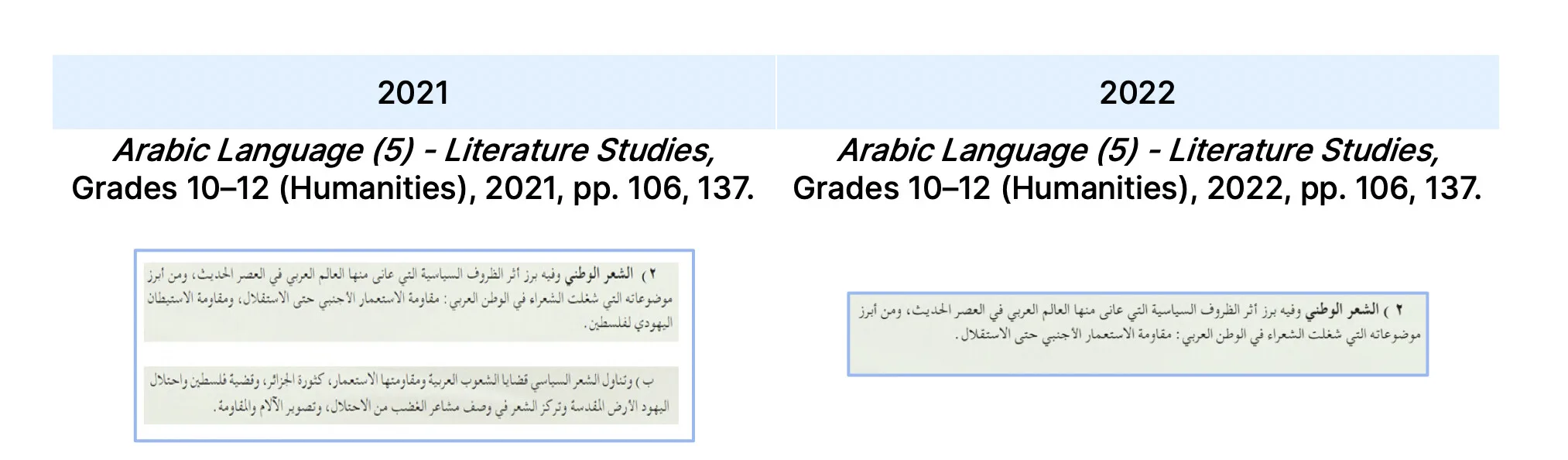
By the middle of the decade, the institute had begun analyzing curricula from Gulf states, starting with Qatar’s in 2016, then the UAE’s in 2018, as well as the Syrian curriculum in areas controlled by the Assad regime and the Iraqi curriculum in the same year. Some curricula were described as showing “shortcomings despite progress,” such as those of Jordan and Egypt; others as “explicitly hostile,” such as Syria and Iraq; others as “hostile extremism,” such as Palestine; others as “problematic and antisemitic,” such as Qatar,
Or as undergoing a “dramatic transformation” such as Saudi Arabia and Morocco, and still others as “leading,” such as the UAE. That did not mean the evaluations were fixed, however, as most Arab countries — with the exception of Palestine — posted uneven progress in some years as a result of reducing “religious and jihadist content.”
Arik Agassi explains in a podcast the organization’s role and its focus on Arab curricula by describing them as “authoritarian curricula in the Arab world that carry a power not found in other educational tools, and often bear the state’s stamp, making them a core means of communication that can either form a barrier to extremism or a blueprint for extremism for future generations, especially in societies where curricula enter a child’s life before tablets do.”
Alongside its rapid and effective harvest of Western attention, it became the cornerstone of the Western narrative on Palestinian curricula. It was helped in that by the media, political and academic networks of its team and leadership, in addition to being the only English-language source on Arab and Palestinian curricula and the most frequently cited one.
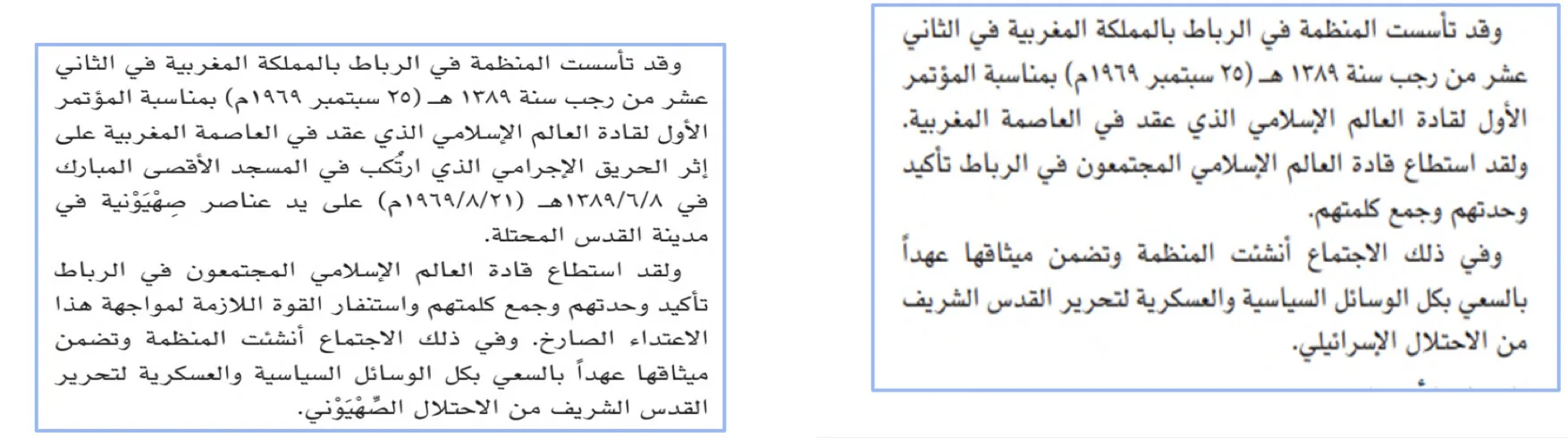
But its legitimacy, which it derived from Western attention, remains distorted. The Universal Declaration of Human Rights or UNESCO standards do not mean ignoring the national and religious identity of societies. So when the organization describes Pakistani textbooks as containing “Islamic content that does not meet UNESCO standards,” it effectively gives Western standards precedence over the standards from which societies derive their customs, social structures and constitutions.
Likewise, its view of the Nakba, which the organization describes as “incitement,” compared with references to the “Land of Israel” in “Israeli” textbooks, which the organization describes as “ethnocentric self-centered perceptions,” represents a double standard that deprives affected societies, by its own criteria, of the ability to challenge its reports.
These standards drew the attention of Professor Nathan Brown of George Washington University and the Georg Eckert Institute, both of which reached different conclusions on a number of curricula the organization had evaluated, to the point that Brown described its role as that of an “incendiary pressure group” whose methodology resembles that of a prosecutor who has already made up his mind.
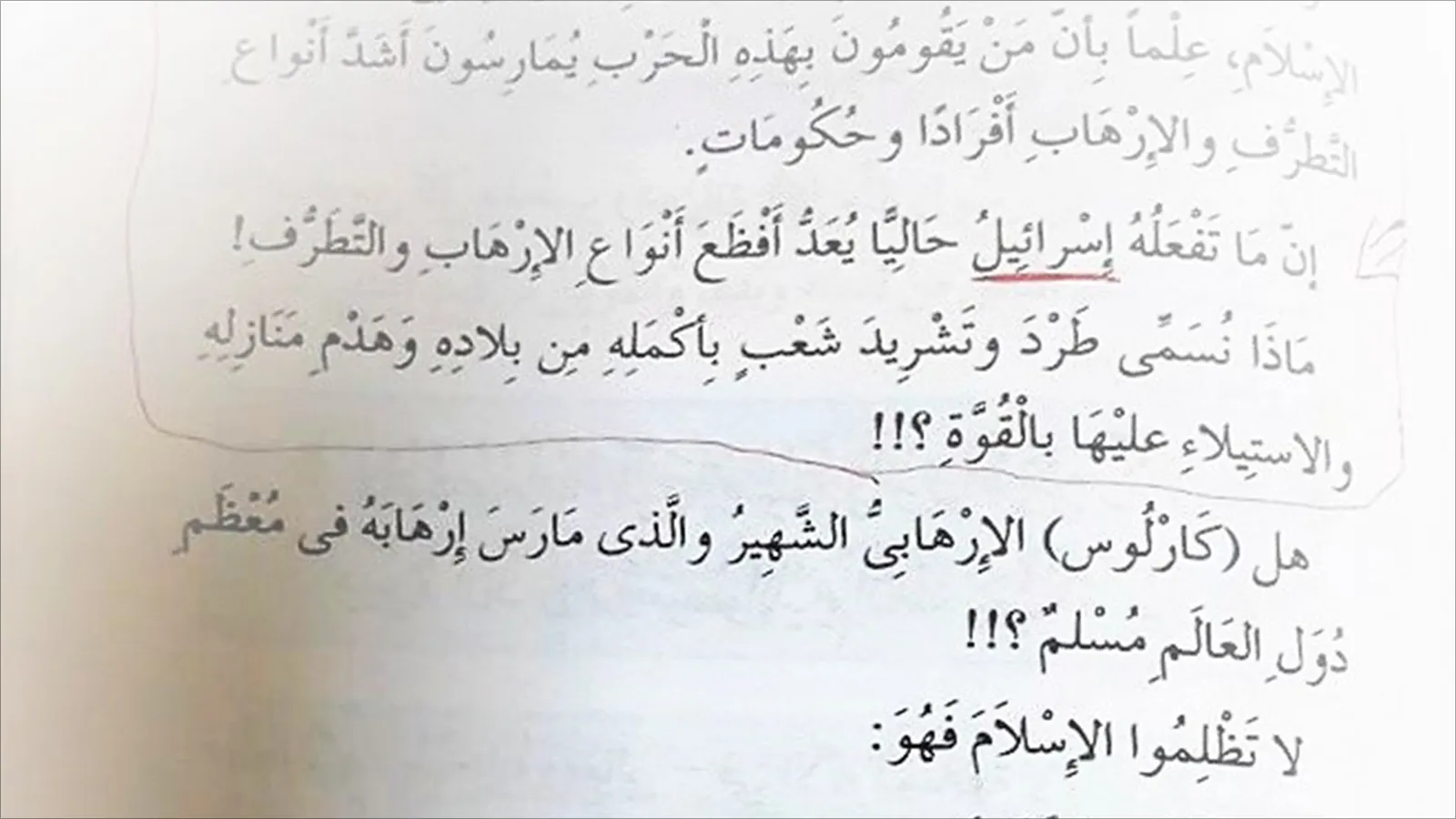
On the other hand, the organization’s own methodology, which focuses on “tolerance, non-violence, recognition of the other, representation of minorities, and acceptance of political settlements” according to what it considers to be based on UNESCO standards for education for peace, excludes other standards of equal importance, such as the colonial history of peoples, the political and economic violence inflicted on them, their right to self-determination and to recover their rights, or support and solidarity with oppressed people in other countries in the face of Western economic, cultural and political domination.
This pattern of evaluation — despite the importance of tolerance, recognition of the other and minority representation — suggests that the standards were used to achieve domination rather than to promote humanitarian principles themselves. In other words, the index was designed to measure the extent to which educational curricula bend and conform to the conditions of the colonizer and the desires of the occupier, and to its need to see itself as powerful and dominant, yet humane and gentle at the same time.
That is what Agassi points to in his podcast interview when he says: “Developing and making progress in curricula often preceded the normalization agreements themselves, and later supported them.” For Agassi and his team, normalization means moving closer to the “Israeli” and farther from Islam, the particularity of the Arab region and its customs and traditions, its rejection of alcohol, adultery and homosexuality, and the silencing of its anger at the Western colonizer and its continuing domination.
Beyond normalization, which is one of the gains of changing curricula, and beyond its role as a pressure tool in Western funding and public policy circles, the organization has succeeded in strengthening its position through several steps, including the presence of its reports in European parliamentary sessions and in interrogation memoranda and discussions related to educational aid, especially with regard to Palestinian curricula.
Among them was the adoption of its indicators and standards in the European study on Palestinian textbooks in 2021, which concluded with a set of demands linking funding to reform of educational content and approved a mechanism to withhold part of education allocations — 20 million euros in parliamentary discussions related to aid — until changes were made to the books, while also proposing that the money later be redirected to alternative programs if the required reforms were not implemented.
That culminated in the European Parliament’s Committee on Budgetary Control in 2022 approving tighter oversight of Palestinian curricula and linking the continuation of some forms of support to curriculum reform.
In this way, the organization has become, alongside the “Israeli” government and its army, a tool of educational siege against Palestinian generations. It has become an instrument for forcibly imposing its mood, interests, orientations and security, tying compliance to funding and international acceptance to national, religious and social disintegration not only for Palestinians, but for Arab states and other countries around the world that appeared on the institute’s map as a stamp of its supposed efficiency in pursuit and restriction, nothing more.
A little land and religion, and a lot of coexistence
On the ground, between 2016 and 2024, the organization subjected more than 238 educational books in Qatar, 294 books in Jordan, 271 books in Egypt, 371 books in Saudi Arabia, 21 books in Iraq, 18 books in Syria, 220 books from the UAE, 222 books from Palestine before 2019, and 270 curriculum books after that, in addition to 71 teachers’ guides, to examination and review, including books from the West Bank, East Jerusalem, UNRWA and private schools.
This does not stop at published curricula. Some of the organization’s reports have dealt with curricula still under preparation, most recently a special report on Syria after liberation in which it predicts the educational orientations of Hayat Tahrir al-Sham in its coming curricula, less than two months after the fall of the former Syrian regime.
In tracking all these curricula, IMPACT-se ignored the distinction between Islamic jurisprudential rulings, civic values in national education curricula, and inflammatory mobilizing rhetoric aimed at rallying students toward specific violence or hostility. All of its reports relied on reading the first and second levels solely through the lens of the third.
With regard to the concept of jihad, for example, the organization documented in its latest report on Jordan on the 2023-2025 curricula that the 10th-grade Islamic education textbook teaches jihad, presents martyrdom as the highest religious example, and frames it as a “military mobilizational” concept, even though the book stresses “the importance of fighting enemies, defending the الوطن and sacrificing oneself to protect it.” In this, it contradicts its own report, which also notes that the Jordanian curriculum generally “calls for concepts of religious moderation, tolerance and the pursuit of peace.”
Indeed, the presentation of the report to the media ignored the overall indicator in favor of the direction the organization sought to promote. When the report was released, CEO Marcus Sheff said: “It is regrettable and particularly concerning that the Jordanian curriculum includes some of the oldest antisemitic stereotypes and glorifies martyrdom.” That statement overshadowed the entire report and was adopted in the West.
The same happened with Egyptian curricula, which the report “Curriculum Reform in the Middle East” described as having “succeeded in aligning its curriculum with international standards, but still suffers from some shortcomings in discussing Jews and martyrdom, which remains in the higher, unrevised grades.”
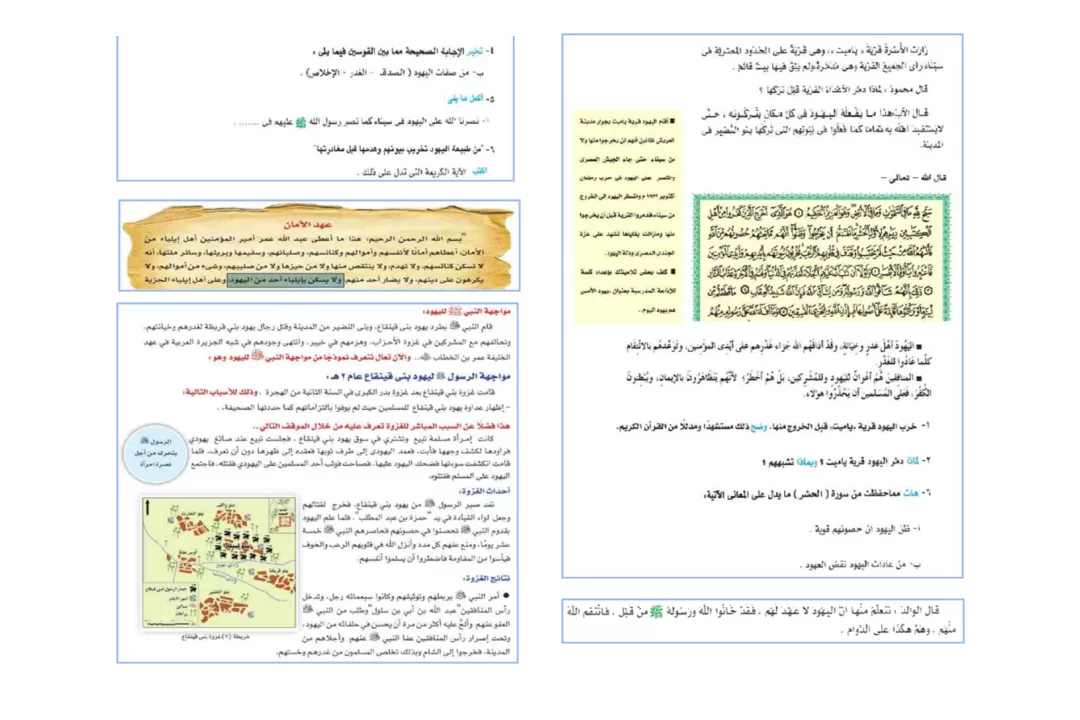
Here too, “martyrdom” — a deeply rooted historical religious concept tied to Arab and Islamic national identity — is lumped together with “antisemitism,” and the curriculum is described as deficient because the idea of “defending the الوطن” does not appeal to it, even though that is the very Western and “Israeli” framing that reinforces nationalism and the authority of the state and its protection as a survival priority.
This extends to concepts such as diyah, People of the Book, dhimmis, the gharqad tree and others, which the organization shows strong sensitivity toward when they appear in curricula, though less so than “jihad and martyrdom.” Stories about Jews with the Prophet Muhammad (PBUH), and his relationship with the Jews of Medina — Banu Nadir, Banu Qaynuqa and Banu Qurayza — are treated as stereotypical images of Jews, antisemitic and confining them to treachery and as a threat to Muslims.
This confirms that the organization treats historical incidents in religious curricula as evidence of incitement and seeks either to conceal historical facts documented and agreed upon in Islamic sources or to reinterpret them so they are not “antisemitic.”
Then, under the constraint of family, the individual and freedoms, the methodology suddenly shifts from “compliance with UNESCO standards” to “compliance with Western values.” Thus the curricula of Jordan, Saudi Arabia, Iraq, Egypt and Palestine are criticized because they describe “homosexuality as a threat to the survival of humanity, neglecting the values of the single family.
If we look at the organization’s methodology in dealing with Palestine, the contradiction becomes even more pronounced and the double standard more evident. In its 2019 report on the Palestinian curriculum, the organization documented 1,509 references (93.5 percent) to “Israel” expressed through terms such as “the occupation” and “the entity,” while the direct name “Israel” appears in only 6.5 percent of cases — which it considered an “erasure and non-recognition of the other.”
Yet the organization itself considered the naming in “Israeli” curricula of Palestinian lands as “Judea and Samaria” to be natural, and even praised a historical research exercise from a book used at the settlement religious school Har Bracha in the West Bank — Judea and Samaria according to the report — as generally recognizing the Palestinian Authority as a legitimate political entity because it described the areas surrounding the school as “inside Area B, which is administered by the Palestinians.”
This is an erasure from the map that the organization does not fault, even as it faults Arab and Palestinian curricula for referring to the borders of Palestine under the British Mandate — historical facts — considering that an erasure of “Israel,” even though it did not yet exist. The same standard appears in its attacks on the phrase “from the river to the sea” in Palestinian curricula, even though the phrase sometimes appears in official “Israeli” literature and discourse without receiving the same level of scrutiny from the organization.
The scrutiny expands to include UNRWA itself, which has repeatedly stated that it uses the curricula of host countries — including the Palestinian Authority curriculum — as a standard U.N.-approved practice in all refugee situations around the world, with modifications overseen by UNESCO to remove any content “inconsistent with U.N. values,” and that it has an “advisory group of educational experts” that includes representatives from globally recognized institutions such as UNESCO and the World Bank.
Its curricula are described as “problematic” — even though the organization acknowledges that UNRWA does not have a curriculum of its own — and it is faulted over, among other things, a fourth-grade lesson declaring that Palestinian refugees “will certainly return to Jaffa, no matter how long it takes.” That content is consistent with the right of return as stipulated in General Assembly Resolution 194, but the organization describes it as “extremist, intolerant and rejecting the other,” and its executive director considers it a representation of “1.3 million Palestinian children being radicalized every day”.
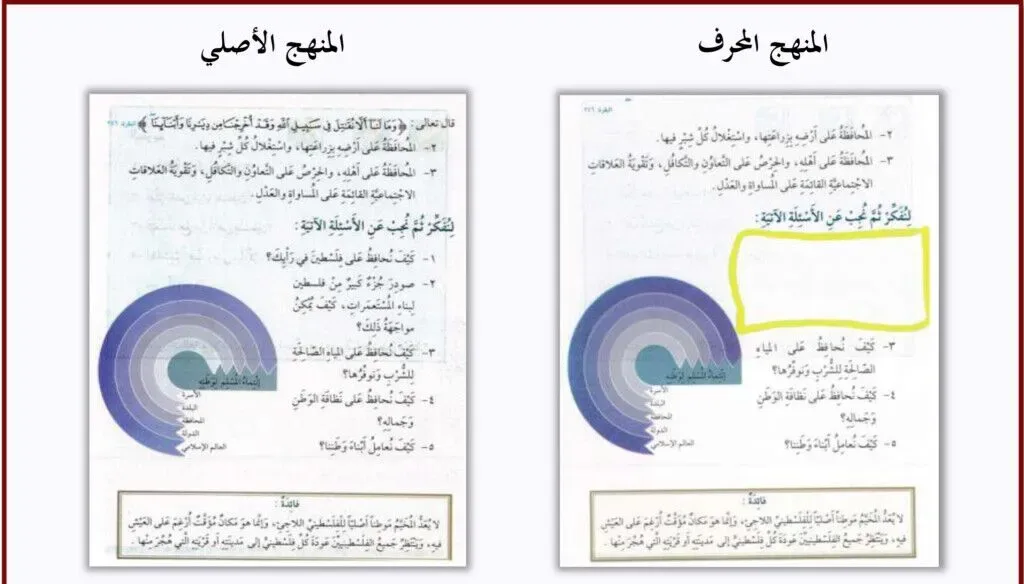
In doing so, it measures any Palestinian adherence to earlier U.N. resolutions as a rejection of peace rather than a commitment to international legitimacy. That can be seen as a selective mechanism in the use of UNESCO and U.N. standards as legitimizing cover for the organization, while ignoring U.N. resolutions, especially those related to the Palestinian cause.
Based on the above, the organization’s use of the values of “coexistence and tolerance” appears selective and partial, invoked when they serve to condemn a curriculum. This extends to its treatment of jurisprudential, historical and heritage content as the functional equivalent of direct political incitement an approach that places any Islamic religious material in a “problematic” frame regardless of context. This is especially clear in Saudi curricula, where the organization complains about the abundance of Islamic religious texts and their broad distribution across different textbooks.
By contrast, these standards and their rigor are absent when it comes to the “Israeli” curriculum the naming of the West Bank with biblical names, the lack of recognition of the Palestinian right to self-determination in official Israeli educational literature, and the erasure of Palestinian presence on the land turning “global standards of tolerance” from a double-edged balance into a one-way instrument that measures the commitment of the Palestinian side — and Arabs more broadly — to standards that the “Israeli” side is not required to meet.
This means that the standards and methodology have been transformed in the West, thanks to the organization, into tools for measuring the degree to which each Arab state accepts the “Israeli” narrative and sovereignty over land, history and memory, rather than measuring its actual commitment to comprehensive human rights as set out in the same U.N. charters when applied equally to all parties.
The UAE … a compass
The UAE entered the evaluation lists relatively late, but it had already gone far ahead in changing curricula and educational methods, changes it launched in 2014 under the banner of “combating religious extremism and promoting tolerance and coexistence.” That is why the “Israeli” evaluation in 2018 focused on the subject of “moral education,” introduced in 2017.
This coincidence between the introduction of the subject into all public and private schools in the country from first through 12th grade made the Emirati curriculum a model of “positive education.” The Emirati curriculum issued in 2016 was later described in a 2022 report as “When Peace Goes to School“.
This is not limited to curricula, but extends to active Emirati participation in the organization’s work through its regional representative, Alaa Alshimmari, and through some of the most prominent figures on its advisory board, beginning with Kamal Abdel-Malek, editor-in-chief of Arab and World Literature and professor of Arabic literature at the American University in Dubai; Mohammed Al-Husseini, an Emirati researcher and lecturer in Islamic studies at the Oxford Centre for Religion and Public Life and senior fellow in Islamic studies at the Westminster Institute; and Dr. Ali Rashid Al Nuaimi, the first chairman of Hedayah, the International Center of Excellence for Countering Violent Extremism, a participant in founding the Sawab Center, and founder and chairman of the Global Council of Muslim Communities.
This active Emirati participation prompted Marcus Sheff to say that “the UAE and its curricula are real preparation for a new era of peace and tolerance,” and that the new curriculum born from the vision of Sheikh Mohammed bin Rashid Al Maktoum as part of the national “UAE Vision 2021” agenda, and later incorporated into the priorities of “Vision 2030” aimed at building a highly skilled and highly productive workforce, is exceptional in its positivity toward Judaism and other religions.
This did not emerge from nowhere, but was the outcome of a parallel network outside the classroom that accompanied these transformations. According to the U.S. State Department, and the American Jewish Committee, the strategy of training preachers and imams, the adoption by the General Authority of Islamic Affairs and Endowments of a unified weekly Friday sermon text distributed to imams, and the authority’s launch in June 2023 of the “National Program for Religious Moderation” to promote moderate interpretations of Islam through training programs specifically for imams and preachers all contributed to this process.
Then came the establishment of Hedayah to combat extremism in 2012, and its graduation of 1,500 imams and 600 female religious preachers trained to promote moderate Islam and coexistence with other religions. Added to this network is the Sawab Center to counter “extremist” content online.
That gave the Emirati curriculum special value in the organization’s reports, as a “unique achievement and moral superiority,” because its lessons “praise love, affection and family ties with non-Muslims; speak positively about interfaith relations, especially with Christianity; and teach tolerance and acceptance of Judaism.” Its reports also praised the “institutional religious pluralism” embodied in the Abrahamic Family House, a complex that includes a mosque named after Imam al-Tayeb a church named after St. Francis and a synagogue named after Maimonides all designed identically and at equal height “to erase any hierarchical ranking among religions,” along with the distinct significance of building the first synagogue in the Arabian Peninsula in nearly a century.
Notably, the “Israeli” celebration of the Emirati curriculum was not complete. Media reports (The Times of Israel) recorded that “gender roles” still need more work, and that “Israel” does not appear on textbook maps, while other maps place it in the negative space around the borders of a Palestinian entity or show its borders without a name.
According to Lazara Berman, history lessons on the Arab-“Israeli” wars place “Israel” in quotation marks, signaling that it is not a real state, and portray “Zionism negatively” in an 11th-grade history book when it says: “Palestine, which was burdened by the yoke of establishing a new national homeland for the Jews on its land,” and that it “witnessed strong Arab resistance to greedy Zionist ambitions from the moment of their inception.”
The journalist also objects to the absence of teaching about the history of Jews in the Arab region and the lack of mention of the Holocaust, in contrast to extensive lessons in Palestinian literature and history. But he ignores Emirati references to Iran as an occupying enemy and to the Turks as “invaders and colonizers who occupied Arab countries, no less than the French and British colonizers, exploited Arab wealth and left them weak and backward.”
Even so, the organization’s CEO departs from the journalist’s concerns, saying: “Even with these lessons, the trend is very positive. The paragraphs that demonized ‘Israel’ have been removed, and passages blaming the Zionist enemy for seeking to exterminate the Palestinian people have been deleted. The Abraham Accords appear in three separate textbooks, and children are taught that the treaty has the approval of Islamic scholars. That alone is enough to promote normalization among people.”
Thus, the Emirati model appears in IMPACT-se reports as a “compass” and a benchmark model against which the performance of the rest of the Arab states is measured. The author of the special report on the Emirati curriculum, Eldad J. Pardo, gave it “high marks in its pursuit of peace and tolerance,” considering its message “the best tool for combating extremism and violence while building a viable future for the UAE.”
It is important to note here that the objections of the “Israeli” journalist are unlikely to remain in the coming years. The organization’s role in designing Emirati curricula will become clear, because according to the UAE Embassy in the United States, the UAE plans to include Holocaust education in primary and secondary school curricula.
According to the report, the UAE will work with IMPACT-se the Institute for Monitoring Peace and Cultural Tolerance in School Education, with branches in Jerusalem and London and with Yad Vashem, the Holocaust memorial in Jerusalem, to help develop a new curriculum, making it the first Arab country to take this path.
In conclusion, IMPACT-se cannot be viewed simply through its assessment of a paragraph on jihad or a map of Palestine, but through its ability to subject Arab and Islamic schoolbooks to its own standards and methodology and its success in convincing the world that it is the authority that determines how future generations should see and read about “Israel.”
Here, the battle is no longer over a page in a history or Islamic education textbook, but over education itself as a tool for re-engineering the future and shaping human beings in a way that aligns with the West, its values and “Israel’s” place within it. The aim of evaluation is no longer merely to review curricula, but rather to push for the production of a new curriculum in which religion is marginalized, the vocabulary of national identity and freedom recedes, and describing the other as an “other” because it is in fact other becomes a denial of that other, an extremism and a hostility to its existence, according to a scale that is not necessarily governed by standards of rights and justice, but by proximity to the dominant narrative and adaptation to it.