






هذا التقرير متاح أيضًا بـ العربية
Noon Post has obtained exclusive documents related to Syrian businessman Mohammad Wahoud, whose name has been linked to extensive investments and partnerships with influential figures in the fallen Assad regime and who is currently under investigation by the Commission for Combating Illicit Gains.
The documents — which Noon Post is withholding from publication in line with investment contracts for a number of his projects — include official papers issued after the regime’s fall confirming the imposition of a precautionary seizure on his and his wife’s and children’s movable and immovable assets, and placing a number of his projects and investments under the commission’s supervision pending the completion of legal procedures.
According to information obtained by Noon Post from private sources, the commission has opened an investigation into the sources of Wahoud’s wealth and the way several of his investment projects were managed, amid suspicions involving violations, bribery and manipulation of some official documents.
The most prominent of these projects are the Jonada Hotel and Tourist Resort in Tartous, the Khan Suleiman Pasha project in Damascus, a residential development known as Al-Fadel Suburb, in addition to extensive investments in the real estate sector.
The sources also indicate that the Jonada project was a partnership between Wahoud and Yasar Ibrahim, the businessman who served as an aide to the deposed Syrian president, and that the contracts were manipulated to present the project as solely owned by Wahoud, while implying that Ibrahim had been trying to blackmail him or seize the project.
The sources add that this account was accepted by the relevant authorities after official documents issued by the Ministry of Economy and the governorates of Damascus and Tartous were submitted, but those documents were arranged through bribery operations, with the minimum amount for some of them reaching about $300,000, paid to a number of officials.
The sources indicate that the file, including its details and leaked documents, later reached the Commission for Combating Illicit Gains, which reopened the investigation into the case.
As a result, a decision was issued to seize the assets of Mohammad Wahoud, his wife and his children, and his projects and investments were placed under the commission’s supervision pending the completion of legal procedures. This information is confirmed by an image of a precautionary seizure order issued by the Legal Affairs Directorate at the Syrian Finance Ministry on June 8.
However, a review of the exclusive documents and a cross-check against data available in open sources showed that some of the circulating accounts cannot be stated with certainty based on the available evidence, while other information that had not previously received attention came to light.
They also show that the course of Mohammad Wahoud’s investment projects underwent repeated and unexplained changes in contracts, partners, and ownership and management structures, and that official documents and open sources offer differing accounts that do not always align with one another.
In this report, Noon Post retraces the trajectory of a number of Mohammad Wahoud’s projects and companies by comparing leaked documents with official records and open sources, in order to track the evolution of ownership and management structures, reveal the changes that affected his most prominent investments, and determine whether they are consistent with the accounts circulating about them.
Mohammad Wahoud and his network of companies
Mohammad Ali Wahoud is a Syrian businessman born in Baniyas, Tartous, in 1960. His wife, Nada Mahmoud Sayed Rassas, was born in Latakia in 1963. His children are Ali, born in Damascus in 1987, and Ghalia, born in Damascus in 1991.
According to a merchant registration certificate dated Jan. 26, 2025, obtained by Noon Post, Mohammad Wahoud is registered in the commercial registry under No. 80786. His stated business purpose is the trade, import and export of all materials permitted by the state; representing Arab and foreign companies and agencies; participating in tenders; purchasing and owning land; concluding contracts; and registering trade names.

Data from the platform “Who’s Who,” which specializes in documenting professional information on public figures and companies in the Arab world, indicates that Wahoud holds management positions and owns stakes in a number of companies operating in the tourism, insurance and machinery sectors.
He is chairman of the board and a founding partner of Intrados Tourism Development in Syria, where he owns 2.06 million shares, representing 10 percent of the company, valued at 10.3 million Syrian pounds.
He is also the founder and chairman of Wahoud Group, and the general manager and a founding partner in Wahoud Group, Ghassan al-Tawil and Partners in Syria, where he owns 100 shares, representing 10 percent of the company, valued at 1 million Syrian pounds.
He is a founding partner in Al Aqeelah Takaful Insurance in Syria, where he owns 200,000 shares, representing 1 percent of the company, valued at 20 million Syrian pounds.
He is also a founding partner in Wahoud Machinery in Syria, where he owns 3,000 shares, representing 30 percent of the company, valued at 3 million Syrian pounds.
A businessman close to the Assad regime
Mohammad Wahoud’s name appeared in a report titled “The Business Network Financing the Syrian Regime and Circumventing International Sanctions,” issued in 2020 by the organization Pro-Justice, a nonprofit that seeks to prevent impunity for war criminals in societies suffering from civil wars or emerging from them.
According to the report, Wahoud works in the investment and tourism sectors and maintains hidden partnerships with figures from the Syrian regime, foremost among them Maj. Gen. Ali Haidar, the former commander of the Special Forces, which enabled him to carry out major projects for government ministries and institutions.
After the outbreak of the Syrian revolution in 2011, Wahoud sided with the regime, providing major investment services in support of its projects while benefiting from the corruption networks spread across the regime’s ministries and institutions. He dissolved all of his companies in Britain for fear of being targeted by European sanctions imposed on businessmen close to the regime.
The report said Wahoud has a close partnership with Kuwaiti businessman Abdulhamid Dashti in Al Aqeelah Takaful Insurance, the same company where Ihab Makhlouf served as vice chairman of the board and which is currently headed by businessman Badie al-Droubi.
Al Aqila Takaful Insurance Company is a founding partner in Intrados Tourism Development Company, in which it holds a 2 percent stake.
Among the network of companies and projects linked to Mohammad Wahoud, the Intrados project — later known as Junada — stood out as one of his most prominent investments and one of the longest-running in terms of changes to the corporate structure and the investors associated with it.
Since it was announced in 2006, the project has gone through successive phases of launch, setbacks and restructuring. It has also appeared in documents and open sources under different names, including Intrados, Porto Tartous and Junada, alongside the names of the local and foreign companies that developed it or held stakes in it.
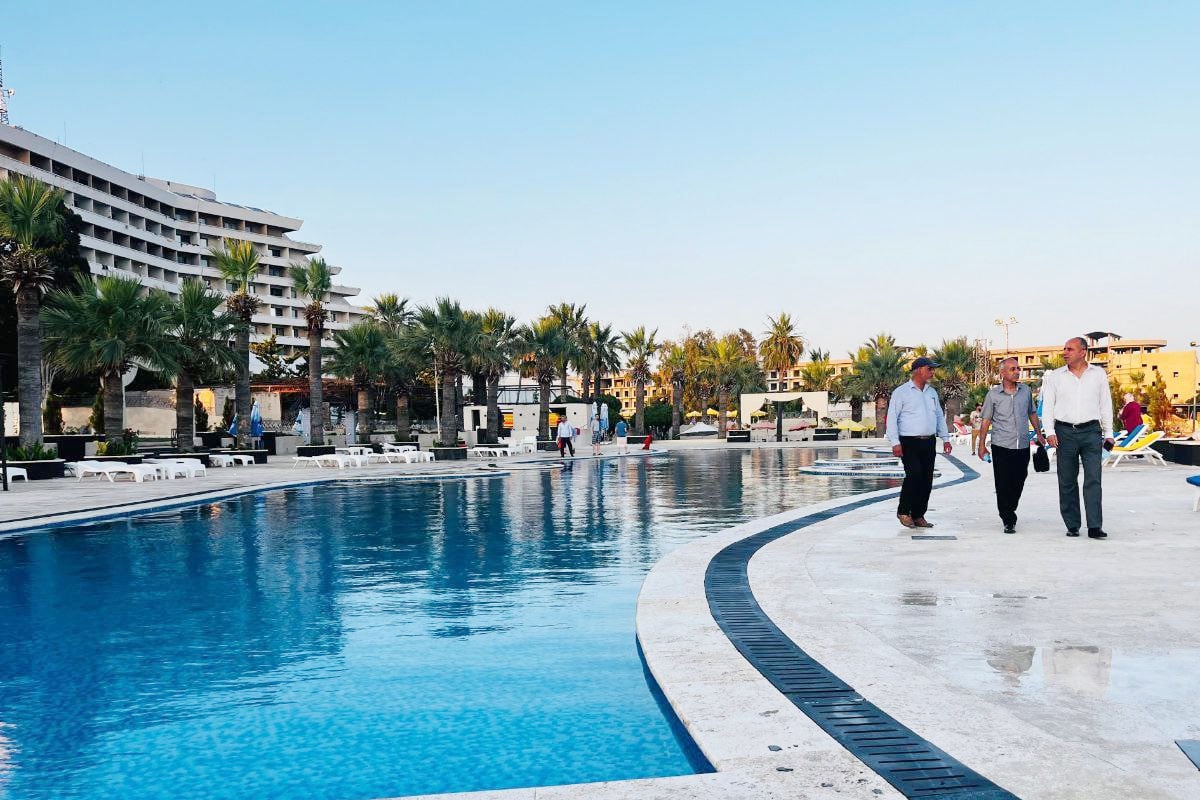
Because of this long time span and the number of entities associated with it, Noon Post went back to the project’s founding documents and its earliest promotional materials to understand how it was presented at launch and to trace the evolution of the corporate structure and the investors linked to it over the years.
The research showed that the project was marketed as one of the flagship investments of Wahoud Group, making an understanding of the group and its activities the starting point for understanding the project’s trajectory later on.
Wahoud Group
According to the company’s self-description, it is considered one of the leading developers and investors in some of the most important projects in Syria, particularly in the tourism and real estate sectors.
Founded in Syria in 1983, it has offices in the Lebanese capital, Beirut; the Jordanian capital, Amman; and the city of Bristol in the United Kingdom. It also recently opened an office in Dubai, United Arab Emirates.
It adds that its activities span a wide range of fields, most notably facilitating the entry of international companies into the Levant region. In Syria, it also enjoys an extensive and distinguished network of relationships across both the public and private sectors, enabling it to identify genuine investment opportunities and viable markets.
It also follows up on the implementation of major contracts for the companies it represents with a number of government entities, including the Syrian General Establishment of Railways, the Port of Tartous, the General Establishment of Electricity, the General Establishment of Telecommunications, the Syrian Petroleum Co., the Baniyas Refinery, the Ministry of Housing, and the Ministry of Tourism.
The Manhom platform states that she is a founding partner in the “Wahoud, Ghassan Al-Taweel and Partners Group” in Syria, where she owns 400 shares in the company, representing 40 percent, valued at 4 million Syrian pounds.
She is also a founding partner in “Green Line Engineering Co.” in Syria, where she owns 400 shares in the company, representing 40 percent, valued at 4 million Syrian pounds.
Meanwhile, a company registration certificate dated Jan. 26, 2025, issued by the Directorate of Internal Trade and Consumer Protection in Damascus province, shows that the company of Mohammad Wahoud, Hassan Al-Taher, and their female partner is registered in the commercial registry under No. 14592, dated March 28, 2006.
It is a limited partnership with capital of 30 million Syrian pounds and a term of five years beginning Jan. 1, 2022, renewable by written agreement among the partners. It consists of Mohammad Wahoud as a general partner of Syrian nationality, Hassan bin Adnan Al-Taher as a general partner of Palestinian nationality, and Nada bint Mahmoud Sayed Rassas as a limited partner of Syrian nationality (Wahoud’s wife).

The “Intrados” project
The “Intrados” project is among the most prominent projects featured on the official website of the “Wahoud Group.” Below are the details provided there regarding its scope, specifications, and implementation plans as they were announced at the time.
An agreement was signed between the Tartous City Council and a group of private investment companies to develop a tourism and commercial complex in the Syrian city of Tartous under the name “Intrados,” the ancient Phoenician name of the city.
The joint company established in Syria to carry out the project was named “Intrados” for Tourism Development. At the time, Porto, a subsidiary of Egypt’s Amer Group, was set to operate the bulk of the project under the name “Porto Tartous.”
According to what Wahoud Group published on its official website at the time, the project was planned to include hotels, tourism, commercial and residential facilities, a yacht marina, a shopping mall, tourist apartments, and entertainment facilities stretching along 1.5 kilometers of Tartous’ waterfront.
The articles of incorporation, obtained by Noon Post, show that the Intrados project was established in 2006 as a joint-stock company (joint sector) between the Tartous City Council and a number of Syrian and foreign investors, with the aim of building, operating and managing an integrated tourism complex that would include five-star and four-star hotels, an apartment hotel, shopping centers, administrative offices, a marina for yachts and boats, as well as entertainment and sports facilities, public gardens and an open-air theater, to be operated by an international hotel company.

Intrados articles of incorporation
According to the contract, the Tartous City Council contributed properties No. 8091 and 9347, in addition to the right to dispose of about 150,000 square meters of public maritime property, making its in-kind contribution 30 percent of the company’s capital, while the investors committed to financing the studies, construction and outfitting works, equivalent to 70 percent of the capital.
The contract set the company’s capital at 10.3 billion Syrian pounds, equivalent at the time to $200 million, divided into 20.6 million shares, with each share valued at 500 Syrian pounds.
The contract also specified the shareholder structure at the time of incorporation: the Tartous City Council held 30 percent of the shares; the British company Junada International Limited held 25 percent; the British company Kerwoud Investment Company Limited held 25 percent; Wahoud Group (UK) Limited held 10 percent; and businessman Mohammad Ali Wahoud held 10 percent of the shares.
The contract also highlights the mechanism for transferring ownership of the land on which the project was to be built. It stipulated that the Tartous City Council would transfer ownership of the properties to the company after permanent structures had been completed at a cost equal to 30 percent of the value of the investors’ contribution, while maintaining a compulsory security notation in favor of the Ministry of Tourism until the project was put into operation.
This mechanism takes on particular importance when compared with subsequent government documents, which showed that the issue of transferring ownership of the land returned to the forefront of discussion after the project stalled, as part of proposed measures to address its legal status.
The Ministry of Internal Trade and Consumer Protection issued Decision No. 785 approving the company’s bylaws, according to the “Who’s Who” platform.
The company’s bylaws were later amended in accordance with the Companies Law issued under Legislative Decree No. 29 of 2011. The word “Private” was added to the company’s name, and the share value was changed from 500 Syrian pounds to 100 pounds.
The capital was also reduced from 10.3 billion Syrian pounds to 103 million pounds, and the amendment included an increase in the number of shareholders through the addition of two founding companies and four individuals.
The entry of Egypt’s Amer Group
In October 2008, Wahoud Group, the project’s developer, announced that it had awarded the resort’s management contract to Egypt’s Porto Marina, a subsidiary of Amer Group, which was to operate the largest part of the project.
In the following years, the project began to be marketed under the name “Porto Tartous,” in line with what appeared on Wahoud Group’s official website, which stated that the largest part of the project would be managed under that name by Porto, Amer Group’s subsidiary — indicating that the project had shifted from the name “Intrados” to the “Porto Tartous” brand, without any mention of a change in the company developing or owning the project.
News reports published during 2009 show that the Intrados project had moved into the implementation phase of its hotel components. In February of that year, Emirates 24/7 reported that UAE-based Greenline Interiors had signed a contract worth 700 million Emirati dirhams with Wahoud Group to design and carry out interior decoration and finishing works for three luxury hotels within the resort under development in the city of Tartous.
The report said the project was being developed by Intrados, with the participation of British investors, and that it extended over an area of about 1.5 kilometers of land reclaimed from the sea. The Emirati company later announced the opening of an office in Syria to follow up on implementation of the contract, indicating that the project had moved from the planning and construction stage to the outfitting of its hotel facilities.
In December 2010, Wahoud Group, the project’s developer, announced that the Porto Village Hotel, located within the Porto Tartous project, would open its doors in early 2011.
Less than a month later, Reuters reported that Amer Group, the project’s operator, had begun offering residential and tourism units for sale, indicating that its role was not limited to managing and operating the project, but also extended to marketing its units within the Porto Tartous project.

But the partnership between Intrados and Amer Group did not last. After about six years from the start of the cooperation, a dispute between the two parties in 2014, against the backdrop of financial and technical disputes related to the implementation of the “Porto Tartus” project, prompting “Intrados” to seek termination of the contract and demand $176 million in compensation.
The dispute was then referred to the Cairo Regional Centre for International Commercial Arbitration, which issued a ruling in favor of “Amer Group,” before Egyptian courts later upheld its right to receive $51.68 million in compensation and ordered “Intrados” to pay it.
Despite the legal dispute that continued between “Intrados” and “Amer Group,” the project returned to the spotlight in 2019, when the minister of tourism in the Syrian regime government at the time, Mohammad Rami Martini, announced the resolution of delays affecting four major tourism projects, including the “Intrados” project and “Al-Fadel Suburb.” He said the ministry had reached technical and legal formulas, while putting in place a mechanism to follow up on the implementation of stalled projects in a way that would ensure their completion, diversify the tourism product, and increase state revenues.
Minutes of a meeting held at the Prime Ministry on Jan. 25, 2018, and devoted to discussing stalled tourism projects in Tartus province, showed that the “Intrados” project remained, nearly 10 years after its launch, on the list of projects that had not been completed, alongside “Al-Fadel Suburb,” the “Asas” Hotel, and the “Arwad” Hotel.
In the presence of representatives from the Ministry of Tourism, Tartus province, and the investors, the reasons for the delays and the proposed measures to address them were discussed, before a decision was taken to transfer ownership of the remaining project land to the Tartus City Council, pursuant to Article 33 of Law No. 65, with the investor bearing the resulting legal consequences — a step approved during the meeting by Mohammad Ali Wahoud, chairman of the board of “Intrados.”
These minutes show that Wahoud remained, up to that point, the company’s official representative in negotiations with government bodies. They also indicate that the state was rearranging the project’s legal status after years of delays, while, in the case of other stalled projects such as “Al-Fadel Suburb,” it opted to prepare new contract addendums and restore financial balance and the project timeline instead of terminating those investments.
In the same context, local reports published in 2019 show that the committee tasked with addressing stalled projects proposed submitting a recommendation to the government to transfer ownership to the Tartus City Council, on the condition that it would later be transferred back to the company “in accordance with due process.”
However, the documents reviewed by Noon Post do not clarify whether this proposal was actually implemented, nor the legal mechanism adopted if it was, especially since the project is built on public maritime property subject to the provisions of Law No. 65 of 2001.
This phase takes on particular importance because it came immediately before the project’s ownership structure was reorganized. In 2020, Sawari Tourism Investments was established as a limited liability company with capital of 5 million Syrian pounds, equally owned by Ali Najib Ibrahim and Ramez Ali Zioud. According to its bylaws and data from the Manhom platform, its activities focus on tourism and hotel investment and operations.
During the same period, disclosures published on the Kuwait Stock Exchange revealed that Markaz Trade Real Estate Co. had received an offer from Intrados to purchase its 10 percent stake in the project for $21 million, signaling moves to reorganize the shareholder structure after years of setbacks and disputes.
Minutes of the General Assembly Meeting
The latest document reviewed by Noon Post the minutes of the ordinary general assembly meeting of Intrados Tourism Development, held on Sept. 22, 2024 shows that the restructuring was reflected in the shareholder composition.
Alongside the Tartous City Council retaining its 30 percent stake, Junada International Limited, Kerwoud Investment Company Limited and Wahoud Group (UK) Limited, in addition to Mohammad Ali Wahoud, remained on the list of shareholders, while Sawari Tourism Investments appeared as a new shareholder holding 10.95 percent of the company’s shares.

Minutes of the Assembly 22-9-2024
Why did Sawari enter a troubled project?
Sawari Tourism Investments was established on June 8, 2020, as a limited liability company with capital of 5 million Syrian pounds. According to the Manhom platform, its activities focus on investing in, owning and operating tourism and hotel facilities, as well as managing tourism complexes. The Ministry of Internal Trade approved its bylaws under Decision No. 1355.
Sawari’s entry came at a time when the Intrados project was undergoing a reordering process after years of setbacks and legal disputes, opening up several possibilities. Among them are that Sawari may have entered to buy the stake of a withdrawing shareholder, as part of a company restructuring and the attraction of a new investor to help sustain the project, or within the framework of transferring influence to figures close to the presidential palace.
However, the documents reviewed by Noon Post do not settle any of these possibilities, as it was not possible to obtain documents clarifying how the shares were transferred to Sawari or the reasons for its entry into the shareholder structure.
But news reports attributeThe beneficial ownership of “Sawari” belongs to businessman Ahmad Khalil and links the company to what was known as the “sunset arm” in the tourism sector, a network of companies overseen by Yassar Ibrahim and Ahmad Khalil, lending weight to the hypothesis that figures close to the Syrian regime were involved in the company.
By contrast, a review of the UK commercial register (Companies House) reveals another discrepancy: the three British companies listed among the shareholders of “Intrados” in the minutes of a 2024 general meeting are shown as “dissolved.”
The records also show Mohammad Ali Wahoud’s connection to these companies, as he held managerial positions in them, while his wife, Nada Sayed Rassas, was a director of Kerwoud Investment Company Limited.
The continued listing of these companies as shareholders in Syrian documents, despite their dissolution in Britain, raises questions about whether ownership of the shares was transferred to other parties without that being reflected in the documents reviewed by Noon Post, or whether there is another legal or procedural explanation that could not be verified.
Open-source research findings confirm that the project’s investment identity was not stable. The official website of “Intrados,” previously listed on the “Wahoud Group” website, is no longer functioning, while Noon Post found two different websites for the “Junada” resort presenting two different accounts of the entity operating the project.
The first website describes the resort as part of the “Intrados” project, which the page says is the largest tourism project on the Syrian coast and one of the flagship investments of the “Wahoud Group.” It stretches 1.5 kilometers along the Tartous Corniche and includes residential, commercial, and tourism components within an integrated urban plan.
By contrast, the other website that the resort belongs to the All Seasons Group, without mentioning the “Intrados” project or the “Wahoud Group” the same company with which the Syrian Ministry of Tourism announced it had signed a contract in June 2025 to invest in the resort, according to the Syrian Arab News Agency (SANA).
At the time, the ministry said the new company would take over management of the resort and develop its services, while the company’s general manager, Rami Alrahmoun, said work at the resort was continuing and that the new management had begun making changes in preparation for its reopening.
But the company’s identity raises questions. While some media reports describe it as a Turkish company and others as a Syrian one, Noon Post did not find any company registered under the name All Seasons in the Turkish commercial registry. Meanwhile, Rami Alrahmoun’s official website lists All Seasons Hotel GmbH, registered in Austria, and describes it as a company specializing in the purchase, development and resale of real estate, with property assets in the cities of Vienna and Kaprun.
Rami Alrahmoun, a Syrian businessman who has lived in Europe for more than 20 years, is active in real estate development and the management of tourism properties. He owns and manages a chain of companies and properties in Austria, in addition to other companies in Hungary. His business focuses on purchasing properties, developing them and reinvesting in them, particularly in the hotel and tourism sector.
Khan Suleiman Pasha
The “Intrados” project was not the only one surrounded by questions and conflicting documents. Documents obtained by Noon Post show that the Khan Suleiman Pasha project also underwent changes in its investment contracts and the identity of its partners, opening the door to tracing its trajectory from the signing of the contract to the subsequent amendments.
The official website of the “Wahoud Group” presented the Khan Suleiman Pasha project as one of its hotel projects in Damascus. It involves rehabilitating the historic khan in the Old City and investing in it under a build-operate-transfer (BOT) system for 25 years, preceded by two years of restoration work. Once completed, it is to include 30 rooms and suites dedicated to luxury tourism.
This information matches a copy of the investment contract obtained by Noon Post, issued by the Damascus Governorate on March 22, 2007, which stipulates that the investment contract was concluded between the Damascus Governorate on one side, and the “Wahoud Group,” represented by Mohammad Ali Wahoud, and the Saudi company “Nesco,” represented by engineer Ali Hassan Saleh Al-Hamadi, on the other, jointly and severally.
The contract set the minimum value of study, implementation, construction and outfitting works at 160 million Syrian pounds. It also stipulated that the Damascus Governorate would receive an annual investment fee equivalent to 19% of total operating revenues, or the minimum amount stated in the economic feasibility study, whichever is greater, with the investment period set at 25 years beginning after the completion of restoration and outfitting works within a maximum period of 730 days.
The addendum changes the contract terms
However, an exact copy of the first addendum to the contract, dated May 24, 2022, shows that the agreement underwent substantial amendments nearly 15 years after it was signed.
While the original contract was concluded between the Damascus Governorate on one side and the Wahoud Group and Saudi company NESCO on the other, the addendum was limited to the Wahoud Group, represented by Mohammad Wahoud, with no mention of NESCO or the legal basis for its exit from the contractual relationship.
The addendum also extended the investment term from 25 years to 30 years and raised the annual investment fee due to the Damascus Governorate from 19 percent to 20 percent of total revenues, while setting a minimum annual payment of 275 million Syrian pounds, to increase by 5 percent every three years.

The khan contract addendum bearing the Tourism Ministry stamp
Noon Post did not find any document explaining why NESCO exited the contract, or whether that occurred through an assignment of rights, a transfer of shares, or a new agreement between the parties, even though it was an original party to the investment contract signed in 2007.
The absence of NESCO’s name from the addendum is particularly significant because a review of open sources shows that it was not a minor partner in the project. Rather, it was part of a broader investment consortium that entered the Syrian market during that period, with the group’s Egyptian branch, Egypt for Tourism Investment, serving as the entity involved in implementing projects inside Syria.
According to a report issued by Byblos Bank on April 26, 2007, the Wahoud Group was developing the Kempinski Damascus project in partnership with Saudi group NESCO, as part of the wave of Gulf investment in Syria’s tourism sector at the time.
A report prepared by Jihad Yazigi for The Syria Report and republished by newspaper L’Orient-Le Jour also noted that the Syrian Ministry of Tourism selected the joint bid submitted by Saudi group NESCO and the Kempinski hotel chain to develop and manage three hotel projects in Damascus, following the 2006 and 2007 Tourism Investment Market forums, before management contracts were signed between the parties.
The report said that the Wahoud Group was a partner to both NESCO and Kempinski in the first two projects Khan Suleiman Pasha and Kempinski Damascus while the investment value of the Khan Suleiman Pasha project was estimated at about $3.5 million, compared with about $22 million for the Kempinski Damascus project.
However, the course of this partnership was not without disputes, according to ReportIn a report published by Hotelier Middle East in 2010, Kempinski Group announced that the management agreement for a number of hotels, including its projects in Damascus, had ended “amicably” with the owners, who decided to pursue a different investment path.
By contrast, Nesco denied that any contracts had been terminated, stressing that all agreements “remain in force” and describing Kempinski’s statements as “premature and far from the truth.”
This divergence in the two sides’ positions shows that the status of the contractual relationship between the partners was not agreed upon even at that time, while Noon Post did not find any document clarifying whether Nesco later withdrew from the project, transferred its rights to another party, or exited under a contractual settlement.
In the absence of such documents, the company’s disappearance from the annex signed in 2022 remains a shift that the available records do not explain, despite its presence as an original partner in the investment contract signed in 2007.
Last January, the Ministry of Tourism announced the opening of Khan Suleiman Pasha after restoration work was completed, confirming that the building is owned by Damascus Governorate and that its development was carried out in partnership with Wahoud Group.
The “Concorde Tartous” project
Returning from Damascus to Tartous, another investment document obtained by Noon Post reveals details of the Al-Fadel Suburb project, which in subsequent years also appeared under the name “Concorde Tartous,” making it possible to trace its trajectory from the signing of the contract to its eventual stumbling.
Investment contract No. 84 for the “Al-Fadel Suburb” site, signed July 23, 2007, and obtained by Noon Post, shows that Tartous Governorate entered into an investment contract with Wahoud Group and Concorde Wahoud Company, represented by Mohammad Ali Wahoud, to carry out a tourism project on the city’s southern waterfront under a build-operate-transfer (BOT) system.

Al-Fadel Suburb investment contract
The document sets the investment value at about $172 million, with implementation work to be completed within a period not exceeding 42 months, in return for Tartous Governorate receiving an annual investment fee equivalent to 10 percent of total operating revenues, with a minimum of 66.5 million Syrian pounds per year.
These details closely match the project presented by Wahoud Group on its official website under the name Concorde Tartous Resort, which it said was being carried out in partnership with the UAE-based Concorde Dubai company and included the construction of a five-star hotel with 250 rooms, along with 1,000 tourist apartments and leisure facilities, at an estimated cost of $175 million, over an area of about 225,000 square meters, to be invested for 45 years.
Tala Engineering Consultancy and Project Management also presents“The project appears in its portfolio under the name Concord Resort and Hotel – Tartous, which states that its owner is Tartous Governorate, while Wahoud Group is responsible for its development.
Economic reports published during the same period also indicate that the project was also known as Al Fadel Resort, as some sources used the two names interchangeably to refer to the same project, consistent with the information contained in the contract and Wahoud Group’s documents.
A report published by Al Iktissadi in 2012 confirms this overlap, noting that the Al Fadel Resort “Concord” project began implementation in 2008, with a contract value of about $176 million and a contractual execution period of 45 months.
However, Tartous City Council said at the time that it had sent several letters to the investing company requesting that it complete the deficiencies in the executive plans for the eastern section of the project and submit the plans for the western section, but received no response. That prompted it to contact the Directorate of Tourism to form a joint committee to examine the reasons for the delay and take the necessary legal measures regarding the contract.
These details show that the project did not remain confined to the announcement and marketing stage, but had in fact entered the implementation phase before running into difficulties that prompted official bodies to begin legal proceedings against the investor a trajectory similar to that seen in other investment projects carried out by Wahoud Group during the same period.
Taken together, the original contracts and their addendums, official documents and commercial records, and open sources show that a number of the most prominent projects linked to Mohammad Wahoud underwent repeated changes over the years in project names, partner companies, and ownership and management structures, without the available documents always clarifying the legal basis or the full chronology of these transformations.
Although the exclusive documents do not settle all the circulating accounts surrounding these projects, they reveal gaps that warrant verification, whether related to changes in the parties to some contracts, corporate restructuring, the continued appearance in some records of entities that no longer exist, or the transfer of project management between different parties over the years.
At a time when the Commission for Combating Illicit Gain continues its investigations into Mohammad Wahoud’s wealth and a number of his investments, the answer to many of these questions remains contingent on what the official investigations may reveal, while these documents record one aspect of the trajectory of projects that for years formed part of Syria’s most prominent tourism investments.