

هذا التقرير متاح أيضًا بـ العربية
After a long absence, figures from the era of late President Hosni Mubarak have returned to the spotlight through a number of media and news platforms and channels, after years of staying away from or being kept away from the public scene.
What is striking is that this return did not come in the form of a fleeting individual appearance by any one of them, which might have been accepted within its narrow context. Rather, it appeared closer to a systematic course, through successive and simultaneous appearances by a number of ministers, journalists and figures associated with the former era, and through content that was nearly identical.
Some of them were also presented as heroes who bore responsibility under difficult circumstances, and at times as victims of the January revolution, after having previously faced corruption accusations and been described by the Egyptian street as the “remnants of the regime.”
This striking return, carried out in a way that many Egyptians found provocative especially since it included names whose presence in the public memory is tied to a state of tension and popular anger has opened the door wide to speculation about the motives behind this recall and its timing. What lies behind the recycling of Mubarak-era figures in the media scene? And are they being used to serve specific political goals or particular interests of the ruling authority?
A systematic return
A close look at the Egyptian media scene shows that this was not random or merely coincidental. A number of symbols of the Mubarak regime suddenly became regular guests on multiple media platforms and channels. What is notable here is that these figures appeared with prominent media personalities who enjoy broad popular reach and credibility among segments of the audience, giving those interviews exceptional momentum and expanding their impact and circulation.
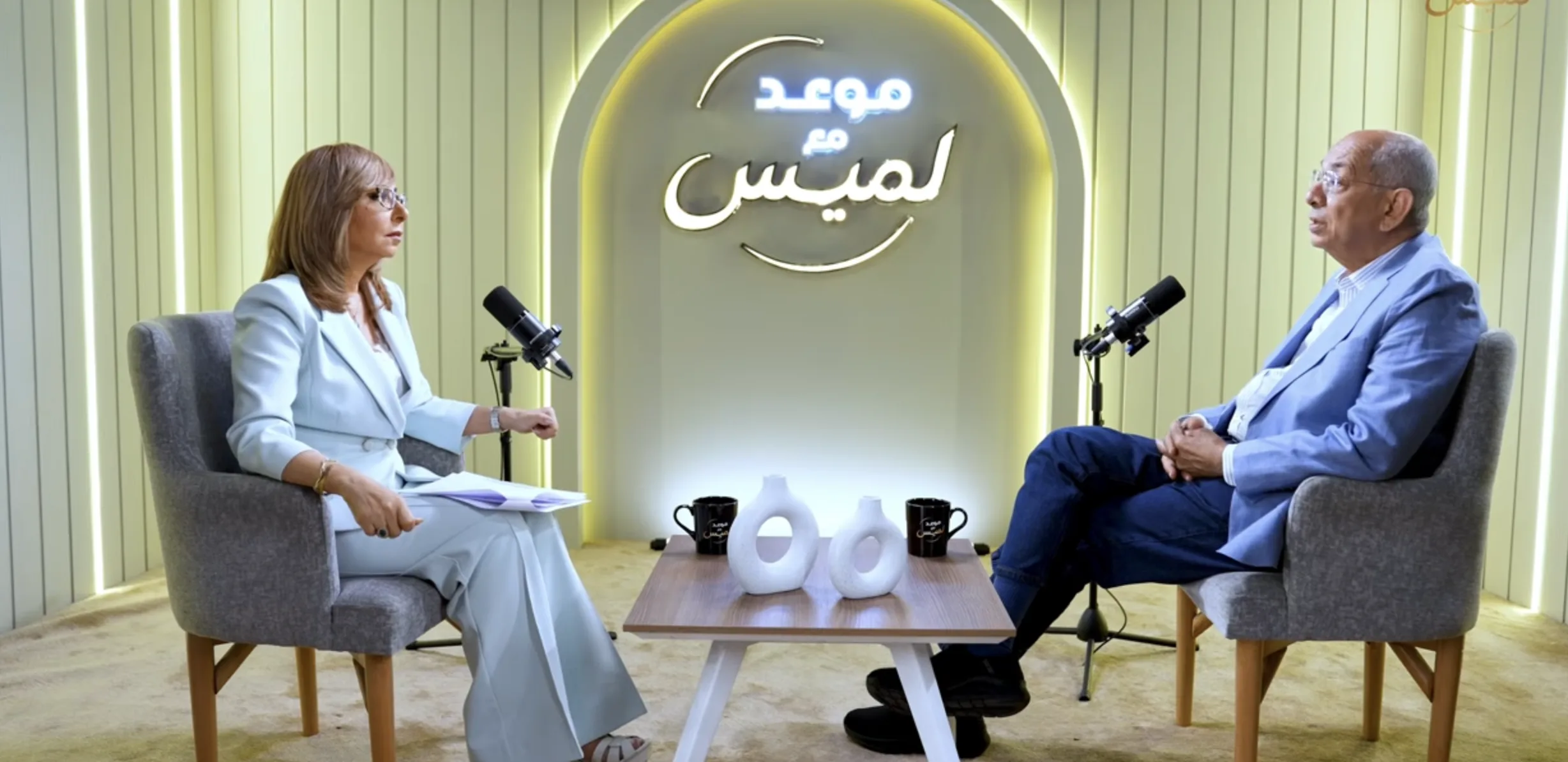
The latest of these appearances was that of former Finance Minister Youssef Boutros-Ghali, who returned to Egypt in February 2025 after spending nearly 14 years outside the country, in an extended interview with TV host Lamis Elhadidy.
Among his most notable remarks was his praise for what he described as the “major leap” in roads, bridges and new cities projects, and his talk of there being a “clear vision and boldness” in current economic decision-making. He also voiced support for some of the financial policies adopted by the current authorities, foremost among them the shift from in-kind subsidies to cash support.
Boutros-Ghali also touched on some economic decisions during the Mubarak era, saying that the former president had rejected proposals to raise diesel and energy prices, holding that refusal partly responsible for worsening the economic imbalances of that period. This sparked debate within the old regime camp itself, especially after Alaa Mubarak, the former president’s son, commented on his account on the platform X, describing what was said as “strange words at an even stranger time.”
At roughly the same time, former Health Minister Hatem El-Gabaly appeared as a guest of media host Magdy El-Gallad, where he discussed the rise of the Policies Committee within the dissolved National Democratic Party, the issue of hereditary succession, and the behind-the-scenes developments in the days preceding the January revolution.
He noted that Gamal Mubarak was behind the proposal of Ahmed Nazif’s name to head the government, and also spoke about state agencies detecting, five days before the revolution broke out, what he described as movements linked to Hamas, while presenting his view of an “American plan to spread chaos.”
Before the appearances of Boutros-Ghali and El-Gabaly, former Culture Minister Farouk Hosny had taken part in a number of television interviews and cultural discussions, speaking about his relationship with Hosni Mubarak, his wife Suzanne Mubarak, and his son Gamal, as well as the circumstances surrounding the regime’s fall. He considered one of the biggest mistakes of the Mubarak regime to be the length of time it remained in power, noting that he had imagined the former president would step down before the revolution broke out and open the way for a different political transition.
Alongside these names, other media platforms hosted officials and figures associated with the Mubarak era, including Mostafa El-Feki, the former presidential information secretary, who reopened a number of governance files in lengthy interviews. There was also columnist Osama Saraya, the former editor-in-chief of Al-Ahram and one of the journalists close to the presidency during the Mubarak era, who appeared in several interviews in which he revisited the details of his relationship with Presidents Anwar Sadat and Hosni Mubarak and offered his account of how decision-making was shaped within the state during that period.
So too did former Irrigation Minister Mohamed Nasr Allam, who adopted the current regime’s narrative by blaming the January revolution for worsening the Grand Ethiopian Renaissance Dam crisis. He said Addis Ababa had benefited from the turmoil Egypt witnessed during the revolution to push the project through, while stressing that he had expected the revolution because of the worsening domestic conditions at the time.
Demonizing January: Playing the same tune
Although figures from the Mubarak regime were a central part of the scene that contributed to the outbreak of the January revolution, and among the reasons for the rise in popular anger against the former regime, they tried in their recent media appearances to recast the memory of the revolution and present it from a different perspective one that aligns, to varying degrees, with the narrative embraced by the current authorities, which is based on casting doubt on the revolution, distorting its image and stripping it of its political and historical symbolism.
Most of these figures agreed on presenting an alternative account of why the revolution broke out. It is not portrayed as a popular uprising against a regime accused of corruption, authoritarianism, and political and economic failure, but rather as a foreign-backed plot aimed at spreading chaos and destabilizing the state. According to this narrative, the mistakes made during the Mubarak era did not warrant a revolution of such magnitude.
In their view, the problem did not lie in the structure of the regime as a whole, but in a limited number of mistakes that could have been addressed through dialogue and gradual reform.
A number of officials who faced corruption accusations after the revolution also sought to clear their names and refurbish their image before public opinion, in an attempt to move them in the Egyptian imagination from the position of “remnants of the regime” to that of successful technocrats and reformers with visions and ideas. This path appears aimed at dismantling the comprehensive negative image of the Mubarak regime that formed one of the main pillars of the revolutionary discourse in January.
Likewise, the insinuation that the United States played a role in the outbreak of the revolution, the talk of foreign plots to stir chaos, and the linking of the events of January to threats to Egypt’s water security through the Grand Ethiopian Renaissance Dam crisis all intersect with the current official narrative, which views the revolution as a political and security nightmare that still casts its shadow over the broader scene — a specter that has not disappeared from the calculations of the authorities despite more than 15 years having passed since it began.
Dismantling what remains of the Mubarak era
Despite the regime’s near-total authoritarian dominance over the public sphere, Sisi’s government still looks with suspicion and concern at the legacy of the Mubarak era, especially with every economic crisis that hits the country. Nostalgia for that period is renewed among segments of Egyptians, some of whom see it as more favorable to the poor and low-income groups compared with current conditions.
The popularity still enjoyed by Mubarak’s two sons especially Gamal Mubarak in some popular circles, which is clearly visible during his participation in a number of public occasions, may also represent a source of concern for the regime, especially with the recurring calls, from time to time, for his return to political life or his candidacy in a future presidential election.
This nostalgia for Mubarak and his era, along with Gamal Mubarak’s growing popularity, appears to have become a chronic headache for the current authorities. From this perspective, the recent media appearances of figures from the former regime can be read as an attempt to dismantle what might be called the “Mubarak bloc,” whose presence has grown in recent years.
What is striking is that the statements of these figures, despite the different paths they took and the varying content they offered, ultimately converge within one framework: acknowledging that Mubarak committed fateful mistakes, even if they did not rise to the level of justifying a revolution against him, and suggesting that Gamal Mubarak who was not suitable to succeed his father at the time does not represent a viable alternative for power today.
The roles these figures played within that discourse varied: some criticized the policies of the Mubarak regime, some presented themselves as reformers who opposed hereditary succession, while others claimed they had warned the former president of the consequences of certain decisions or tried to distance themselves from their closeness to the circles of decision-making.
This discourse sends implicit messages to the Egyptian street that the Mubarak regime was not an ideal model of governance, and that nostalgia for it is based, to a large extent, on an emotional and selective memory that does not rest on a comprehensive reading of the facts of that period. It also suggests that what is known as the “Mubarak bloc” is no longer a cohesive bloc, and that talk explicitly or implicitly of the return of that regime or its figures to the political scene remains unlikely.
From here, this media space can be seen as an attempt to contain nostalgia for the Mubarak era and give it a limited outlet to express itself through some of its symbols, but under the watch of the authorities and within a controlled framework that ensures this nostalgia does not turn from an emotional state into a political project capable of imposing itself once again in the public sphere.
A comparison that serves the current regime
The clearest meaning that can be drawn from these interviews with figures from the Mubarak regime is the making of an indirect but calculated and controlled comparison between the former regime and the current one. The Mubarak era was presented as a period that was not the best, and the former president as someone who did not possess sufficient decisiveness and boldness to take difficult economic decisions, such as raising prices and restructuring the subsidy system, unlike the decisions taken by the Sisi regime.
A number of figures from the former regime also directed criticism at Mubarak, accusing him of rigidity, hesitation and clinging to traditional methods of running the state, while expressing admiration for the current regime’s ability to strengthen the military establishment, develop infrastructure and tighten control over state institutions at a time when the region is passing through extremely dangerous upheavals and transformations.
Although this discourse did not include a direct or sharp attack on the Mubarak regime, it carried implicit accusations of weakness, an inability to anticipate risks, and allowing events to develop without decisive intervention, in addition to permitting political projects with far-reaching effects to pass through foremost among them the hereditary succession project. These are signals suggesting that the former regime lacked a clear vision and the ability to manage crises before they exploded.
There is no doubt that such a narrative serves the current regime, presenting it as one marked by decisiveness, the ability to rebuild the state, and the willingness to take difficult decisions regardless of public mood or their social cost. The mere fact that these figures have been allowed to appear and speak, after years away from the scene, also works to the authorities’ advantage as they seek to present themselves as more open and capable of accommodating voices that belong to earlier political periods.
In the same context, recalling figures from the Mubarak regime to speak about their experience, despite the possibility that this may renew nostalgia for that period, can be read as a display of strength by the current regime, which wants to underscore that it neither fears nor is embarrassed by these appearances especially after succeeding in controlling their course and presenting them in a way that serves its political narrative and objectives.
Ultimately, this recall cannot be interpreted as a retreat from the policy of constricting public space, or as a genuine opening of the door to different political currents. If the goal were truly to broaden the margin for expression, then inviting figures from other opposition currents Islamists, leftists, liberals and others would have been more meaningful and more consistent with such a direction.
Accordingly, the goal appears to go far beyond what is being promoted in the media. The authorities are seeking to reshape the memory of the Mubarak era in a way that reinforces their legitimacy and presents them as a strong and decisive state, while also containing nostalgia for that period and confining it to an emotional and sentimental realm, preventing it from turning into a political project and extinguishing any potential hopes for the return of that regime or its symbols to the scene once again. It is more a burning away of what remains of that regime than a beautification of its image.