







Until the early 18th century, the Bedouin of the Negev moved in search of water and pasture. They continued to move across the region into the mid-19th century, when the Ottoman state made sustained efforts to settle them in permanent locations.
Before the Nakba of 1948, the Negev’s Arab population was estimated at between 55,000 and 70,000. More than 70 per cent were displaced. According to Ben-David, a researcher at the Hebrew University, only about 12,000 remained.
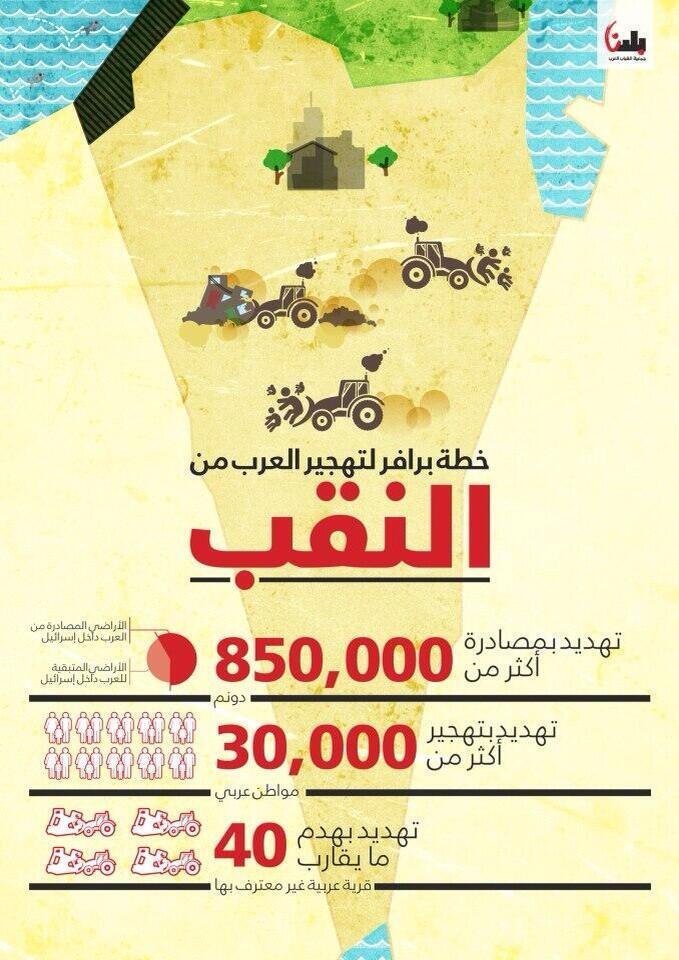
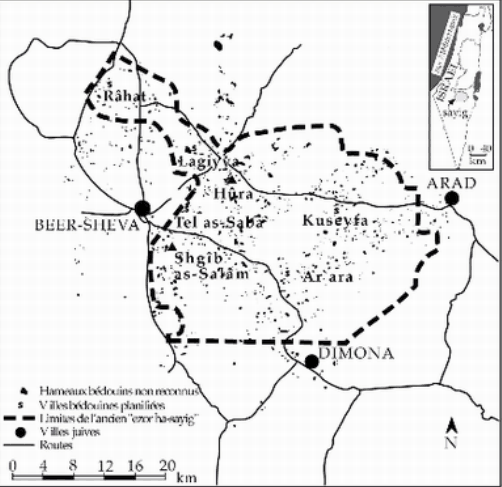
Before 1948, Arabs lived throughout the Negev. After Zionist militias took control of the area, many were displaced. Those who remained were forcibly moved to the Siyaj, an area between Arad, Dimona and Beersheba, shown below.
Under Israel’s 1953 Land Law, anyone absent from their land after 1952 would lose it. Bedouin families consequently lost land outside the Siyaj. Those moved into the area came to regard the land where they had been resettled as their private property.
In 1954, the Israeli state granted the Arabs of the Negev citizenship, as it did other Arabs inside Israel. They remained under military rule from 1951 to 1966. By the end of the 1950s, the state had taken control of more than 90 per cent of the Negev’s land.
During military rule, the Negev’s Arabs had no permanent village or city. Each of the 19 tribes lived either on land to which it had been moved or on land its members had occupied within the Siyaj before the Nakba.
After military rule ended in 1966, the state began planning permanent towns and villages for them. Many Negev Arabs also brought land ownership claims against the state before the Supreme Court. They continued their legal struggle despite initial rulings that, because they were classified as nomadic Bedouin, they could not own the land.
The state established seven recognised permanent communities: Tel as-Sabi in 1968; Rahat, a city, in 1972; Shaqib al-Salam in 1979; Kuseife in 1982; Ar’arat al-Naqab in 1983; Hura in 1989; and Lakiya in 1990.
Estimates put the Negev’s Arab population at approximately 220,000 by 2013. Slightly more than half lived in the recognised communities; the rest lived on their land in unrecognised villages. Families who refused to give up their land in exchange for a home in a recognised community remained in these villages, which number about 50.
Professor Arnon Soffer, a geography researcher at the University of Haifa, gives a much higher figure: more than 1,000 unrecognised communities, containing about 64,000 homes, with another 2,000 built each year.
The unrecognised villages lack basic infrastructure, including water, electricity and sewage systems, despite residents’ legal efforts to secure these services. Water and electricity lines serving other towns, including Jewish settlements and cities such as Arad and Dimona, pass near many of the villages.
The Israeli authorities repeatedly demolish homes in the unrecognised villages. Demolition orders against older houses are generally frozen, while orders against newly built houses are enforced soon after construction, even where residents claim ownership of the land.
In 2007, the Israeli government appointed a committee headed by Judge Eliezer Goldberg to address Bedouin Arab settlement in the Negev. It reported a year later. Among its principal recommendations were that Negev Arabs receive ownership of half the land they claimed and financial compensation for the other half; that as many unrecognised villages as possible be recognised; and that the government provide infrastructure for the 50,000 homes or other structures in those villages.
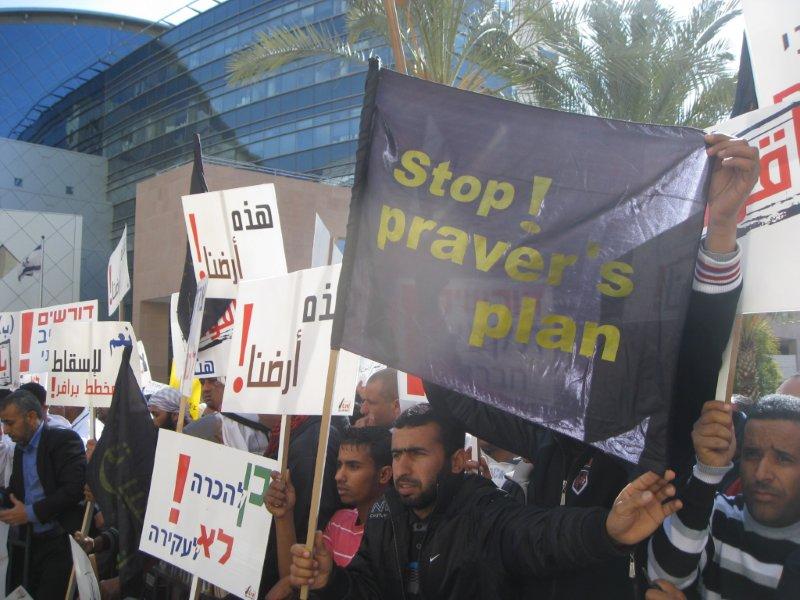
The government then established a programme to implement the committee’s recommendations, headed by Ehud Prawer and Benny Begin. Known in the media and internationally as the Prawer Plan, it proposed confiscating nearly 800,000 dunams in return for financial compensation and demolishing homes in areas it deemed unsuitable for planning. An estimated 40,000 people would be removed from their land and housed in the seven existing recognised communities or in a limited number of new villages. The approach follows the principle of “the largest number of residents on the smallest area of land.”
The Prawer programme was introduced as a bill in the Knesset and passed its first reading by 43 votes to 40. It was then referred to the Interior and Environment Committee for scrutiny, a process expected to take several months. After reviewing the bill clause by clause and hearing different views, the committee was expected to return it with recommendations or observations. It would then face second and third readings and fail if defeated at either stage.

Negev Arabs oppose the plan for several reasons:
- They argue that it would compound the injustice of their displacement during the Nakba by denying them the right to claim ownership of the land they lost.
- They point out that their communities lived in the Negev before the Nakba and the establishment of Israel, while Jewish immigrants have been given land and towns with well-developed infrastructure. They ask why the Bedouin should be denied land and rights inherited from their forebears.
- They cite individual farms owned by wealthy Jewish immigrants from Europe and elsewhere, some of them larger than unrecognised villages, as evidence of discrimination in the plan.
- If offered land elsewhere as compensation, they demand the right to build homes and farm on it. Under the Prawer Plan, they say, replacement land would be designated for agriculture alone, with no right to live on it.
- They regard the proposed removal of 40,000 people from their homes as a new Nakba.
No more than 5 per cent of Negev Arabs volunteer in the Israeli army. Most of those who do come from unrecognised villages, yet their communities still lack basic services.
To me, the Negev is the Nakba of our time. I may have escaped displacement as a child, but perhaps one day Yamen, a child from an unrecognised village, will wake to find his uncle’s house no longer beside his father’s, the dunes where he ran every afternoon gone, and the Negev he knew changed.