










هذا التقرير متاح أيضًا بـ العربية
For fishermen, the sea had always been an open horizon and, for residents of Yemen’s western coast, a source of livelihood. When forced to flee, residents were used to travelling overland towards Lahj, Aden, Abyan, Taiz and other parts of Yemen. But as the Houthi group advanced and took control of large stretches of the western coast last September, their options narrowed and the fighting spread. The sea became a route they had to take to survive.
The sea crossing was neither a search for adventure nor a conventional migration route. It was an escape from relentless shelling that spared nothing, after land routes themselves became dangerous for residents trying to leave combat zones.
Faced with two equally grim choices,staying amid the fighting or venturing across unfamiliar waters to the other shore, thousands chose to risk their lives in boats, only to discover that the sea might hold a fate even harsher than the land they had fled.
Seven hours at sea
As fighting on Yemen’s western coast intensified in recent months, thousands of families were forced to leave their areas. Some headed to other Yemeni governorates, while others chose to cross the sea to Djibouti despite the dangers of the journey.
According to the International Organization for Migration, the number of people displaced within Yemen between the beginning of September and 12 October 2026 reached about 217,303, representing 36,216 families.
Among them is Ali Mohammed, who fled with his family from the Yakhtul area on the Waheja coast, north of Mokha, after clashes and air strikes intensified there.
Ali told Noon Post that he had hesitated to leave by land for fear of being cut off or shelled, but decided to depart before leaving became even more difficult.
This time, Ali did not head elsewhere in Yemen. Instead, he chose Djibouti, where he had previously been displaced. His familiarity with the country helped him decide to return with his family.
The crossing from the Waheja coast took about seven hours. They left in the morning and arrived in Djibouti in the evening. Ali said the journey cost about 3,000 Saudi riyals for him and his family.
The crossing was dangerous. Winds and storms intensified while the boat was at sea, carrying women and children, including an infant no more than a month old. Ali describes the choice between the two routes this way: “The land route was fear and terror for all of us, but at sea we faced even greater dangers.”
Despite the ordeal, the sea offered him a way to survive. He says he wished there had been a land route to Djibouti, as he would have felt safer.
Fighting disrupts escape routes
Mokha district director Sultan Abdullah Mahmoud says the escalation and clashes affected several land routes linking Mokha to other areas and governorates, most notably the Mokha–Al-Kadha–Taiz road to the east and the roads leading to Tor al-Baha in Lahj governorate to the south.
He told Noon Post that Lahj and Aden were the main destinations for displaced people at the start of the escalation. Most headed towards Lahj before clashes along the fronts leading to Dhubab and Tor al-Baha, and the roads connected to them, disrupted their journeys.
According to Abdullah, some displaced people took the Mokha–Barah junction road to Al-Hawban, then headed for Marib, Sanaa or the city of Taiz. Others were forced to remain in Al-Hawban because clashes made it difficult to continue to Taiz.
Forced to flee by sea
Sultan Abu Zaid, media director for Mokha’s local authority, told Noon Post that families began fleeing to neighbouring governorates and areas, including Aden, Lahj, Abyan, Taiz and Al-Turbah, as the fighting escalated.
He says the largest wave of displacement took place on 9 and 10 September 2026. From Wednesday afternoon until sunset on Thursday, vehicles packed the road linking Mokha and Aden, forming two lanes of traffic heading in the same direction and bringing traffic to a standstill in Ras al-Arah, in Lahj governorate.
He says congestion at checkpoints in Ras al-Arah, together with continued shelling of the area, prevented families that had delayed leaving from continuing towards Aden. This prompted some to look for alternative routes, including a sea crossing to Djibouti.
Mokha district director Sultan Abdullah says the local authority has no accurate figures for the number of people who left by sea, as the boat crossings were organised individually. Most of those who took this route came from the Yakhtul area.
Data from the International Organization for Migration indicate that displacement by sea to Djibouti increased alongside the military escalation on the western coast.
On 6 October, the organisation announced that more than 3,700 refugees from Yemen had arrived in Djibouti over three weeks, following what it described as a dangerous journey across the Red Sea. It also noted that Djibouti was facing other humanitarian pressures linked to migration flows along the eastern route.
Suffering after survival
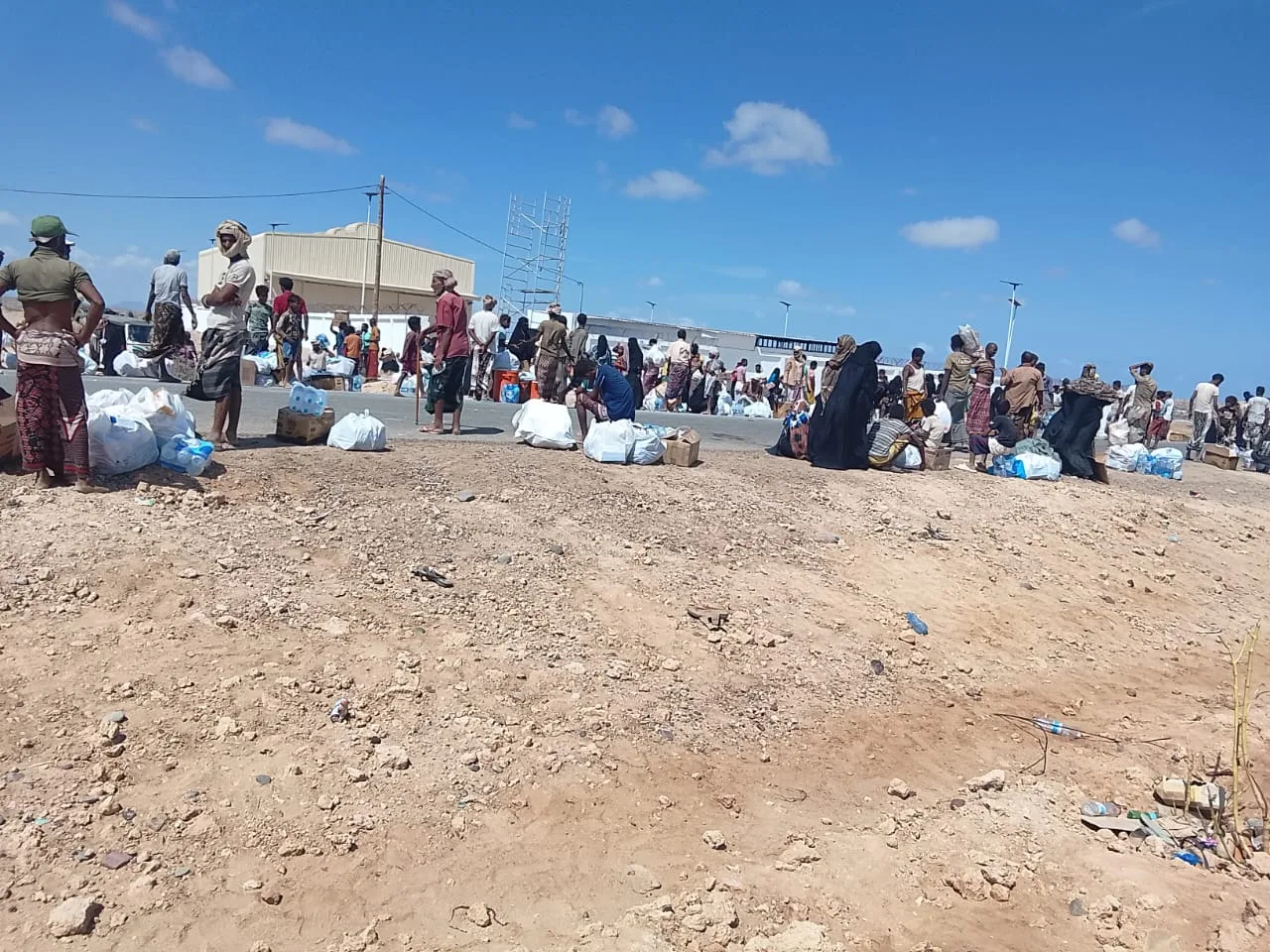
Ahmed, a displaced Yemeni in the coastal city of Obock in northern Djibouti, says he has recently met families arriving from several areas on the western coast, including Dhubab, Bab al-Mandab, Mokha and Yakhtul. Ahmed is a pseudonym.
He told Noon Post that air strikes and the difficulty of fleeing elsewhere in Yemen, because of road closures and unaffordable transport costs, had driven some families to seek refuge in Djibouti, with benefactors covering their transport expenses.
Ahmed describes difficult conditions for displaced people, with shortages of food, drinking water, medicine and materials for shelter, deteriorating health services and the spread of cases of diarrhoea and vomiting. He says nine displaced people died over about a month for reasons that remain unknown. Tents are overcrowded, he adds, and not all families receive aid, some of which is distributed around midday.
Ahmed accuses the Djiboutian authorities of preventing some displaced people from leaving the camp in Obock to travel to Aden. He says attempts to leave were met with beatings and detention, and that security forces dispersed a protest by displaced people.
Noon Post was unable to independently verify these allegations. It tried to contact the Yemeni ambassador to Djibouti and several relevant officials for comment but had received no response by the time this report was prepared.
Displacement from the western coast to Djibouti shows how civilians’ options for survival are shrinking. A destination that appears accessible when fighting begins may become impossible to reach within hours. A familiar road may become dangerous, leaving families’ decisions about departure dependent on developments on the ground.
This explains the range of displacement routes and the differences between local estimates of the number of displaced people and UN figures. Patterns of displacement change with the course of the fighting, the routes available and families’ ability to afford to leave.
Reaching Djibouti does not end their suffering. Families have survived shelling and the dangers of the road only to face harsh humanitarian conditions and an uncertain future, without knowing when they will be able to return home.
