



هذا التقرير متاح أيضًا بـ العربية
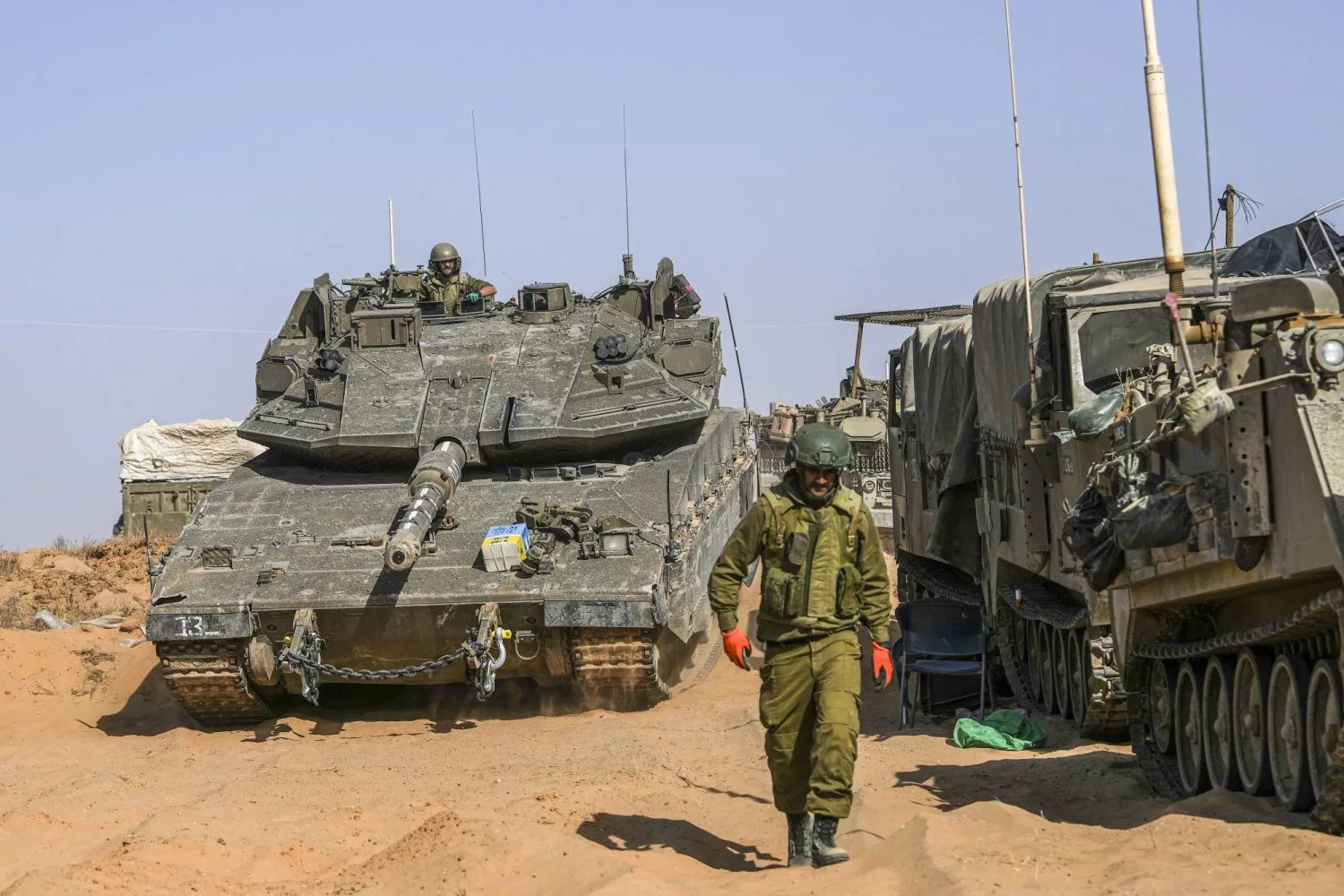
On 7 October, the first anniversary of “Al-Aqsa Flood,” Israeli Prime Minister Benjamin Netanyahu proposed renaming the ongoing genocidal war on the Gaza Strip. Speaking at a government memorial session, he suggested replacing “Iron Swords” with the “War of Resurrection” or the “War of Rebirth,” particularly after the war had expanded to the Lebanese front against Hezbollah in recent weeks.
Netanyahu argued that “Iron Swords” no longer served its purpose or reflected a war now bound up with the narrative of the Jewish state’s survival and existence. The name, he claimed, no longer captured the nature of the war.
His opponents — Israeli politicians, writers and media figures — argued that renaming the war on its first anniversary was nothing more than a desperate attempt to conceal his failure and evade responsibility for the causes of the 7 October 2023 attack and the war launched in response.
This is not the first time the Zionists have renamed a war or military operation carried out by their army, either while it was under way or after it ended. The first change to a military operation’s name came during the 1948 Nakba war, known in Zionist discourse as the “War of Independence,” during which the establishment of the state of “Israel” was declared.
An operation to open the road to the Negev during the ethnic cleansing of the Nakba was initially called “Eser Hamakot/Ten Plagues.” While it was under way, its commander in the Zionist militia forces, Yigal Allon, renamed it Operation “Yoav.” The name honoured Palmach education officer Yitzhak Dubno, nicknamed “Yoav,” who was killed defending Kibbutz Negba in southern Palestine during the operation.
War or military operation?
The Zionists distinguish between a war, or “milhama” in Hebrew, and a military operation, or “mivtsa.” What we have called the Gaza wars in recent years, before the war that began on 7 October, are regarded by Israelis as military operations and were given different names. By contrast, “Iron Swords” — the ongoing genocidal war in Gaza — was classified as a war.
The occupation army and the war cabinet always assign names to wars and military operations. Some operations conducted within a war also receive names of their own.
According to a study by Israeli researcher Daphne Gabrieli-Nuri of the Truman Institute for the Advancement of Peace at the Hebrew University, the Hebrew state has given some 81 names to the wars and military operations it has waged since its establishment in 1948.
Her study shows that, in recent decades, these names have been drawn from two main sources: nature and the environment in the land of “Israel,” accounting for 27 per cent; and the Tanakh (the Bible/Torah) and other religious texts, accounting for 38 per cent.
The remaining names, used for wars and military operations in the state’s early decades, came from military vocabulary, specifically references to their time and place. The June 1967 war, which we Arabs know as the “Naksa,” is known in Israel as the “Six-Day War.” The name refers to its duration: the occupation army defeated the Arab armies in six days. In Arab discourse, it was therefore considered a setback on a par with the Nakba of 1948.
The major wars fought by the occupation army are usually named retrospectively, whereas military operations receive their names as soon as they are announced. For example, the name of the 1948 War of Independence was settled after the Zionists’ ethnic cleansing operations that year had ended. Nor was “Atzmaut/Independence” its only name. At the time, it was also called “Milhemet Hashihrur/War of Liberation” and “Milhemet Hekomemiyut/War of Establishing Existence,” alongside “Milhemet Ha’atzmaut/War of Independence.”
Although David Ben-Gurion favoured “War of Existence” to emphasise the Israeli people’s rebirth in their national homeland, “Atzmaut/Independence” ultimately became the established name for the war during which the Hebrew state’s establishment was declared.
In a May 2023 article titled “From Peace for Galilee to Shield and Arrow: How are military operations named?” Israeli writer Shahar Ilan explains that some campaigns launched by the army begin as military operations with one name and acquire another when they become wars. One example is the Lebanon war, or “Milhemet Levanon” in Hebrew. It began as a military operation in 1982 and was named “Shlom Hagalil,” meaning Peace for Galilee, as soon as it was announced and launched. As the operation dragged on and became a prolonged war, during which the occupation army occupied Beirut and held southern Lebanon for many years, it became known in Zionist memory as the “Lebanon War.”
The same applies to the 1956 Tripartite Aggression against Egypt, in which “Israel” took part. At the outset, Israel called its participation “Kadesh,” meaning “holiness.” The aggression later became known in Israel as the “Sinai War,” after the occupation army occupied the Gaza Strip and Sinai for five months, from November 1956 to March 1957.
Normalising war through its name
Wars are initially named to identify and distinguish them. They are rarely numbered unless the numbering itself has become a distinguishing feature. Israelis thus distinguish their army’s successive wars and military operations against the Gaza Strip by name. These range from the assault of late 2008 and early 2009, which we know as the “Battle of Al-Furqan” and which Israel calls “Operation Cast Lead” (Mivtsa Oferet Yetzuka in Hebrew), through the 2014 battle of “Al-Asf al-Ma’kul,” known in Israel as Operation “Protective Edge,” to Operation “Shield and Arrow” against the Islamic Jihad movement in the Strip in 2023. Had these operations simply been numbered, Israelis would still be unable to distinguish them, Ilan writes.
The purpose of naming a war is therefore necessarily sociological. This is a general phenomenon, not confined to Zionist society and its wars. Even so, the relationship between Israeli society and the names of its army’s wars has undergone changes with clear sociological dimensions since the early 1990s, particularly in the shift towards names drawn from beyond military vocabulary.
A televised report broadcast four years ago on Israel’s Kan channel, titled “How are military operations’ names fixed?” shows that, since the early 1990s, the occupation army has begun drawing names for its operations from nature, literature, the Tanakh and sacred texts, moving beyond military terminology.
According to the report, occupation army officer Eran Duvdevani was the first to call for this shift in the early 1990s. Duvdevani gave the Hebrew name “Anvei Haza’am/Grapes of Wrath” to the lightning military operation the occupation army launched against southern Lebanon in April 1996, during its occupation there.
As Duvdevani recounts in the report, he proposed a literary name before the operation began, after being asked to suggest one drawn from nature and literature. He consulted his mother, who had taught Hebrew literature at a school for many years. She suggested “Grapes of Wrath.”
Ilan explains that giving military operations names drawn from nature, literature or sacred texts, rather than military vocabulary, serves to normalise the occupation army’s wars and operations within Israeli society. The idea is that a war’s name helps generate a shared national or religious feeling towards it, rallying society behind the war and securing its support.
In the same Kan report, occupation army officer Gal Hirsch says he coined the name “Homat Magen,” translated into Arabic as “Defensive Shield,” for the operation to storm Jenin refugee camp in 2002 during the Second Intifada. The operation followed a Palestinian fighter’s suicide bombing at the Park Hotel in Netanya in March 2002.
Hirsch says he chose “Defensive Shield” in response to the Park Hotel operation to reflect the Israeli national mood at the time. He took the name from a Hebrew poem, “Bein Gvulot/Between Borders,” written by Israeli poet Haim Hefer during the Palmach era.
Names are also assigned to internal, non-combat operations or measures connected to the army or entrusted to it, such as the 2005 disengagement from the Gaza Strip — the “unilateral withdrawal from the Strip.” The operation to evacuate and dismantle the settlements in the Strip was initially named “Zohar Harakia/Sky Glow.” A group of Jewish rabbis protested to the government, arguing that the name was associated with a prayer recited at funerals.
The operation was then renamed “Shivat Ahim,” meaning “bringing back the brothers” — Jews bringing their Jewish brothers back from the Strip into the country. With the new name, the government sought to give the evacuation a sense of national and religious closeness after it had provoked intense anger towards the government among religious Jewish groups.
How the name is chosen
When the occupation army and its war cabinet intend to announce a war or military operation, they choose its name through a bureaucratic process. Each military officer formally involved in consultations on the decision to go to war, and each politician on the war cabinet, submits a report setting out plans and proposals for a war or military operation. The report includes a proposed name intended to reflect its character and nature.
The proposed names circulate among war cabinet members until one is chosen by consensus. Alternatively, a name outside the list may be selected if everyone involved considers it appropriate to the military mission, whether an operation or a war.
