















هذا التقرير متاح أيضًا بـ العربية
During the assault on Gaza, weapons flowed in both directions between Serbia and Israel: Serbian factories exported ammunition and shells to the Israeli occupation army, while Belgrade received Israeli missiles, drones, electronic warfare systems, intelligence and communications equipment.
As these exchanges expanded, the relationship entered a new industrial phase in September 2026, when a facility assembling drones designed by Elbit Systems, one of Israel’s largest arms companies, opened near Belgrade. This brought Serbia into the Israeli weapons production chain, extending a relationship previously focused primarily on procurement and supply.
A growing arms partnership: The opening of a factory for Israeli drones in Serbia comes after record arms deals and intensive cargo flights between Belgrade and Tel Aviv. pic.twitter.com/prSa2i0MeZ
— NoonPost (@NoonPost) September 17, 2026
In less than two years, Serbia signed contracts with Elbit worth nearly $2 billion, while Serbian arms exports to Israel rose from a low level in 2023 to about €114 million in 2025.
Alongside these purchases and exports, the two countries signed an agreement to protect classified defence information, and Serbian factories joined the drone production chain. Aleksandar Vucic, who resigned as president in September 2026 after leading the country through most stages of this partnership’s development, announced plans for further factories and production for foreign armies.
This shift drew on a Serbian military industry that predates the state in its current form. Serbia inherited factories, engineers and export networks from Yugoslavia, then rebuilt its industry after wars, sanctions and Nato’s 1999 bombing campaign. But it continued to seek technology it lacked in sensors, electronics and network-centric warfare.
Elbit, meanwhile, entered Serbia as it expanded production capacity outside Israel amid rising global demand for weapons. These complementary needs produced a partnership that took Serbia from being a market for Israeli systems to becoming part of Elbit’s industrial network. Belgrade is seeking to move from manufacturing ammunition and traditional military platforms into higher-value military technology.
NoonPost is publishing this report as part of its series, “The Israeli corridor in the Balkans”, which traces Tel Aviv’s expansion in the Western Balkans through weapons, technology, money, energy, tourism and political relations, and examines how these sectors are becoming a network of influence linking Israel to countries across the region.
From the Yugoslav arsenal to Elbit Systems
When Elbit entered Serbia’s military industry, it found a sector with foundations dating back to the Yugoslav era. Yugoimport, now Serbia’s state organisation for arms trading and the defence industry, traces its roots to a Yugoslav institution established in 1949 to secure materials and components for domestic military manufacturers. It began exporting in 1953, after production exceeded the army’s needs.
In 1974, trade in weapons and military equipment was consolidated under a federal administration that absorbed the organisation. The company was reorganised in its current form in 2006 and later expanded into systems development and technology transfer.
Alongside Yugoimport, a network of factories and institutions retained part of Yugoslavia’s military infrastructure. They include Krusik in Valjevo, western Serbia, one of the country’s leading manufacturers of ammunition, explosives, shells and rockets; UTVA in Pancevo, near Belgrade, an aviation company involved in designing and producing aircraft and aerial system components; and Sloboda in Cacak, one of Serbia’s most important manufacturers of ammunition and military components.
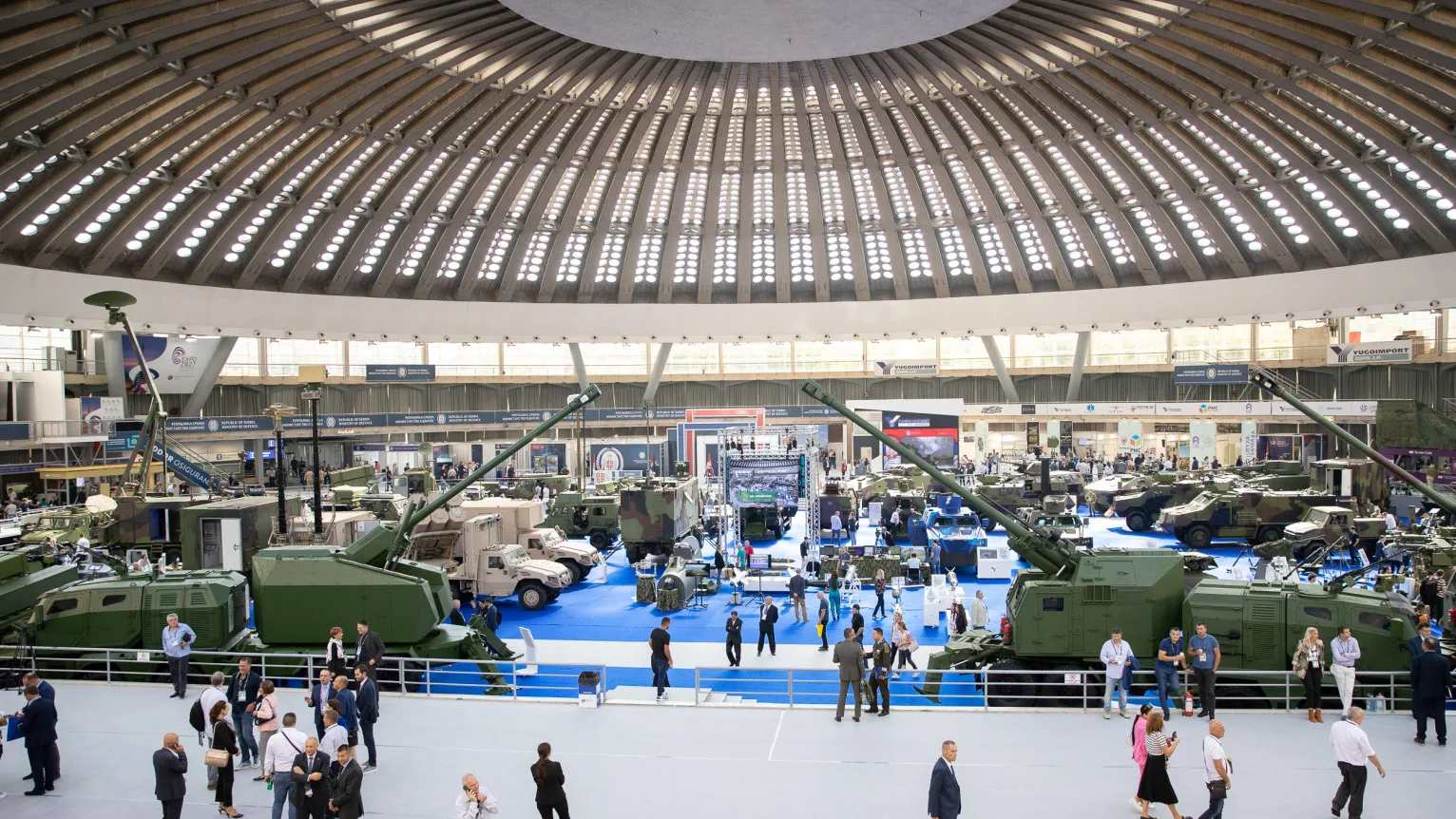
The network also includes EDePro, a Serbian company specialising in propulsion systems and rocket and aircraft engines, and the Military Technical Institute in Belgrade. The institute is the Serbian defence ministry’s main research and development institution, responsible for designing and testing some of the country’s domestically produced weapons and systems. Public and private companies also supply this industrial network with components, engineering expertise and industrial services.
By the middle of this decade, Serbia’s defence industry employed about 24,000 people. This gave the country a base of engineers, workers, production lines and export experience not available on the same scale elsewhere in the Western Balkans.
The industry suffered severe blows during the 1990s. Sanctions, Yugoslavia’s collapse and the wars closed markets on which its factories had depended. The Kosovo war then brought direct confrontation with Nato, which launched a 78-day air campaign in March 1999 after negotiations with Belgrade failed and Serbian operations against Kosovo Albanians escalated.
The strikes targeted military and industrial facilities and infrastructure in Serbia, weakening large parts of its production capacity. After 2000, however, reconstruction allowed the country to preserve an industrial base smaller than Yugoslavia’s, but still capable of producing ammunition, artillery, rockets, vehicles, aircraft and drones, and returning to foreign markets.
Reconstruction did not close every gap. Serbian industry remained stronger in its traditional fields than in the electronics that enable modern weapons to detect targets, operate autonomously and communicate with other systems. This was the gap Israeli companies would later enter.
The defence relationship with Israel predates the recent deals by more than a decade. In June 2012, the two defence ministries signed a bilateral cooperation plan covering exchange visits, training and cooperation between military units. During the visit, the Israeli delegation also held talks with Yugoimport. These contacts developed into regular consultations, which in 2017 reaffirmed both sides’ desire to expand military and economic cooperation and direct communication between their armies.
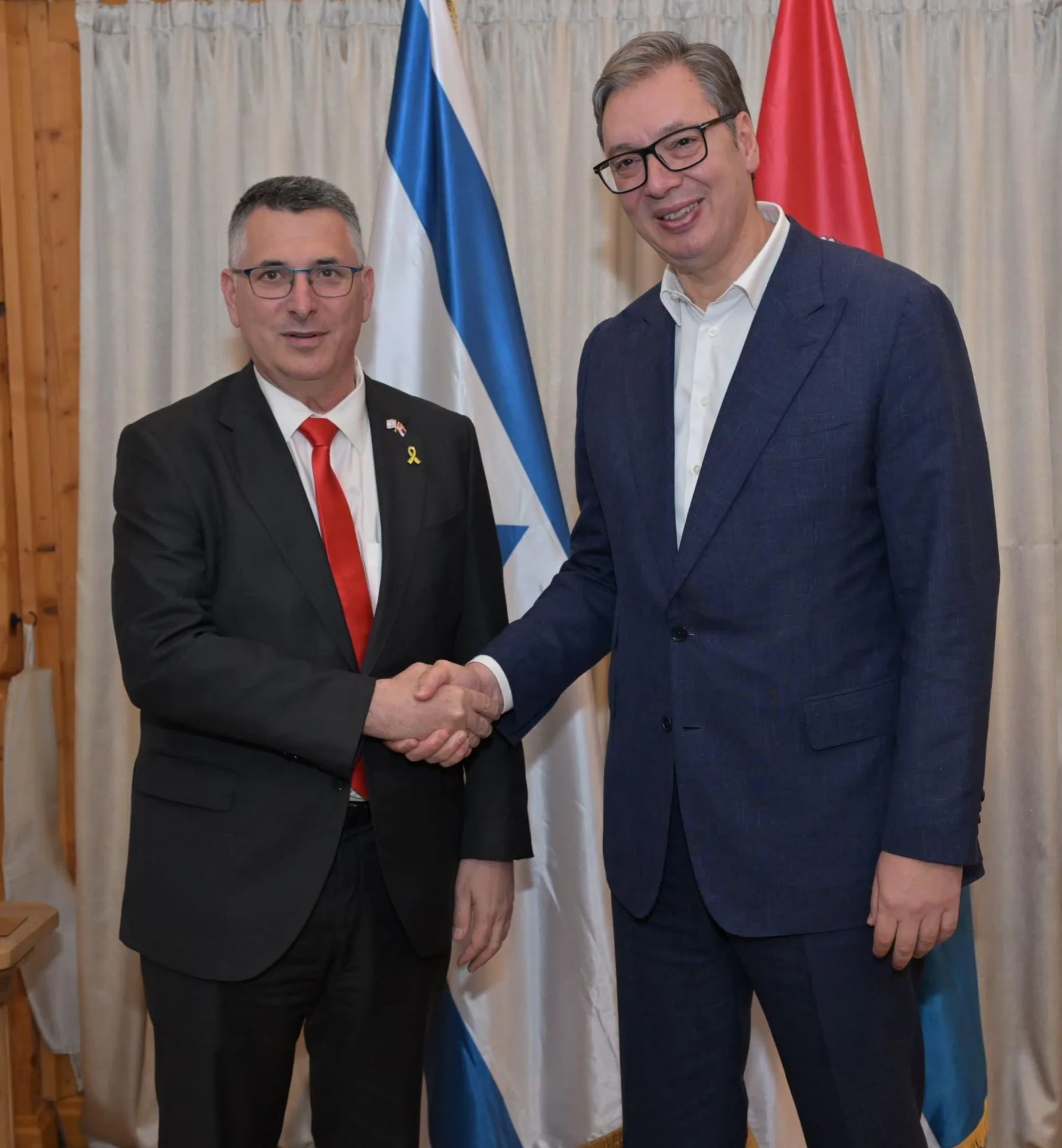
In July 2017, the two countries signed a memorandum of understanding on military, defence and defence-industry cooperation. Then Serbian Defence Minister Aleksandar Vulin said the agreement provided a framework for expanding the partnership. His visit also included an introduction to Israeli cybersecurity solutions, showing that the technical and industrial relationship had been taking shape years before Elbit acquired its current role.
The Washington Agreement of September 2020 gave this cooperation fresh political momentum. US President Donald Trump brought the leaders of Serbia and Kosovo together at the White House for understandings officially focused on normalising economic relations between Belgrade and Pristina. They also included provisions concerning Tel Aviv: Serbia pledged to move its embassy to Jerusalem, while Kosovo and Israel agreed to mutual recognition.
Although Belgrade expressed displeasure when Israel established diplomatic relations with Kosovo in February 2021, the dispute did not halt closer security and technological ties. A few years later, these developed into multibillion-dollar arms contracts and production projects in Serbia.
The major advance came on 18 November 2024, when Elbit announced two contracts worth about $335 million with a European country later revealed to be Serbia. They covered the PULS rocket system and Hermes 900 drones.
In August 2025, the company added a $1.635 billion contract covering long-range precision missiles, reconnaissance drones, loitering munitions, signals intelligence, communications, electronic warfare, electro-optical sensors, vehicle upgrades, force digitisation and command-and-control networks. This brought the total value of the three contracts to about $1.97 billion.
The August package introduced the element that shifted the relationship from buying weapons to building industrial capacity: Elbit coupled it with cooperation intended to strengthen the purchasing state’s industrial capabilities. In April 2026, an agreement on protecting and exchanging classified defence information provided a legal framework for handling sensitive technology and information.
Nikola Lunic, a retired Serbian naval officer and security and geopolitics analyst, believes such an agreement is necessary when a defence company with advanced technology enters another country. Protecting secrets and research and development, he argues, becomes part of the industrial relationship itself.
Five months later, a facility opened in Makis, Belgrade, employing about 100 people. It began assembling three models of small tactical drones developed by Elbit: the Lanius X, designed for reconnaissance and engagement in urban and enclosed environments; the offensive FireFly X, designed to operate even amid jamming and electronic warfare; and the Magni X, intended for reconnaissance and field surveillance.
The Serbian manufacturer Krusik joined the supply chain to provide explosives and warheads, combining Israeli technology with Serbian industrial production from the project’s first phase.
Vucic spoke of gradually expanding production and establishing at least three additional factories. Months earlier, he had said Serbs “do not know how to make drones the way Israel does” and that his country wanted to train its personnel to acquire that expertise.
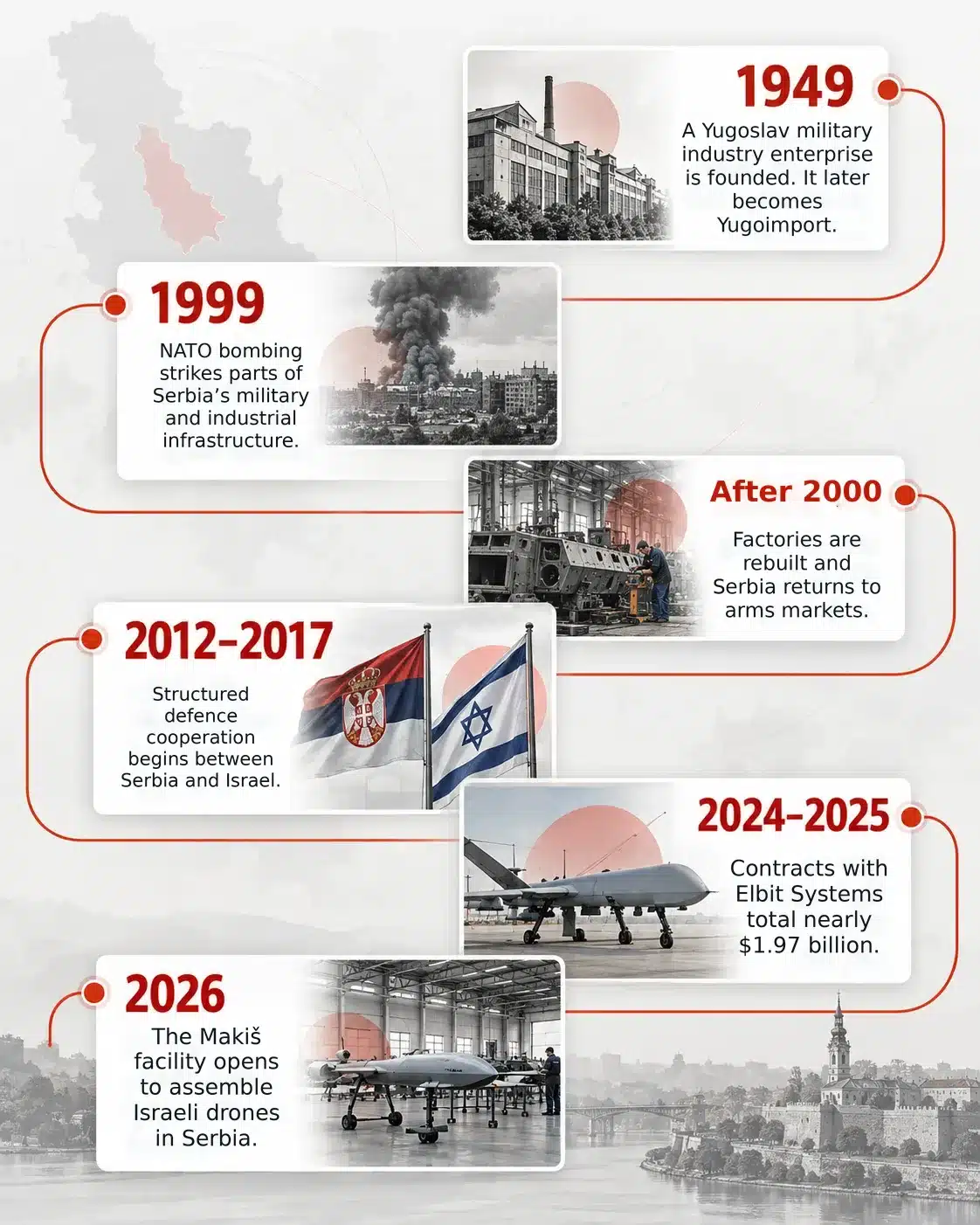
The project’s details show the limits of Serbia’s achievements so far. The Hermes 900 itself is not manufactured in Makis, and the contracts did not specify Serbian production of sensors, electronics, engines, software or algorithms, the components that account for the most significant share of the technological value. What has been established is domestic assembly, local employment and Krusik’s participation in the supply chain, with plans to expand the role of Serbian engineers and factories.
Even the facility’s ownership remained ambiguous. Documents revealed in April by the Balkan Investigative Reporting Network (BIRN) and the Israeli newspaper Haaretz described a project in which Elbit would hold a 51 per cent stake and Yugoimport 49 per cent.
After the opening, however, another investigation by the same outlets found that the facility operates under the name SDS Technologies, which is linked to a British company. Elbit denied owning a stake in a drone factory in Serbia. This left the project’s legal structure unclear, without changing the fact that Israeli technology had entered an existing Serbian industrial base.
That base matters because of the factories, engineering expertise and military export networks Serbia inherited from Yugoslavia. It allowed Elbit to enter through a partner that did not need to build its industrial capabilities from scratch. Belgrade, meanwhile, used the cooperation to close the gap that had remained its traditional industry’s weakest point: the technology that enables modern weapons to detect targets, operate autonomously and communicate within a single combat network.
What has Israel changed in the Serbian army?
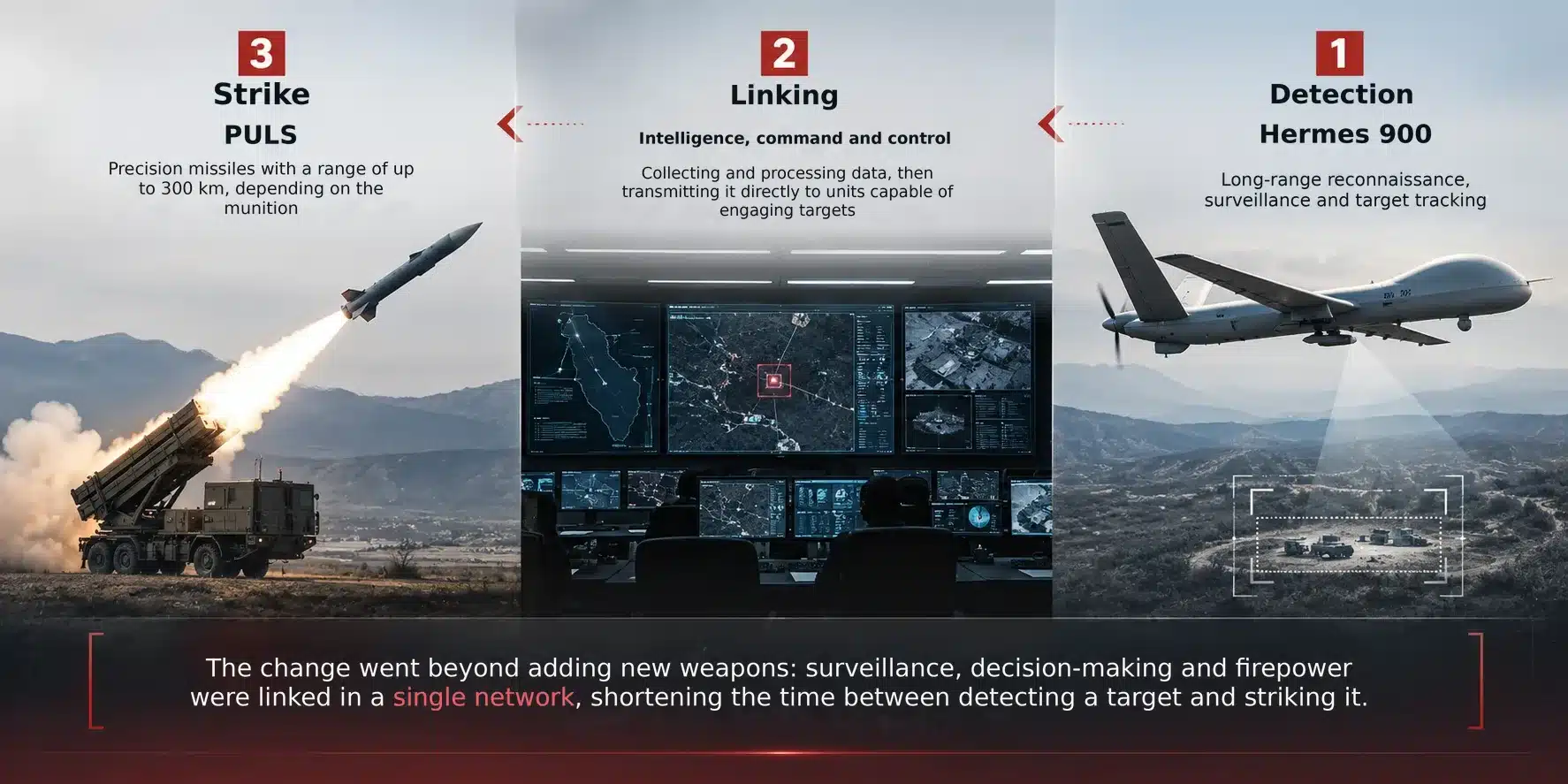
The Israeli deals reveal a deeper shift in how Serbia is building its military power. Belgrade is seeking to shorten the interval between detecting a target, deciding how to respond and striking it. Acquiring a long-range missile or an advanced drone separately cannot close that gap.
This is what makes Elbit’s package significant: it enables information to be gathered in the field, transmitted, processed and delivered to units capable of carrying out a strike. It brings the Serbian army closer to a model of network-centric warfare that links reconnaissance capabilities and firepower within a single system.
Petar Vojinovic, an aviation expert and editor-in-chief of the specialist Serbian website Tango Six, explained that the technology Elbit is bringing to Serbia forms part of a broader plan for what is called the “digital army.”
Sensors continuously gather information and transmit it in real time to other platforms capable of engaging the target without activating their own radars and exposing their positions. He described these as capabilities that, just a few years ago, the Serbian army could only “dream of.”
Within this system, the Hermes 900 provides long-range reconnaissance, surveillance and target designation, while signals intelligence, communications and electronic warfare systems gather information about the operational environment. Command-and-control systems distribute that information among units. When a strike is required, PULS gives Serbia a missile range of up to 300 kilometres, depending on the munition used.
Military analyst Vlade Radulovic believes the introduction of PULS represents Serbian artillery’s biggest advance so far, because the army previously lacked the ability to strike positions with artillery at such distances.
He explained that the Hermes 900 can gather information, track targets and help PULS identify them. The deal’s value therefore lies more in integrating detection, transmission, decision-making and firepower than in each system individually.
This technological development came alongside organisational changes within the armed forces. In April 2026, Vucic ordered the creation of specialist offensive drone units and made digitisation, drones and interoperability priorities for modernisation. This extended the impact of Israeli technology to how forces are organised and used within military units.
The partnership forms part of a broader shift in Serbia’s arms suppliers. Belgrade retains Russian and Chinese systems, has purchased French Rafale fighter jets and works with other Western companies.
Radulovic believes Western technology is playing a growing role in the army. He argues that using multiple suppliers gives the Serbian leadership room to manoeuvre and reduces its exposure to supply disruption from any single source, at the cost of greater complexity in operating systems built to different technical approaches.
Turkey had been a candidate for a larger role in this shift after Belgrade expressed interest in Bayraktar TB2 drones. But Ankara’s delivery of those drones to Kosovo in 2023 affected Serbian calculations, even as talks on military and industrial cooperation continued between the two countries.
Over the same period, Elbit was able to offer a broader package linking drones and strike capabilities with reconnaissance and military networks, alongside local industrial cooperation. This embedded the company in Serbia’s military modernisation.
In the Western Balkans, this advance gives Serbia additional weight as the arms race shifts from buying systems to developing the capacity to produce them. Kosovo has also moved to develop domestic ammunition and drone production with Turkish support. Alongside rising defence spending across the region, these developments make the ability to replenish stockpiles and manufacture some of those supplies domestically an increasingly important factor in the balance of power.
Why does each side need the other?
Through this partnership, Belgrade wants to move beyond the limits of the industry it inherited from Yugoslavia and acquire the higher-value technology used in modern weapons. Developing this domestically would require years of investment and expertise; Elbit offers a faster route.
Serbia has characteristics that distinguish it from other partners in the Western Balkans. It combines a military-industrial base inherited from Yugoslavia with an engineering workforce and long experience in arms exports. It also remains outside the EU and Nato without being isolated from the European market, while maintaining relations with Russia, China and the Middle East.
This combination gives Elbit Systems a partner capable of taking on production quickly and reaching markets the Israeli company cannot access as easily on its own.
Vuk Vuksanovic, a Serbian researcher and lecturer in the Department of War Studies at King’s College London, places the project within Belgrade’s broader ambition to acquire technology and know-how and reach new markets. In return, he says, Israel gains a supply chain outside its surrounding region, which is in a state of constant tension.
He adds a political dimension, describing Israel as a “shortcut to the White House,” in the Serbian authorities’ calculations. He argues that the US lies at the heart of the relationship, consistent with Belgrade’s policy of spreading its partnerships across competing international powers.
From an Israeli perspective, Jonathan Spyer, a researcher specialising in security and regional politics, believes the partnership with Serbia also reflects an Israeli desire to diversify supply sources and reduce exclusive dependence on a single major power. He describes Serbia as an entry point from the Middle East into Europe and a natural arena for competition among regional powers.
This interdependence took on a different significance from the first days of the assault on Gaza. Vucic told The Jerusalem Post in June 2025 that Israeli officials had contacted Belgrade on the evening of 8 October 2023 with an urgent request for ammunition.
Vucic said Serbian state institutions completed the licensing and approvals within four days, a speed he said had never been achieved before. He then declared that he was the only one in Europe trading military ammunition with Israel at the time, despite criticism from European officials.
Months after supplies began, Israeli Prime Minister Benjamin Netanyahu gave the closer ties an explicit political description. In February 2024, he called Vucic a “true friend of Israel” and thanked him for Serbia’s steadfast support “in word and deed,” as Serbian arms shipments to Israel increased alongside military flights between Belgrade and Nevatim Air Base.
Exports provide another incentive for Belgrade. For decades, Serbia’s military industry has depended on foreign markets, so Israeli drone production is joining an established sales network.
At the Makis facility’s opening, Vucic said its output would supply the Serbian armed forces and those of other countries. He also spoke of at least three additional factories.
Vucic also said an unnamed Middle Eastern country would be able to buy the product from Serbia after being unable to purchase it directly from Israel. His statement reveals the export role Belgrade envisages for the project, although the customer’s identity and the terms of re-export remain unclear.
Elbit, meanwhile, is entering Serbia amid record demand. Its order backlog reached $32 billion by the end of June 2026, about 73 per cent of it from customers outside Israel. Europe was the main driver of the increase during the second quarter.
The company’s chief executive, Bezhalel “Butzi” Machlis, said increased investment in production infrastructure aimed to raise output capacity and speed up delivery of outstanding contracts.
David Levenson, a defence industry analyst at the research unit of Israel’s Bank Hapoalim, explains that Elbit’s model distributes production across its foreign markets. This allows production lines inside Israel to prioritise the occupation army’s needs when demand rises, while subsidiaries and overseas factories fulfil part of its international contracts.
Serbia offers this model an existing industrial base and established export network. Its political position connects it to the European market from outside the EU and Nato, while preserving channels to Russia, China and the Middle East. This makes it suited both to supplying its own army and to expanding Elbit’s production capacity and access to additional markets.
The depth of this interdependence becomes clear when examining the flow of weapons in the opposite direction. Yugoimport alone exported €42.3 million worth of weapons and ammunition to Israel in 2024, compared with about €1.4 million in 2023.
An investigation by BIRN and Haaretz documented at least 20 flights from Serbia to Israel’s Nevatim Air Base during the year, as well as Serbian 155mm artillery shells linked to the manufacturers Krusik and Sloboda. Exports continued to rise, reaching nearly €114 million in 2025.
This increase came as the occupation army continued its assault on Gaza, amid UN and human rights calls to halt arms transfers to it. Serbian authorities withheld much of the information about licences and shipments on the grounds that it was classified. Serbian industry thus became an ammunition supplier to Israel as Belgrade signed its largest contracts to acquire Israeli military technology.
Here, the partnership’s structure is clearest: Serbia provides the industrial base, workforce and export network, while Israel retains the advanced technology used to design and control the systems. The extent of Serbia’s gains depends on how much of that knowledge is transferred to it.
This arrangement explains why Serbia has moved ahead of the rest of the Western Balkans in military-industrial relations with Israel. Kosovo is building much of its modernisation around partnerships with Turkey and the US, while Israeli projects in Albania, Bosnia and Herzegovina, North Macedonia and Montenegro have not reached the same combination of large contracts, local production, suppliers and export ambitions.
This is the significance of the Makis factory: it adds a new link to an industry rooted in the Yugoslav era, partly destroyed in the 1990s and subsequently rebuilt. Belgrade is now trying to move that industry from exporting shells to possessing the technology that guides them and connects them to a network. Israel, meanwhile, is working to integrate Serbian industry into a production, supply and export system extending beyond its own borders.
