












In an unprecedented move, the administration of President Donald Trump has designated the Muslim Brotherhood and its branches in Egypt, Jordan, and Lebanon as “terrorist organizations,” citing alleged support for Hamas and activities Washington claims threaten its interests and those of its allies.
The decision has sparked questions about its timing, motivations, and the forces that influenced the White House to act. It also raises significant legal and political implications, both domestically and internationally including potential impacts on individuals and entities connected to the Brotherhood within the United States.
Timing and Justifications
The designation imposes economic sanctions and bans all financial or logistical support for the listed branches.
The U.S. Department of the Treasury designated the Brotherhood’s branches in Egypt and Jordan as Specially Designated Global Terrorists (SDGT). Meanwhile, the State Department labeled the group’s Lebanese branch a Foreign Terrorist Organization (FTO).
Many analysts believe the timing of the decision is driven by several factors:
-
It follows up on an executive order signed by Trump in November 2025 to initiate the designation process.
-
The decision accelerated in the wake of the Israeli assault on Gaza, after official documents alleged that a Brotherhood-linked faction in Lebanon had launched rockets at Israel following the October 7, 2023, Hamas attack.
-
Accordingly, the Trump administration based its decision on accusations that these branches supported Hamas and orchestrated “destabilizing campaigns” against U.S. allies.
-
Trump also sought to fulfill a longstanding promise popular among America’s right-wing circles, where Republicans and conservative figures have for years pushed for a tougher stance on the Brotherhood.
Trump previously attempted to take this step during his first term in 2019, under pressure from Arab allies, but the move was postponed at the time. Now, with a second term underway, the political environment has shifted, allowing Trump to pursue what he views as part of a broader campaign against what he calls “radical political Islam.”
Who Pushed Washington Toward Designation?
A combination of domestic and foreign pressure drove Washington toward this decision. The following are the key actors who encouraged or welcomed the designation:
-
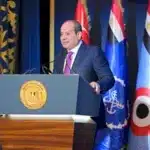
Egypt: Cairo played a leading role in lobbying for the move. Since the 2013 military coup and the domestic classification of the Brotherhood as a terrorist group, President Abdel Fattah el-Sisi’s regime has repeatedly urged Washington to adopt the same stance. During a 2019 visit to the White House, Sisi explicitly asked Trump to add the Brotherhood to the U.S. terror list. Today, Cairo warmly welcomed the decision, hailing it as a “decisive step” that reflects the alleged “danger of the group.”
-
United Arab Emirates: The UAE has opposed the Brotherhood since 2011, labeling it a terrorist organization in 2014 alongside Saudi Arabia and Egypt. It promptly welcomed the U.S. decision, describing it as evidence of the Trump administration’s “systematic and sustained efforts” to confront what it called “the Brotherhood’s violence and destabilizing activities.”
-
Saudi Arabia: Riyadh has designated the Brotherhood a terrorist organization since 2014, claiming its ideology undermines social cohesion. It praised the U.S. decision, reiterating its “condemnation of extremism and terrorism and its support for anything that strengthens Arab nations’ security and stability.”
-
Israel: While no official Israeli statement has been issued, analysts suggest that Tel Aviv stands to benefit the most from the decision. The Brotherhood and its affiliates most notably Hamas are among Israel’s fiercest regional adversaries. Brotherhood leaders claim Trump acted under pressure from Israel and the UAE to serve political goals unrelated to direct U.S. interests.
-
U.S. Domestic Actors: The Trump administration’s move was also backed by a strong domestic current. The Republican right has long viewed the Brotherhood as a threat. Prominent supporters of the president such as activist Laura Loomer and others have publicly called for a more aggressive stance.
In fact, conservative-led states like Texas and Florida launched their own campaigns in 2025 to classify the Brotherhood as a terrorist group at the state level. Florida Governor Ron DeSantis even signed an executive order listing the Council on American-Islamic Relations (CAIR) as a terrorist organization, citing alleged ties to the Brotherhood.
Anticipated Ramifications
The decision carries a range of legal and political consequences, both within the United States and across the Middle East:
1. Legal and Security Implications in the U.S.
With the designation in place, any financial or material support for the Brotherhood or its branches becomes a federal crime under laws prohibiting support for terrorist organizations. While no formal Brotherhood organization exists within the U.S., the ruling could affect individuals or entities proven to have direct ties to its branches in Egypt, Jordan, or Lebanon.
For example, any known member of these branches seeking to enter the U.S. would be automatically barred under FTO entry restrictions.
U.S.-based individuals with current or even historical organizational ties to those branches could face legal action, including deportation or asset freezes if any form of support is proven.
Experts also note that the decision could influence asylum and visa applications by individuals with Brotherhood affiliations. U.S. courts may become less inclined to grant asylum to Brotherhood members or sympathizers. This hardline stance could extend to allied Western nations that may follow Washington’s lead, further restricting international movement and residency for Brotherhood-affiliated figures.
Overall, the move provides U.S. law enforcement with stronger legal grounds to target alleged Brotherhood-linked funding networks including charities suspected of serving as fronts.
2. Impact on the Middle East Political Landscape
Regionally, the decision is likely to embolden the Brotherhood’s adversaries. Egypt may use it to press other countries to extradite senior Brotherhood figures residing abroad.
Jordan might intensify its investigations into investments or organizations suspected of Brotherhood ties, using the U.S. stance as justification. More broadly, the climate for political Islam in the region may deteriorate.
Observers fear the move could weaken Islamic movements that have participated in democratic processes such as Tunisia’s Ennahda or Morocco’s former ruling Justice and Development Party by lumping them together under one label. This could further marginalize them politically and deepen polarization across the region.
In short, Washington’s designation marks a significant turning point in its Middle East policy. Far from being a spur-of-the-moment decision, it reflects the convergence of pressure from Arab allies, the influence of America’s right wing, and a volatile regional backdrop shaped by the Gaza war.
Time will tell how this designation is leveraged in U.S. policy, and whether it will succeed in weakening a century-old organization as its supporters claim or only fuel further polarization and instability, as its critics warn.


