










In January 2026, Elon Musk’s involvement in Iranian affairs extended far beyond tweets and tech promises. The American billionaire began actively supporting the protests that have gripped Iran since late 2025, fueled by a worsening economic crisis.
But how exactly is Musk supporting these protests? Is it out of genuine sympathy for the Iranian people or are deeper political and economic calculations at play, aligned with the agendas of Washington and its allies?
The Role of X
One of Musk’s most recent and visible moves was changing the Iranian flag emoji on his platform X (formerly Twitter) to the “Lion and Sun” flag, a symbol favored by opposition groups in exile.
The sudden change came after a user tagged Musk and the platform’s head of product, requesting the update. The executive replied, “Give me a few hours.”
As a result, official Iranian government accounts on X now appear with the monarchist-era flag in their profiles. The Lion and Sun emblem was part of Iran’s national symbol before the 1979 Islamic Revolution.
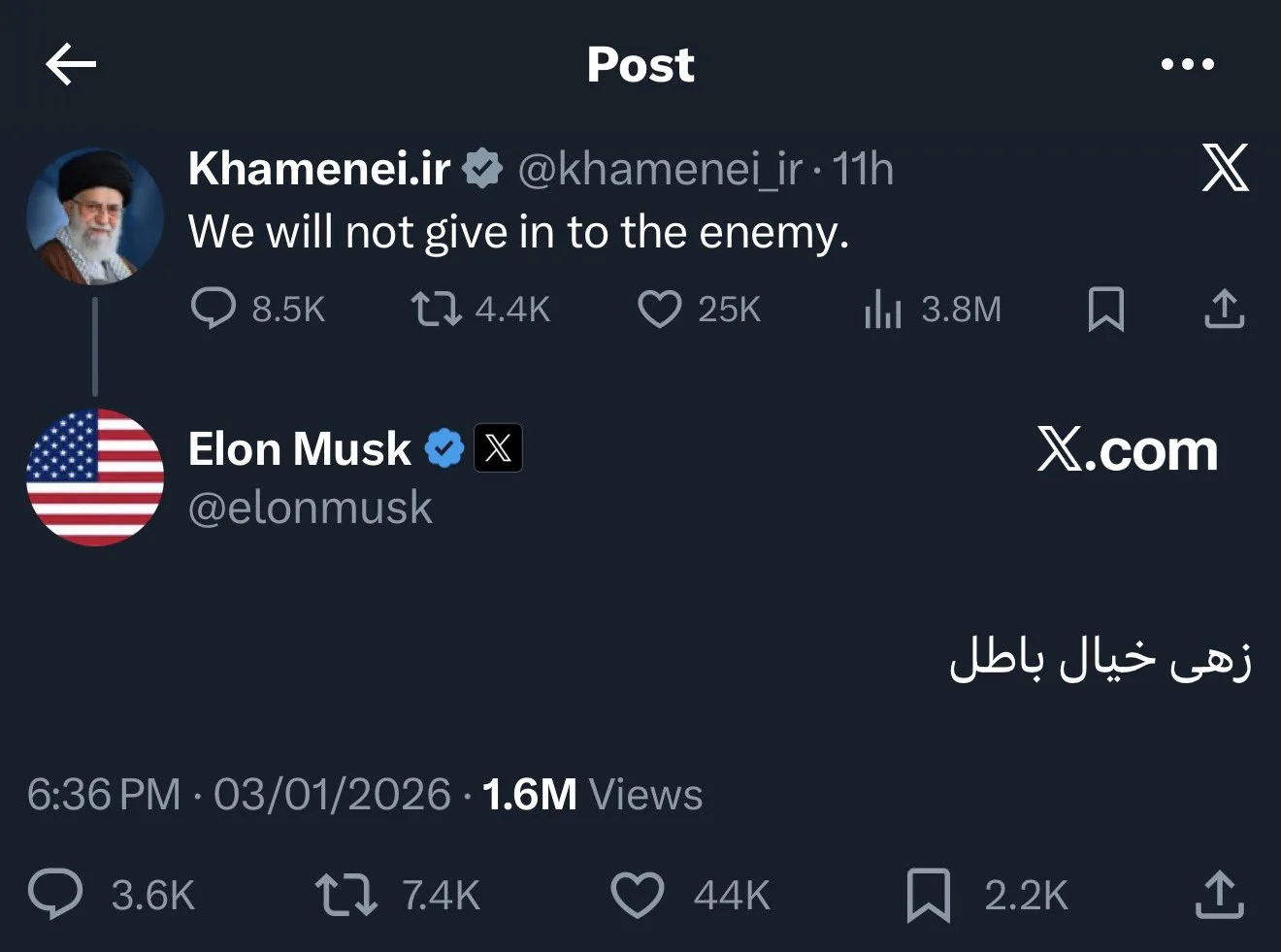
Since the start of the current wave of protests, Musk has been vocally critical of the Iranian regime on X. In a striking move, he commented in Persian on a post by Supreme Leader Ali Khamenei, writing: “زهی خیال باطل” a phrase roughly translating to “What a vain delusion.”
That comment went viral, with demonstrators quickly adopting it as a chant against Khamenei in the streets highlighting Musk’s growing role in fanning anti-regime sentiment.
The Role of X Spaces
Calls for Musk to intervene escalated on international platforms, with opposition activists urging the SpaceX CEO to provide access to Starlink, his satellite-based internet service.
Since January 8, Iranians have faced near-total internet blackouts as protests intensified across the country. Activists hoped Starlink could help break the digital blockade.
While there’s no definitive confirmation that Starlink has been activated in Iran during the latest blackout, Musk has taken various steps and made statements in the past:
-
He activated Starlink during the 12-day confrontation between Iran and Israel when Tehran cut off internet access.
-
During the 2022 protests over the death of Mahsa Amini, Musk stated his company was close to deploying 100 Starlink terminals in Iran.
A U.S.-Israeli Agenda
Musk’s actions seem to align with long-standing U.S. and Israeli interests in Iran. Since the Islamic Revolution, Washington has made no secret of its desire to see regime change in Tehran and it now appears one of its most effective allies might be in Silicon Valley, not the CIA.
Israel has also moved quickly to express official support for the protests and has offered public assistance to demonstrators widely seen as an attempt to destabilize Iran from within after the failure of military options.
By offering uncensored internet through Starlink, Musk has undermined Tehran’s information controls, enabling alternative communication channels for activists and potentially for U.S. and Israeli intelligence operatives operating inside the country.
When Israel and the United States launched airstrikes on Iran in June 2025, Iranian authorities imposed an 11-day internet blackout. Starlink’s role proved pivotal.
According to the Israeli outlet The Jerusalem Post, thousands of Starlink terminals were smuggled deep into Iran with help from foreign intelligence services. The result: an estimated 20,000 covert Starlink stations operating inside the country.
The newspaper reported: “Thanks to this parallel network, images and videos of celebrations over the strikes on regime targets and widespread protest footage flowed freely, beyond the reach of Iran’s censors. In clear terms, Musk achieved what governments could not: breaking the information blockade and empowering a campaign to destabilize the regime from within.”
This wasn’t a spontaneous act of philanthropy. It came in direct response to public calls from figures tied to former U.S. President Donald Trump’s administration, who urged Musk on X to deliver a “knockout blow to the Iranian regime” by offering free internet access.
Western documents also indicate that Musk maintains close ties with U.S. national security agencies. His company SpaceX has signed multibillion-dollar contracts with the Pentagon and intelligence agencies to develop surveillance satellites.
During the current protests, The Jerusalem Post reported that Israeli Minister Almog Cohen contacted Israeli-American investor Dovi Frances to inquire whether Starlink was operational inside Iran. Frances confirmed he had spoken with Musk, though he didn’t disclose the contents or outcomes of their conversation.
A report from the Jerusalem Institute for Strategy and Security (JISS) argued that granting Iranians unrestricted access to Starlink could tip the balance in favor of regime opponents aligning with Israel’s strategic goals.
Economic Motivations
But Musk’s actions are not purely about “freedom of expression.” They are also tied to broader agendas involving resources and geopolitical influence particularly concerning lithium, often referred to as the “oil of the 21st century.”
In March 2023, Iran announced the discovery of 8.5 million tons of lithium reserves near the city of Hamedan the largest known deposit in the world. The find triggered concern in Israel and the West due to lithium’s strategic importance in manufacturing batteries, electric vehicles, and electronics.
Notably, Musk hinted in a 2020 tweet at the willingness to topple governments for lithium, writing: “We will coup whoever we want! Deal with it.”
This mindset reflects Musk’s readiness to secure strategic resources regardless of political cost mirroring former President Trump’s alleged attempt to oust Venezuelan President Nicolás Maduro to control oil assets.
In Iran’s case, analysts believe its vast lithium reserves make it a target for major industries, and the West may seek to wrest control from the spheres of China and Russia.
Musk’s industrial ambitions namely Tesla and its battery technology converge with Washington’s interest in regime change, ensuring future, unhindered access to this vital resource.
Tehran’s Response
Tehran has responded to Musk’s actions with suspicion, seeing them as part of a broader U.S.-Israeli scheme. As Starlink’s role inside Iran expanded, authorities swiftly declared its terminals illegal. Parliament passed laws criminalizing the use of unlicensed satellite internet.
The government warned citizens that installing Starlink dishes could result in severe punishment, and it lodged a formal complaint with the International Telecommunication Union demanding an end to unauthorized Starlink broadcasts over Iranian territory.
In Iranian media, Musk has been portrayed as a subversive actor with malicious intentions. In January 2026, the semi-official Tasnim News Agency reported that Musk had activated the Starlink network over Iran, calling it clear coordination with U.S. and Israeli operations.
Iranian outlets have also highlighted Israeli enthusiasm for Musk’s actions. Channel 14 in Israel reported that the billionaire pledged to keep Starlink free for Iranians as long as the protests continue and instructed his technical team to counteract the regime’s jamming efforts.
As a result, Tasnim labeled Musk an implicit partner in “an international conspiracy against Iran, providing logistical and technical support aimed at toppling the Islamic Republic.”
Pro-government Iranian media has gone as far as to describe these efforts as a hybrid war combining technological superiority with psychological and media campaigns against the state.
Elon Musk’s interest in Iran is no longer a matter of cultural curiosity or vague solidarity with protesters. It has become a key element in a broader geopolitical equation where political agendas, economic interests, and strategic calculations converge, driven by technology, symbolism, and control over the digital battlefield.


