










In the early hours of Saturday, October 7, 2023, fighters from the al-Qassam Brigades the military wing of Hamas crossed the skies above Israeli settlements surrounding Gaza using rudimentary paragliders in an operation dubbed the “Al-Aqsa Flood.”
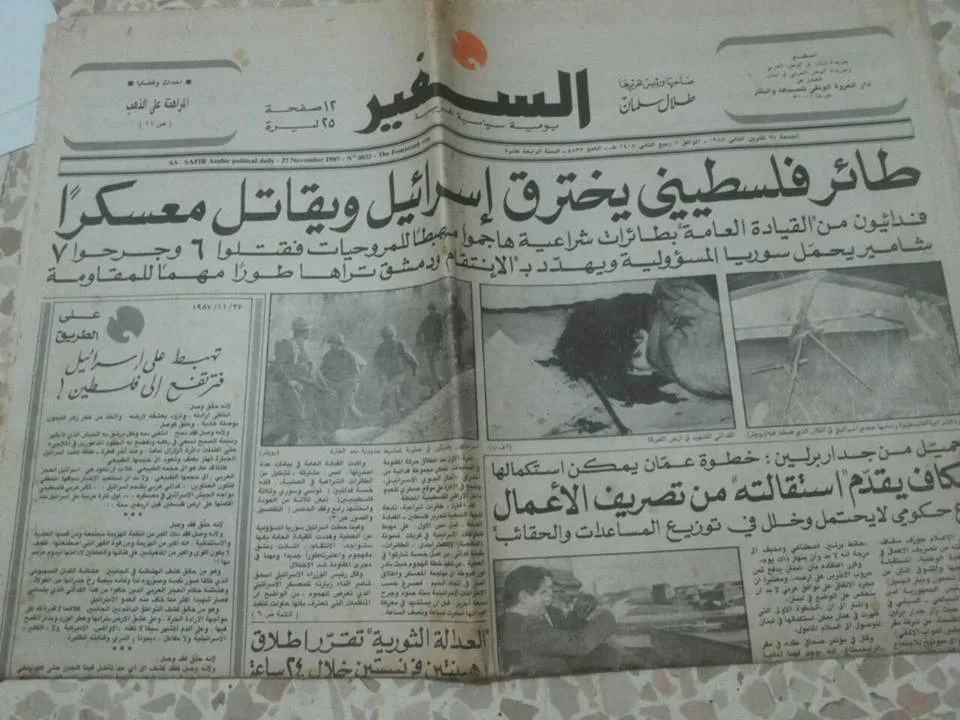
This striking image of human-powered aircraft equipped with simple wheels and propellers evoked a scene from 36 years earlier, when two Arab men affiliated with the Popular Front for the Liberation of Palestine General Command (PFLP-GC) launched a similar attack.
Using gliders from near the Lebanese-Israeli border, one of the men infiltrated an Israeli military base, killing and injuring several soldiers.
That operation was led by Syrian fighter Khaled Mohammad Akra from Aleppo. It was carried out in response to the 1953 Qibya massacre. Akra had joined the Palestinian resistance in Lebanon at the age of 14 and died a martyr as he glided toward Palestine in a traditional hang glider.
Khaled Akra
Born in 1967, Syrian national Khaled Mohammad Akra believed that armed struggle was the only path to liberating Palestine. In 1983, driven by this conviction, he joined the Palestinian resistance, hoping to support his Palestinian brethren in the face of an Israeli occupation that had seized land and violated dignity with impunity before Arab leaders.
Akra aligned himself with the Popular Front for the Liberation of Palestine General Command, a leftist, nationalist Palestinian faction that broke away from the main PFLP on April 24, 1968, establishing its leadership headquarters in Damascus.
Akra who later took the nom de guerre Abu Rami was drawn to the faction because of its pan-Arab character; its ranks included fighters from across the Arab world, with some even rising to leadership positions.
The group emphasized that its struggle was part of a global fight against colonialism, racism, and terror targeting oppressed peoples.
He received his military training in Naameh, southern Lebanon, where he learned to carry and use weapons, holding onto the hope that one day he would be selected for a fedayeen operation against the Israeli occupation, either inside the occupied territories or abroad.
At the time, the PFLP-GC had conducted several such attacks targeting Israeli interests both within and outside of Palestine.
A Unique Operation
After months of training and an unrelenting desire to be martyred for Palestine, Akra was selected to lead a four-man fedayeen unit that included himself, Tunisian fighter Miloud bin Naja Nouma, and two Palestinians. Their mission: to carry out a bold assault against Israeli soldiers. Akra was just 20 years old.
Unlike previous operations that typically involved crossing land borders, this mission would breach Israeli territory from the sky an unprecedented tactic aimed at bypassing the fortified border fence, which made land incursions nearly impossible.
Late on November 25, 1987, the team prepared their gliders. However, the two Palestinian fighters were forced to land back in Lebanon due to technical issues, while the Syrian and Tunisian continued their flight. High hopes rested on their shoulders within the leadership of the PFLP-GC.
With red-and-white wings, the oversized gliders powered by small engines and fans no larger than a lawn mower took off across the northern border of occupied Palestine. Onboard were Arab fighters who had dedicated their lives to the Palestinian cause.
Israeli soldiers heard the buzz of engines overhead and issued alerts to military bases and civilian centers in the north. Helicopters equipped with searchlights were deployed but found nothing the gliders were flying low, just above the treetops that blanketed the area.
Akra successfully crossed the buffer zone, which ranged between 5 and 12 miles wide in the south, and landed in a field of grass and thorns near the settlement of Kiryat Shmona in northern occupied Palestine.
Armed with a Soviet-made Kalashnikov rifle, a silenced pistol, and grenades strapped to his body, he ran roughly 200 meters to Gibor military base, home to elite Israeli special forces.
Spotting an Israeli military truck, Akra opened fire, killing the driver and injuring a female soldier. He then infiltrated the base with ease, passing an armed guard who fled upon hearing gunfire.
Once inside, the Syrian fighter unleashed a barrage from his assault rifle and threw grenades into tents crowded with Israeli troops. He killed five more soldiers and wounded six others, catching the entire base by surprise.
The clash lasted over an hour, prompting Israeli soldiers to call for reinforcements. Helicopters, flares, and tracer rounds lit up the battlefield until the young fighter from Aleppo, Khaled Mohammad Akra, was killed by Israeli machine-gun fire.
An Israeli Shockwave
The attack left widespread destruction: three barracks were demolished, five tents burned, and more than six vehicles destroyed. Casualties littered the base and its entrances. It was the deadliest Palestinian assault inside occupied territory since March 1978, when 11 Palestinian fighters killed 37 Israelis and injured 82 others after hijacking a bus.
The Israeli military faced sharp criticism in the aftermath. Despite heightened alert levels, it had failed to take necessary precautions, according to Israeli media. The sentry at the base gate, rather than engaging the attacker, had fled in fear.
Israeli outlets also revealed that many of the soldiers killed or wounded were playing backgammon and checkers when the Arab fighters stormed the base, highlighting a significant military failure.
The operation shattered the myth of Israeli military invincibility. Gibor was assumed to be a heavily fortified military complex yet it was exposed as vulnerable to even a single determined fighter.
Israel was stunned that one Arab fighter could inflict such damage. The incident rekindled old fears that Palestinian armed groups might still pose a cross-border threat, despite years of perceived calm.
The next day, numerous Israeli businesses and institutions shuttered. Residents were told to shelter in place, and commando units were dispatched to search for any additional infiltrators.
To deflect public outrage, Israeli authorities blamed the base’s guard. He was sentenced to three years in prison for cowardice a scapegoat in what came to be known as the “Shin-Gimel Syndrome,” a term describing the tendency to punish lower-ranking individuals to shield senior commanders from accountability.
The Night of the Gliders
The glider attack proved a bitter disappointment for Israel. Two fighters from the Palestinian resistance had struck a base housing some of Israel’s most elite forces using no more than modified paper-thin gliders equipped with propellers and lawn mower engines.
The operation also served as a morale boost for the Palestinian national movement. Just days later, the First Intifada known as the “Children of the Stones” uprising erupted and continued until 1992, culminating in negotiations between the PLO and Israel that led to the Oslo Accords in 1993.
The glider mission stands as a testament to the Palestinian struggle against occupation and a reminder of Arab solidarity with a cause long neglected by the international community and Arab leadership alike.