











هذا التقرير متاح أيضًا بـ العربية
Under sniper fire and indiscriminate shelling that targets anything that moves, villagers in Saber district in Taiz province face growing danger as they try to rescue the wounded and recover the dead. A siege restricts residents’ movement and hampers ambulance access to some areas. Roads to the wounded have become perilous, forcing residents, both men and women, to carry the injured and the dead on their shoulders over rugged terrain for long distances because ordinary vehicles cannot reach them.
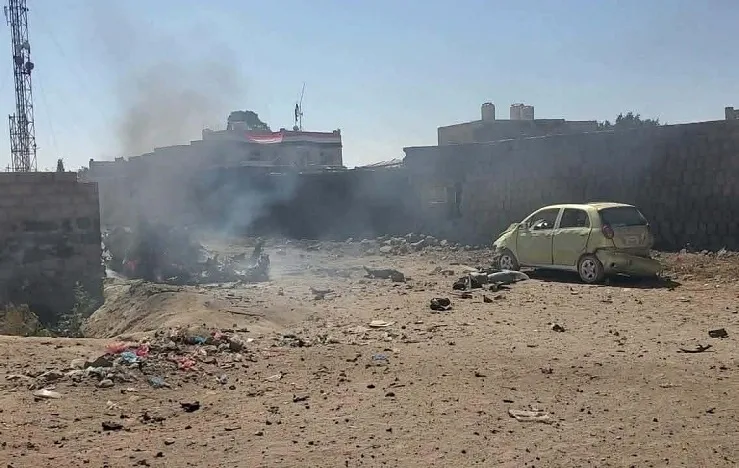
On 20 October 2026, the Yemeni news agency Saba reported that an ambulance had been targeted in the Al-Shaqab area of Saber al-Mawadim district while transporting 18-year-old Taybah Abdulraqib Abdo Abdullah, who had been wounded by sniper fire. According to the local source cited by the agency, the attack killed the girl and the ambulance driver, wounded the accompanying doctor and destroyed the vehicle.
The Taiz Human Rights Center documented yesterday, Tuesday, the killing of civilian Hossam al-Numani after a Houthi suicide drone targeted an ambulance he was driving in Jabal Saber, south of #Taiz, while he was carrying out a humanitarian mission to rescue a woman wounded by Houthi fire in the Al-Shaqab area, killing him and injuring the medic accompanying him https://t.co/dfVpyHkcGI
— مركز تعز الحقوقي THRC (@taiz_hrc) October 21, 2026
Ambulances under threat
In Al-Aawat, west of Al-Shaqab in Saber al-Mawadim district, an ambulance came under attack on Wednesday 28 October while on its way to rescue an injured civilian. Shehab al-Shaqab, a local resident, said three people were injured, including a member of the ambulance crew. The vehicle was also damaged and could not continue its work.
#Taiz ..
The Houthis targeted an ambulance while a medical team was trying to transport an injured civilian in the village of “Al-Aawat,” west of the Al-Shaqab area in Saber district.
According to local sources:
The attack injured 3 people, including two members of the medical crew, in addition to damaging the ambulance. Sources said this was the second Houthi attack on an ambulance within days in Saber al-Mawadim district.
#Yemen
— فارس الحميري | Fares Alhemyari (@FaresALhemyari) October 28, 2026
Al-Shaqab told Noon Post that this was the second such incident in a week. The difficulty of reaching the vehicle prevented the wounded from being evacuated immediately, he said. A team was only able to carry them out on stretchers after nightfall.
Direct attacks are not the only obstacles facing ambulances. The risks of sniper fire and shelling in combat zones also hinder their movement, as do difficult roads to some villages.
Safwan Mohammed Saeed, head of the emergency movement and ambulance department at Al-Thawra Hospital Authority in Taiz province, told Noon Post that the hospital has two working ambulances. They respond to emergency calls from the hospital or through the Health Office’s emergency operations room.
He said the ambulances operate on front lines and in combat zones, where they face the dangers of sniper fire, mortar shells and drones. Attacks on ambulances and medical crews affect response times and the transport of the wounded, he said. Reaching areas that are difficult to access also requires crews to consider their safety and choose safer routes.
The terrorist Houthi militias target an ambulance south of Taiz city
https://t.co/CDF6C9rf0i
— وكالة الانباء اليمنية (سبأ) (@sabanew_) October 29, 2026
Medical transport, including ambulances, has special protection under international humanitarian law. Article 11 of the 1977 Additional Protocol II to the Geneva Conventions stipulates that medical units and transport must be respected and protected at all times and must not be attacked. Medical transport loses this protection only if it is used, outside its humanitarian function, to commit hostile acts, and only after a warning has been given and, where appropriate, a reasonable time limit set.
Residents carry the wounded
When ambulances cannot reach the wounded, residents have to transport them themselves, amid continuing sniper fire, shelling and dangerous roads. Women as well as men have carried the wounded and the dead on their shoulders, walking long distances.
One such case involved Musheera al-Naqeeb and her father Mohammed, who were killed in shelling that targeted the village of Al-Adan in the Al-Naydani area of Saber al-Mawadim district, southeast of Taiz.
Iftikar Qassem al-Naqeeb, Musheera’s aunt and Mohammed’s sister, said fighting resumed after hours of calm, with seven shells hitting the village. Her brother had moved to his daughter’s house with other relatives, believing it to be safer and less exposed to fire because other homes surrounded it.
As the shells fell, family members did not dare go outside for fear of shelling and sniper fire. Iftikar risked moving between houses to check on relatives until she reached Musheera’s home, where she found that her brother and niece had died.
She sought help from relatives and local residents to recover the two bodies, but fear of gunfire and shelling prevented anyone from responding. That evening, she left the area. She returned at about 9pm with her husband and covered the bodies before leaving again because of the continuing danger.
The next morning, according to Iftikar, the Houthis prevented the family from burying the two bodies in the village cemetery. The family was forced to carry them towards Dhi Rahbah, a journey of about three hours on foot. Iftikar carried Musheera’s body, while others carried her father’s.
Iftikar Qassem – a relative of Quran martyr Musheera and her father Mohammed recounts the story of transporting her body https://t.co/RczOkJ9ibz
— قناة يمن شباب الفضائية (@TVyemenshabab) October 24, 2026
Some women who had joined the journey at the outset turned back out of fear, while the women of the family continued carrying the two bodies until they reached Dhi Rahbah. But the family was unable to bury them there and had to transfer the bodies to Al-Thawra Hospital in Taiz city.
A very painful video
#Watch how the body of martyr “Musheera Mohammed Qassem” was transported after she and her elderly father were killed today when Houthi shelling targeted her family’s home in “Saber al-Mawadim” south of #Taiz
A mother carrying her daughter’s body, and a father who had already gone to heaven before her
O Lord, Houthi criminality has reached its peak
And You are the Almighty Avenger. https://t.co/Uzyknk2ez3
— طارق فؤاد البنا (@Tarek_albanna) October 20, 2026
Residents’ suffering is not limited to cases that end in death. The wounded sometimes face long waits for help. Omar al-Naqeeb, a resident of the villages of Saber, told Noon Post that the dangers of sniper fire and the difficulty of reaching injured people have sometimes left them without aid for days. He cited Jameel Mohammed Abdulghani al-Humairi, from the village of Al-Naydani, who was wounded by shrapnel and remained in pain for about four days before receiving help.
Al-Naqeeb said a woman named Hayat Abdulraqib, in her late 50s, also went without aid for four days after being wounded by shrapnel because no ambulance was available and there were fears that anyone trying to reach her would be targeted.
In the village of Al-Amad in the Al-Aqroud subdistrict of Al-Misrakh district, south of Taiz, Fakihah Abduljalil Sufyan was shot by a sniper on the evening of Friday 30 October. She was taken to the advanced field medical centre in the village of Dubbah, where she died.
Fathi al-Quraidhi, a resident of Al-Aqroud, told Noon Post that persistent, intense sniper fire prevented residents from rescuing the wounded, while civilians faced danger in their villages and homes. He said Fakihah’s family could not reach Al-Amad to bury her there. They were forced to bury her in Dubbah for fear that family members would come under sniper fire while transporting her.
Protection under international humanitarian law extends beyond medical transport and crews to the wounded and sick, including civilians. Article 7 of Additional Protocol II to the Geneva Conventions of 1977 stipulates that they must be respected, protected and treated humanely. They must receive the medical care their condition requires as quickly as circumstances permit, without adverse distinction except on medical grounds.
Article 8 also requires parties to the conflict to take all possible measures, without delay, to search for and collect the wounded and sick and provide the care they need.
The hospital faces the effects of war
The difficulties of rescuing the wounded do not end when they are taken away from the fighting. Taiz’s health sector faces difficulties in receiving and treating patients amid the effects of war, limited resources and delays in some injured people reaching care.
Dr Fahd al-Nadhari, director of the Public Health and Population Office in Taiz, told Noon Post that fighting, shelling, sniper fire, road closures and attacks on ambulances and medical crews obstruct ambulance teams and delay their response. Teams sometimes have to postpone setting out, change routes or wait for safer conditions, he said. This delays first aid and increases the likelihood of complications, particularly in critical cases.
Al-Nadhari said the Health Office had documented more than 15 direct attacks on ambulances, some of which, he said, had resulted in injuries and deaths among paramedics.
He added that a shortage of ambulances, the large area to be covered, fuel shortages and insufficient maintenance limit the health sector’s ability to meet needs and respond to emergency calls. He said the office had set up advanced ambulance posts and organised the referral of the wounded from these posts to stabilisation centres and then to referral hospitals, depending on the severity of their injuries and the resources available.
The office has also trained health workers near combat zones and equipped some with medical kits, he said. It runs a round-the-clock operations room to receive reports, establish locations and track ambulance movements, coordinating with the relevant authorities and the local community to identify safe alternative routes.
Al-Nadhari called for three fully equipped ambulances, fuel and maintenance, as well as guaranteed safe corridors allowing medical crews to reach and transport the wounded.
