







هذا التقرير متاح أيضًا بـ العربية
On 6 August 2026, Nickolay Mladenov, the high representative for the Gaza Strip on the “Peace Council”, publicly thanked the United Arab Emirates alongside Qatar, Türkiye, Egypt and the US for supporting the negotiations. Since the UAE was not listed among the official mediators in the ceasefire talks, the praise partly revealed a role it had been playing behind the scenes.
Three days later, on 9 August, a clearer indication emerged. Discussing the “Green City” project east of Rafah, the Israeli prime minister’s office was quoted as saying that the UAE would build and finance it. The office also said the occupation authorities had formally asked local militias cooperating with them to take charge of security and inspect residents inside the city. The Emirati role had moved from a passing diplomatic reference in Peace Council statements to an explicit Israeli acknowledgement of direct involvement.
These two signals, just days apart, renewed attention to a role that had remained unclear in coverage since the war’s early months. The UAE’s declared role was primarily linked to relief efforts known as the “Gallant Knight” campaigns, facilitated by Israel. But its undeclared involvement in shaping the “day after” in Gaza predates the Trump plan. That involvement is connected to complex diplomatic and security efforts revealed through a series of developments, most of them secret and some public.
The day after and the clash of wills
The “day after” became a contentious issue in the war’s earliest months. As the genocidal war intensified, questions arose about who would govern the enclave once military operations ended, alongside related issues of security, border crossing management, reconstruction and Gaza’s relationship with the West Bank. Three distinct visions emerged, sharing the conviction that “the pre-Oct. 7 situation will not return,” but differing in their goals and means.
The Israeli vision, as Netanyahu outlined at the start of 2024 and repeated before Congress that July, rejected any Palestinian governance linked to either Hamas or the Palestinian Authority — “neither Hamastan nor Fatahstan,” in his words. Instead, local actors would manage civil affairs while Israel retained security control.
View this post on Instagram
Under Biden, Washington agreed with Tel Aviv on sidelining Hamas but rejected a permanent Israeli security presence. After Israel refused to allow the Palestinian Authority to return, Washington shifted towards an Arab force taking charge for a transitional period under an international framework. By contrast, the “Arab Six” proposed transferring governance entirely to the Palestinian Authority, alongside a political process leading to statehood — a proposal that Blinken rejected as unrealistic, according to leaked accounts.
The Palestinian position remained firm: any arrangement for the day after must be exclusively Palestinian and based on internal consensus. But that consensus proved impossible to achieve. Repeated interventions, the Moscow and Beijing conferences, and the outcomes of the Palestine summit in Cairo all failed to produce a common formula. The continuing division left an opening for external projects.
Against this backdrop, the UAE adopted a position that differed from publicly declared Arab positions. On the one hand, it rejected Israeli proposals that would maintain a security presence in the enclave under Arab cover. Responding to Netanyahu’s statement in May 2024 that Abu Dhabi might help administer Gaza, Sheikh Abdullah bin Zayed said the UAE would not be a “cover and supporter” for a continued Israeli presence, and that Netanyahu had no legal right to determine such steps.
On the other hand, the UAE’s reservations about the Palestinian Authority’s return under its current leadership marked a significant divergence. As documented by the head of the Emirates Policy Center, the UAE believed that Prime Minister Mohammad Mustafa lacked the independence and capacity to carry out reforms. It therefore charted a third course, developing a vision of its own.
The Emirati vision takes shape
The UAE did more than express reservations. Its position developed into a comprehensive practical proposal, which Abu Dhabi was the first Arab party to put forward. On 17 July 2024, Lana Nusseibeh, assistant foreign minister for political affairs, outlined a vision in the Financial Times for a “temporary international mission” in the enclave. It would have three tasks: responding to the humanitarian crisis, establishing law and order, and laying the foundations for a competent government that would pave the way for unifying the West Bank and Gaza under one legitimate Palestinian authority. Nusseibeh stipulated that the mission should be formed at the formal invitation of a Palestinian government led by a competent, independent new prime minister. It should also be accompanied by a strong US commitment to a two-state solution and cooperation from Israel in its capacity as an occupying power.
A few days later, on 25 July, Reem Al Hashimy, minister of state for international cooperation, reaffirmed this vision in official statements. She stressed that security and stability begin with a just, sustainable solution and a political path towards an independent Palestinian state; that returning to the pre-7 October status quo cannot achieve lasting peace; and that Abu Dhabi is ready to play its part in a sustained effort to resolve the conflict.

Domestically, this was promoted as the “first practical vision to come from an Arab party,” taking into account the minimum interests of all sides — Palestinian, Arab, Israeli and American — and involving them all in the arrangements. This wording reveals Abu Dhabi’s ambition to take the initiative and direct the planning of the enclave’s future.
Alongside the public proposal, less visible discussions were taking place. Media sources reported a meeting in Abu Dhabi in July 2024, convened at Abdullah bin Zayed’s invitation. Those attending included Brett McGurk, then an adviser to the US president; Ron Dermer, the Israeli minister of strategic affairs and a close Netanyahu associate; and two Israeli defence officials.
According to the reports, the meeting aimed to bridge the gap between the Emirati, US and Israeli positions. It took place one day after Nusseibeh published her vision in the Financial Times — a coincidence that suggests the scale and level of these efforts and their official backing.
The overlap between the Trump plan and the Emirati vision
The similarities between Abu Dhabi’s summer 2024 proposal and Trump’s 20-point plan, announced in October 2025, are difficult to attribute to coincidence. Nusseibeh’s proposed structure — a temporary international administration, a competent technocratic government, the marginalisation of the national structure in favour of an alternative civil administration, Gulf-funded reconstruction and a link to a political process — has direct counterparts in the Trump plan. These include the “Peace Council” as a transitional authority, a Palestinian technocratic committee to manage day-to-day affairs, the disarmament of the resistance and an international stabilisation force.
This overlap reveals that Emirati ideas provided the main framework for the US plan, without implying that it was copied literally. More precisely, Abu Dhabi put forward the early proposal whose elements were incorporated into the US document more than a year later.
The overlap extended an organised Arab effort that predated the Trump administration. Under Biden, a group known as the “six countries” — the UAE, Saudi Arabia, Egypt, Jordan and Qatar, along with the Palestinian Authority — coordinated with Secretary of State Antony Blinken and presented its visions for the day after during his shuttle diplomacy. But that effort reached its limits when Blinken rejected the Arab proposal, leaving the initiative stalled between US rejection and Israeli intransigence over any prospect of a political solution.
When the Trump administration took over responsibility for the issue, this core group expanded into a framework involving eight countries, completing what the “six countries” had begun. The UAE retained a leading position, drawing on three advantages over its partners: its normalisation ties with the Israeli occupation government, which were neither severed nor downgraded throughout the war; its financial weight in reconstruction; and its early role in formulating the vision itself. This made Abu Dhabi the Arab party best placed to work simultaneously with the US, Israel and Arab states.
The overlap then took practical form. The Emirati vision became the framework guiding the process, while other Arab visions remained constrained by the requirement for an elusive Palestinian consensus. Abu Dhabi’s formula became the proposal most consistent with what Israel accepts and the US sponsors.

The UAE’s expected role in Gaza
Beyond the proposals themselves, the arrangements taking shape point to an Emirati role that extends beyond funding and relief. This aligns with an Israeli veto on any Qatari or Turkish participation in the day after — whether in the international force, verification committees or the civilian-military monitoring centre — while Israel welcomes and facilitates Emirati involvement.
This distinction reflects Tel Aviv’s strategic assessment: it views Qatari influence as hostile and incompatible with its calculations, while seeing Emirati influence, tied to the normalisation agreements, as that of a reassuring partner. Researcher James Dorsey identified this effort early on. In November 2024, he wrote that Mohammed bin Zayed was manoeuvring, with Netanyahu’s backing, to replace Qatar with the UAE as the main Gulf player in postwar Gaza, and that both sides saw Emirati-funded aid and reconstruction as a means of marginalising Hamas.
The UAE’s leading position is evident in the composition of the Peace Council’s bodies. Reem Al Hashimy sits on Gaza’s executive council, and several members of the technocratic committee — the National Committee for the Administration of the Gaza Strip — have direct ties to Abu Dhabi or the UAE-backed political current led by Mohammed Dahlan. More significant, both symbolically and practically, is Nickolay Mladenov’s position. Appointed by Trump as high representative and the link between the technocratic committee and the Peace Council, he is also director-general of the Anwar Gargash Diplomatic Academy in Abu Dhabi, the government institution responsible for training Emirati diplomats.
His simultaneous roles in the international administration and a sovereign Emirati institution led Middle East Eye to describe him as “the UAE’s man in Gaza,” a description that reflects Abu Dhabi’s scope to influence decision-making on the ground and shape the enclave’s future at this historic moment.
Alongside these developments, Mohammed Dahlan has made a notable return to prominence. Sources said he played a role in the final hours before agreement was reached on Mladenov’s roadmap for moving to the agreement’s second phase, drawing on his network of relationships inside the enclave and with Palestinian factions, as well as a channel of communication with the US administration and envoy Jared Kushner. Dahlan himself confirmed his involvement in relation to the second phase. This places a UAE-backed Palestinian political current at the centre of efforts to manage communication channels and gives it credit for helping hold the agreement together.
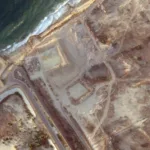
All these strands converge in the “Green Rafah” or “Rafah Ghetto” project. According to reports citing Netanyahu’s office, the UAE is responsible for building and financing the planned city east of Rafah, within the militarily controlled “yellow line,” and Israel has formally requested that militias drawn from the remnants of Yasser Abu Shabab’s group take charge of security and inspect residents.
Earlier evidence from the ground supports this account of a UAE role in backing the militia. Previously published photographs from the group’s positions east of Rafah showed Emirati number plates, making the link between external funding and the local security force more than a mere assumption.
In addition to these indicators, sources told NoonPost that the UAE-backed political current led by Mohammed Dahlan is active on the ground in Gaza. Its efforts include extensive engagement with figures and professionals to prepare them to fill government vacancies as soon as the technocratic committee arrives in the enclave. The sources confirmed that the UAE has so far provided the main funding for the committee tasked with administering Gaza during the transitional phase, and that the principal financial pledge to facilitate the government’s work comes from the same source.
Taken together, these developments reveal that the UAE has been a pivotal player, working behind the scenes both politically and on the ground. Its aim is to take primary responsibility for shaping the enclave’s future after the war, with clear Israeli facilitation alongside restrictions on, and outright rejection of, other Arab and Islamic roles.
Meanwhile, the UAE openly declares that its project cannot stand or succeed without removing the Palestinian resistance’s presence entirely and promoting proposals for “de-radicalization,” which it sees as a more effective way to create an opening for the spread of the “Abrahamic culture”, based on normalisation agreements and coexistence with the occupier.
