


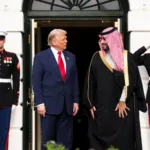






All eyes turn to Washington on November 18 as U.S. President Donald Trump receives Saudi Crown Prince Mohammed bin Salman in a visit laden with political symbolism. The Middle East is undergoing an unprecedented phase of strategic fluidity, where security shifts intersect with a reshaping of regional alliances lending this meeting unusual weight in the calculations of both parties.
This visit carries added significance as it marks bin Salman’s first trip to the U.S. in nearly eight years since the 2018 murder of dissident journalist Jamal Khashoggi at the Saudi consulate in Istanbul. That event briefly ruptured U.S.-Saudi ties and placed the crown prince at the center of international condemnation.
While both sides have since moved past that crisis, this visit appears aimed at cementing a new chapter and burying the remnants of past discord.
Despite the broad range of issues likely to be discussed, the spotlight is on one key topic: Saudi-Israeli normalization. The Trump administration seeks a diplomatic breakthrough to bolster its “peacemaker” narrative, with Riyadh seen as the crown jewel in a broader normalization drive.
Subtle signals of warming ties between Saudi Arabia and Israel over the past few years have fueled expectations of a possible public rapprochement.
However, realpolitik complicates these ambitions. Both Saudi Arabia and Israel operate within delicate regional balances, driven by distinct agendas and shaped by the fallout from the war in Gaza.
They must also contend with sensitivities among Arab, Muslim, and Israeli publics. While normalization is a key pillar of U.S. Middle East policy, it remains elusive for now.
What Does Bin Salman Want from the Visit?
For Crown Prince Mohammed bin Salman, normalization is not an end in itself, but a bargaining chip within a broader strategy to secure political, security, and economic gains. As the architect of sweeping domestic and regional reforms, bin Salman understands that official recognition of Israel holds limited appeal unless it yields substantial returns.
Chief among his priorities is bolstering Saudi Arabia’s military capabilities. Riyadh is pressing Washington to approve the sale of advanced weapons systems, including the stealth F-35 fighter jet currently possessed only by Israel in the region. This is not just about military parity; it reflects bin Salman’s ambition to reassert Saudi Arabia as a leading regional power.
Beyond weapons, the crown prince seeks a formal defense pact with the U.S. not a revocable executive arrangement like the one with Qatar, but a binding congressional treaty. Such a deal would provide strategic longevity, transcending the uncertainty of U.S. political cycles.
While a defense agreement could reduce Riyadh’s reliance on Israeli security cooperation, it faces a major hurdle: congressional approval, which is unlikely without clear progress toward normalization with Israel.
Economically, bin Salman envisions deeper partnerships with the West to diversify Saudi Arabia’s oil-dependent economy, in line with Vision 2030. These ties span beyond investments and tech transfers they include integrating Saudi Arabia into global supply chains and transnational infrastructure projects.
In this context, normalization becomes a strategic tool leveraged to extract maximum gains intertwining Riyadh’s quest for greater regional influence with Washington’s and, by extension, Israel’s, willingness to offer concessions.
The Gaza War Upends the Equation
The war in Gaza has dramatically shifted the normalization trajectory. The Israeli assault on the enclave has disrupted calculations on all sides including Washington’s, which was playing a central mediating role.
Before October 7, 2023, the atmosphere was ripe for normalization. A growing sentiment in Riyadh suggested that Palestinians should not hold veto power over regional alignments. This view was exemplified by former Saudi Ambassador to the U.S. Prince Bandar bin Sultan’s frequent criticisms of the Palestinian leadership.
Against this backdrop, the Biden administration was nearing a deal it saw as the culmination of years of diplomacy and a key to regional influence.
However, the Hamas-led Operation “Al-Aqsa Flood” and Israel’s subsequent onslaught in Gaza upended that momentum. The attack appeared, in part, intended to derail what many in the U.S. and Israel had described as an impending “normalization celebration.”
The Abraham Accords of 2020 had already sparked debate over Arab concessions without reciprocal gains for Palestinians.
Before the war, Riyadh viewed Israeli violations as routine and not a serious obstacle to rapprochement. But the scale of violence in Gaza, coupled with openly hostile rhetoric toward Saudi Arabia from Israeli political figures, has made continued engagement politically and morally costly.
Arab and Muslim public opinion has shifted sharply, and Riyadh can no longer sidestep Palestinian bloodshed as a marginal issue.
Today, pursuing normalization risks internal backlash and regional instability realities that bin Salman cannot ignore. Any further steps toward normalization are now tied to broader developments that weigh legitimacy and public sentiment alongside diplomatic calculus.
The Two-State Solution Dilemma
One of the most entrenched obstacles to Saudi-Israeli normalization is Riyadh’s commitment to the two-state solution. Unlike other normalization signatories, Saudi Arabia continues to anchor its foreign policy to the 2002 Arab Peace Initiative, which ties recognition of Israel to the establishment of an independent Palestinian state.
Bin Salman reaffirmed this stance as recently as September 2024, stating that Saudi Arabia would not establish diplomatic ties with Israel without a Palestinian state with East Jerusalem as its capital.
Israel, however, shows no indication of moving in that direction. Netanyahu’s government backed by far-right factions explicitly rejects a Palestinian state. In 2024, it accelerated settlement expansion in the West Bank and undermined the Palestinian Authority, marking the most aggressive land appropriation since the Oslo Accords.
Even a change in Israeli leadership is unlikely to alter this stance. Historically, even centrist governments have balked at core concessions. The Israeli Knesset has adopted positions framing a Palestinian state as an existential threat rendering any progress politically costly.
Far-right parties have also threatened to collapse the coalition over any recognition of Palestinian sovereignty, leaving Netanyahu politically cornered and the Israeli position structurally paralyzed. This entrenched stance places Riyadh’s condition beyond near-term reach.
Security Dilemmas Shadow Progress
Riyadh is unapologetically focused on enhancing its defense posture amid shifting regional threats. The Israeli strikes on Doha earlier this year shocked Gulf states, exposing vulnerabilities even among nations closely aligned with the U.S. and Israel.
Saudi Arabia now views regional deterrence as insufficient and believes similar strikes could occur in Riyadh or Abu Dhabi unless the Gulf security framework is revamped.
Israel, meanwhile, fears that arming Saudi Arabia with advanced weapons could erode its qualitative military edge a foundational tenet of Israeli defense doctrine. Further tensions exist over Saudi ambitions for a civilian nuclear program, with some Israeli defense officials warning that granting such capabilities could trigger a regional arms race.
These diverging security interests, combined with Israel’s post-October 7 shift in focus to internal threats and border defense, reduce normalization’s urgency for Tel Aviv. The result: a slowed, uncertain path forward.
Public Opinion: The Unseen Obstacle
Public sentiment remains a formidable barrier. In Israel, normalization conditioned on a Palestinian state is deeply unpopular. A May 2024 poll showed 74% of Jewish Israelis oppose any normalization tied to Palestinian sovereignty, with only 19% believing coexistence is viable an all-time low.
In Saudi Arabia, public resistance is just as strong. While the kingdom lacks electoral politics, its leadership remains sensitive to youth sentiment. During the Gaza war, Saudi youth spearheaded rare boycott campaigns against U.S. goods a political statement in a tightly controlled society.
A December 2023 Washington Institute poll found that 96% of Saudis opposed ties with Israel. A January 2024 Doha Institute survey showed 68% rejecting recognition of Israel the highest rate since 2016. Even before the war, 86% of Saudis opposed Israeli teams participating in sporting events held in the kingdom.
These numbers indicate that while normalization might seem feasible on paper, it runs up against a wall of popular distrust in both countries compounded by broader Arab and Muslim skepticism, which now exerts growing pressure on Riyadh in the wake of Gaza.
American Mediation: A Brake More Than an Accelerator
Betting on a decisive American role to clinch a normalization deal may be misguided. Despite Trump’s understanding of the issue’s political value, he lacks the political capital or willingness to exert real pressure on either side.
Trump knows he cannot override Israeli interests to satisfy Saudi demands, especially on arms and security guarantees. Confronting the Israeli security establishment or its powerful Washington allies is politically perilous. Additionally, the U.S. is wary of entering long-term defense commitments that may later become costly liabilities.
Trump is likely to adopt a cautious, transactional approach seeking to extract economic and political gains from Riyadh without upsetting influential pro-Israel actors in the U.S. His administration may prefer to manage rather than resolve the issue, inadvertently slowing rather than accelerating the normalization process.
Gradual Normalization: The Most Viable Path
Given the current landscape, hopes for an imminent Saudi-Israeli normalization agreement appear more aspirational than realistic. The convergence of political, security, and societal hurdles makes a formal declaration unlikely in the near term.
Nonetheless, this does not mean the normalization file is closed. Both sides see strategic value in keeping the door open, awaiting more favorable conditions. Incremental normalization offers a practical alternative. It sidesteps contentious issues while delivering tangible gains.
Covert intelligence and security cooperation can be expanded quietly. Tech partnerships—in cybersecurity, fintech, and agrotech can deepen without public fanfare. Economic integration projects, like the India-Middle East-Europe corridor, can foster functional cooperation with high mutual benefit.
This pragmatic path aligns with Trump’s transactional style: prioritize low-profile, high-reward collaboration over high-risk political declarations. For now, normalization remains a tool -not a goal- for all three parties, and a formal Saudi entry into the Abraham Accords is not yet on the horizon.