








Year after year, the olive harvest season in the West Bank has become a barometer of Israel’s deepening annexation and settlement policies. What was once presented as isolated attacks has now evolved into a systematic, officially sanctioned approach aimed at depopulating the Palestinian countryside through daily pressure and economic deprivation.
At the heart of this slow war, the olive tree remains a living witness to a struggle not only over land, but also over memory and identity.
The Palestinian Farmer and the Fight Against Settlement
Nidal Hammad, a resident of the village of al-‘Araqa west of Jenin, was among this year’s victims of settler expansion. While tending his olive grove near the separation wall, he and his family persisted in their work despite the hostile conditions. Speaking to Noon Post, he described a deeply worrying situation, especially after the complete closure of the village, which made access to the land extremely difficult.
The roads are rough, and anyone who manages to reach their land does so “by a miracle.” Hammad affirmed that he and others continue to work their lands, placing their trust in God, even though at any moment they may be expelled or banned from entering.
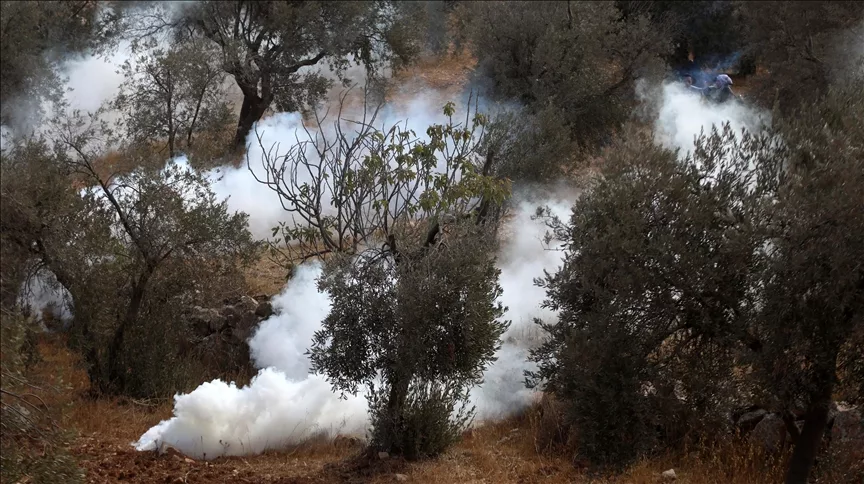
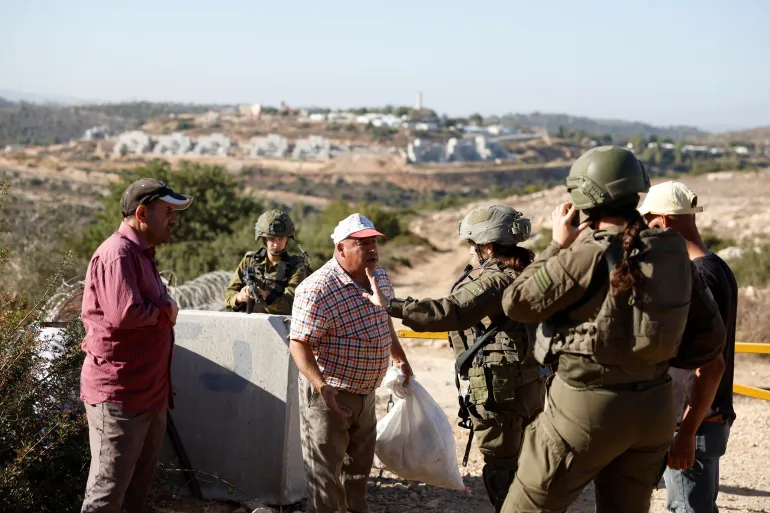
Hammad explained that Israeli forces regularly harass farmers. Soldiers came and ordered them to leave, claiming the area was off-limits. This prohibition near the wall occurs almost daily under the pretext of “security,” forcing them to retreat and then attempt to return an ordeal that recurs every season.
He added that working conditions are extremely difficult. The roads leading to the land are rocky and uneven, often damaging vehicles and forcing farmers to hire expensive private transport. Accessing the olive trees after registering and entering the restricted area feels like “an adventure.”
According to Hammad, the wall has cut off between four and six dunums of his land, previously used for grazing sheep and cattle. Now inaccessible, this has also harmed local livestock resources. Once self-sufficient in dairy, his family is now forced to purchase milk products from outside sources.
Regarding this year’s olive harvest, Hammad described it as average not particularly abundant but acceptable compared to previous years. He emphasized that every drop of oil produced is a symbol of labor and resilience, as merely reaching the trees has become a challenge in itself.
Elsewhere, Subhi al-Tawil and his family from the village of Far’ata east of Qalqilya were assaulted by settlers while picking olives on their 12-dunum plot. Al-Tawil told Noon Post that the settlers began by harassing them during the harvest, eventually throwing stones and stealing the yield that he and his three sons had worked hard to collect.
When the Israeli army intervened, it was not to stop the settlers but to detain the family for hours, break his wife’s phone, and force them to leave their land under the pretext of “lacking coordination with the Israeli side” even though no such coordination was ever required.
He added that settlers continued monitoring the farmers with drones, obstructing the harvest while being shielded by the Israeli military, which actively impeded Palestinian access to their own lands.
Escalating Settler Violence in the West Bank
Ayman Gharib, head of the Khaili al-Aghwar Association, told Noon Post that settler attacks against Palestinian farmers have sharply increased this year, particularly after the Israeli government gave settlers the green light to seize land in the West Bank through annexation decisions and on-the-ground measures.
Gharib explained that official support and the lack of accountability for settlers have contributed to the spike in violence. Major violations have been documented in areas such as Kafr Malik, al-Mughayyir, Abu Falah, Sinjil, Turmus Ayya, al-Shuyoukh, Sa’ir, Ya’bad, and several parts of Salfit and the Jordan Valley.
Hundreds of olive trees have been uprooted or destroyed, and farmers have been barred from reaching their land. One case involved the assault of an elderly woman in Turmus Ayya.
According to Gharib, his association’s field teams and volunteers continue documenting these violations daily, despite settler attacks, equipment confiscations, and military interference. He also noted a drop in the number of international volunteers due to entry bans and deportations, increasing the burden on local activists.
He stressed that farmers live under constant pressure and fear. “The olive tree is not just a tree,” he said. “It symbolizes family, roots, and steadfastness.” Despite everything, Palestinians are determined to remain on their land and resist the occupation’s attempts to uproot them.
He concluded by saying that documenting and publicizing the truth remains the most powerful weapon to confront these violations, calling on the media and international community to support Palestinian farmers and defend their rights especially in the Jordan Valley, where efforts to erase Palestinian identity and memory are intensifying.
According to a report published on the official website of the Wall and Settlement Resistance Commission, there have been 158 recorded attacks against farmers since the beginning of October. These include 17 carried out by Israeli forces and 141 by settlers, involving physical assault, movement restrictions, intimidation, and live fire.
The majority of violations occurred in Nablus (56 cases), Ramallah (51 cases), and Hebron (15 cases), in addition to the destruction of 795 olive trees across 29 incidents involving uprooting and bulldozing farmland. The Commission stated that these acts aim to undermine Palestinian resilience and sever their connection to the land. Still, farmers have remained resolute, continuing to access their fields and confront the occupation’s tactics.
Despite the relentless assaults, Palestinian farmers insist on staying rooted in their land and preserving their cultural and national identity. Their defiance carries a clear message: they will not surrender to settler violence, even when it is backed by the Israeli military.


