

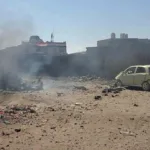













On October 27, fighters from the Rapid Support Forces (RSF) released videos showing civilian and pickup trucks engulfed in flames, surrounded by charred bodies in civilian clothes people who appeared to have attempted to flee their vehicles during an aerial strike in northwestern El Fasher, North Darfur. Time, however, was not on their side.
It was later revealed that the RSF had used drones to destroy a convoy stretching nearly 2.1 kilometers as it attempted to leave the city, shortly after El Fasher fell into RSF hands. The group then unleashed a wave of atrocities that may constitute crimes against humanity.
The use of drones to obliterate the convoy underscored just how critical these aircraft reportedly supplied by the United Arab Emirates had become to the RSF’s operations. Drones played a decisive role in the group’s capture of El Fasher, after multiple failed attempts prior to their large-scale deployment in August.
A Crumbling Status Quo
Nimir Abdelrahman, the former governor of North Darfur and a senior figure in the Sudan Liberation Movement – Transitional Council, which later aligned with the RSF, had previously brokered a ceasefire between the army, the RSF, and other armed movements. This agreement divided the city into zones of control.
That arrangement held until April 2024, when the RSF amassed a large force to lay siege to El Fasher. The blockade starved the population, forcing civilians to eat animal feed. In May, the RSF launched its offensive from its strongholds in the northern districts—areas it had emptied of residents.
For months, the RSF struggled to break through to the city center, meeting fierce resistance from the army and its allies despite starvation, a lack of medical supplies, and constant exhaustion. The RSF, however, had access to uninterrupted supply lines of military equipment, much of it provided by the UAE and routed through Libya, Chad, and Nyala Airport in South Darfur.
Its most significant breakthrough came after suffering thousands of casualties at the city’s gates: the RSF overran the Zamzam displacement camp, located 12 kilometers southwest of El Fasher, shortly after displacing the surrounding villages and cutting a critical supply route.
The RSF seized the Zamzam camp in April, just days after downing a military aircraft used by the army to ferry food and arms including short-range drones into the city. The downing came shortly after the RSF deployed Chinese-made FK-2000 air defense systems.
A Shift in Superiority
These air defense systems stripped the army of its aerial superiority, giving the RSF freedom to mass fighters and tighten its ground siege. The group began deploying strategic Chinese-made CH-95 or FH-95 drones for intensive nighttime airstrikes on El Fasher, likely to avoid satellite detection.
Civilians were forced into underground shelters to evade the drones. They limited their movements and avoided any source of light, knowing full well they faced a ruthless enemy that made no distinction between fighters and civilians children, the elderly, or women.
The RSF later used drones to support ground offensives starting August 3, pushing deeper into a city already weakened by hunger. They simultaneously destroyed water sources, healthcare facilities, and retail shops.
Under the relentless drone attacks launched from Nyala, the army was forced to retreat from its key defensive positions, particularly after losing control of the Abu Shouk displacement camp north of the city. This allowed the RSF to move in, displace the camp’s residents, and advance further.
As civilians fled neighborhoods and sought refuge in El Fasher’s upscale Al-Daraja Al-Oula district, the burden on the army and its allies grew. They had to restrict their movement to protect the displaced only for the RSF to pursue them with drones, killing hundreds in an apparent campaign of terror.
Drones Redefining Warfare
El Fasher may come to mark a turning point in the history of warfare a place where a major city was taken through remote-controlled tools that dehumanize their targets, treating civilians not as families of flesh and blood, but as objects. The drone campaign in Sudan represents a shift toward a new kind of war.
The RSF used drones not just for attacks but also for surveillance tracking army movements, supply lines, and troop concentrations. Fighters frequently published videos showcasing the drones’ precision and their effectiveness in intelligence gathering.
To say that El Fasher was not defeated is technically true it was butchered by modern drones like the Chinese Sunflower-200, which boasts a range of 2,500 kilometers. According to an RSF intelligence officer, the UAE remains the group’s principal weapons supplier.
The army had, in the past, managed to down several suicide drones using electronic jamming systems that cut communication between the drone and its operator, or by disrupting GPS signals. They also relied on heavy machine guns like the Dushka and visual camouflage.
But in El Fasher, the army had few means to counter modern drones, especially under a long-standing ground siege and an air blockade enforced by the RSF’s air defense systems. Though they succeeded in destroying some drones, this came only after the city was already on its last breath.
Leaked reports suggest that RSF drone operators were trained by experts in Libya, though Darfur Governor Minni Arko Minnawi claims the operations are directed from outside Sudan. He argues that the precision of the strikes exceeds the RSF’s known capabilities.
Minnawi attributed El Fasher’s fall to foreign “aggressor nations”—unnamed—which he says provided the RSF with logistical, financial, and intelligence support, including electronic warfare capabilities that disabled satellite-based communication systems. This effectively severed contact between army units in El Fasher and their command centers elsewhere.
He also alleged that after losing most of its leadership, the RSF turned to recruiting mercenaries from neighboring countries and beyond. It relied on drone warfare orchestrated from outside Sudan and on advanced technology to disrupt communications thanks to foreign intelligence agencies.
Control over communications and drones, Minnawi said, gives any force the upper hand on the battlefield, regardless of how heroic the resistance may be. Warfare has thus evolved: no longer centered on ground assaults and rapid maneuvers, but on AI-powered precision strikes.
Still, human will and determination can turn the tide. The army must seek effective deterrents and develop civil defense systems to protect civilians.
Ultimately, the battle for El Fasher has made one thing clear: wars are no longer fought solely with artillery and rifles. Drones now define the contours of victory and defeat. These small machines have redrawn the balance of power and if this pattern continues, we may be entering an era where humans no longer fight wars, but machines fight in their stead.


