











From New York to San Francisco, from Boston to Atlanta, and through cities like Chicago and Los Angeles, massive crowds of Americans poured into the streets on Saturday, October 18, in over 2,700 demonstrations across nearly every state a spectacle described as “the largest day of protest in modern American history.”
This sweeping wave of mobilization rallied under the slogan “No Kings,” a clear rejection of what protesters view as President Donald Trump’s growing authoritarianism and a denunciation of policies they see as threats to democracy and restrictions on the rights of immigrants and political dissenters.
In a mocking response to this public outcry, Trump posted an AI-generated video on his Truth Social platform depicting himself wearing a royal crown, piloting a fighter jet, and dumping what resembled waste on protesters—a clear sign of his disdain for the movement and indifference to its demands.
As the protests expanded horizontally across the states and vertically through more organized and well-funded civic support the movement has evolved beyond mere symbolic defiance into a structured sociopolitical force. This transformation has raised serious questions about its potential to influence the current American political landscape.
“No Kings”: A Protest Movement Unlike Any Other
The “No Kings” movement, which has become the unifying slogan of this American uprising, stands as one of the largest and most widespread protest campaigns in recent U.S. history. It represents a broad, grassroots repudiation of what it describes as the growing authoritarian tendencies within Trump’s administration.
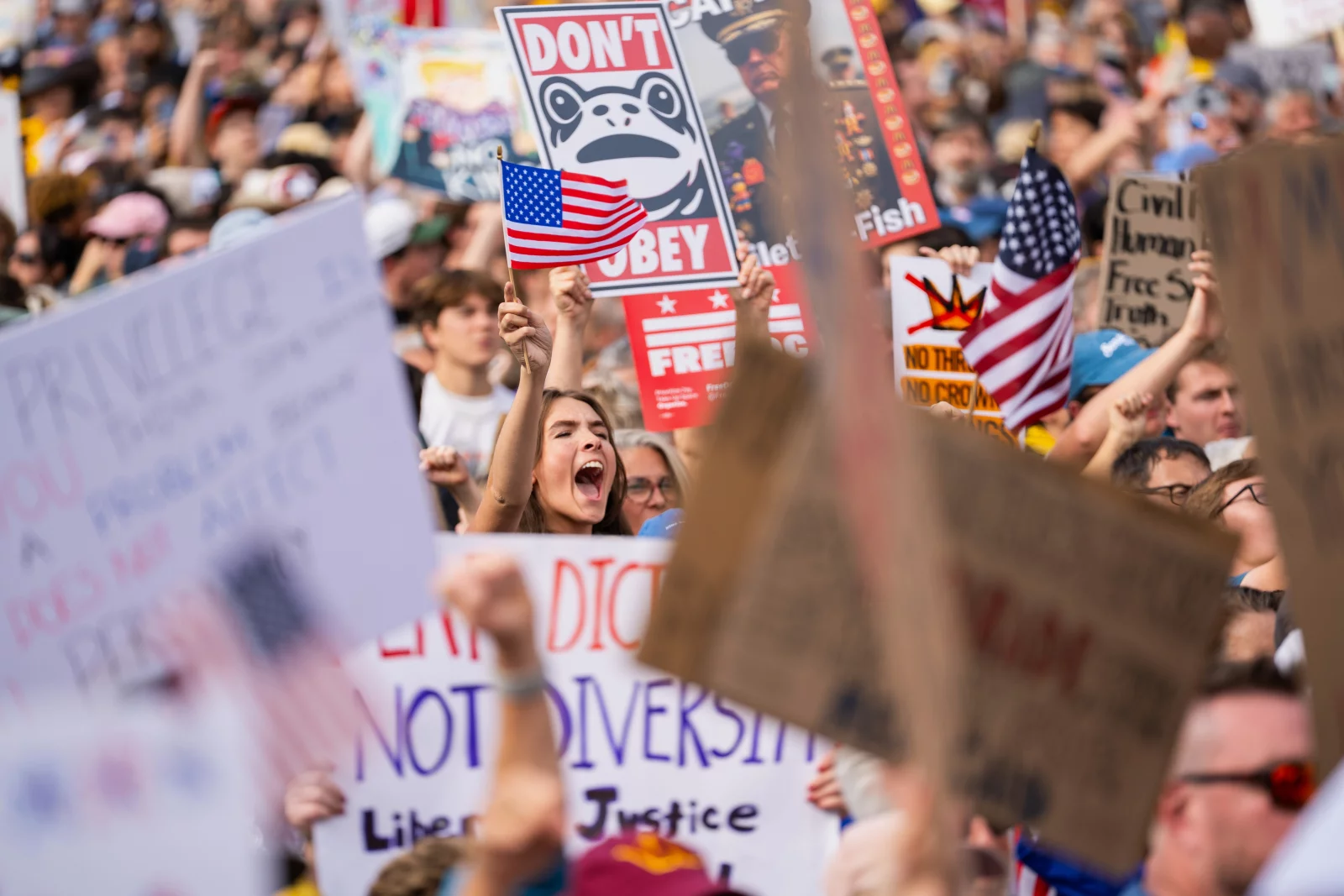
Organizers drew inspiration from the historical legacy of the American Revolution, which rejected British monarchy. They aim to revive that founding principle in the face of what they perceive as an attempt to consolidate executive power beyond legal bounds. The movement rests on three foundational pillars:
A symbolic dimension that captures public anxiety over executive overreach and legal manipulation; a numerical dimension evident in the vast crowds flooding the streets, underscoring the power of popular will; and an institutional dimension, asserting that the executive branch is subject to the rule of law and that the people are the ultimate guardians of democracy.
At its core, the movement proclaims: “The president may think his power is absolute, but in America, we have no kings. We will not surrender to chaos, corruption, or cruelty.” It emerged as a direct response to what its founders see as escalating authoritarianism during Trump’s second term.
The name “No Kings” symbolizes the rejection of transforming the president or the executive branch into an elevated, monarchical authority. Its catchphrase “No thrones, no crowns, no kings” captures this ethos. The movement’s first major protest took place on June 14, with demonstrations in over 2,000 locations across the country. It reached its peak on October 18, expanding to more than 2,600 sites nationwide.
Protesters have championed the protection of civil liberties, the independence of the judiciary and legislature, and the accountability of executive power. They reject authoritarian tactics such as deploying the National Guard in cities, mass immigration raids, and efforts to erode democratic checks and balances. For them, protest is not anti-American it is an expression of the belief that democracy is only safeguarded through participation.
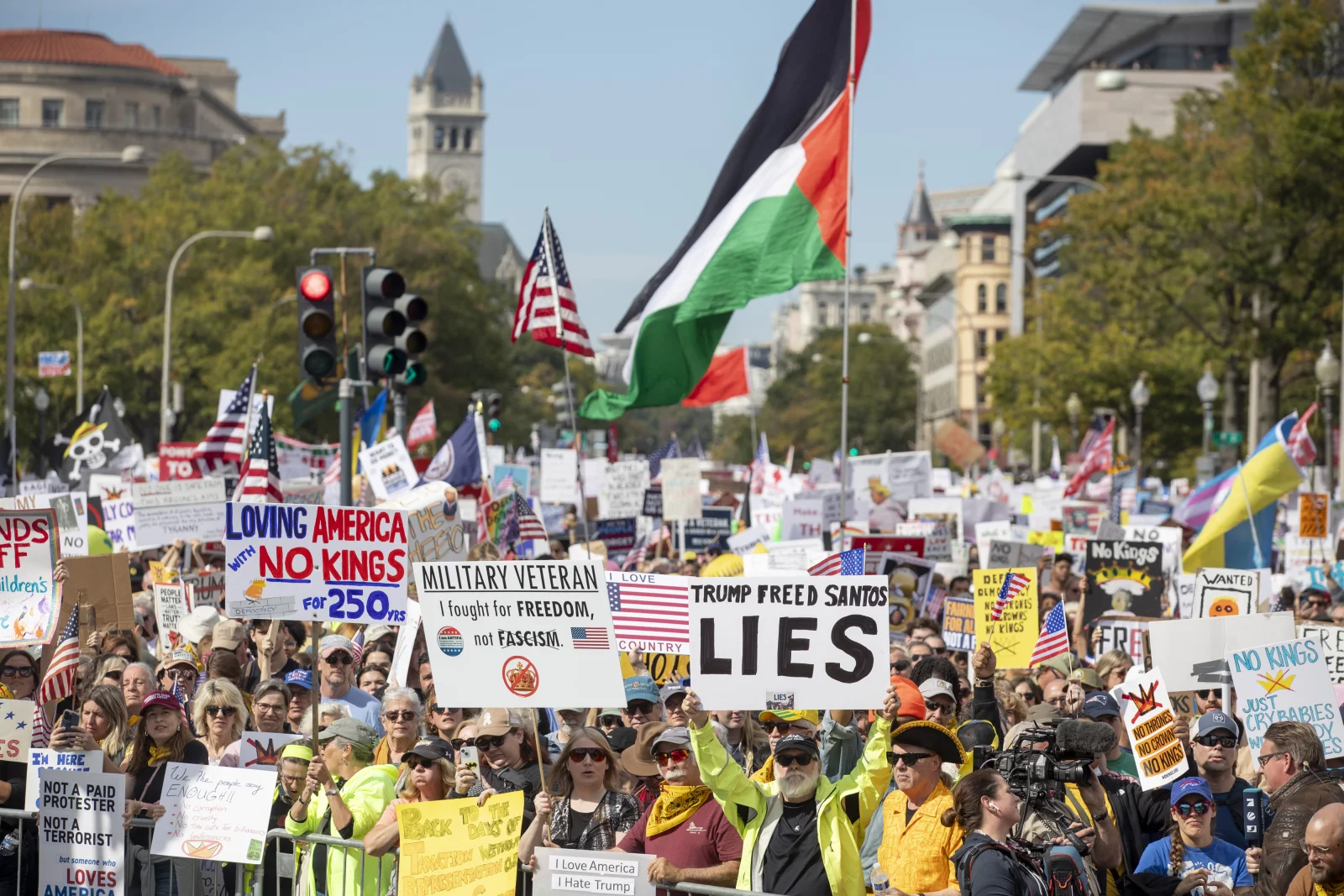
The movement draws strength from key civil and human rights organizations like Indivisible, the American Civil Liberties Union (ACLU), MoveOn, and others that have helped scale the movement across all 50 states. Solidarity protests have also taken place in European and Australian cities, where demonstrators echoed the “No Kings” message in support of the American cause.
Tactically, the movement emphasizes peaceful protest and uses visual symbols most notably the color yellow to unify participants. So far, it has steered clear of violence or direct confrontations with law enforcement, though some observers warn that this could change if tensions escalate.
Meanwhile, Republican voices have denounced the movement as “anti-American” and “fueling extremism,” while Trump has dismissed it as an “unpatriotic” campaign driven by “enemies within.” Its supporters, however, view it as a constitutional expression of dissent, arguing that such accusations are attempts to discredit a movement that seeks to protect democracy from erosion.
There is growing evidence that the movement is far from a spontaneous phenomenon. Rather, it is the product of broad, multi-actor alliances involving human rights groups, major labor unions, civic organizations, and cultural and political entities working in coordination.
These institutional backers provide logistical support, ongoing recruitment, and nonviolent protest training allowing the movement to maintain extraordinary reach and mobilization capacity.
This level of organization suggests the movement could evolve from symbolic protest into a pressure network capable of orchestrating synchronized action and sustained advocacy. With robust institutional backing, the movement may not only improve its funding and planning capabilities but also amplify its core message: that the executive is not above the law, and the people have the final say.
Denouncing Trump’s Authoritarianism
Participants in the “No Kings” movement are united in their belief that since the start of his second term, Trump has been behaving like an unchecked monarch—flouting the Constitution and destabilizing the democratic order.
American anxieties over “Trumpian authoritarianism” have intensified in response to a series of alarming actions, including:
-
Militarization of cities: Deploying federal forces and the National Guard to suppress peaceful protests;
-
Crackdowns on immigration: Harsh and coercive policies targeting immigrants;
-
Curtailment of freedoms: Erosion of press freedom and democratic norms;
-
Economic consequences: Policy decisions undermining social and economic safety nets, such as cuts to Social Security programs.
In response, millions of Americans have taken to the streets demanding essential reforms: the protection of democratic institutions, the advancement of civil rights, an end to unchecked executive expansion, and the accountability of those who violate the law.
Strengths and Vulnerabilities
The American protest movement boasts several strengths that fuel its growing momentum. Chief among them are its vast scale and widespread public participation. Estimates suggest that over seven million Americans joined the latest wave of protestsa number that reflects deep public discontent and exerts real pressure on the government and security apparatus.
The movement has also shown a remarkable ability to attract diverse social groups across geographic and political lines. Its resonance has extended overseas, and its institutional alliances have given it growing legitimacy and organizational resilience.
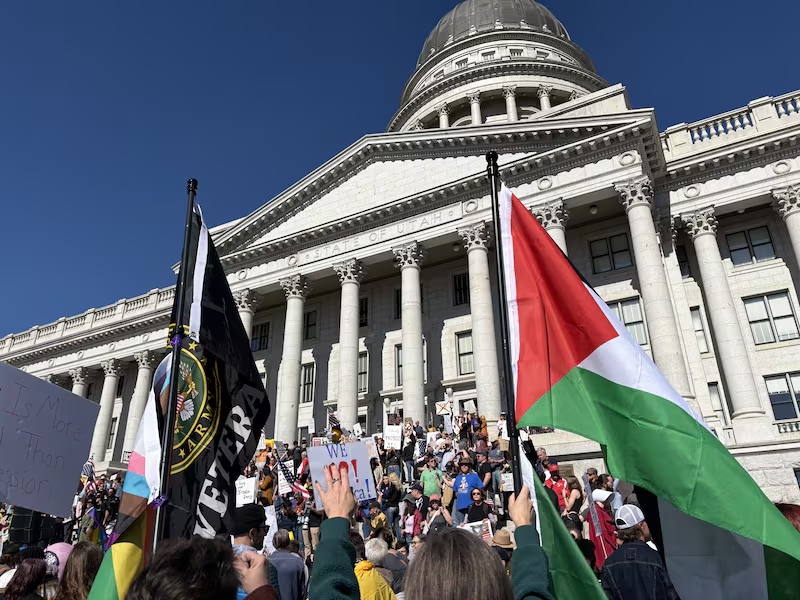
Its use of simple yet potent symbols like the historical and political connotations of “No Kings” has made the movement’s message both accessible and widely shareable across different social strata and media platforms.
However, challenges remain. Despite its size, the movement’s impact is still largely symbolic. It has yet to translate its energy into concrete political or legislative change.
Furthermore, the movement’s dominant left-leaning ideological tone risks alienating moderate or undecided constituencies. This could limit its broader appeal and restrict its influence to certain ideological enclaves within the American political spectrum.
From Protest to Power: Four Conditions for Impact
As of now, “No Kings” has succeeded in reshaping the political conversation around executive power. Yet, it remains at a crossroads still rooted in protest, not transformation.
To evolve into a lasting political force, the movement must meet four essential conditions:
-
Sustained and institutional organization: Developing permanent coordination mechanisms and transforming grassroots groups into policy-oriented lobbying entities.
-
Expanded political alliances: Building strategic relationships with diverse voter blocs and local representatives capable of enacting legislative reforms.
-
Tangible victories: Setting clear, measurable goals—such as advancing bills that strengthen congressional oversight and institutional independence.
-
Electoral translation: Converting mass mobilization into organized electoral pressure, ensuring that the voices in the streets translate into votes at the ballot box.
Only then can the movement move beyond symbolic protest and begin reshaping the American political order.
Will It Affect Trump’s Future?
It’s too early to determine whether this movement at least in its current form will directly impact Donald Trump’s political future. His entrenched support among conservatives and populist right-wing voters remains largely intact and resistant to rapid erosion.
Trump and his Republican allies have projected internal discipline, framing the protest movement as part of a “liberal conspiracy” aimed at politically sabotaging him. At the same time, Trump has used this narrative to rally his base, portraying himself as the victim of “political persecution.”
Still, the rising symbolism of the “No Kings” movement should not be underestimated. Compared to the wave in June, this latest resurgence is more far-reaching and better organized. Millions have mobilized across all 50 states, and growing international solidarity may tarnish Trump’s global image associating him in public consciousness with authoritarianism and democratic backsliding. Such a perception could have long-term political consequences.
If the movement maintains its momentum, it may redefine its political weight during the upcoming elections. Its ability to galvanize youth and independent voters especially in swing states like Michigan, Pennsylvania, and Arizona could weaken Trump’s prospects.
But if it remains confined to liberal circles and fails to break ideological barriers, its electoral influence may wane, leaving it as yet another protest movement that made noise but shifted little.
Ultimately, the deeper value of “No Kings” lies beyond Trump. It reasserts a foundational American idea: that no executive power should be treated as sovereign or above accountability. It teaches future politicians, journalists, and lawmakers that “power must be watched, not worshiped.”
In short, the movement may not change Trump but it could very well change how Americans view the presidency itself.
The future of “No Kings,” then, lies in one of two scenarios: Either it harnesses its institutional muscle and civic backing to become a permanent political force, or it fizzles out, confined to ideological echo chambers and fading from relevance. The coming weeks will reveal which path it will take.


