











هذا التقرير متاح أيضًا بـ العربية
On the same day that the Supreme Council for Media Regulation granted licences to a number of websites, including July, which launched only a few months ago, the Supreme State Security Prosecution summoned journalist Lina Attalah, editor-in-chief of Mada Masr, for questioning for the sixth time on charges of operating a website without a licence.
Attalah was released on bail of 100,000 Egyptian pounds after questioning, then referred to trial on the same charge just 24 hours later, even though Mada Masr had been seeking to regularise its status since the 2018 media regulation law came into force, following the procedures it set out. Its latest application remains pending, with no decision to date. The same happened to Al Manassa, whose editor-in-chief, Nora Younis, had previously been investigated on the same charge.
In a sudden development at the first hearing, Cairo Misdemeanours Court fined Attalah 3 million Egyptian pounds, ordered Mada Masr’s closure and detained her until the fine is paid. At the time of writing, NoonPost has been unable to obtain comment on the fate of the website and its staff.
One hearing to shut down Mada Masr
According to Hossam Bahgat, executive director of the Egyptian Initiative for Personal Rights, who attended the hearing, the court adjourned after the defence team insisted on sufficient time to review the case file. When the hearing resumed, the judge ordered everyone except Mada Masr’s editor-in-chief and her defence team to leave the courtroom. The room then filled with officers and guards in plain clothes, including an officer from National Security.
Bahgat said the presiding judge and a representative of the State Security Prosecution later entered the courtroom. The judge announced that the court had rejected all the defence’s procedural motions, including requests to add documents to the file and hear witnesses. He then asked the lawyers to begin their pleadings, but the defence team maintained its position and refused to proceed until its requests had been addressed. The judge then surprised them by summoning a lawyer unknown to any member of the team and announcing that the court had appointed him to defend Attalah.
Bahgat said the eight members of the defence team loudly objected to the appointment of another lawyer while they were present. Attalah herself said she refused to be represented by the court-appointed lawyer, but the presiding judge refused to record her objection in the hearing minutes.
Bahgat said the presiding judge personally recorded the appointed lawyer’s requests in the minutes, although the lawyer had not uttered a word. The judge then began reading out the guilty verdict as the defence team shouted objections. He imposed the maximum penalty on Attalah: a fine of 3 million Egyptian pounds, the closure of Mada Masr and the confiscation of equipment and devices.
Bahgat added that those present were shocked when, after the ruling, security personnel surrounded Attalah, lifted her off the floor and carried her out of the courtroom. He confirmed that she remains detained.
Punishment for independent journalism
Over the past eight years, the referral of websites for investigation on charges of operating without a licence has been linked to their publication of journalism opposed to the regime. In September 2022, Attalah and three female journalists from Mada Masr were referred for investigation after publishing a report on corruption within the pro-regime Mostaqbal Watan Party. In August 2025, she was referred for investigation again on the same charge after publishing a report on conditions inside Badr prison.
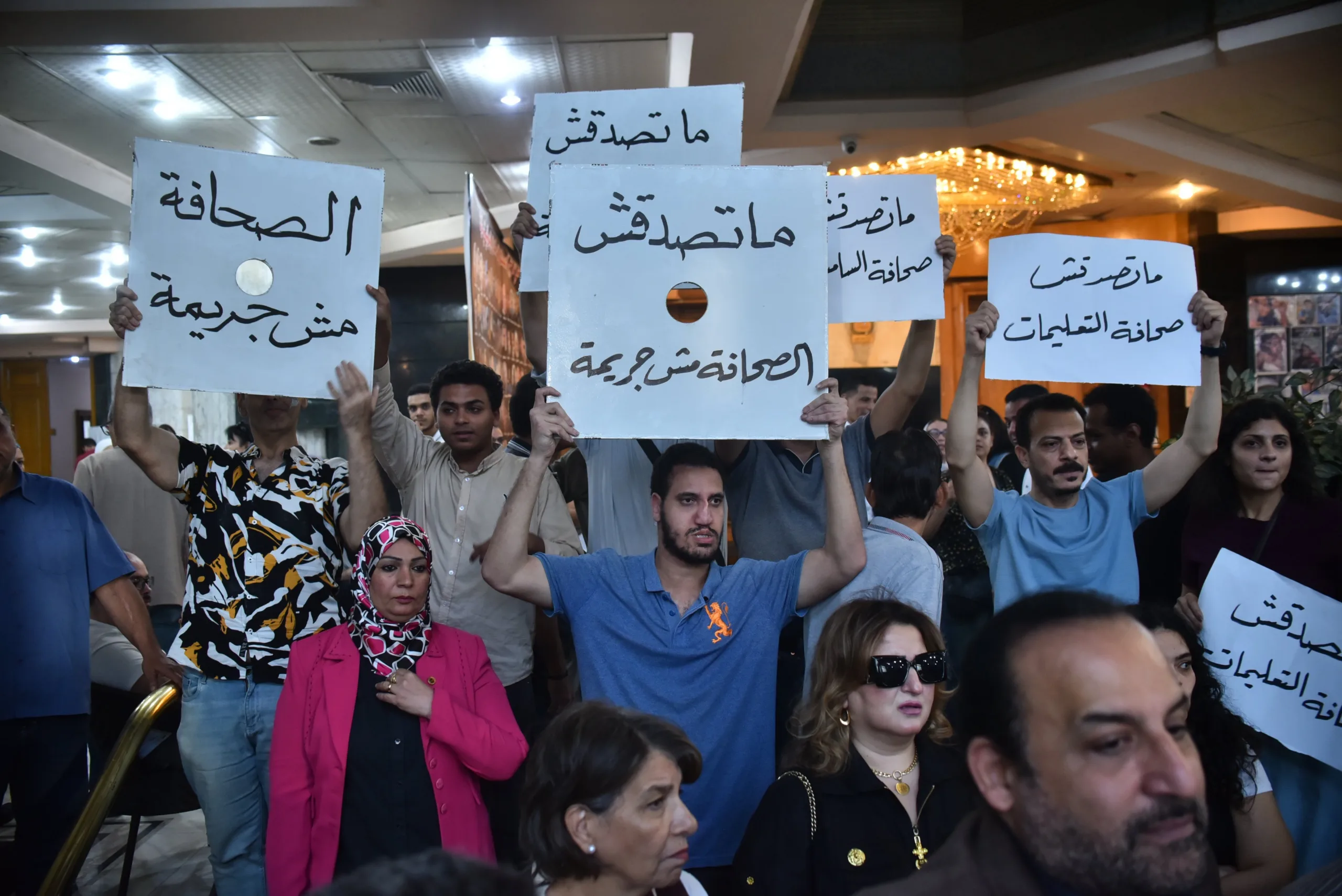
She was summoned again for questioning on charges of operating a website without a licence after Mada Masr expressed solidarity with the journalists of Matsada2sh and took part in the “Until They Return” initiative, which brought together eight newspapers to fact-check official statements during the “Egyptians Forum.”
According to Hassan al-Azhari, Mada Masr’s legal adviser, the website first applied for a licence in October 2018, after the media regulation law was issued. It renewed its application after the law’s executive regulations were issued.
– خطوة جديدة تضيّق الخناق على الإعلام المستقل في مصر: نيابة أمن الدولة تحيل لينا عطا الله، رئيسة تحرير “مدى مصر”، إلى المحاكمة، بعد ساعات من إخلاء سبيلها مقابل 100 ألف جنيه.
– تُحاكَم عطا الله بتهمة إنشاء وتشغيل موقع إخباري دون الحصول على ترخيص، وتنطلق أولى الجلسات أمام جنح القاهرة الجديدة يوم 27 أكتوبر الجاري.
– دفاع “مدى مصر” انتقد سرعة الإجراءات، معتبرًا أن الإحالة الفورية بعد التحقيق، وتحديد موعد قريب للمحاكمة، أمر لا تبرره طبيعة القضية.
– كما استُخدمت خلال التحقيق اتهامات مطاطة كبث أخبار مضللة، في حين تُلاحَق عطا الله بسبب ترخيص تماطل الجهات الرسمية في منحه للموقع منذ يونيو 2023.
– ولا تقف الملاحقات عند “مدى مصر”، إذ يقبع صحفيو “متصدّقش” الستة، أي فريق التحرير بأكمله، خلف القضبان حتى الآن.
— نون بوست (@NoonPost) October 22, 2026
Al-Azhari said the Supreme Council for Media Regulation had not responded to the website’s requests to regularise its status. In January 2021, those running the outlet were surprised to learn that the council had rejected its licence application. They were informed during Public Prosecution investigations involving several of its journalists in a publication-related case.
In press statements, al-Azhari said the website had filed a grievance against the rejection and brought a case before the administrative courts to challenge it. Yet it has still not been granted a licence, despite seeking one since 2018, while other websites are being licensed.
He said that in October 2022, Mada Masr filed a lawsuit before the State Council challenging the Supreme Council for Media Regulation’s decision to deny it a licence without giving reasons. The council later justified its decision by saying that some required information and documents were incomplete. This prompted the outlet to submit a new application supplying the missing material, but it has received no response to date.
Given the speed of Attalah’s referral to trial, al-Azhari had expected a ruling fining the editor-in-chief and shutting down the website — which is exactly what happened.
He stressed that denying independent news websites licences deprives their journalists of union and legal protection, exposes them to security risks, restricts their right to access information and denies them the legal safeguards necessary for their protection.
Complex procedures and pending licences
Before the 2018 press and media regulation law was issued, websites were not generally subject to a mandatory legal framework governing their work. Some website managers therefore limited themselves to obtaining a registration and deposit certificate from the Office for the Protection of Intellectual Property Rights at the Information Technology Industry Development Agency, or a certificate for the use of artistic works from the General Administration of Artistic Licensing at Egypt’s Ministry of Culture.
The 2018 press and media regulation law granted the Supreme Council for Media Regulation broad powers over websites. Article 6 states:
“It is not permissible to establish websites in the Arab Republic of Egypt, or to manage them, or to manage offices or branches of websites operating from outside the republic, except after obtaining a license to do so from the Supreme Council in accordance with the rules and conditions it sets in this regard. Without prejudice to the prescribed criminal penalties, in the event of a violation of the provisions of the preceding paragraph, the Supreme Council may take the necessary measures, including revoking the license, suspending the website’s activity, or blocking it, in the event that no valid license has been obtained. Interested parties may challenge the resulting decision before the Administrative Court.”
Under the law and its executive regulations, issued in 2020, applicants must submit an application to establish or operate a website to the council’s general secretariat, accompanied by proof of payment of a fee of 50,000 Egyptian pounds. The council’s licensing committee examines the application within a week of its registration, then prepares a report setting out its opinion. The report is submitted to the council within 30 days for a decision on whether to grant or deny the licence. A licence is valid for five years and can be renewed by applying six months before it expires and paying the same fee.
Article 12 of the executive regulations governs the handling of licence applications, particularly those that do not meet the conditions or are rejected. It requires the council to notify applicants that they must supply any missing information within 30 days of the licensing committee’s report being presented to the council. Notification must be sent by registered post with acknowledgement of receipt.
The council must also approve or reject an application, by a majority of the members present, within 90 days of receiving all the required information and documents. It must notify the applicant of its decision by registered post with acknowledgement of receipt. The same article guarantees applicants the right to challenge the council’s decision before the Administrative Court.
While Mada Masr was ordered to close by a court, Salah al-Din Hassan, founder and editor-in-chief of Zat Masr, decided to close his website himself after he and its staff faced harassment. This included the jailing of one of its editors for six months and the repeated summoning of its editor-in-chief for questioning.
Hassan told NoonPost that the application procedures are extremely complicated. Applicants must first submit their file electronically, then take it to the council’s headquarters in the Maspero building and telephone the employee responsible, on whom acceptance of the file depends. If it is accepted, the applicant must obtain a payment order or receipt allowing them to pay the 50,000-pound licensing fee at the bank.
– قضت محكمة مصرية بتغريم لينا عطا الله، رئيسة تحرير موقع “مدى مصر”، ثلاثة ملايين جنيه وإغلاق الموقع ومصادرة معداته بتهمة إدارته دون ترخيص، واحتجزتها قوات الأمن عقب صدور الحكم.
– رفضت المحكمة طلب الدفاع تأجيل القضية للاطلاع على أدلتها، وانتدبت محاميًا لم تختره عطا الله ورفضته، فيما مُنع الصحفيون من حضور الجلسة وسط حضور أمني مكثف.
– تعود القضية إلى طلب ترخيص قدّمه الموقع عام 2018 وسدّد رسومه، لكنه لم يتلقَّ أي رد رسمي، ولم يعلم برفضه إلا أثناء التحقيق مع عطا الله عام 2022.
– دفع فريق الدفاع بعدم دستورية المادتين 6 و105 من قانون تنظيم الصحافة والإعلام، وهما تشترطان الترخيص وتعاقبان من يخالفه بغرامة تصل إلى ثلاثة ملايين جنيه مع الغلق والمصادرة.
– قدّم نقيب الصحفيين خالد البلشي مذكرة إلى المجلس الأعلى لتنظيم الإعلام، أكد فيها أن عدم إخطار الموقع بالقرار مخالفة إجرائية، وأن مكان هذا النزاع هو القضاء الإداري لا المحاكم الجنائية.
– طالبت النقابة بوقف الملاحقات القضائية المرتبطة بالترخيص، ورفع الحجب عن المواقع الإخبارية، وتخفيف شروط الترخيص بما يتناسب مع طبيعة الإعلام الرقمي.
— نون بوست (@NoonPost) October 27, 2026
Hassan stressed that reaching the point of paying the fee is extremely difficult, as the payment receipt is considered an indication that the website is progressing through the licensing process and evidence of good faith that can be relied on during investigations.
He said some websites obtain licences just a few months after applying, while his own waited two years after applying in 2023 before he decided to shut it down at the beginning of 2026, even though it had faced no problems with the authorities when it submitted its application.
Licensing as a tool to silence the press
Shaimaa Hamdy, editor-in-chief of Athar, told NoonPost that licensing had become a pretext for abusing and harassing independent news websites. She said the press and media regulation law had been promoted as a means of regulating the media and the work of websites.
But media organisations and groups concerned with press freedom and freedom of expression condemned its executive regulations for imposing conditions described as arbitrary and prohibitive. Chief among these were the 50,000 Egyptian pound application fee and the requirement for websites to have a team of journalists registered with the syndicate.
Hamdy added that these conditions assume a website has enough capital from the moment it launches to cover at least the cost of applying for a licence.
– طالبت “هيومن رايتس ووتش” السلطات المصرية بإسقاط القضية ضد لينا عطا الله، رئيسة تحرير “مدى مصر”، مؤكدة أن الصحفيين لا ينبغي أن يُلاحَقوا جنائيًا بسبب عملهم.
– وصفت المنظمة الملاحقة المتسارعة لعطا الله بأنها تصعيد ضد الإعلام المستقل في مصر، فيما دعت إلى إنهاء المضايقات المتكررة بحق وسائل الإعلام وإسقاط التهم المرتبطة بممارسة حرية التعبير.
– اعتبرت المنظمة فرض شروط للترخيص ثم تجاهل محاولات “مدى مصر” استيفاءها محاولة لتقويض المنصة، مشددة على أن هذه الممارسات تنتهك القانون الدولي لحقوق الإنسان.
– شاركت المنظمة في نداء أطلقته أكثر من 100 منظمة مدنية لمنح “مدى مصر” ترخيصًا للعمل، في وقت تقول فيه المنصة إنها لم تتلق ردًا على طلبها المقدم عام 2023.
— نون بوست (@NoonPost) October 27, 2026
Hamdy stressed that, despite objections to the law, the demand was now simply for it to be applied. The crisis today, she said, lies in its selective enforcement. Independent websites whose editorial policies do not meet the relevant authorities’ approval are punished with silence: their licence applications go unanswered beyond the statutory deadline or are rejected without explanation. This leaves organisations waiting for years without knowing the outcome of their applications or the reasons for rejection.
She said Mada Masr learned that its licence application had been rejected during the prosecution’s investigation of its journalists, while it was still awaiting a response from the council. She noted that the same applies to Al Manassa, Fakkar Tany and other independent websites.
Hamdy said she was personally following up on Athar’s licence application and was aware that it could face the same obstacles, whether rejection or a failure to respond. She regarded this as a policy that had been in place since the law was issued.
Hamdy criticised the council, saying it “abandons people to their fate,” even though its primary role is to regulate the media. She said the abuse of organisations whose journalism does not win the authorities’ approval had pushed a number of journalists to work abroad, after opportunities for journalistic work inside Egypt narrowed amid restrictions on press freedom and difficulties obtaining licences.
She stressed that the issue went beyond the fate of independent websites to the freedom to publish and the future of the profession, asking, “What comes next? And who will trust a press that offers only one voice?” She argued that the existing crisis of confidence between citizens and the government, and between the public and media outlets that adopt a single viewpoint, was likely to worsen, creating more tension, anxiety and uncertainty.
– جددت نيابة أمن الدولة العليا في مصر حبس صحفيي منصة “متصدقش” الستة 15 يومًا، خلال جلسة عُقدت عن بُعد من سجن بدر، دون تحقيقات جديدة أو مواجهتهم بأدلة، بحسب بيان المنصة.
– أكدت “متصدقش” أن جلسات التحقيق منذ احتجاز صحفييها في سبتمبر لم تشهد تقديم أدلة على الاتهامات، ومنها “التمويل الأجنبي” و”الانضمام إلى جماعة إرهابية”.
– اشتكى الصحفيون من منع التواصل مع بقية النزلاء وإدخال الكتب، إلى جانب منع ذويهم من إدخال الملابس الشتوية وعدم السماح بشرائها داخل السجن، وفق البيان.
– طالبت المنصة بالإفراج الفوري عن صحفييها وضمان حقوقهم داخل محبسهم، بينما حمّلت السلطات المصرية مسؤولية سلامتهم وطالبت بكشف الأدلة والأساس القانوني لاستمرار احتجازهم.
— نون بوست (@NoonPost) October 27, 2026
Hamdy argued that a free press helps the government confront crises by enabling citizens to understand what is happening and grasp the risks when accurate information reaches them. But when people become accustomed to the absence of truth, they will lose confidence in government warnings, even when the country faces a real crisis that requires those warnings to be believed.
She concluded by stressing the importance of a free and independent press in Egypt. Fighting it, she argued, harms citizens’ right to know, journalists’ right to work freely in accordance with the Constitution and the state’s own interests. She described the day of the ruling to shut down Mada Masr as “a black day in the history of the Egyptian journalism profession.”
Khaled Elbalshy, head of the Egyptian Journalists Syndicate, told NoonPost that the syndicate rejects the closure and confiscation of news websites because these measures violate the Constitution. He said the syndicate had previously submitted a memorandum on Mada Masr’s licensing crisis. The speed with which the maximum penalty was imposed, he stressed, raises many questions about the state’s view of press freedom.
