
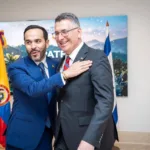



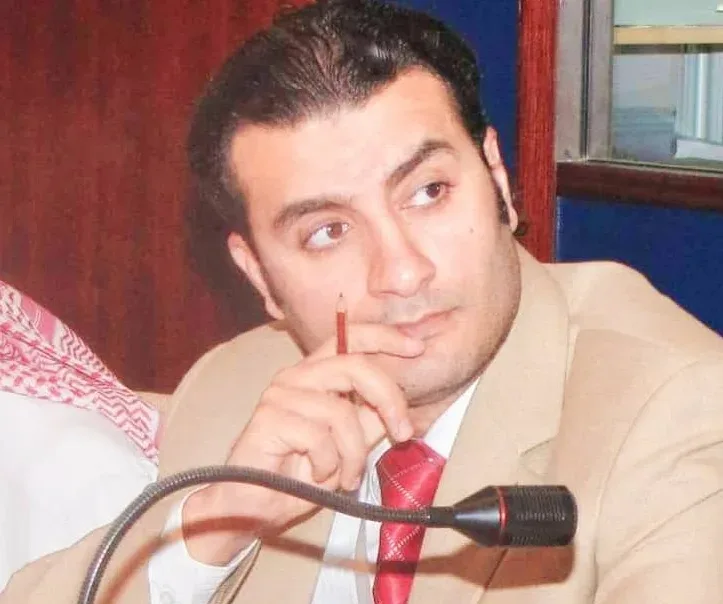

FIFA President Gianni Infantino’s participation in the “Extraordinary Peace Summit” held in Egypt’s Sharm El-Sheikh on Monday, October 13, 2025, sparked widespread controversy and astonishment across political and media circles.
Infantino’s presence—alongside leaders from more than 20 countries was described as “peculiar,” as he stood out as the only non-political figure in a high-level geopolitical gathering. His unexpected appearance prompted questions about the motivations behind such an out-of-context move.
Infantino defended his attendance, which came at the invitation of U.S. President Donald Trump, by expressing a desire to support global peace initiatives. “This goes beyond football,” he stated, emphasizing FIFA’s efforts to position the sport as a “bridge of communication and hope” between nations.
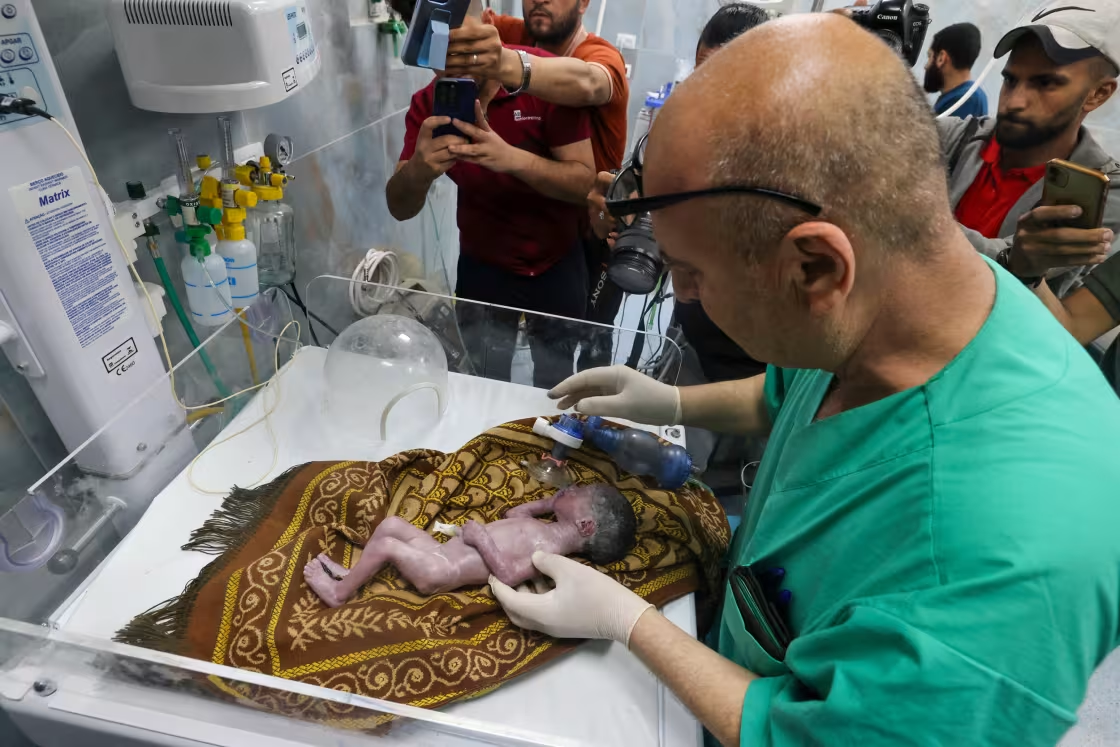
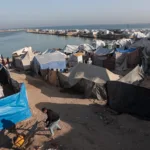
Yet, his subsequent remarks exposed a striking contradiction. Infantino announced FIFA’s intent to play a major role in the reconstruction of Gaza, including building new sports infrastructure in the territory devastated by Israeli attacks. These strikes had obliterated Gaza’s sports ecosystem from stadiums and clubs to players and officials.
Observers viewed this as a blatant attempt to leap over FIFA’s prior silence in the face of atrocities committed against Gaza’s sports sector over two years. During that time, FIFA ignored repeated international human rights calls to impose a football ban on Israel, despite evidence of systemic violations.
Now, as Infantino seeks a share of the “reconstruction pie,” critics argue that FIFA’s pivot reveals an appalling level of hypocrisy and ruthless pragmatism. It undermines the federation’s long-touted values and places it among those complicit in crimes against humanity.
Why Did Infantino Attend the Sharm El-Sheikh Summit?
Trump’s invitation to Infantino wasn’t a random gesture. Choosing the head of FIFA a global sports powerhouse—for a summit of political leaders raises deeper questions about the underlying motivations. Two key dimensions help explain the decision:
1. Personal Ties
Trump and Infantino have cultivated a close, warm relationship over the years. Trump often refers to Infantino as a “dear friend,” while Infantino was among the first to congratulate him on his recent election victory. Their public exchanges reflect a symbolic alliance between the “strongman politician” and the head of the world’s most influential sports body each benefiting from the association. Infantino’s repeated appearances at international events hosted by Trump indicate a bond that transcends diplomatic protocol.
2. Mutual Interests
Behind this friendly facade lie complex calculations. Trump recognizes the power of sport as a form of soft power and seeks to leverage FIFA’s global appeal to bolster his image as a peacemaker. Infantino’s presence at the summit lends Trump a veneer of moral authority and the ability to present himself as a leader uniting politics and sport under the banner of “global peace” a narrative that suits his public persona.
On the other hand, Infantino also reaps rewards. His participation in such a high-profile political gathering grants FIFA greater diplomatic clout, positioning the organization as a key stakeholder in global affairs. It also helps solidify political backing for FIFA amidst ongoing instability, particularly in the wake of the corruption scandals that plagued his predecessor, Sepp Blatter.
Infantino’s presence was thus no mere diplomatic courtesy it was a calculated move benefiting both Trump and FIFA in their respective bids for relevance and influence.
FIFA and Gaza: Silence Bordering on Complicity
FIFA’s response to the war and documented atrocities in Gaza has been marked by a level of inaction that borders on complicity. Despite growing international pressure to suspend Israeli teams from competition, FIFA has stuck to vague platitudes about “peace and unity” without taking any concrete steps.
In March 2024, the Palestinian Football Association filed a formal complaint with FIFA over six Israeli clubs operating in illegal settlements within occupied Palestinian territory—a clear breach of international law and FIFA’s own regulations, which prohibit football activities in occupied areas. Despite the legal clarity of the complaint, FIFA has yet to issue a ruling.
Later, Amnesty International sent a letter to both FIFA and UEFA, urging the suspension of the Israeli Football Association until settlement clubs were excluded from domestic and international play.
By September 2025, over 30 international legal experts joined the pressure campaign, calling on UEFA to bar Israel and its clubs from continental tournaments and urging FIFA to intervene. They cited a UN commission report that classified Israeli actions as genocide and noted the systematic destruction of Gaza’s sports infrastructure and the deaths of at least 421 Palestinian footballers since the war began.
On October 1, 2025, Amnesty Secretary General Agnès Callamard sent a direct letter to Infantino demanding the immediate suspension of the Israeli association. She cited over 65,000 Palestinian deaths, including more than 800 athletes and sports personnel, and described Israel’s actions as part of a deliberate campaign to physically and psychologically annihilate Palestinians.
Infantino responded on October 3 by stating that FIFA “does not engage in suspensions” and that its only goal is to “promote peace and unity.” In an apparent attempt to defuse criticism, he met with Palestinian Football Association President Jibril Rajoub and praised the group’s “resilience,” but offered no tangible commitments.
Double Standards: Between Russia and Israel
FIFA’s deafening silence on Gaza becomes even more glaring when compared to its swift reaction to Russia’s invasion of Ukraine in February 2022. Within a day of the war’s outbreak, FIFA and UEFA issued strong condemnations of Moscow, and within four days, Russian teams were banned from all competitions a swift and unprecedented move.
The contrast could not be starker. While the war in Ukraine triggered immediate action, Israel’s assault on Gaza described by the UN as a genocide—has drawn no comparable response. FIFA has issued no statements of condemnation, held no one accountable, and taken no practical steps despite the mounting humanitarian toll.
This blatant inconsistency highlights the double standards in FIFA’s conduct and raises serious doubts about its commitment to the values of justice and equality. When the victim is Palestinian and the aggressor is Israel, FIFA’s alleged neutrality begins to look like silent complicity.
Reconstruction as Reputation Laundering
After two years of damning silence, Infantino took the stage in Sharm El-Sheikh to announce FIFA’s intention to support the rebuilding of Gaza’s sports infrastructure. He promised to help restore football in Gaza, work with the Palestinian association, and offer opportunities for children through the game.
But behind the humanitarian tone lies a stark contradiction: FIFA’s newfound commitment follows years of ignoring calls to hold Israel accountable for targeting athletes and destroying sports facilities. As international agencies like UNDP, UNRWA, WHO, UNOPS, the World Bank, the EU, the Arab League, and the Organization of Islamic Cooperation rally to plan Gaza’s reconstruction, FIFA’s sudden involvement appears more like an image rehabilitation effort than a genuine moral stance.
Infantino, who remained silent as hundreds of Palestinian athletes were killed, now seeks to rebrand FIFA as a beacon of “hope and unity.” Yet, his organization’s participation in the reconstruction process seems more like a strategic reinsertion into the global spotlight—and possibly a bid for a share in the expected influx of reconstruction funding.
FIFA’s involvement thus becomes a symbolic two-faced gesture: a humanitarian mask to cover a history of inaction. It’s an attempt to recover moral capital long eroded by silence and inaction—and to regain influence in the complex web of international post-war recovery efforts.
Infantino’s presence in Sharm El-Sheikh and his promises to rebuild Gaza’s sports sector cannot be dismissed as mere acts of goodwill. They are part of a broader, calculated effort to reposition FIFA politically and ethically after a prolonged period of troubling silence.
While stadiums were being bombed and athletes were being killed, FIFA clung to empty slogans about unity. Now, through reconstruction, it seeks to recast itself as a force for hope. But the weight of its contradictions lingers, and the question remains: can a body that stayed silent in the face of genocide truly reclaim moral credibility?
When FIFA suspends Russia within days and ignores Israel for years, it becomes clear that its decisions are not rooted in principle, but in politics and convenience.
What happened in Gaza wasn’t a test of FIFA’s crisis management it was a test of its moral conscience. And it failed, unequivocally.