







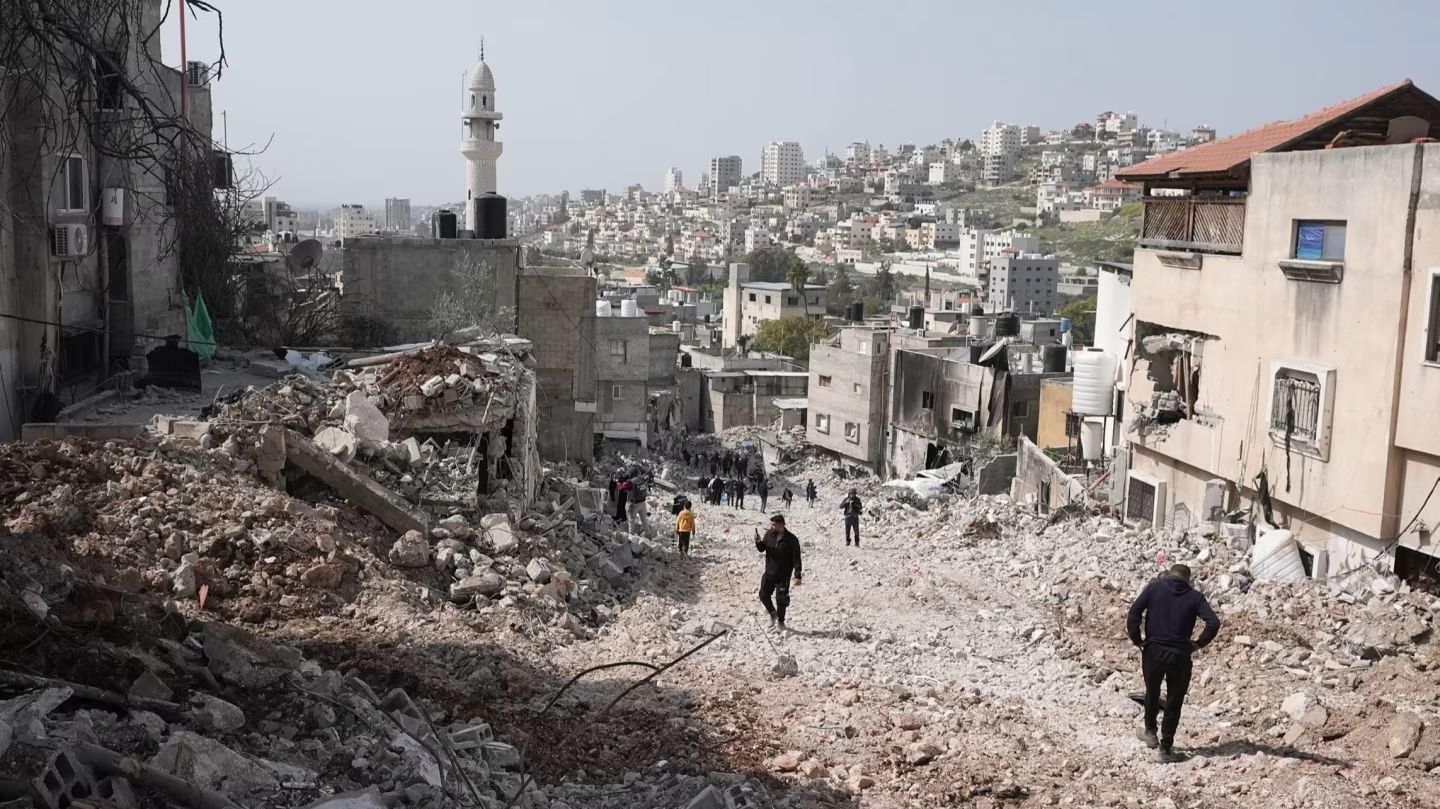
Since its inception, the Zionist project in Palestine has relied on the logic of collective punishment as a foundational pillar of its colonial toolkit. Policies of demolition, land confiscation, and forced displacement were never circumstantial exceptions but rather systematic practices designed to subjugate Palestinians collectively and punish entire communities for the actions of individuals.
From the moment the West Bank was occupied in 1967, Israel’s strategies extended beyond direct violence to include the use of infrastructure itself as a tool of collective punishment. Bypass roads, military checkpoints, and the separation wall were not constructed to facilitate movement, but to dismantle and reengineer Palestinian geography in ways that serve the expansion and entrenchment of the settler-colonial project.
These colonial infrastructures were built to transcend their technical functions and act as political and strategic instruments. They deepen spatial isolation, fracture social and economic ties, and anchor settlements at the heart of the occupied landscape. Since October 7, 2023, this use of infrastructure has only accelerated, transforming it into a mechanism of daily suffocation for Palestinian society.
This article sheds light on the manifestations of colonial infrastructure in the West Bank, tracing its expanding functions in the wake of the October 7, 2023 events. It also examines the Israeli legal mechanisms that have granted such infrastructures a legislative shield, embedding them as an integral part of the daily apparatus of colonial control.
From Domination to Fragmentation
Since 1967, successive Israeli governments have continually reconfigured the geography of the West Bank in line with security priorities and the ideological imperatives of the settlement enterprise. Under the pretext of “public use,” vast areas of Palestinian land were appropriated, most notably for the construction of road networks designed to serve settlements. These roads connected the settlements to urban centers inside the Green Line or linked them across the West Bank, from north to south. Thus, road projects became parallel instruments of land confiscation and demolition—paving the way for settlement expansion while preventing Palestinians from developing their own urban space.
The establishment of settlements was consistently accompanied by the rapid expansion of road and infrastructure networks exclusively dedicated to their service. By 2013, the length of these settler roads had reached approximately 980 kilometers, consuming around 294,000 dunams of West Bank land—over 5% of its total area. With a surge in settlement activity over the past decade, this network grew to roughly 1,200 kilometers by mid-2025, swallowing nearly 7% of the West Bank. Thousands more dunams surrounding these roads were rendered off-limits to Palestinians for construction or agriculture. While some segments remain marginally accessible to Palestinian traffic, the roads were fundamentally designed to serve settlements and fragment Palestinian towns and villages.
Unlike the conventional purpose of roads—to connect population centers and facilitate movement—these settler roads serve an opposite function: isolating Palestinian communities, encircling them, and severing their geographic and demographic continuity.
These networks were deliberately designed as “hostile roads,” creating a suffocating spatial environment and consuming Palestinian land indiscriminately, regardless of its topography or use. This denies Palestinians room to expand their built environment and ensures the supremacy of Israeli settlements. As such, settler infrastructure has become a central tool for carving up the Palestinian landscape and reengineering it around a core principle: anything that is not Palestinian will be rendered Israeli.
Accelerated Lockdowns and Isolation
In his paper “In the Blink of an Eye: Infrastructure and the Rapid Lockdown Mechanisms of the West Bank,” researcher Ashraf Abu Aram argues that the comprehensive lockdown imposed by Israel following the Al-Aqsa Flood operation on October 7, 2023, was not a temporary reaction but the activation of a pre-existing, complex colonial infrastructure meticulously prepared for instant deployment. Within hours, Israel reactivated a network of material tools—bypass roads, checkpoints, and walls—alongside digital surveillance systems and biometric permit regimes, sealing off the West Bank and turning Palestinian cities and villages into isolated, semi-enclosed spaces under complete control.
Abu Aram notes that military checkpoints, army bases, and settlements played a pivotal role in the aftermath of October 7. Nearly 898 checkpoints were mobilized, and thousands of kilometers of bypass roads were activated, allowing settlers and Israeli forces free movement, while Palestinians were denied access. This exacerbated the isolation of Palestinian communities and further eroded their social and economic cohesion.
Moreover, the participation of settlers in enforcing closures reveals a hybrid model of sovereignty—merging the official authority of the state with localized settler power. This turns colonial domination into an integrated daily practice, ready to be activated without the need for centralized decisions.
The suite of digital and legal tools employed across the West Bank after October 7 also functioned as mechanisms for enforcing total control and enacting collective punishment. From the separation wall, which encloses Palestinians within confined areas, to the biometric permit system that reduces movement to an act of humiliating compliance, and the use of AI systems that classify individuals by “threat level,” to border terminals that seal the West Bank off from the outside world—these tools form a fully integrated regime of colonial control, jointly administered by the state and settlers.
Legal Mechanisms and the Entrenchment of Colonial Infrastructure
Since 1967, Israel has built a robust legal framework to underpin its colonial grip on the West Bank. Military orders and civil legislation have granted sweeping authority to the military commander over movement, space, and resources, while land was expropriated under various designations, such as “state land.” This dual legal regime—applying civil law to settlers and military law to Palestinians—has institutionalized discrimination, enabling the imposition of sweeping emergency measures on Palestinian society and laying the groundwork for rapid geographic partition in times of lockdown.
Since October 7, 2023, Israel’s far-right government has accelerated efforts to cement control over the West Bank. It has transferred powers from the Civil Administration to civilian government bodies, granting ministers like Bezalel Smotrich wide-ranging authority over settlements and construction. Procedures for settlement expansion have been streamlined, and legal protections have been fortified. The Knesset has passed laws extending Israeli jurisdiction to settlements, expanding the authority of admissions committees, and empowering the Israel Antiquities Authority to assert control over archaeological sites. Together, these measures have created a potent legal shield to support settlement growth, land expropriation, and the gradual entrenchment of colonial infrastructure.
Since the 1967 occupation, colonial infrastructure in the West Bank has served as a central tool of domination and separation. The intricate network of checkpoints and bypass roads—together with digital surveillance systems and legal frameworks has enabled the fragmentation of territory and the control of people. After October 7, 2023, Israel intensified its reliance on these tools, transforming them into a direct mechanism of isolation and lockdown, underpinned by a legal apparatus designed to advance settlement expansion and enforce sovereignty. This underscores their role as instruments of collective punishment and daily domination over the Palestinian landscape.


