












As Abu Arab al-Batran, 61, prepared for Friday prayers, his wife sat in the living room discussing lunch plans with their children and grandchildren. None of them could have imagined they were moments away from a sudden, collective displacement—without warning, without a chance to say goodbye to the walls that had sheltered them throughout the war. A phone call, barely a minute long, would shatter their lives.
With a voice thick with grief, Abu Arab recalls: “You have 10 minutes to evacuate the building. Inform all the residents.” He pauses to catch his breath. “Those words were uttered by an Israeli intelligence officer, speaking a crude mix of Arabic and Hebrew, laced with cold cruelty. One of our neighbors heard it and rushed to warn us all.”
Ten minutes. That’s all the residents of the 11-story Mushtaha Tower were given. The building housed 75 families, many of them displaced, including children, the elderly, the wounded, and people with physical disabilities—many of whom could not possibly descend 11 flights of stairs in the time given before the tower was obliterated.
Speaking to Noon Post, Abu Arab recounts his long ordeal—how he first fled to Jabalia Camp, spent three months under siege at Kamal Adwan Hospital, lost his home, and moved between relatives’ houses before finally settling with 26 family members in his brother’s apartment in Mushtaha Tower.
“I spent everything I had repairing that apartment,” he says. “Windows, doors, plumbing… even managed to get a water line up to the eleventh floor.”
“We lived there for half a year,” he continues, “my children and my daughters—widows who lost husbands and sons. We made it a home. We shared bread in the worst days of famine. Lunch became our ritual of togetherness—our way to reclaim a smile after all the pain and loss inflicted by Israel’s war of extermination.”
His voice trembles. “Even in what we thought was our final refuge, we weren’t safe. My face betrayed my shock when I got the call. I was stunned. Terrified. How could I evacuate from the eleventh floor with my disabled sister? Where would we go?”
In a flash, thousands poured out of the tower, unable to take even the most basic items—no emergency bag, no bedding, not even a change of clothes.
During our interview, Abu Arab sat on a pile of broken stone in the street. His son joined in: “We ran out in the clothes we were wearing,” he said angrily. “I carried elderly, disabled people in my arms—sobbing, screaming in terror. Parents were shouting their children’s names, afraid they had been left behind in the chaos.”
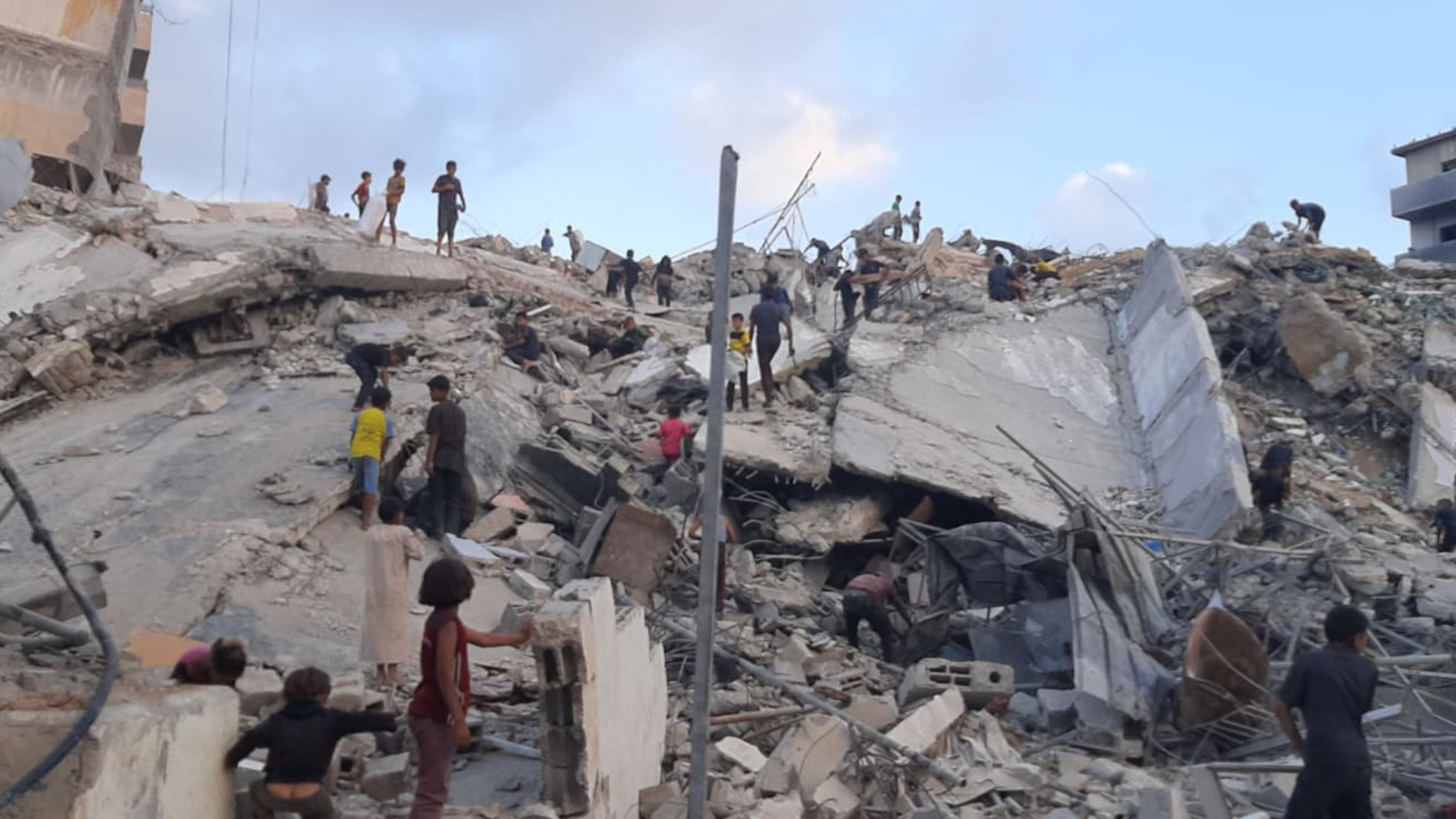
“The building was reduced to rubble in less than 20 minutes,” Abu Arab continues. “A barrage of Israeli missiles shook the earth, bringing down the tower and burying with it our memories, our life’s work, and everything we owned. We were left with nothing.”
Tears welling up, he adds: “The women took refuge in tents set up by relatives at Al-Azhar University, while we men remained near the ruins of the tower. I won’t even consider heading south. I have nothing to help me survive there. I can’t manage away from here.”
Israel’s military strategy to demolish Gaza’s residential towers is part of a broader plan to forcibly depopulate the city in preparation for a reoccupation.
Um Hamza Abu al-Kas, 33, fared no better. After fleeing multiple displacement sites, she lost her apartment in the 14-story al-Sousi Tower. Now, only another heap of rubble remains.
Seven children huddled behind her as she sat on gray stones, her dust-covered black clothes a stark reminder of loss. “Where are we supposed to go?” she asks. “There’s no roof over our heads, not even a tent. We are seven families, each with ten members. At first, we squeezed into a ground-floor apartment. Then we set up tents below the tower—women and children inside the apartment, men in the tents.”
“We adapted the best we could,” she recalls. “We cooked as one big family, the children played together. For a brief time, they felt safe. But the fear returned with the evacuation order. And then the bombing.”
While rummaging through the rubble for medicine and children’s toys, Um Hamza adds: “We were expelled with nothing. I held my daughter, who suffers from a heart condition, and called to my kids to run ahead with a bag that had bread and water. We ran as instructed—500 meters away from the tower.”
She watched in horror as Israeli warplanes leveled the tower. “Fourteen floors flattened—along with all our food, clothes, and essentials.”
Her elderly neighbor interjects, hunched over, leaning on a cane: “I don’t even have a spoon or a pillow left. I left leaning on this stick. Everything is gone. But we will not leave Gaza. Let them destroy every tower—it won’t make me go south. I didn’t flee when death took my loved ones. I won’t flee now. Not from northern Gaza. Not even if I die here.”
Dr. Salah Abdul Ati, head of the International Commission to Support Palestinian Rights (ICSPR), says Israel’s destruction of residential towers has intensified this month. “Seven high-rises—Mushtaha, Sousi, Ru’ya, Tayba, and others—have been flattened. Fifty other multi-story residential buildings were also destroyed.”
“This strategy is meant to terrorize civilians,” he says, “to erase what remains of Gaza’s urban identity and render the city uninhabitable—forcing people into what are effectively concentration camps in the south, as part of a declared plan to depopulate the Strip.”
Abdul Ati stresses these are war crimes, part of an ongoing genocide in blatant violation of international law and humanitarian principles. “More than 86% of Gaza’s housing infrastructure has been destroyed. Israel’s justifications are false, especially as hundreds of thousands remain displaced, living on the streets.”
He confirms that legal action is underway: “We are pursuing cases with international courts, submitting files to the International Criminal Court, and maintaining direct contact with the UN and the Human Rights Council to expose the scale of devastation in Gaza.”
And yet, amid the ruins, a child emerges clutching a toy, smiling. Nearby, a woman brews tea over a small stove beside the remains of her bombed home.


