











Although Israel is the direct perpetrator of the ongoing massacre in the Gaza Strip—through relentless bombardment, systematic killing, and starvation—the culpability does not end there.
Beyond the generous U.S. and Western support that shields these crimes, major corporations are either silently complicit or actively involved in the execution of genocide, turning into civilian arms cloaked in the veneer of technology, all while their hands are soaked in the blood of innocents.
At the top of this blacklist is Microsoft, as leaked documents have exposed a deep security partnership between the company and the Israeli military. This alliance reached its peak after October 2023, when Microsoft poured millions of dollars into providing Azure services used for intelligence gathering and target identification—precisely while Gaza was being pulverized by airstrikes.
More alarmingly, Microsoft’s role extended beyond digital infrastructure in the machinery of death. It became entangled in the tools of blockade and starvation: from financing investors behind the so-called Gaza Humanitarian Foundation—which turned food distribution into death traps where the hungry were gunned down—to forging partnerships with bomb and drone manufacturers responsible for the destruction of bakeries, farms, and water facilities.
The Silent Partner in a Starvation Strategy
The Gaza Humanitarian Foundation was never truly humanitarian in purpose. It was not a relief organization aimed at helping starving Palestinians access food, nor was it an alternative to the UN’s aid mechanism. Rather, it was an Israeli-American strategy to starve, humiliate, and ultimately kill Palestinians in aid lines.
Microsoft has become a silent partner in this scheme—indirectly supporting the founders of this bloodstained project, a group of Israeli military officials, businessmen, and politicians who call themselves the “Mekivim Israel Forum.”
According to the “No Azure for Apartheid” campaign—launched by two former Microsoft employees in 2021 to expose the company’s ties to the Israeli occupation—Michael Eisenberg, who hosted the Mekivim Forum in his home, is also a Microsoft partner through his co-founding of Aleph, a company linked to Microsoft’s advertising division across Europe.
Microsoft had no qualms in backing Liran Tankman, an officer in Israel’s COGAT unit, the same division responsible for denying Palestinians access to food and water. Tankman played a key role in coordinating between American operatives executing the plan and the Israeli army. He received funding from Microsoft for his cybersecurity company Rezilion, whose software is proudly listed on the Microsoft Marketplace.
Notably, Microsoft also provided direct financial support to Elad Gil, the head of research at the Talith Institute, who crafted the operational blueprint for the “Gaza Humanitarian Foundation.” He also conceptualized so-called “humanitarian transition zones”—essentially biometric detention camps, where no food is given without a fingerprint, and no survival without the permission of an armed guard.
Microsoft’s role didn’t stop there. It provided AI services to Boston Consulting Group (BCG), which developed the foundation’s economic model, including scenarios for mass displacement of Palestinians from the Gaza Strip.
Alliances With the Israeli Military
Israel’s siege has not merely restricted food; it has systematically targeted every source of food production and storage. UN agencies have documented that over 85% of Gaza’s water and sanitation infrastructure has been rendered inoperable by continued Israeli airstrikes. A recent UN report warned that the war has virtually eradicated agriculture in Gaza, leaving only 4.6% of land arable.
Microsoft plays a tacit role in destroying Gaza’s basic life infrastructure—from water supplies to bakeries—through its network of military partners that equip the Israeli army with lethal tools.
For example:
-
General Dynamics, a gold-tier Microsoft partner, supplies Israel with 500-pound MK-82 bombs—one of which was used in June 2025 to bomb a crowded café in Gaza, killing at least 41 civilians.
-
Boeing, one of Microsoft’s top S500 clients, supplied 2,000-pound bombs used in the bombing of Al-Mawasi, an area designated as a safe zone for displaced people. Around 90 Palestinians were killed, and a key water source was destroyed.
-
Honeywell, Microsoft’s strategic defense industry partner, supplied munitions used in June 2024 to bomb UNRWA schools sheltering hundreds of displaced families.
Microsoft’s support for Israel is not limited to bomb suppliers. The “No Azure for Apartheid” campaign revealed that the company provides Azure cloud and AI tools to Caterpillar, whose bulldozers are used to raze farmland and destroy water treatment plants—deepening the humanitarian catastrophe in Gaza.
Microsoft is also implicated in environmental warfare: it maintains close ties with the companies supplying white phosphorus to Israel, a chemical used in Gaza bombings that poisons soil and water.
-
ICL, which relies on Microsoft’s Azure Quantum Elements platform for chemical development, has long-standing tech partnerships with the company.
-
Bayer, the German multinational, is another strategic client of Microsoft in cloud computing and AI.
How Microsoft Backed the Blockade Infrastructure
After October 7, 2023, Israel’s blockade on Gaza intensified into a campaign of collective punishment—cutting off basic services like electricity and water almost entirely, exacerbating the starvation crisis.
According to Human Rights Watch, Israel cut off electricity completely on October 7, 2023. By October 15, all wastewater treatment plants shut down due to fuel shortages, collapsing the sanitation system and triggering outbreaks of polio, hepatitis, and other waterborne diseases.
Microsoft played a role in this collapse. It supplies Israel Electric Corporation (IEC)—the body responsible for the blackout—with Azure services and Azure Monitor, a performance tracking system. In other words, the company that deprived two million people of vital power relies on Microsoft’s cloud infrastructure.
The water crisis followed a similar path. On October 9, 2023, Mekorot, Israel’s national water company, deliberately cut Gaza’s water supply. Since then, Palestinians receive only intermittent and inadequate water, amid systematic damage to the network and fuel shortages preventing pump operation.
Here again, Microsoft is deeply involved: Mekorot is both an Azure client and a partner in supporting startup ventures through Microsoft.
Weaponizing AI to Target Aid Efforts
The starvation policy has escalated to brutal extremes—targeting anyone attempting to provide food or water. International organizations have documented sniper attacks and airstrikes on fishermen, farmers, and aid workers, carried out using advanced military tech that runs, in part, on Microsoft services.
Microsoft-powered technologies were directly involved in one of the deadliest massacres of the war on hunger: In January 2024, Israeli drones bombed a crowd of Palestinians waiting for flour at a UN distribution center, killing over 50 people.
The drones used in the attack were made by Elbit Systems, which has close financial and technical ties to Microsoft. Other drones, such as the Matrice 600, were revealed in leaked documents to operate using Azure cloud services, making Microsoft a technical enabler of lethal operations.
This complicity extended to foreign aid workers: In April 2024, Israel assassinated an entire team from World Central Kitchen, striking their vehicles during a relief mission in Gaza. The strike was carried out using Spike missiles from Rafael Advanced Defense Systems, a Microsoft partner with a long history of collaboration in weapons tech.
Punishment for those Who Speak Out
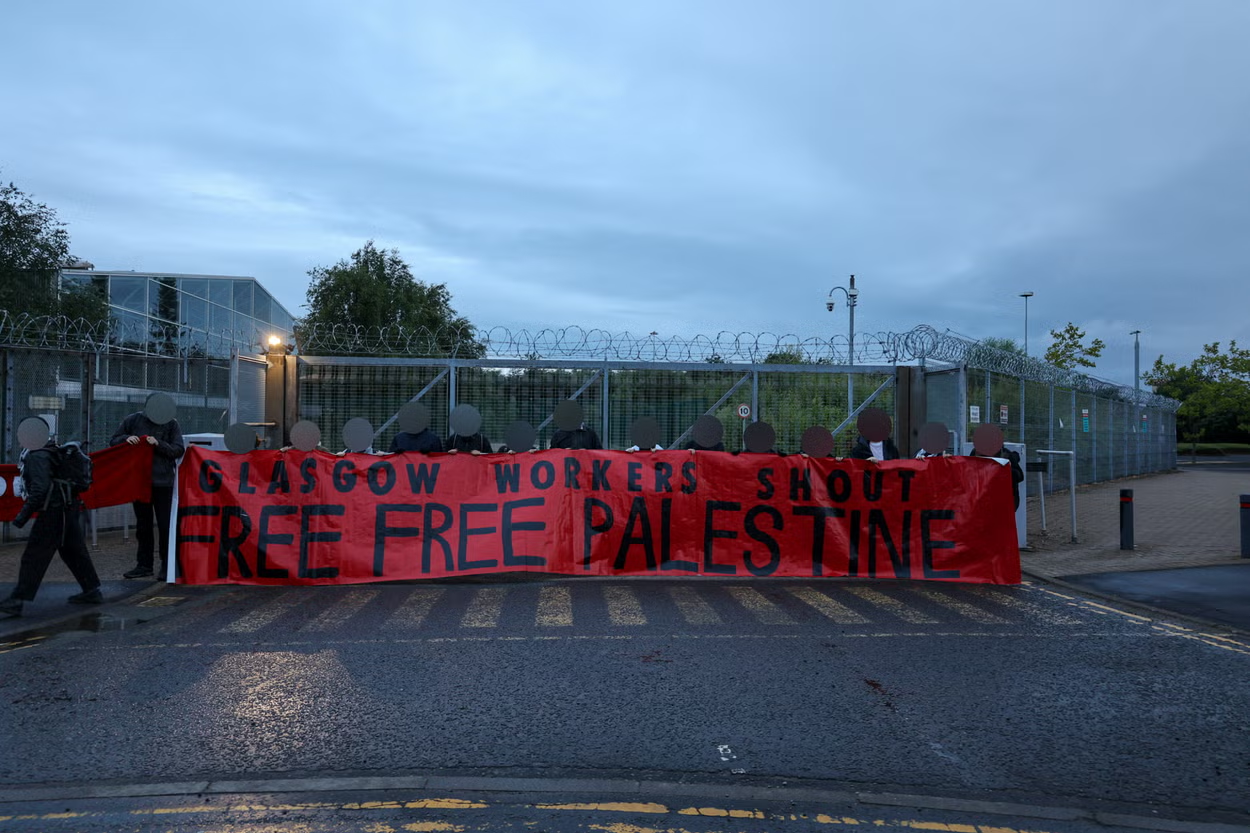
As Microsoft deploys its technological arsenal to support Israel’s war on Gaza, voices within the company have begun to push back—despite the threat of retaliation.
Among the most prominent is Ibtihal Abu Al-Saad, whose actions garnered global attention when she interrupted a keynote by Mustafa Suleyman, Microsoft’s head of AI, during the company’s 50th anniversary celebration. She publicly accused him of weaponizing AI in service of Israeli aggression.
Ibtihal said she could no longer remain silent, especially after discovering Microsoft’s $133 million contract with Israel’s Ministry of Defense for data storage and processing via Azure.
She was not alone. Egyptian engineers Hossam Nasr and Abdo Mohamed staged a protest on October 24, 2024, at Microsoft’s headquarters, commemorating Palestinian martyrs and collecting donations for Gaza’s victims.
Microsoft’s response was swift and unequivocal: any internal dissent or expression of solidarity with Palestine was met with punishment. Employees who dared to question the company’s actions were silenced or dismissed.
In light of the above, if the Israeli occupation is the finger pulling the trigger, then Microsoft is the digital finger, the algorithm, and the cloud infrastructure that enables precise and systematized killing.
Unless the company is held ethically accountable and the world takes serious steps to investigate and confront this collusion, the partnership between technology and genocide will continue—only with new names and faces.


