









After eight rounds of indirect negotiations between Hamas and the Israeli occupation government—since the latest talks resumed in the Qatari capital, Doha, on July 6—Israel stunned all parties by suddenly proposing a “redeployment” map in Gaza as an “alternative to withdrawal.” This map keeps the entire city of Rafah in the southern Gaza Strip under Israeli control.
Despite the talks showing positive momentum and most contentious issues between the two sides being resolved—raising hopes for a temporary truce followed by a full and permanent ceasefire—the Israeli delegation resorted to its favorite tactic: deception. By presenting its proposal without prior notice, Israel upended the negotiating framework and reset the process back to square one.
The Doha negotiations were severely disrupted by this move. The talks have since stagnated over the past 24 hours, with the Israeli delegation remaining in the Qatari capital awaiting a new round of discussions—though these may lead nowhere if Israel insists on its redeployment plan, which both the resistance and mediators find unacceptable.
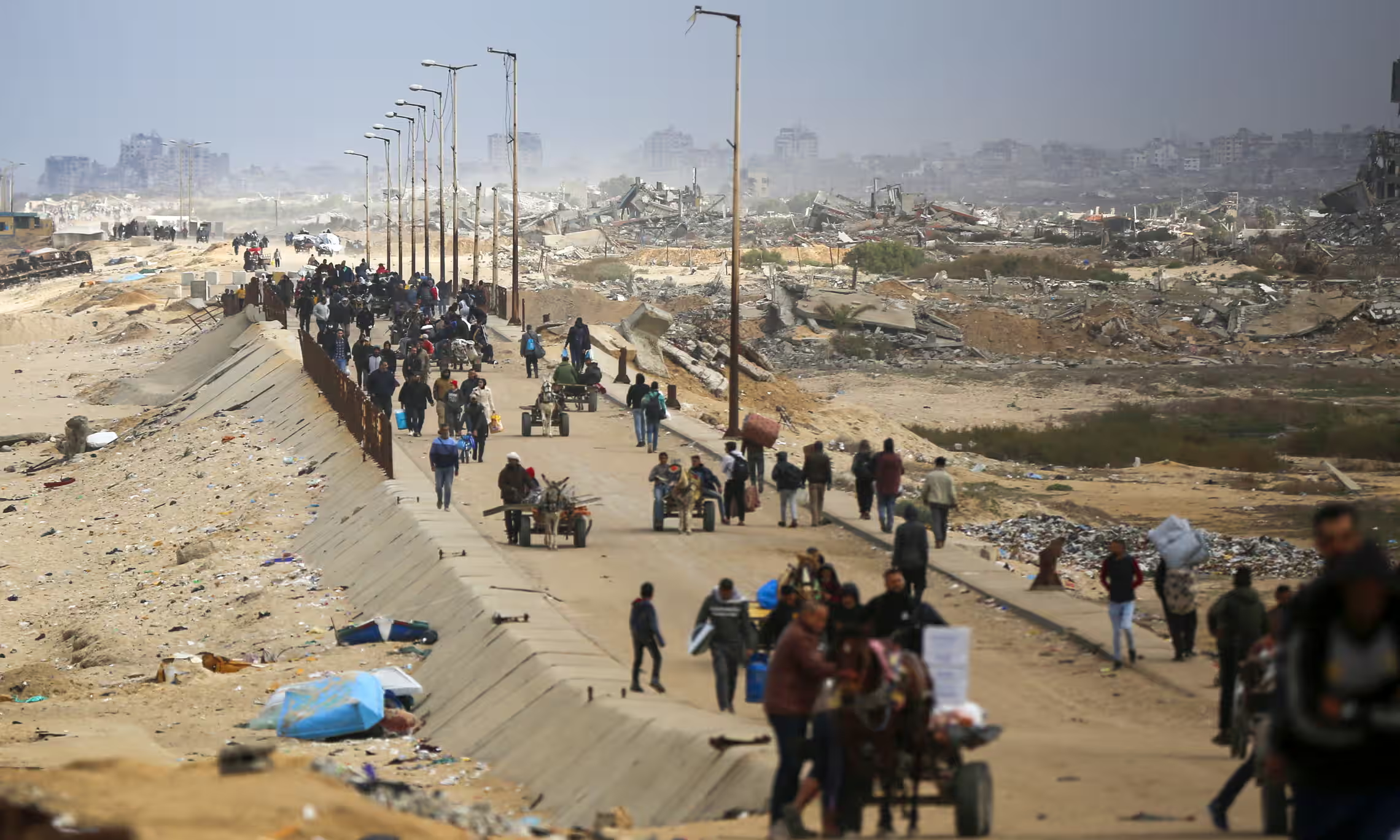
This escalation coincides with an intensification of Israeli military operations that are killing hundreds of Palestinians daily and worsening the humanitarian catastrophe in Gaza. The siege, now in its 103rd consecutive day, has sealed off all crossings, cutting off food, medicine, and fuel in one of the most brutal collective punishment campaigns of the modern era.
A Familiar Israeli Tactic
Israel appears to be circumventing the talks just as they seemed on the brink of a final agreement—especially following optimistic remarks by former US President Donald Trump and his top aides, who stated that a deal was only a matter of time, possibly within days or the coming week.
US Middle East envoy Steve Witkoff had expressed optimism, noting two days ago that three out of four contentious issues had been resolved. According to Axios, the remaining point of contention is the withdrawal of Israeli forces from Gaza. Hamas demands a full withdrawal, while Tel Aviv insists on maintaining control over the Morag corridor between Khan Younis and Rafah in southern Gaza.
Prime Minister Benjamin Netanyahu’s government has faced harsh criticism for clinging to Morag, despite opposition from Israel’s own security establishment. The corridor was meant as a temporary operational measure pending a final agreement to end the war.
Following US pressure and internal consultations, the Israeli negotiator resorted to its usual tactic: publicly agreeing to withdraw from Morag while introducing a more dangerous alternative—maintaining military control over Rafah under the pretext of “monitoring the situation and preventing future threats to Israel.”
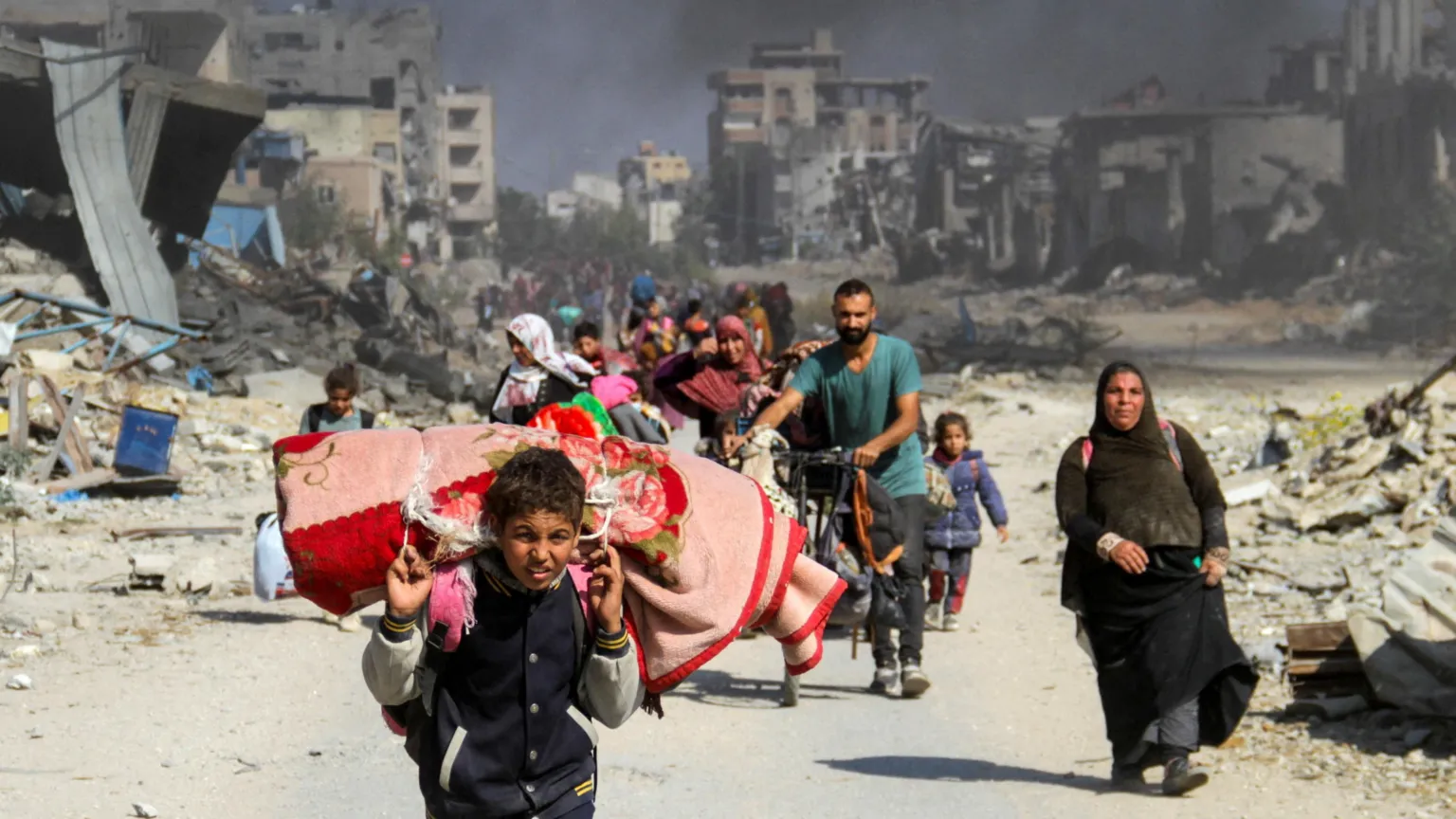
On Friday, July 11, the Israeli delegation presented a map showing the redeployment of its forces inside Gaza. Far from being a mere repositioning, it closely resembles a new occupation plan. The map places the entire city of Rafah under Israeli control, transforming it into a hub for displaced Palestinians with the eventual aim of expelling them to Egypt or via the sea.
Upon closer examination, the map reveals a land grab of up to 3 kilometers deep along the border. It includes large swaths of Beit Lahia, Um al-Nasr, Beit Hanoun, and Khuza’a, extending into al-Tuffah, al-Shujaiya, and al-Zaytoun neighborhoods in eastern Gaza, and reaching Salah al-Din Street in Deir al-Balah and al-Qarara in central Gaza.
In total, according to the map, the Israeli army aims to formally control about 40% of Gaza’s territory—preventing the return of over 700,000 Palestinians to their homes in the north, turning the south into a massive prison camp, and severing Rafah from the rest of the Strip. The plan also involves tightening control over the Philadelphi Corridor on the Egypt-Gaza border, keeping Israeli troops 2–3 kilometers north of it.
A Blueprint for Displacement
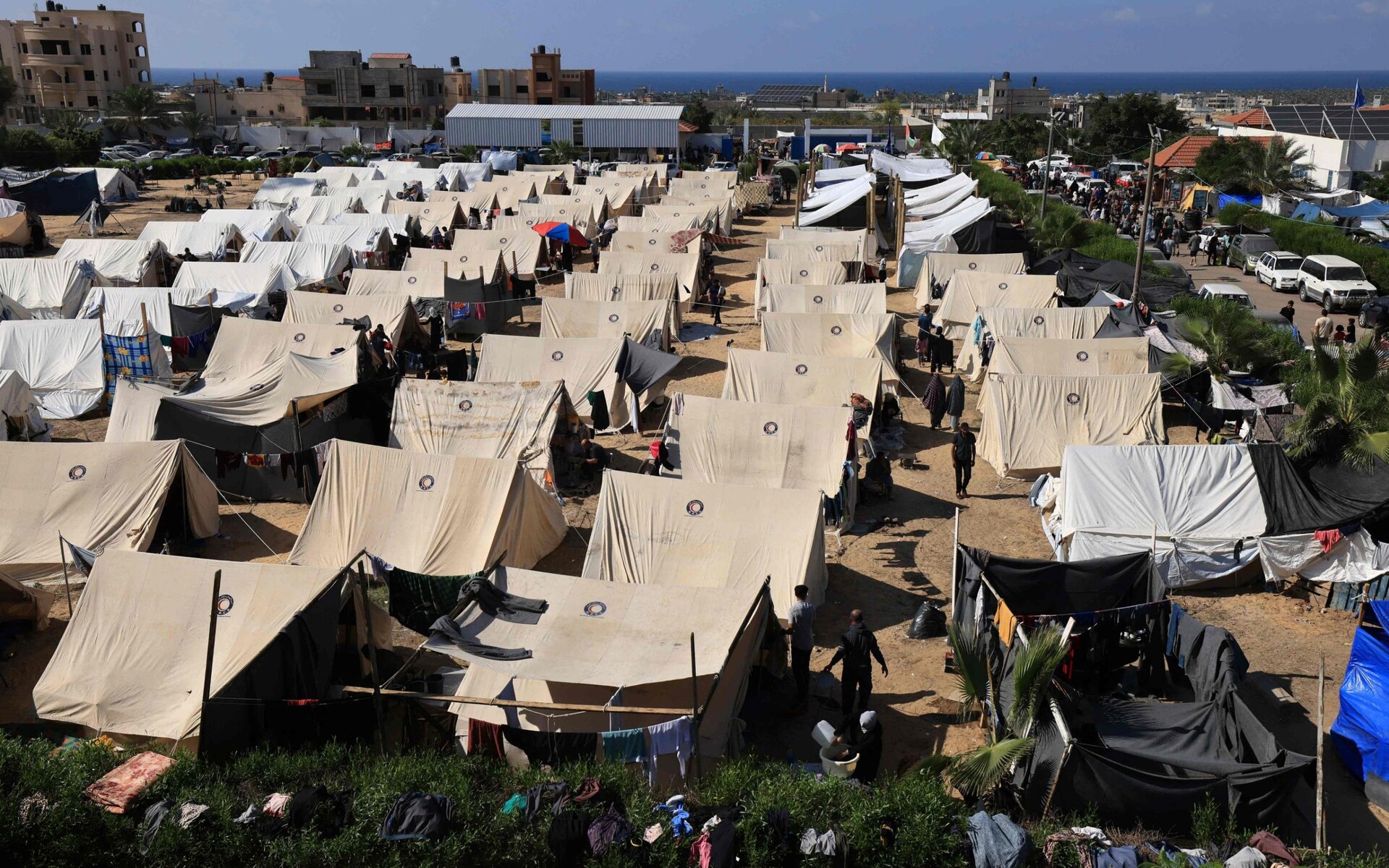
On Monday, July 7, Israeli Defense Minister Yisrael Katz unveiled a new plan to establish a so-called “humanitarian city” in Rafah. The proposed city of tents—built atop the ruins—would initially house 600,000 Palestinians, all subjected to rigorous security screening.
Under this plan, those relocated to the “city” would not be allowed to leave, effectively turning it into a massive refugee camp, or more accurately, an open-air prison holding hundreds of thousands. These people would face a bleak choice: remain under dire conditions and constant danger, or leave Gaza altogether—either by sea to Cyprus and beyond, or overland to Egypt.
This “humanitarian city” plan mirrors the “redeployment map” presented in Doha, which isolates Rafah and hands control of the border and city to the Israeli army. The broader vision fragments Gaza into disconnected enclaves, reshaped both demographically and geopolitically to facilitate forced displacement.
The plan echoes the demands of Israel’s far-right, particularly National Security Minister Itamar Ben-Gvir and Finance Minister Bezalel Smotrich, who threatened to collapse the governing coalition if a full ceasefire deal is reached before achieving the war’s objectives—chief among them the destruction of Hamas and the forced expulsion of Gaza’s population.
Through colonial tools and racist strategies, Israel seeks to turn the dream of displacement—championed by Netanyahu and the far-right—into a lived reality. Using every means of pressure and abuse, the occupation is confronting fierce Palestinian resistance that has thwarted similar schemes in the past and is now bracing for yet another existential battle.
What About the Resistance?
Hamas understands that Netanyahu has no intention of ending the war. He is deliberately prolonging it to serve his political interests, even at the expense of Israeli security—a fact corroborated by a months-long New York Times investigation based on interviews with over 100 Israeli, American, and Arab officials.
The investigation concluded that Netanyahu extended the war far beyond what Israel’s top military leadership deemed necessary, largely to avoid stepping down over longstanding corruption charges. For Netanyahu, the war offers a lifeline to evade accountability.
The report also revealed that the prime minister squandered several opportunities to normalize ties with Saudi Arabia and other countries. The war has tarnished Israel’s global image, eroding the narrative of a modern, moral state.
At the start of the latest negotiation round earlier this month, Hamas and its allies made rare concessions, motivated by the suffering of Gaza’s civilians over 645 days of relentless bombardment and atrocities.
In a significant gesture, Hamas agreed to release eight Israeli captives on the first day of a temporary truce—even without guarantees for a permanent ceasefire.
Still, the group set non-negotiable red lines: a complete withdrawal from Gaza, the return of northern residents to their homes, and the unconditional entry of humanitarian aid.
The Israeli map renders continued negotiations meaningless. Accepting its terms would legitimize a permanent occupation, reversing the 2005 disengagement and serving Israel’s colonial ambitions. It would also dismantle the strategic gains of Hamas’s Operation Al-Aqsa Flood, which had shocked Israel and the US into such brutal retaliation.
Resistance leaders have repeatedly stated that Netanyahu cannot achieve through diplomacy what he failed to secure by force over 22 months of genocidal war. What could not be imposed militarily will not be conceded at the negotiating table.
It has become clear that Netanyahu does not seek peace but rather aims to obstruct any diplomatic path to a ceasefire. He is fully beholden to the far-right, and his talk of negotiation “progress” is merely a tactic to lull the Israeli public while buying time to destroy what remains of Hamas’s infrastructure—even as the group continues to mount sophisticated operations.
While the rejected map is a tool to sabotage the truce, Netanyahu also wants a deal on his terms—one that he can sell as a “victory speech” to salvage his political future and evade corruption charges, aiming for eternal status in Israel’s pantheon of untouchables.
In the end, the resistance faces three possible scenarios in dealing with Israel’s proposal—whether it is a tactical bluff or a serious threat:
-
Accepting the Israeli plan in any form—thereby legitimizing the occupation—is completely off the table, regardless of pressure. After 645 days of war, the most vital lesson is that Gaza’s resistance will never trade its land for empty promises.
-
Pursuing a compromise through battlefield leverage and international mediation, leading to a withdrawal plan that does not confer legitimacy on the occupation—even if it allows flexibility on how withdrawal unfolds.
-
Escalating the armed struggle indefinitely, a path that benefits neither side and could provoke backlash within Israel itself.


