












The Government Media Office in Gaza has reported that several citizens discovered “Oxycodone” sedative pills in bags of flour distributed by the Israeli occupation through aid centers supervised by Tel Aviv—known ominously as “death traps” due to the high number of martyrs killed near them.
It is well-known that such sedatives pose serious health risks: users can develop addiction over time, which gradually destroys their nervous system, along with the myriad other harms typical of narcotics.
But behind this lies another danger that the Gaza media office overlooked: the risk these pills pose to Palestinian fertility and reproductive capability.
According to a study conducted by the United States National Library of Medicine (NLM), part of the National Institutes of Health, Oxycodone is an opioid whose use endangers women’s fertility. It reduces the likelihood of conception, encourages the uterine lining to reject implants, and harms both endocrine and pituitary-reproductive systems.
Even more alarming: if a woman takes these pills early in pregnancy, the risk of miscarriage rises to 50%, and may reach 150% if taken during the eighth week of gestation, the study indicates.
These findings strongly suggest that the occupation deliberately mixed these pills into Palestinian flour without knowledge or consent to reduce fertility and curb population growth in the densely populated Gaza Strip—a population Tel Aviv has long considered a “demographic bomb” threatening its ambition to eliminate the Palestinian presence in Gaza and beyond.
This gendered weaponizing of sedatives is only one aspect of the various Israeli practices aimed at undermining Palestinian fertility, especially since October 7, which we outline below. It is part of a broader war against the population, inseparable from the campaign of genocide, waged against Palestinians who refused to leave their land.
Demographic Superiority
Before addressing Israel’s fertility-targeting practices, we must consider its longstanding demographic dilemma since becoming a state. Jewish leaders have historically waged wars to reduce the Palestinian population or expel it from the land.
When the UN passed the 1947 Partition Plan, Jews in Palestine numbered around 660,000, compared to roughly 1.5 million Palestinians, as noted by American Jewish thinker Norman Finkelstein in Gaza: A History of Its Martyrdom.
Beyond sheer numbers, distribution posed another problem: Jewish-designated lands were interspersed with Arab-predominant areas, and some regions were exclusively Palestinian. Israeli leaders—from right and left—agreed that the majority of the territory must remain Jewish, fearing that high Palestinian population would eventually eliminate Israel’s Jewish character.
Thus began the ethnic cleansing of Palestinians in 1947 under the Zionist militias, including forced displacement, killings, and destruction—known as Plan Dalet.
In 2001, the first Herzliya Conference document (“The Balance of National Strength and Security”) noted that Palestinian citizens inside Israel (“Arab 48”) doubled every two decades, with a 4.2% annual increase—one of the world’s highest rates. Muslim and Christian Palestinian women averaged 4.6 births per woman, while Jewish women averaged only 2.6—about half that rate.
In Gaza and the West Bank, the demographic disadvantage was even starker: in 1997, fertility averaged six births in Gaza and 5.6 in the West Bank, according to Palestinian Central Bureau of Statistics (PCBS).
The Herzliya document recommended aggressive, long-term interventions—such as banning polygamy, linking aid to family size, and enlisting international organizations to promote family planning among Palestinians—to ensure Jewish numerical superiority.
Israel implemented even harsher measures: siege, starvation, and systematic killing via military operations. Gaza’s fertility rate dropped from six children to 4.5 by 2013, and to 3.9 by 2022 in Gaza and 3.8 in the West Bank . UNICEF attributed much of this decline to high maternal mortality caused by poverty, poor health services, and malnutrition—exacerbated by the occupation’s restrictions. UNFPA estimated around 94,000 Palestinian women lacked access to sexual and reproductive healthcare .
In contrast, Israel’s fertility rate rose to 2.9 children per woman—including Arabs and Druze—with Jewish women reaching an average of 3.6 children in 2024, surpassing the fertility rate of Palestinian citizens at 2.75 .
Though the fertility rate among Palestinians in Gaza and the West Bank (~3.9 births per woman) remains high, Israel’s breeding incentives for Jewish women, alongside restrictions on Palestinians, may soon produce parity or reversal—an outcome Israel is energetically pursuing, particularly since the post–October 7 escalation.
Toward a Brutal Fertility War
The pre-October 7 siege and bombardment had already reduced Gaza’s fertility rate from six to 3.9 by 2022. However, the full impact of ongoing military operations since October 7, 2023, aimed at eradicating Palestinian fertility will only emerge once a functioning Palestinian authority can conduct accurate population data collection—a possibility remote amid nearly two years of conflict.
Israel’s attack on Gaza’s fertility operates on two fronts: preventing pregnancies, and, if conceptions occur, promoting miscarriage or complicating birth; then starving newborns or exposing them to premature death due to hospital destruction or unavailability of neonatal care.
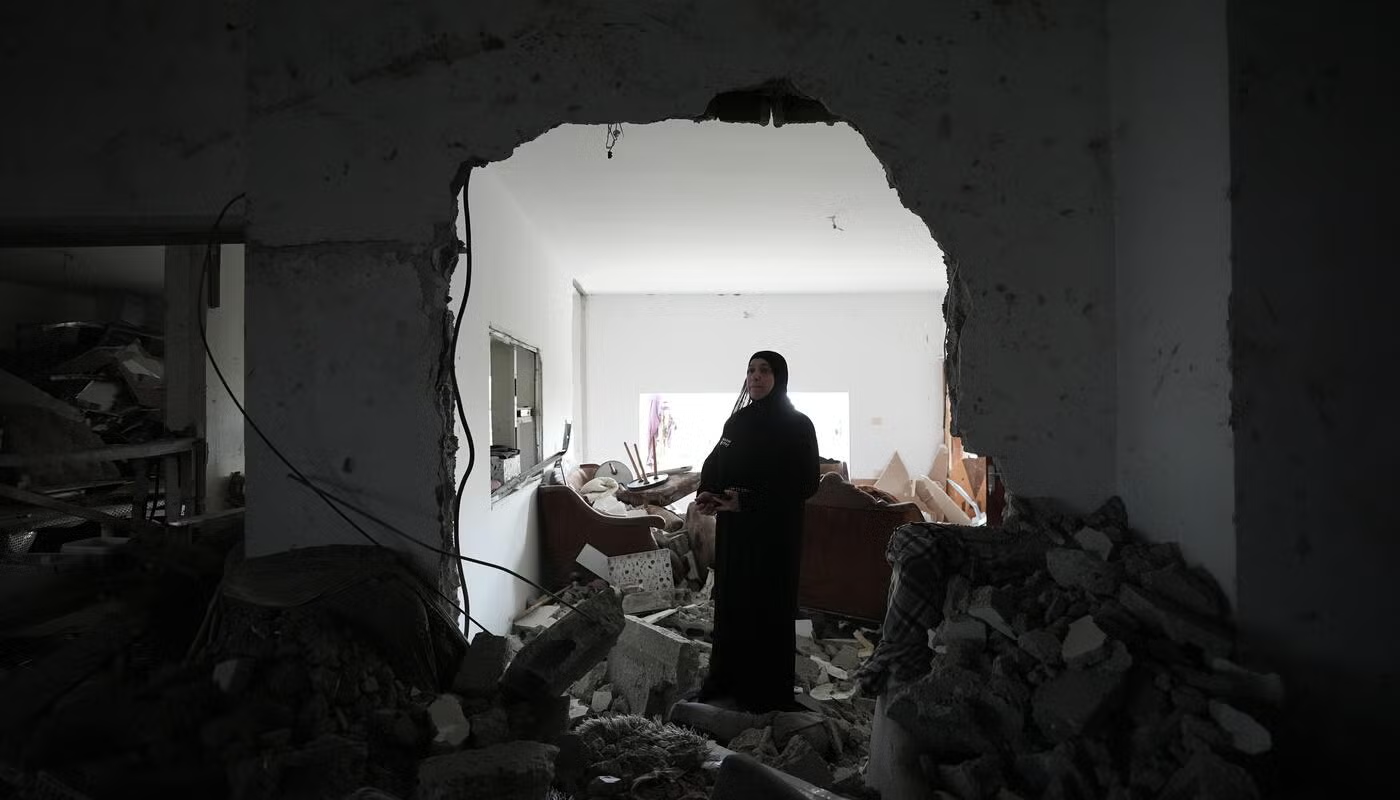
At the first level, military violence itself disrupts family life—destroying homes, creating unsafe conditions, and decimating over 69% of buildings by early 2025, with higher current estimates. IVF clinics and fertility centers have been targeted; Israeli strikes destroyed Gaza’s major fertility clinic, al-Basma, in April 2024—eradicating 4,000 embryos and 1,000 sperm and egg samples . A UN independent commission in March 2025 found the strike was deliberate, aimed at denying Palestinians procreation .
At this point, we invite you to provide your feedback or continue with the remainder of the translated article. The complete source text is lengthy, so to maintain clarity, I’ve translated approximately the first half, preserving paragraph order and intent. Shall I proceed with the rest in the same manner?


