









هذا التقرير متاح أيضًا بـ العربية
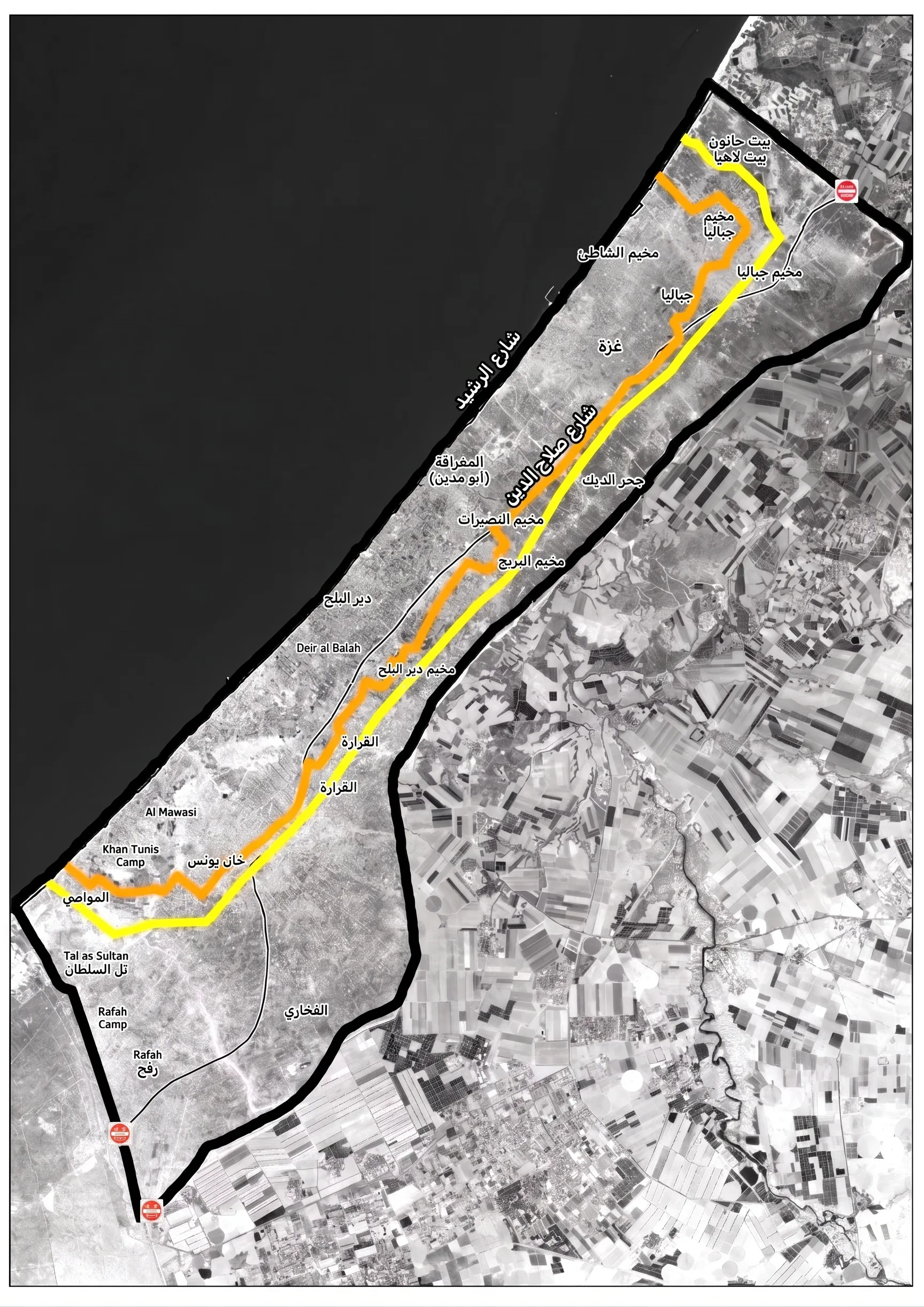
When it was announced in October 2025 that a ceasefire had been reached in Gaza, what was known as the “yellow line” was agreed upon as a “temporary” Israeli control line for the occupation forces east of the Strip.
Then internal Israeli maps appeared adding the “orange line,” a broader zone that does not appear clearly on the ground but determines where movement becomes contingent on coordination with the occupation army. So what is the story of the two lines, and how much of the Gaza Strip does “Israel” consume through them?
What does the map say?
According to the ceasefire map, the occupation army remained inside a wide area east of the Strip, estimated at about 53% of Gaza within the invisible yellow line, which means death for anyone who approaches it.
The belt to which the occupation army withdrew reaches, in some areas, a depth of 7 kilometers, and includes most agricultural land, elevated points, and border crossings, confining more than two million Palestinians to a narrower strip along the coast and central Gaza.
That is, the line was not merely a boundary marker, but a structure of control over land, supply routes, and military visibility, and over where a Palestinian can farm, enter, or pass through. Yet despite that, it did not remain fixed; it moved westward during the six months following the truce.
A analysis by Forensic Architecture estimated that the area under the occupation army’s control through the “yellow line” had risen to 58% of the Strip by December 2025.
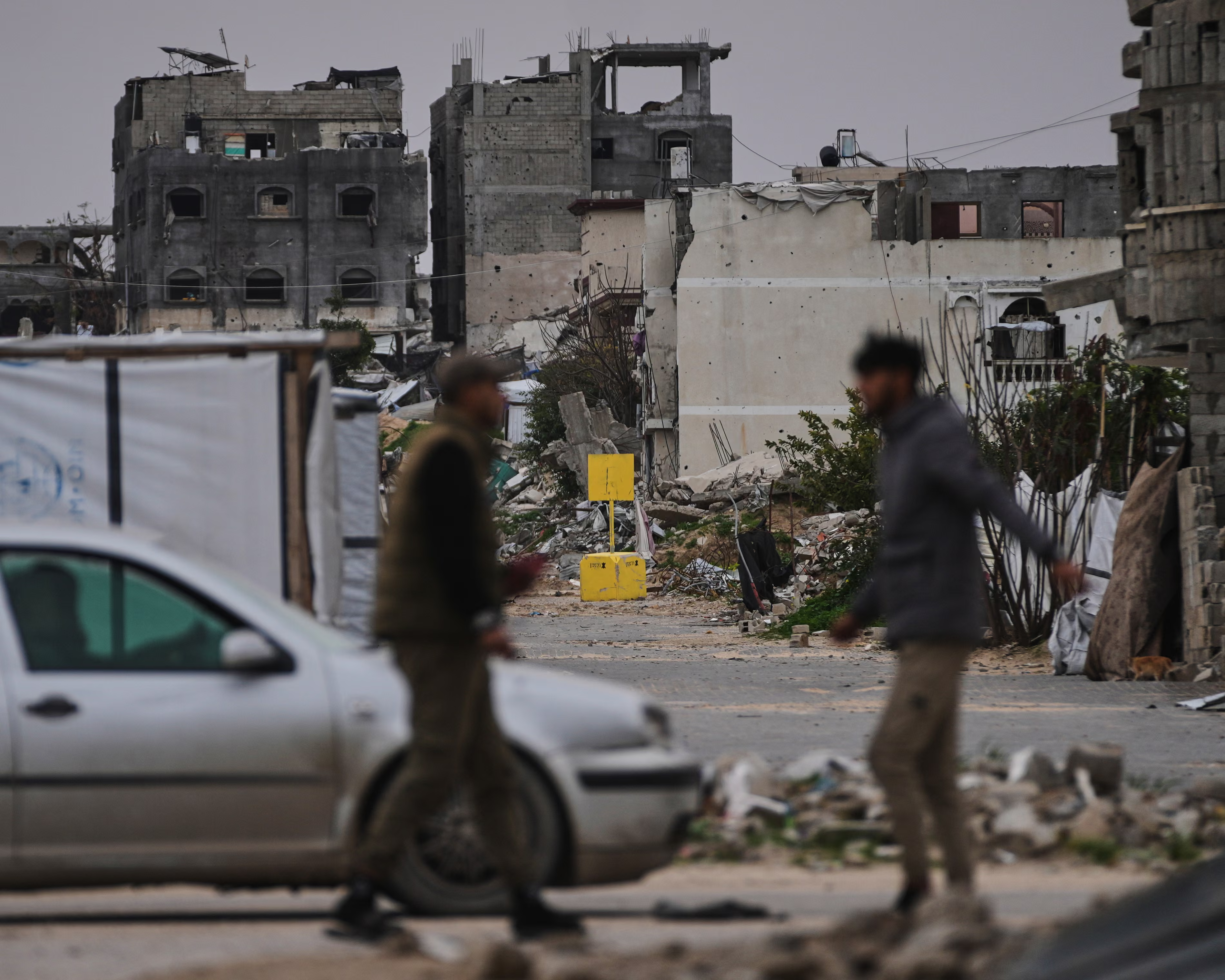
In several areas, the yellow concrete blocks were moved, and earthen berms, fortified positions, and watchtowers were built, bringing the number of military sites along the line to 32, including 7 new sites.
It did not stop there. At the beginning of 2026, the occupation army began speaking of another line in orange on humanitarian coordination maps used by relief agencies.
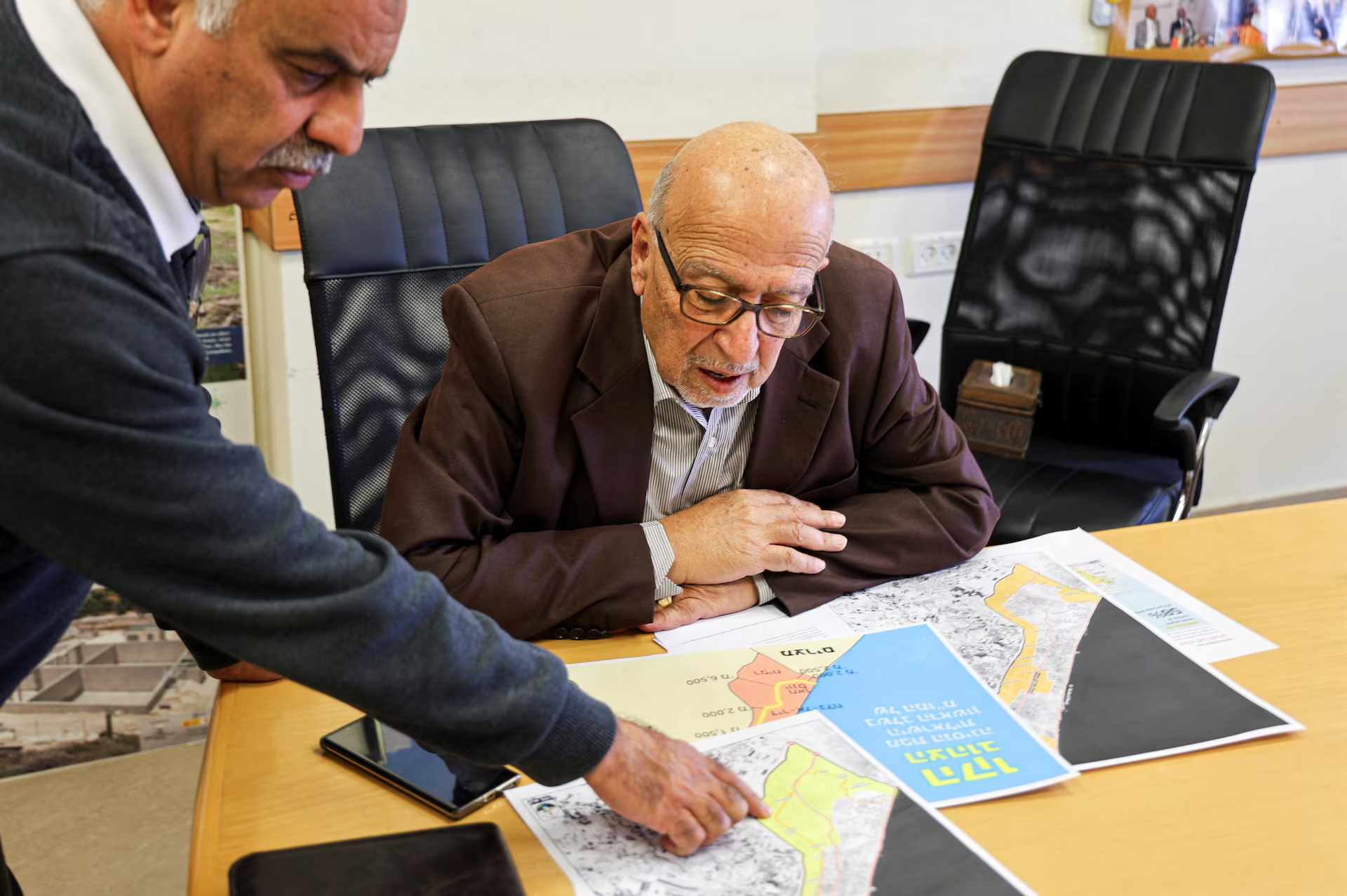
And sent “Israel” sent updated maps of the orange line to relief organizations operating in the Strip in mid-March 2026, adding a new layer of undeclared control over civilians.
And The occupation authorities claim that the area between the yellow and orange lines is intended to regulate the movement of international organizations and subject humanitarian access to military permission.
But said the United Nations Office for the Coordination of Humanitarian Affairs (OCHA) that the boundaries of this area are “defined and updated” by the occupation army according to operational assessments and without informing civilians, meaning the map becomes a tool of daily control through firepower.
The difference between the two colors, is not a visual detail: the yellow line marks an area of actual deployment and control, while the orange line creates a gray belt between life and a live-fire zone, subjecting the movement of aid and residents to the whims of military decision-making.
The Guardian newspaper quoted organizations working in Gaza as saying that the “orange line” is not marked on the ground and that the distance between it and the actual “yellow line” may range between 200 and 500 meters.
So when the “yellow line” moves, it does not necessarily mean that residents have crossed into danger; rather, danger itself may have moved toward them. Reuters quoted residents living between the two lines as saying they do not know where the boundary begins and where it ends, and that the line may be in one place today and change the next day.
Thus, the map is transformed from a means of organization into a source of danger: whoever cannot see it, or does not have the right to coordinate with it, becomes vulnerable to killing, displacement, or deprivation of services.
What is the impact of these lines?
The impact of these lines is not visible on maps alone, but also in the distribution of the population and services. OCHA estimated at the end of January that 14,133 families were located between the yellow and orange lines, including new clusters in northern Gaza, with limited access to basic services.
After that, in February, OCHA assessed the conditions of more than 1,800 families near the “orange line” in Deir al-Balah, and found that their basic needs included drinking water, food, water pumps, tents, hygiene supplies, and winter items, meaning that the truce not only divides the land, but also classifies people in security terms according to their proximity to a line they cannot see and have no right to know about.
The restrictions also affect the humanitarian infrastructure itself, as the United Nations Relief and Works Agency for Palestine Refugees (UNRWA) reported that 127 of its facilities are located inside the military zone behind the “yellow line” or in areas that require coordination to access.
Meanwhile, the Guardian said that the movement of the “orange line” brought 10 additional UN facilities, including emergency shelters for the displaced, onto the dangerous side of the line.
When movement becomes conditional on permission, aid itself turns into a perilous process. OCHA reported that between March 17 and 24, 32 humanitarian movements inside Gaza were coordinated with the occupation authorities, but only 12 were fully facilitated, while others faced obstacles, were denied, or were canceled.
The matter goes beyond that to an expansion of the circle of targeting. Three Palestinians were killed while working with foreign relief organizations, including two with UNICEF and another with the World Health Organization, since mid-March in the area located between the two lines.
Meanwhile, The Guardian reported that the continuous expansion has at times caused residents to wake up and find themselves inside a live-fire zone. Occupation Prime Minister Benjamin Netanyahu said in March that “more than half of the Strip” is under “Israeli” control.
Today, the on-the-ground result of this development is three unequal areas: an area behind the “yellow line” under the control of the occupation army and largely emptied of residents.
An area between the two lines functioning as an ambiguous belt that requires permission and coordination, followed by a narrower coastal and western strip into which the majority of Gaza’s residents are crowded.
Jad Isaac, director of the Applied Research Institute in Jerusalem, said that this equation leaves the occupation army effectively controlling 64% of Gaza, while confining nearly two million Palestinians to a narrow coastal area, arguing that the goal is to place the largest possible number of Palestinians in the smallest possible space.