










هذا التقرير متاح أيضًا بـ العربية
Amid rapidly unfolding regional developments and growing fears over successive geopolitical shifts resulting from the American-Israeli escalation toward Iran, Syrian Foreign Minister Asaad al-Shaibani’s visit to Cairo according to the Syrian Foreign Ministry comes as a step aimed at pushing Egyptian-Syrian relations into a new phase, at a time when the new Damascus is pursuing a foreign policy centered on breaking isolation and adopting diversification of international partnerships as a firm strategy.
This non-protocol visit also comes after a series of shuttle tours eastward and westward, including Russia, Europe, and the Gulf region, before culminating in his stop in Cairo. This raises questions about the files al-Shaibani is carrying and his strategic objectives at a regionally sensitive moment that reflects shifting dynamics and new interactions across the Middle East.
An Important Context: The Significance of the Timing
Al-Shaibani’s visit to Cairo comes at a time when Egyptian-Syrian relations are experiencing a state of relative coolness, despite signs of cautious openness in recent months. This comes amid differing views on a number of regional issues, alongside the rise of undisciplined media rhetoric on some platforms, which has contributed to fueling public tension.
Among the most prominent issues that have sparked widespread debate on social media is what is being circulated regarding the conditions of the Syrian community in Egypt, which numbers more than 1.5 million, amid repeated talk of challenges related to residency and procedural restrictions, which has further intensified public debate between the two sides.
It was also fueled by the decision by Homs Governorate to change the name of a street bearing the name of Lieutenant General Abdel Moneim Riad to “18 April,” escalating the controversy. Although local authorities said the move came in the context of commemorating internal events, it was met with angry reactions in Egyptian circles given the national symbolism carried by the former name.
On the other hand, the visit coincides with rapidly growing rapprochement between Damascus and a number of Gulf capitals, reflected in the resumption of diplomatic relations and the renewed presentation of Syria as an active Arab partner. This context cannot be separated from reading al-Shaibani’s movements, including his visit to Cairo, which appears to be an extension of this broader path of Arab repositioning.
These moves also come amid mounting regional escalation against the backdrop of American-Israeli tensions toward Iran, which has reshuffled the cards of regional balances and pushed many powers to reassess their alliances and foreign policies. This also intersects with the continued Israeli escalation on more than one front, including Lebanon and Syria, amid attempts to impose new realities on the ground with direct implications for Arab national security.
Strengthening Diplomatic Relations
The issue of reactivating diplomatic relations between Damascus and Cairo tops the agenda of the Syrian foreign minister’s visit, amid previous obstacles that prevented the completion of accreditation procedures for Syrian diplomats to work at the embassy in Cairo, due to the incomplete formal restoration of relations.
Internal estimates indicate that the current visit represents an opportunity to prepare the political and diplomatic climate for reorganizing representation between the two sides, including settling the status of existing cadres and opening the door to a more stable phase in managing bilateral relations.
In a broader context, Damascus is moving quickly to end the political isolation imposed on it during the previous phase by adopting a multidirectional diplomatic approach marked by flexibility and distance from ideological alignments, allowing it to open up simultaneously to the West, the East, and the Arab world within a strategy based on diversifying partnerships and expanding its political room for maneuver.
The movements of the new Syrian state reflect a clearly pragmatic approach to managing its foreign policy, as seen in the map of visits led by al-Shaibani and other officials in recent months: beginning with outreach to the United States to discuss the sanctions file, passing through the Gulf states within the framework of normalization and strengthening partnerships, and reaching Europe in pursuit of greater international legitimacy, in parallel with reinforcing its domestic presence.
In this context, the Cairo visit takes on special importance, as it comes within efforts to achieve an Arab balance that repositions Syria within the region, based on a shared awareness in Damascus and Cairo of their pivotal role as two essential pillars in the equation of regional stability.
Shared Pragmatism
Meanwhile, while Damascus is seeking through these diplomatic moves to reposition itself within the Arab world after years of isolation, Cairo is moving in a parallel direction to consolidate a balanced role within the region, based on maintaining a network of stable relations with various parties.
The economic dimension has not been absent from the scene either, as Cairo seeks to cement its presence in the Syria reconstruction file, drawing on the technical expertise and logistical capabilities it possesses that qualify it to play an active role in this path. In return, Damascus views the Egyptian market as a promising economic gateway to strengthen its trade and investment engagement, especially in light of the notable successes achieved by the Syrian community in Egypt over the past decade, providing a practical foundation on which to build expanded economic cooperation between the two countries.
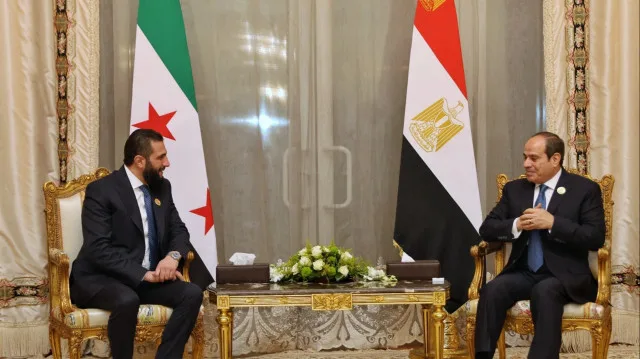
In this context, the Egyptian approach appears closer to prioritizing the logic of shared interests over points of ideological disagreement, opening the way for reviving bilateral relations and restoring their momentum. Over decades, these relations have long constituted one of the pillars of balance and stability in the region, making their reactivation today part of a broader equation to recalibrate the regional rhythm.
A Test for a New Phase at a Sensitive Time
In light of the shared challenges facing both Syria and Egypt, which have been exacerbated by the repercussions of war and regional transformations, launching a new phase of bilateral relations appears to be a real test of the two countries’ ability to adapt to rapid changes by reassessing the nature of their relationship in a way that ensures strategic interests prevail over any ideological differences or temporary disputes.
The visit carries the potential to serve as an entry point to a broader phase of mutual engagement, which could take shape in the form of high-level visits between the leaderships of the two countries, or momentum toward concluding cooperation agreements and strategic partnerships, in addition to addressing the outstanding issues that have contributed to tension in recent months.
Ultimately, this visit may represent an important stop in the process of dismantling points of disagreement and rearranging alliance priorities, amid a regional and international environment marked by a high degree of fluidity and uncertainty. This could pave the way for a shift from cautious relations to a more integrated partnership—a path that, if realized, would strengthen both countries’ ability to confront shared challenges. Will al-Shaibani’s mission succeed in turning this momentum into a tangible reality?