





هذا التقرير متاح أيضًا بـ العربية
In the occupied West Bank, the weapon pointed at Palestinians is not always carried by a regular soldier. Sometimes, a settler appears in military uniform at a checkpoint or on patrol near villages and fields, relying on a military status granted by the “Hagmar” system linked to the “Israel”i occupation army.
This report examines how the occupation army has turned some West Bank settlers into armed units tied to it through “Hagmar,” and how these units are used through checkpoints, patrols, blocking access to land, and protecting settlement outposts to expand control over Palestinians and their land.
What is Hagmar?
“Hagmar” is an abbreviation for the phrase “הגנה מרחבית” — “regional defense” — which was coined by the occupation army to describe local reserve battalions made up mostly of settlers.
These units are linked to the army’s Central Command and are officially presented as a framework for guarding settlements in emergencies, with the task of monitoring internal boundaries and setting up checkpoints and patrols.
And the describes the member of these militias as “a fighter in the place where he lives,” stressing that these forces belong to the Israeli military establishment and operate under its command.
But such a definition conceals a more complex reality: Hagmar is not merely “civilian guarding” around settlements, but local reserve units that recruit settlers, provide them with weapons and military uniforms, and integrate them into the army’s security structure.
The Israeli rights group documents that the so-called “protection system” in settlements does not rely on a single component, but on “regional defense squads,” “security coordinators,” and rapid military response teams.
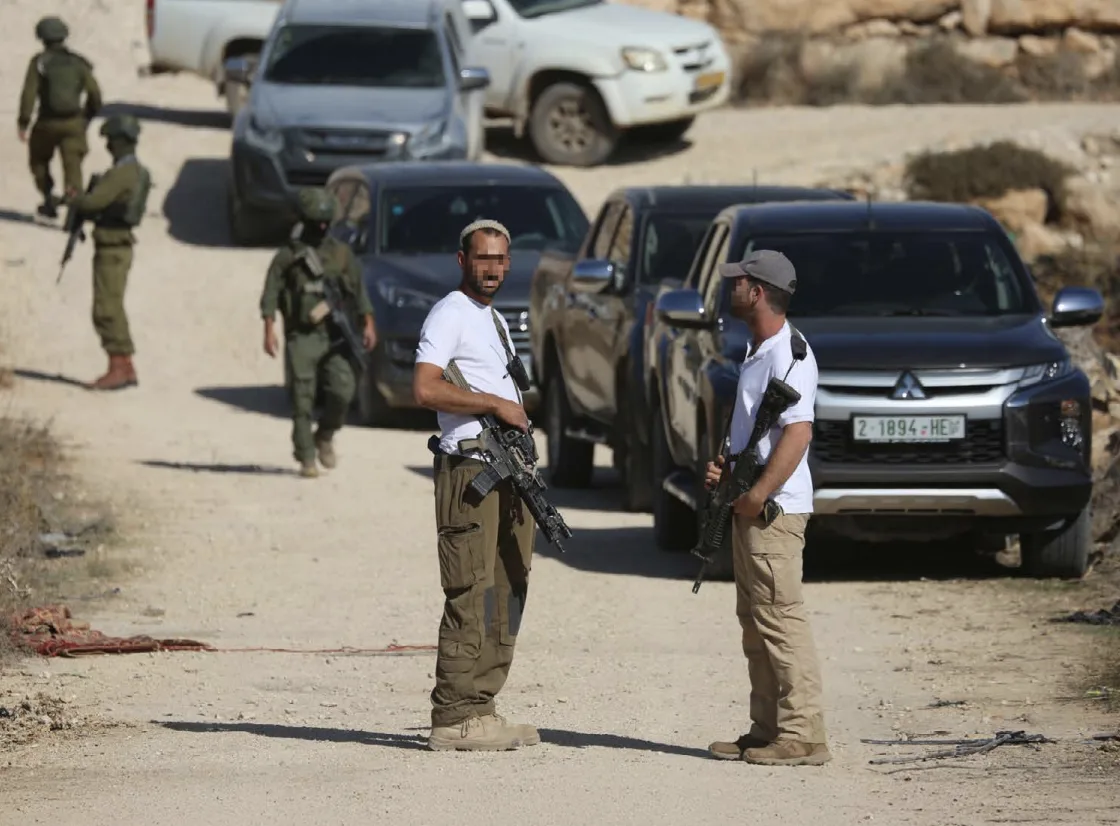
After Operation Al-Aqsa Flood on October 7, 2023, the occupation army called up thousands of settlers into these units and distributed thousands of rifles to members of the so-called regional defense forces and “civilian security teams,” in a rapid expansion of the armed settlement structure.
These forces stem from a doctrine dating back to the early days of the Zionist project. Since its establishment, “Israel” has relied on “regional defense” to compensate for a lack of strategic depth by arming residents of agricultural settlements.
In 1971, this doctrine expanded to settlements in the West Bank, with military orders stipulating the appointment of “civilian security coordinators” and the formation of guard teams. These coordinators became partners of the military establishment, receiving funding and training from the Ministry of Defense and being considered its “agents.”
From a Palestinian perspective, Hagmar constitutes settler militias with official cover that allows them to carry weapons legally and grants them security and policing powers in dealing with Palestinians.
How does it operate against Palestinians?
On the ground, Hagmar members appear in Palestinians’ lives as additional gateways to repression and abuse through several field methods.
1- Raiding Palestinian communities
In December 2023, a rights report documented the participation of Hagmar “regional defense soldiers,” together with armed settlers, in a raid on Khirbet Khallet al-Daba south of Hebron.
At the time, they smashed solar panels and water pipes, assaulted a resident, and stole tools, a generator, money, and gold. The incident reveals how military status gives settlers the ability to raid and vandalize Palestinian land under security cover.
2- Opening fire on roads and at checkpoints
On August 27, 2024, a rights report documented an incident near the settlement of Efrat, south of Bethlehem, in which soldiers from a “regional defense unit” opened fire on a Palestinian car, killing Khalil Salem Khalil and injuring others.
The danger of the incident lies not only in the shooting itself, but in the fact that the force involved was not merely a regular military patrol, but a settler unit operating around a settlement, turning the Palestinian road into a space controlled by settlers mobilized under a security designation.
The following clip shows a settler from the Havat Maon outpost opening fire on Palestinian Zakaria al-Adra near the village of Tuwani in Masafer Yatta, south of Hebron, on October 13, 2023.
3- Closing off land and preventing grazing
In southern Hebron, a report by the Financial Times revealed that a company commander in Regional Defense Battalion 7771, which includes settlers from nearby settlements and outposts, declared a Palestinian grazing area near the settlement of Carmel a closed military zone for 30 days.
In practice, this decision became a tool to prevent Palestinian shepherds from accessing their pastures and to expand the settlement’s authority beyond its boundaries.
4- Controlling daily life
This system is not only visible in shootings and raids, but also in the control of daily life. In the Jordan Valley, rights groups document a pattern in which “regional defense units” and settlement councils overlap with the occupation army and police in preventing grazing, confiscating livestock, and restricting the movement of Bedouin communities.
For Palestinians, this becomes an economic and on-the-ground tool: preventing grazing means striking at their source of livelihood and gradually pushing families away from their land.
Where does its danger lie?
A military status for a settler identity
The danger of Hagmar lies not only in carrying weapons, but in the status that the occupation state confers on those weapons. A settler who once appeared as an “extremist civilian” can later emerge wearing a military uniform or moving under a security designation that grants him the authority of a soldier.
This ambiguity is the essence of the danger. A Palestinian confronting such a person does not know whether he is facing a regular soldier subject to a military chain of command, or a settler shielded by the army’s uniform and status. In both cases, he faces an adversary with a direct interest in the land and field authority exercised in the name of “security.”
The danger of this overlap appeared in the Deir Jarir area east of Ramallah. According to documentation by the Israeli rights group B’Tselem, the area witnessed more than one incident involving armed settlers or so-called “regional defense soldiers” in shootings and assaults against Palestinians.
In April 2026, the organization documented an incident in which a settler-soldier from the “Uriah Farm” outpost opened fire on a group of Palestinians, killing Ali Hamadneh.
Testimonies by Israeli soldiers published by the Israeli rights group Breaking the Silence confirm that the “civilian coordinators” — meaning the settlers affiliated with “Hagmar” — wield broad authority over soldiers, determine their lines of contact, and influence their decisions.
Official cover that prevents accountability
This overlap provides official cover for abuses. Yesh Din found that some Hagmar recruits had records of nationalist-motivated crimes, yet were still given weapons and official uniforms.
The transformation here is not limited to granting weapons, but extends to legitimacy as well. When a recruited settler opens fire or prevents Palestinians from reaching their land, the act is often presented as a security measure rather than a settler crime.
Data from Yesh Din indicate that a very small percentage of settler crime cases against Palestinians end in conviction — a gap that becomes even more dangerous when the perpetrator is armed, wearing a military uniform, or operating under a security designation.
Authority that extends beyond the settlement’s boundaries
The danger of Hagmar extends far beyond the settlement’s alleged security protection. Through closed military zones, checkpoints, patrols, and the prevention of grazing and farming, the settlement’s authority expands to surrounding roads, fields, and pastures.
Rights and UN reports link the escalation in settler attacks, checkpoints, and denial of access to land to the emptying of dozens of Palestinian communities since 2023. In this context, Hagmar becomes part of a broader coercive environment pushing Palestinians toward displacement from their land.
Privatizing the occupation
Most dangerously, the occupation government transfers a large part of the management of daily control to the armed settler community — what rights groups call the “privatization of the occupation.”
This means giving extremist settlers the tools of government to exercise repression in the name of security. With powers fragmented between the Ministry of Defense and settlement councils, the occupation turns into a network of local militias.