






هذا التقرير متاح أيضًا بـ العربية
Targeting ports, oil facilities, and airspace in the Gulf has raised questions broader than that of the direct losses: Is Iran merely testing the defenses of the GCC states, or is it probing their ability to act as a unified front at a moment of regional war?
The battle is no longer merely military; it has gone The Economist that Iran’s missiles are trying to drive a wedge between the Gulf states, while raising the InstituteThe Italian Institute for International Political Studies (ISPI) poses the question from another angle: Will the Gulf Cooperation Council emerge from the war more cohesive or more divided?
In this sense, the attacks do not only raise questions about the strength of air defense, but about something deeper: Are the Gulf states truly a united front, or countries brought together by fears of Iran and divided by geography and their relationship with Washington and “Israel”?
Is Iran trying to split the Gulf ranks?
Selective targeting
Iran does not pressure the Gulf as a single bloc; rather, it chooses specific points of weakness. It has suggested targetingThe ports of Fujairah and Khor Fakkan, two outlets that bypass the Strait of Hormuz, suggest to many analysts that the goal is not so much to strike facilities as it is to serve as a reminder that bypassing the strait is not safe.
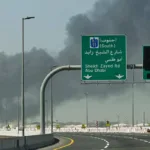
At the same time, targeted Iran targeted energy facilities in Saudi Arabia, Kuwait, and Qatar, prompting observers to speak of “dozens of versions of the 2019 Aramco attack.”
These strikes raised the economic cost of the war and made energy security a focal point for negotiation, rather than merely a military battle. And it noted Data ACLED indicated that the UAE was the most exposed to attacks, while Kuwait was the most exposed to human losses.
Some believe analysts say that Iran wanted to send several different messages: punishing the UAE for normalizing relations with “Israel”, pressuring the remaining states, and granting a relative exemption to Oman in encouragement of its role as a mediator.
It apologizes publicly while brandishing military threats
Iran does not operate through missiles alone, but through contradictory messages as well. In a public speech, presented President Masoud Pezeshkian offered an apology to neighboring countries that had been subjected to Iranian attacks, saying that Tehran does not seek confrontation with them. But this apology did not erase the Islamic Revolutionary Guard Corps’ escalatory rhetoric toward its neighbors.
According to the Doha Institute for Studies, the paradox reached its peak when strikes resumed hours after Pezeshkian’s apology, targeting Qatar, Bahrain, the UAE, and Saudi Arabia, reflecting a contradiction between the political discourse of de-escalation and the course pursued by the Revolutionary Guard.
Tehran then added another layer of ambiguity through denial. After the ceasefire took effect, the denied Revolutionary Guard denied launching any missiles or drones toward the Gulf states, saying that Iranian forces “did not launch anything toward any country,” rejecting reports of attacks on facilities in the region.
This duality serves a political purpose: it opens the door to de-escalation for Gulf capitals that want to distance themselves, while keeping the threat in place for anyone drawing closer to Washington or “Israel”. It also allows Tehran to portray the Gulf as a victim of its entanglement with American bases, rather than as a direct adversary.
Psychological warfare
Iran is waging a parallel battle of messages, trying to plant an unsettling question inside the Gulf: does the American presence protect the Gulf states, or does it make them targets in any confrontation with Iran?
In this context, warned The Islamic Revolutionary Guard Corps warned that any country whose territory or bases are used in American or “Israel”i operations against Iran could fall within the scope of targeting.
Iran uses maps as part of this psychological warfare. In May 2026, published the IRGC Navy published a map of an area it says falls under its control in the Strait of Hormuz, extending eastward to a line between Iran’s Jabal Mubarak and the Emirate of Fujairah.
The map was not merely a navigational statement, but a message to the UAE and the rest of the Gulf that alternative ports outside Hormuz are not beyond Iranian pressure.
Has the Gulf united or fractured under pressure?
The attacks pushed the Gulf states to raise the level of defensive coordination , share alerts, and intensively operate their air defenses, especially as the scope of missile and drone attacks expanded. They also issued joint statements condemning Iran.
The most important point of cohesion lies in the shared fear of a collapse in oil and gas exports, as attacks on Saudi, Qatari, and Kuwaiti energy facilities prompted the states to cooperate in securing pipelines and ports.
However, differing reliance on Hormuz creates a fundamental difference : the states located behind the strait (Kuwait, Bahrain, Qatar) feel more threatened, while Saudi Arabia and the UAE have partial outlets via the Red Sea and Fujairah.
This explains why some states are pushing for a swift settlement, while others see continued pressure as a way to force Iran to back down. Some of these divergences become clear when analyzing each country’s position.
- The UAE and Bahrain: They were subjected to intense attacks, but adopted a hawkish position. Abu Dhabi showed greater readiness to join an international coalition to secure the Strait of Hormuz and demanded the need to “deprive Iran of its missile capabilities,” while Manama, as the headquarters of the U.S. Fifth Fleet, took a similar stance.
- Saudi Arabia: It has East-West pipelines that give it room to maneuver, so it adopted a more cautious position. It hosted the extraordinary consultative Jeddah summit at the end of April, but refused to allow its territory to be used to launch attacks on Iran, preferring diplomatic solutions.
- Qatar: It focused on protecting gas facilities and its traditional mediation role. It calls for stopping the war and avoiding escalation, but it could not avoid the strikes. Nevertheless, it rejects being drawn into a confrontational alliance with Iran and is trying to maintain balanced relations with Washington and Tehran.
- Kuwait: It depends entirely on the Strait of Hormuz, and therefore seeks to end the war quickly. Despite being subjected to devastating attacks, it remained reserved about escalation and called for a political solution.
- Oman: It maintained a more balanced discourse, combining condemnation of the attacks with an emphasis on positive neutrality and a call for dialogue, in line with its traditional role as a mediation channel.
These differences show that the GCC does not act as a unified security alliance, but rather as a framework for political coordination, with each state calculating its interest based on its geography and its economic and political relations.
Even on economic issues, some Gulf capitals tend to calculate their interests individually, as is evident in files such as oil policy, the UAE’s exit from the OPEC oil alliance, for example, indicates its pursuit of economic independence even in the face of shared danger.
The Italian ISPI Institute concludes that that the Gulf states after the war on Iran are not in a state of complete fragmentation, but they are also not moving within a single strategic vision, in its assessment.