





هذا التقرير متاح أيضًا بـ العربية
In a public square in Tehran, men and women gather around members of the Revolutionary Guard explaining the basics of handling a Kalashnikov: ammunition, assembly and disassembly, and how to hold the weapon.
The weapon no longer appears only on battlefronts or in military parades, but also in squares, mosques, and mass wedding events, in an Iranian attempt to turn fear of a return to war with the United States and “Israel” into a daily ritual of mobilization, crafting the image of a society ready to defend and sacrifice.
From training tents in Tehran to campaign “Janfada,” or “Sacrifice for Iran,” the Kalashnikov, the missile, and the military uniform are becoming tools in a psychological and political discourse aimed inward to boost morale and outward to show that if war returns, it will no longer remain confined to traditional military fronts.
What Is Happening in Iran’s Streets?
After the ceasefire and the start of a fragile truce, training tents appeared in some squares in Tehran, where members of the Revolutionary Guard and the Basij offer short courses for civilians on handling Kalashnikovs and light weapons.
These courses focus on identifying types of ammunition, how to assemble and disassemble the weapon, and basic safety rules, while trainees are allowed to hold the weapon under instructors’ supervision.
آموزش استفاده در سلاحی که ایرانیان را در ۱۷ و ۱۸ دی به خاک و خون کشید.
اسلام باید برود، هر کسی گفت نمیشود، وقتش نیست خودش هم باید برود.#اسلامزدایی #ایرانیسیم pic.twitter.com/K0NCf9y6sX
— Maziar (@MaziarIrani_) May 18, 2026
Alongside this, the scene includes symbolic displays, such as car parades equipped with machine guns and television programs showing symbolic gunfire inside studios.
These scenes, which began about two weeks after the truce, seek to show that society is ready to defend itself without implying that the population is being armed or trained for actual combat.
Where Is the Training Taking Place?
The training tents were concentrated in well-known public squares in the capital, most notably Haft-e Tir Square and Vanak Square. Imam Hussein Square was also used to host mass weddings as part of the “Janfada” campaign, where training tents were set up alongside the platform.
The activities were not limited to the capital. State television also broadcast footage of training in mosques in the cities of Ahvaz, Kerman, Shiraz, and Zahedan, where men and women were seen learning how to handle light weapons.
Who Is Participating and What Are They Learning?
Men and women participate in these scenes, some of them wearing traditional religious attire, and the presence sometimes extends to boys seen standing beside unloaded rifles.
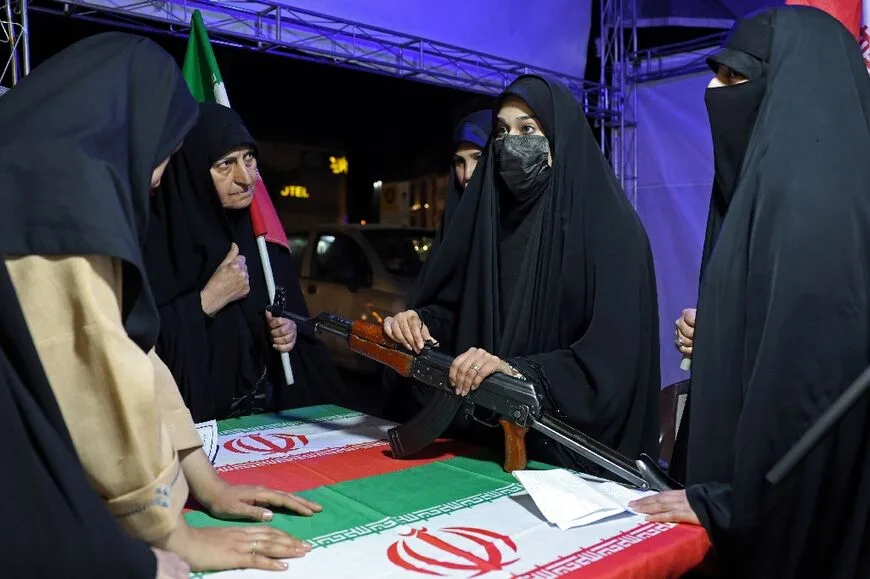
The training is limited to the basics of using the Kalashnikov: identifying ammunition, assembling and disassembling the weapon, basic aiming, and carrying the weapon safely, without live fire.
Participants also sign a symbolic pledge to sacrifice in war, and in some cases trainees receive a “Janfada” card after completing the weapons course confirming that they received the basic instruction.
Who Is Training the Civilians?
These courses are led by members of the Revolutionary Guard, the military force that answers directly to the Supreme Leader and plays a central role in the missile and warfare system.
The Basij also take part in the training. The Basij is a popular mobilization force established by order of Khomeini in 1979 and includes hundreds of thousands of volunteers. It is often used to suppress protests and carry out internal security operations.
In the squares, the instructors identify themselves as Basij volunteers and stress that the training is voluntary, not mandatory.
What Is the “Janfada” Campaign?
Janfada means in Persian “Sacrifice for Iran,” and it is a campaign launched by the authorities to encourage civilians to volunteer and prepare for sacrifice in the event that war returns.
The campaign is tied to religious and national symbols, as it includes mass weddings in Imam Hussein Square, where couples are paraded aboard military trucks equipped with machine guns and the grooms stand beside “Kheibar Shekan” missiles.
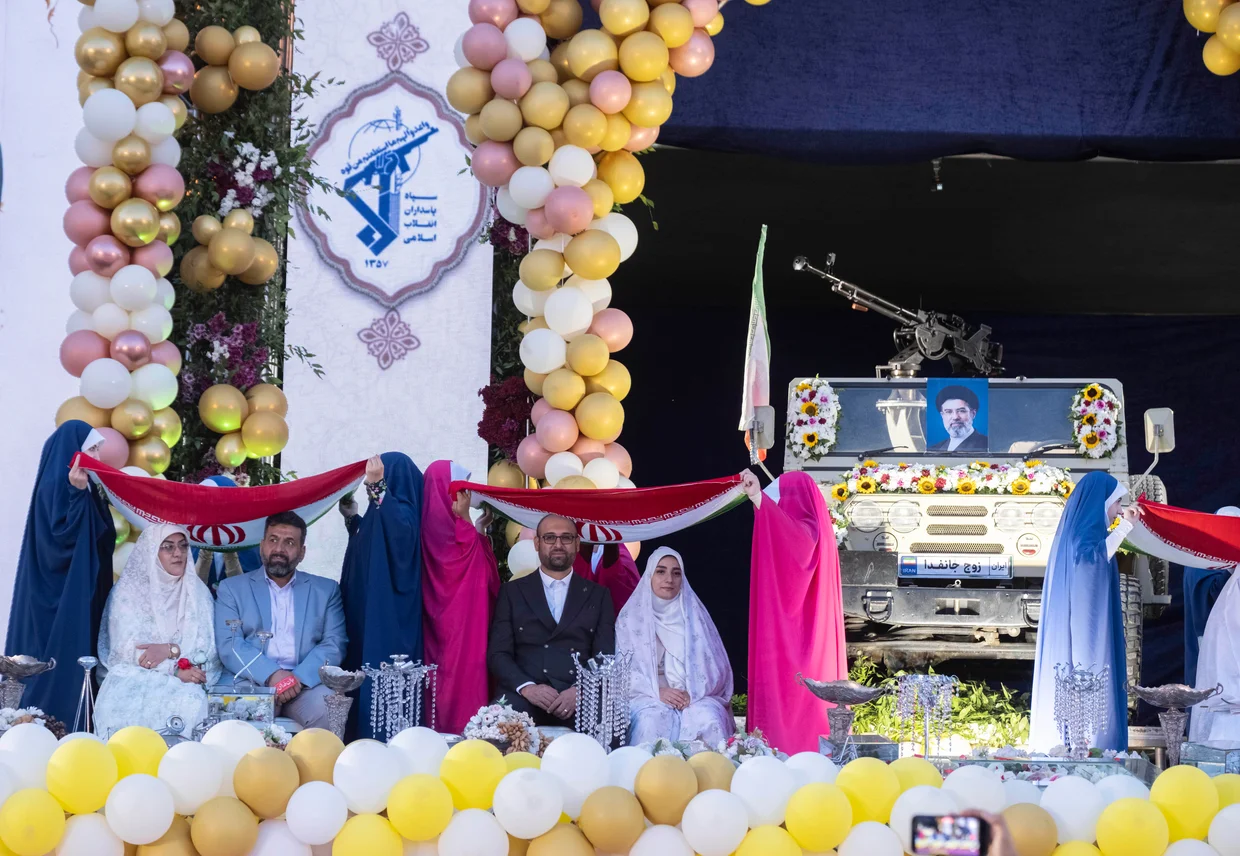
This campaign carries a dual message: strengthening national feeling and loyalty, and sending deterrent signals to adversaries that society is ready.
Real Mobilization or a Deterrent Image?
So far, the evidence suggests that what is taking place is more a coordinated symbolic and psychological mobilization than a broad military mobilization.
Reports confirm that the scenes are limited and organized, and that trainees are using unloaded weapons and receiving theoretical instruction.
Despite some officials speaking of millions of volunteers, there is no evidence of mass armament or the creation of civilian combat units.
Why Now?
These activities come after a bloody war with the United States and “Israel,” amid fears of renewed fighting under a fragile ceasefire.
By spreading weapons across squares, mosques, and the media, and linking them to wedding rituals and patriotism, the authorities seek to turn war into a daily presence in the public consciousness and reinforce the message that society is ready to defend itself.
At the same time, this display remains confined to the framework of symbolic mobilization and psychological warfare directed inward and outward more than it represents actual preparation for a coming battle.