









An internal U.S. government document has revealed that Washington is preparing to lift some sanctions imposed on Eritrea a move that observers see as directly tied to the growing strategic importance of the Red Sea and the rapidly shifting geopolitical landscape following the U.S.-Israeli war on Iran, tensions surrounding the possible closure of the Strait of Hormuz, and the broader regional and global repercussions of those developments.
The document, a memorandum sent by the U.S. State Department to several countries, indicated that the sanctions rollback is scheduled to take place this May, though it did not specify an exact date for an official announcement. A State Department spokesperson, speaking positively about U.S.-Eritrean relations, said that “the Trump administration seeks to promote peace and prosperity in the Horn of Africa and looks forward to strengthening the relationship between the United States and the people and government of Eritrea.”
According to The Wall Street Journal, Massad Boulos, President Donald Trump’s adviser on Arab and African affairs, secretly met Eritrean President Isaias Afwerki in Cairo late last year to discuss easing U.S. sanctions and launching high-level talks aimed at resetting U.S.-Eritrean relations.
Beyond the war involving Iran and concerns over the closure of the Strait of Hormuz, many analysts view the American move as part of a broader effort to redraw the balance of power in the Red Sea and the Horn of Africa, especially amid escalating regional tensions, the ongoing war in Sudan, persistent security instability in Somalia, fears of renewed confrontation between Ethiopia and Eritrea, and the resurgence of internal conflict in Ethiopia’s Tigray and Amhara regions.
A Strategic Location Long Underutilized
Eritrea now sits at the center of a major geopolitical restructuring in the Horn of Africa and the Red Sea driven by a geographic position it failed to capitalize on during decades of isolation, but which has once again forced itself onto the international agenda. To understand Washington’s current shift toward Asmara, two key factors must be examined: the geography that granted Eritrea unparalleled strategic significance, and the sanctions regime that defined its relationship with the West.
Eritrea lies in the northeastern corner of the Horn of Africa and overlooks the Red Sea along a coastline stretching roughly 1,200 kilometers, making it one of the longest coastlines bordering this vital maritime corridor. Its maritime reach is further enhanced by the Dahlak Archipelago, which consists of more than 350 islands and extends Eritrea’s influence far beyond its land borders.
The East African state borders Sudan to the west and northwest, Ethiopia to the south, and Djibouti to the southeast, while facing Saudi Arabia and Yemen across the Red Sea. This positioning places Eritrea at the intersection of three geopolitical spheres: the Horn of Africa, the Arab world, and the Red Sea security architecture.
Most importantly, Eritrea lies near the Bab el-Mandeb Strait the strategic chokepoint linking the Red Sea to the Gulf of Aden and the Indian Ocean while separating the Horn of Africa from the Arabian Peninsula. Eritrea’s Assab Port sits only around 60 kilometers from the strait, making Asmara an indispensable player in any equation concerning maritime security.
The importance of this location has become even more pronounced given that the Suez-Red Sea route normally carries around 12–15% of global trade and approximately 30% of global container traffic, while Bab el-Mandeb itself is considered one of the world’s most critical energy chokepoints.
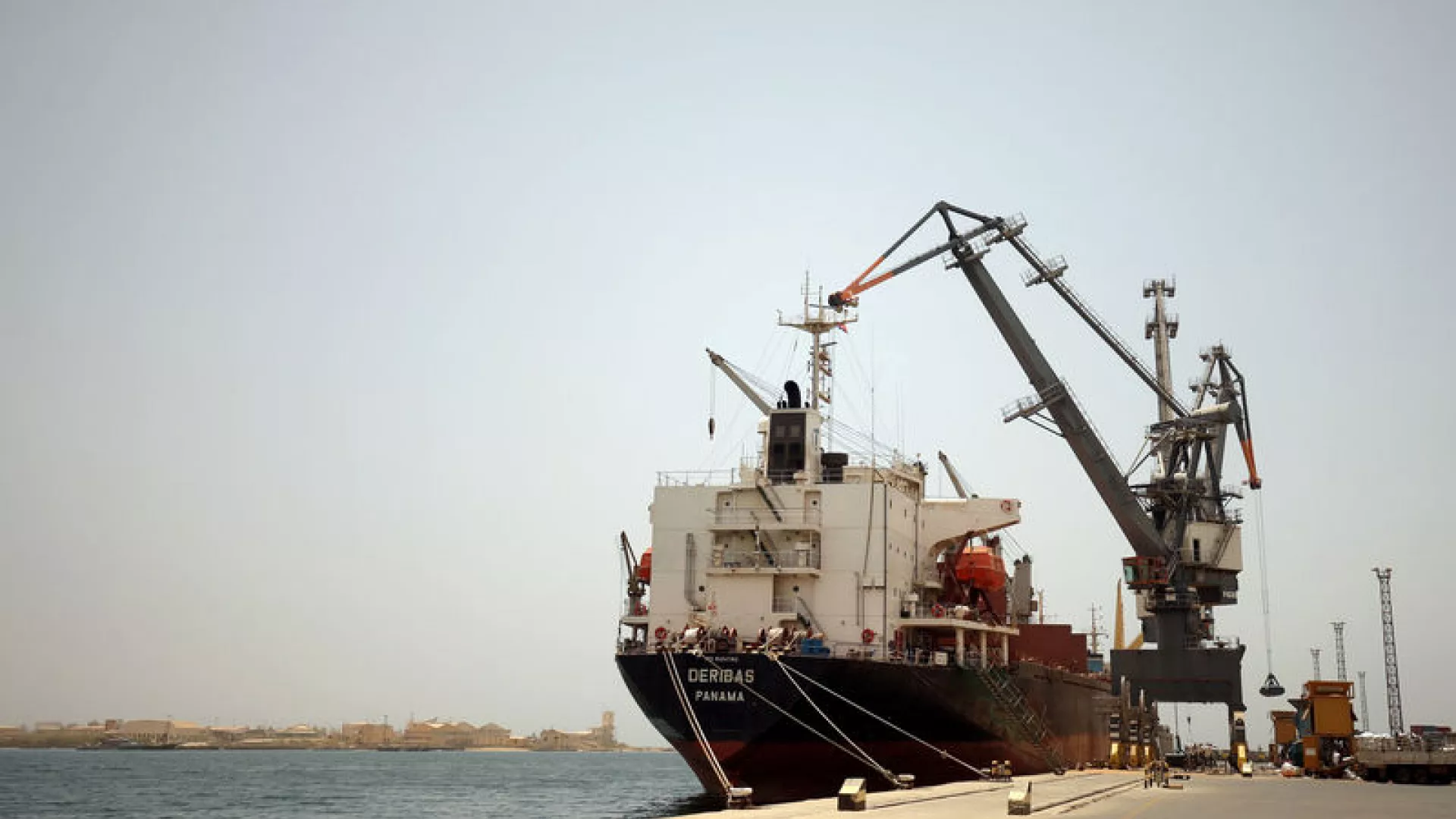
In addition to its extensive coastline, Eritrea possesses two naturally deep ports capable of accommodating large vessels: Massawa and Assab. The former served historically as Ethiopia’s principal maritime gateway before Eritrean independence in 1993 and holds deep historical significance dating back to the first migration of the Prophet Muhammad’s companions to the Kingdom of Aksum. Assab, meanwhile, boasts a particularly deep harbor that has attracted the attention of regional and international military powers alike.
Eritrea also sits directly opposite Saudi Arabia along the Red Sea, placing it squarely within the region’s broader security equation, whether in confronting Houthi threats or navigating the competition for influence among major regional powers.
Yet despite these advantages, Eritrea has largely been treated as a marginal state since gaining independence from Ethiopia on May 24, 1993, due largely to the highly authoritarian system established by President Isaias Afwerki. His government adopted a controversial doctrine of “self-reliance” while becoming embroiled in recurring conflicts and tensions with neighboring states and major international actors.
As a result, Eritrea became subject to multiple rounds of Western and American sanctions. Although United Nations sanctions were eventually lifted, Eritrea’s strategic geography has once again forced itself into regional and global calculations amid the accelerating transformations unfolding across the Red Sea and the wider international arena.
From Partnership to Entrenched Hostility
Ironically, the early years of President Isaias Afwerki’s rule were marked by strong ties and high-level coordination between Asmara and Washington, particularly between 1993 and 2000. During that period, the Clinton administration pursued a strategy of supporting what former President Bill Clinton described as a “new generation of African leaders”: Isaias Afwerki of Eritrea, Meles Zenawi of Ethiopia, Yoweri Museveni of Uganda, Paul Kagame of Rwanda, and Laurent Kabila of the Democratic Republic of Congo.
The objective was to isolate and contain the regime of Sudanese President Omar al-Bashir, which Washington viewed at the time as a rogue state and a major threat to American interests in the Horn of Africa.
That policy was largely shaped by Susan Rice, who served first as Director for African Affairs at the U.S. National Security Council and later as Assistant Secretary of State for African Affairs during Clinton’s second term. Rice viewed these leaders as a vanguard capable of stabilizing the region and containing Islamist expansion from Khartoum without direct U.S. military intervention.
Washington therefore strongly supported the arming of Sudan’s neighbors and the creation of what became known as the “Frontline States,” coordinating military and logistical support for the Sudan People’s Liberation Movement led by John Garang through Eritrean, Ethiopian, and Ugandan territory in an effort either to overthrow Bashir or at least weaken his regime.
That period witnessed intense U.S.-Eritrean coordination, including American backing for Eritrean efforts to undermine Bashir in the mid-1990s after Asmara accused Khartoum of supporting Eritrean Islamist opposition groups.
But Susan Rice’s broader strategy ultimately collapsed. The alliance unraveled dramatically in 1998 after the sudden outbreak of a devastating border war between Eritrea and Ethiopia. At the same time, conflict erupted among Washington’s own regional allies, with Uganda and Rwanda clashing against Laurent Kabila’s government in Congo.
That same year, Bashir’s regime began changing its posture after Sudan expelled Osama bin Laden in 1996 and subsequently entered into covert intelligence cooperation with Washington following the 1998 bombings of the U.S. embassies in Nairobi and Dar es Salaam.
Sudan’s relations with Ethiopia also improved significantly during that period. Meles Zenawi had once been a close ally of Omar al-Bashir before ties deteriorated in 1995 following the attempted assassination of former Egyptian President Hosni Mubarak — an operation linked to figures associated with the Sudanese government.
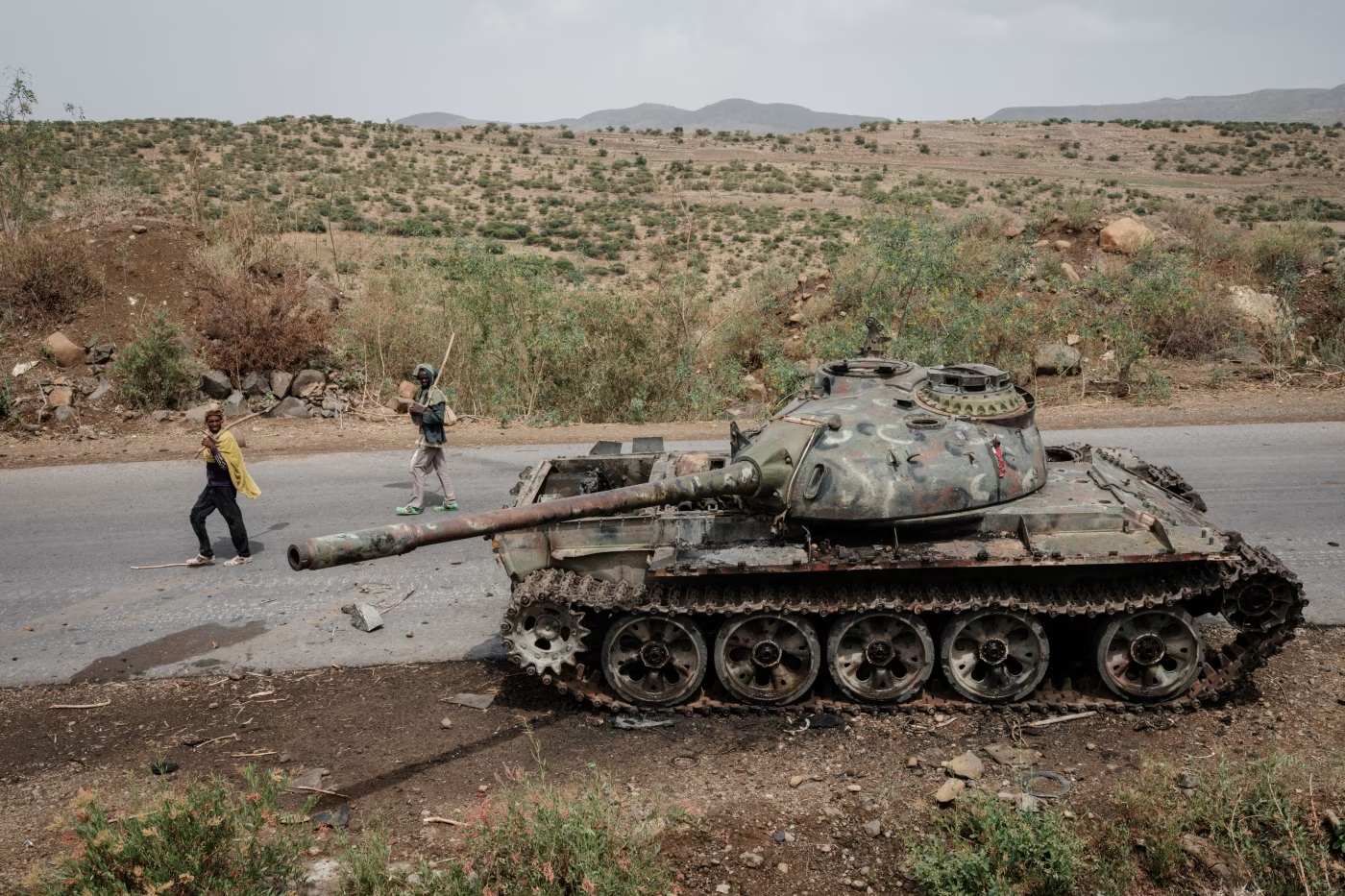
Back in Washington and Asmara, however, the Eritrean-Ethiopian border war of 1998–2000 marked a turning point. Eritrea accused the United States of siding with Addis Ababa, ending the brief honeymoon between the two countries and ushering in an era of deepening estrangement.
The first U.S. sanctions on Eritrea were imposed in September 2005, when then-Secretary of State Condoleezza Rice banned defense exports and military-related commercial services under the Arms Export Control Act (AECA), citing religious freedom violations. This sanctions regime remained in place independently even after broader UN sanctions were imposed in 2009 and later lifted in 2018.
Further sanctions followed in 2011 under the State Department’s annual Trafficking in Persons report due to criticism of Eritrea’s indefinite mandatory national service program, which Washington considered a form of ongoing forced labor.
International sanctions were imposed in December 2009 under UN Security Council Resolution 1907, which established an arms embargo and economic sanctions against Eritrea. The United States was the principal force behind the resolution, which cited two main accusations: Eritrean support for Somalia’s al-Shabaab movement, viewed by Washington as a direct terrorist threat, and Eritrea’s refusal to withdraw troops during its border dispute with Djibouti in 2008.
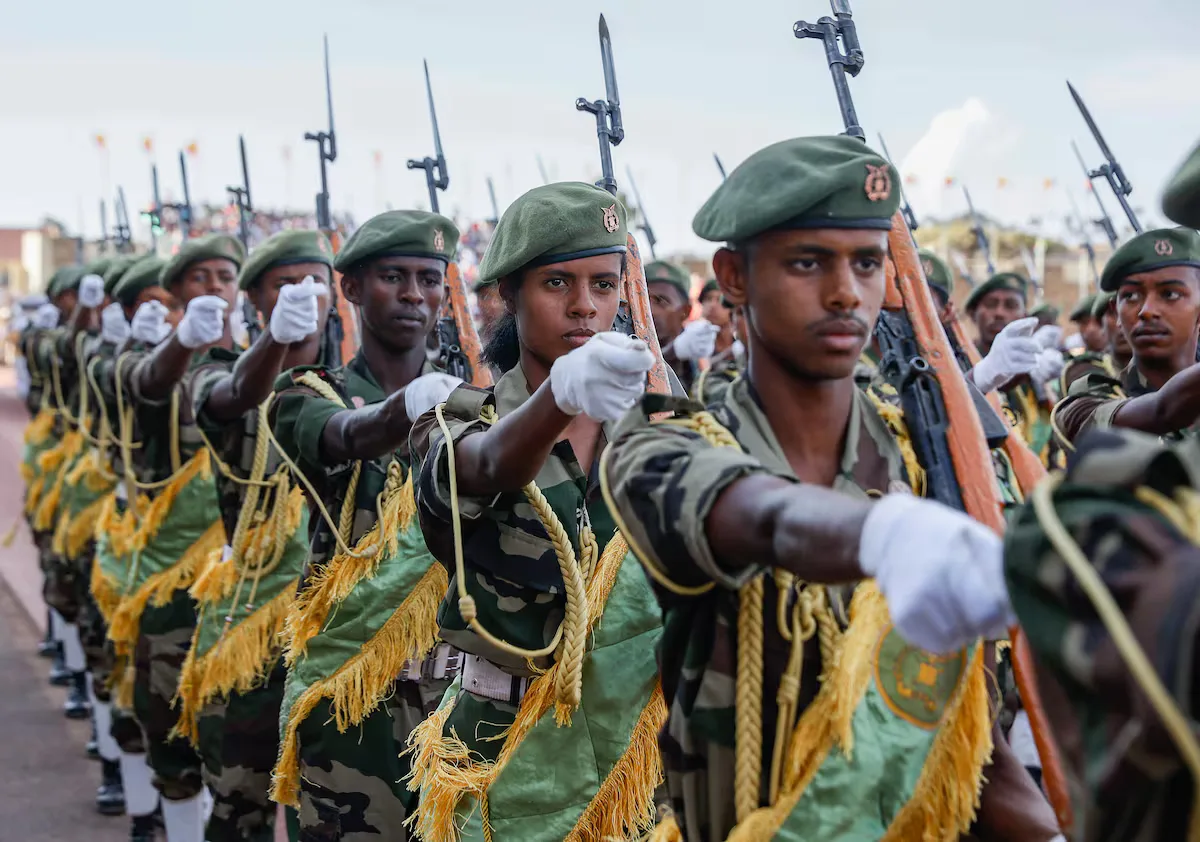
The sanctions Washington is now reportedly preparing to lift were imposed by the Biden administration in 2021 and targeted Eritrea’s ruling party, military, and senior officials over the role Eritrean forces played in the Tigray war alongside the Ethiopian army. Both forces were accused of committing atrocities against civilians in the region.
On November 17, 2021, President Joe Biden signed Executive Order 14046 imposing sanctions on Eritrea over its role in the Tigray conflict, which erupted in November 2020 between Ethiopia’s federal government and the Tigray People’s Liberation Front and involved extensive Eritrean military intervention.
For months, Eritrea denied deploying troops in Tigray before later acknowledging their presence while rejecting responsibility for abuses. However, UN investigators and human rights organizations documented massacres, widespread sexual violence, kidnappings, and looting carried out by Eritrean forces during the conflict between 2020 and 2022.
The sanctions targeted the Eritrean Defense Forces, the ruling People’s Front for Democracy and Justice (PFDJ), and the party-linked economic conglomerate Hidri Trust. Senior figures such as national security chief Abraha Kassa and economic adviser Hagos Ghebrehiwet were also sanctioned. Separately, Eritrean army chief General Filipos Woldeyohannes was sanctioned in August 2021 under the Global Magnitsky Act for serious human rights abuses.
Importantly, these sanctions were largely symbolic and political rather than economically devastating. Eritrea’s closed economy — often described by Freedom House as resembling a militarized authoritarian system akin to North Korea — is only weakly integrated into the Western financial system. The targeted institutions and individuals held few assets abroad and maintained minimal engagement with international banking systems.
The sanctions’ primary significance therefore lay in branding Eritrea as a pariah state, obstructing diplomatic normalization, complicating the appointment of a U.S. ambassador, discouraging other countries from engaging with Asmara, and legally restricting future military or intelligence cooperation.
The Anticipated Shift
On November 6, 2024, immediately after Donald Trump’s election victory was announced, Eritrean Information Minister Yemane Gebremeskel revealed in a post on X that President Isaias Afwerki had sent Trump a warm congratulatory message “on behalf of the Government and people of Eritrea, and personally,” celebrating his “historic return” as the 47th president of the United States.
The Eritrean minister added that Afwerki expressed hope the election would “open a new chapter of constructive and fruitful cooperation” between Eritrea and the United States.
Such gestures are unusual for a leader whose country has long maintained deeply hostile relations with Washington. Yet the move may reflect a certain convergence between the personalities of Trump and Afwerki. Both men favor centralized decision-making outside traditional institutional frameworks. Trump has also repeatedly expressed admiration for what he calls “strong leaders,” including Egyptian President Abdel Fattah el-Sisi, whom he reportedly referred to during the 2019 G7 summit as “my favorite dictator.”
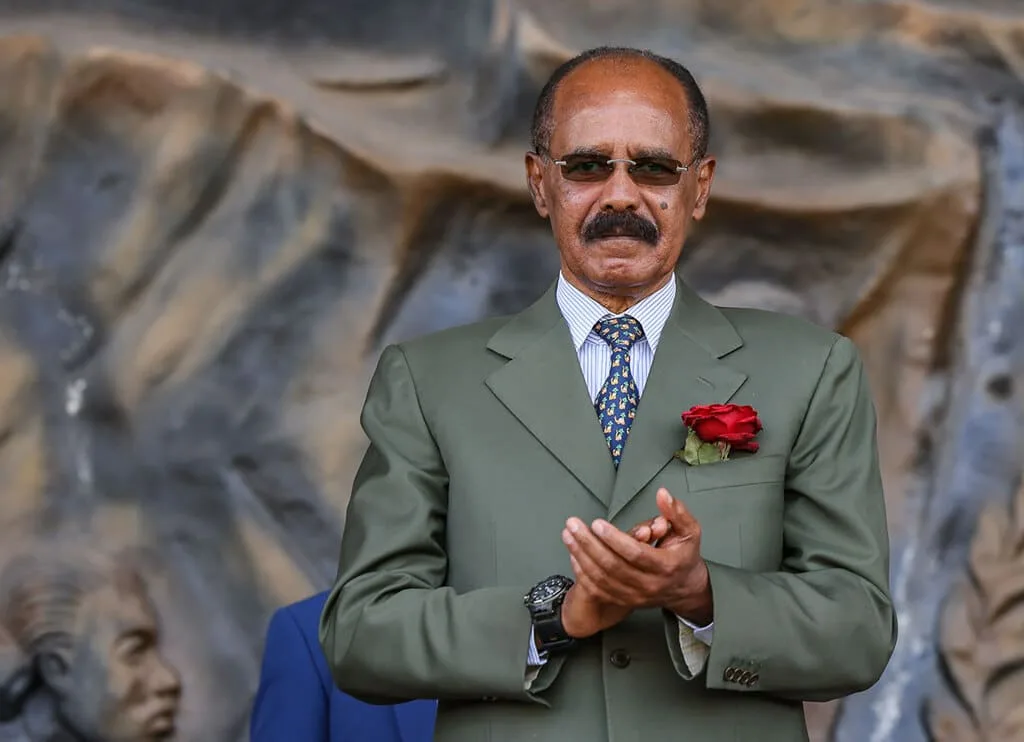 Further signaling Asmara’s openness toward a Trump administration, Afwerki stated in January 2026 during an interview with media outlets close to his government that he sought partnerships with the United States based on mutual respect and national sovereignty, calling for Trump’s second term to be used to build “fruitful and stable” relations.
But the potential rapprochement between Washington and Asmara extends beyond personal chemistry. It reflects broader geopolitical transformations that have pushed the United States to reassess its approach toward Eritrea amid discussions of easing sanctions — a shift demonstrating the triumph of strategic calculations over human rights concerns.
Foremost among these changes is the Red Sea’s return to the center of global strategic calculations following the Iran war, tensions surrounding Hormuz, Houthi threats to maritime navigation, Ethiopia’s growing ambitions for sea access, and the broader American military repositioning from the Gulf toward the African coastline.
Leaks also suggest that Cairo played a mediating role between Washington and Asmara. The Wall Street Journal reported that Trump’s Africa adviser Massad Boulos held a secret meeting with Isaias Afwerki in Cairo late last year to discuss sanctions relief and the launch of high-level talks aimed at recalibrating bilateral relations.
Winners and Losers
The anticipated U.S. decision to lift sanctions on Eritrea is not merely a tactical repositioning; it is a geopolitical event that redistributes gains and losses between two competing blocs in the Horn of Africa and the Red Sea.
According to this emerging alignment, the perceived losers include Ethiopia, the United Arab Emirates, the Rapid Support Forces in Sudan, Somaliland, and Israel. The apparent beneficiaries, meanwhile, include Egypt, Eritrea, the Sudanese army, Saudi Arabia, Turkey, and Qatar.
Ethiopia appears to be the biggest loser from any U.S.-Eritrean rapprochement. For three decades, Addis Ababa served as Washington’s primary regional ally in the Horn of Africa. But lifting sanctions on Eritrea shifts the equation from “Washington aligned with Ethiopia” to a more complex balance in which Washington positions itself between Ethiopia and Eritrea.
The second blow concerns Prime Minister Abiy Ahmed’s ambitions for maritime access. Abiy has repeatedly argued that landlocked Ethiopia possesses a “historic right” to sea access remarks widely interpreted in Eritrea as possible preparation for military action. The leaked American document reportedly sent a clear signal opposing any attempt to obtain a port by force while warning both Ethiopia and Eritrea against destabilizing interference in one another’s affairs.
The UAE and Somaliland also stand to lose significantly. Over the past decade, Abu Dhabi built a network of influence across the Horn of Africa through strategic partnerships with Ethiopia, backing for Sudan’s Rapid Support Forces, investments by DP World in Somaliland’s Berbera Port, and expanding ties involving Israel.
That network now faces major disruption if Washington pivots toward Eritrea particularly if the United States eventually utilizes infrastructure originally developed by the UAE itself, including Assab’s military facilities, which Abu Dhabi operated during its close partnership with Eritrea between 2015 and 2021.
Assab enjoys clear geopolitical advantages over Berbera. It lies only around 60 kilometers north of Bab el-Mandeb, compared to more than 250 kilometers separating Berbera from the strait. This geographic difference grants any naval force stationed in Assab the ability to respond to threats in a matter of hours rather than days.
Moreover, rapprochement with Eritrea allows Washington to avoid the diplomatic complications that would accompany formal recognition of Somaliland in exchange for access to Berbera Port — a proposal strongly opposed by the African Union, Saudi Arabia, Egypt, and Somalia itself.
On the other side of the ledger, Sudan emerges as one of the major beneficiaries. Eritrea has become a strategic rear base for the Sudanese army, hosting and training armed groups aligned with Khartoum while supporting communities in eastern Sudan with ethnic and linguistic ties to Eritrea.
Egypt also benefits substantially. Cairo reportedly played a mediation role between Washington and Asmara, strengthening its standing as a regional power capable of facilitating major diplomatic understandings. Egypt further sees strategic value in geographically containing Ethiopia, especially amid ongoing disputes over the Grand Ethiopian Renaissance Dam.
For Cairo, Red Sea stability is existential given the importance of Suez Canal revenues. Strengthening Eritrea as a stable ally directly enhances the security of the maritime corridor and reduces disruptions that have forced shipping to reroute around the Cape of Good Hope.
Reassuring Ethiopia Before Lifting Sanctions
Despite all this, Washington is unlikely to abandon Ethiopia entirely in favor of Eritrea. American policymakers understand that opening toward Asmara could unsettle Addis Ababa, which is why the United States moved simultaneously to lift its arms restrictions on Ethiopia.
In recent days, Washington ended the arms embargo imposed on Ethiopia in September 2021 during the height of the Tigray conflict. At the time, the U.S. justified restrictions on defense exports to both Ethiopia and Eritrea because of worsening humanitarian conditions and escalating hostilities.
American officials increasingly fear that Ethiopia — the region’s largest demographic and economic power — has deepened military cooperation with rival powers such as Russia, China, Iran, and Turkey. Lifting the embargo therefore appears aimed at restoring Western influence and offering Addis Ababa an alternative to non-Western military suppliers.
The parallel timing of lifting arms restrictions on Ethiopia while easing sanctions on Eritrea suggests that the current U.S. administration seeks to effectively “reset” the Tigray sanctions file for both sides simultaneously.
Analysts also argue that the coordinated moves send a message discouraging Ethiopia from pursuing military options for sea access while reassuring Eritrea amid escalating border tensions.
Human Rights Criticism
The expected sanctions relief has drawn fierce criticism from human rights organizations, which argue that it rewards one of the world’s most repressive governments and entrenches impunity for atrocities committed in Tigray.
Groups such as Freedom House warned that Eritrea risks being transformed into a “rehabilitated spoiler” not because its behavior changed, but because its geography has acquired renewed strategic value.
Yet the Trump administration appears prepared to brush aside such criticism. It has repeatedly declared its intention to abandon decades-old policies centered on democracy promotion and human rights conditionality in favor of hard-nosed strategic and commercial partnerships.
The administration has emphasized peace and prosperity in the Horn of Africa while prioritizing direct investment and trade relationships focused on energy and critical minerals, alongside efforts to reduce the role of traditional aid structures such as USAID.
At the same time, Washington is expected to maintain parallel measures such as Magnitsky sanctions and visa restrictions in order to frame the easing of sanctions as a calibrated move rather than a blank check.
Ultimately, the broader irony remains that in an era of geopolitical pragmatism, human rights concerns are increasingly shifting from the center of policymaking to its margins.
How Afwerki Is Likely to Respond
The Eritrean government will likely approach the American move with what might be described as “cautious welcome” a tone already reflected in statements issued by the Eritrean embassy in Washington.
President Isaias Afwerki, now 80 years old and long accustomed to governing through isolation, is unlikely to suddenly transform Eritrea into a full Western ally. Instead, he will seek to extract specific gains: greater international legitimacy, reduced isolation, potential investments in Assab Port, and expanded economic opportunities all without making meaningful concessions on human rights, compulsory military service, or elections.
Domestically, the regime will likely portray the decision as a victory for resilience and proof that Eritrea’s doctrine of self-reliance ultimately forced Washington to return to Asmara.
Economically, Eritrea may see limited investment flows tied to Assab’s development, military cooperation with Saudi Arabia, and potential engagement with American mining firms, though not enough to fundamentally transform the country’s closed economy.
Regionally, Asmara will likely grow more confident in confronting Ethiopia while expanding its role in Sudan and along the Yemeni coastline as it gradually re-enters global strategic calculations.
Placed side by side, Washington’s two recent decisions — lifting sanctions on Eritrea while removing arms restrictions on Ethiopia — reveal the essence of Trump’s emerging strategy: not full alignment with either side, but rather the construction of a managed balance designed to transform the historic hostility between Asmara and Addis Ababa into a rivalry contained under an American umbrella.
Washington has rediscovered Eritrea’s strategic value — its geography, coastline, proximity to Bab el-Mandeb, and ready-made ports — yet it also recognizes that it cannot sacrifice Ethiopia, a country of more than 120 million people, one of Africa’s largest economies, and a longstanding counterterrorism partner.
The United States, therefore, appears intent on “holding the stick from the middle”: Ethiopia receives arms but is warned against using force to secure sea access, while Eritrea gains sanctions relief but is likewise cautioned against provoking its far larger neighbor.
Given Trump’s fondness for presenting himself as a peacemaker, some analysts even believe he may eventually attempt mediation between Isaias Afwerki and Ethiopian Prime Minister Abiy Ahmed perhaps seeking another fragile diplomatic arrangement similar to recent regional cease-fire deals elsewhere in Africa.
In the final analysis, the true winner of the latest regional realignments may be Washington itself. The United States is transforming from the exclusive ally of Ethiopia into an arbiter between Ethiopia and Eritrea at a moment when both countries arguably need Washington more than Washington needs either of them.
The biggest loser, meanwhile, may be the United Arab Emirates, which built its regional strategy around Ethiopia’s rise as the dominant power in the Horn of Africa and invested heavily in Somaliland and Berbera Port, only to discover that Washington is now turning toward Asmara for a host of strategic and military reasons.
Ultimately, recent American moves suggest that Washington does not seek a single hegemonic power in the Horn of Africa or the Red Sea. Instead, it seeks a dynamic balance that serves American interests above all else a doctrine that closely reflects Trump’s broader foreign policy worldview: no permanent allies, no permanent enemies, only shifting deals and evolving balances.