












هذا التقرير متاح أيضًا بـ العربية
The number of people in need of psychological treatment in the Gaza Strip is increasing day after day, and the reality suggests that society is gradually shedding the constraints of “stigma,” with people turning to mental health clinics without embarrassment because of their urgent need to recover. While the number of those seeking services has doubled, the same is not true for psychiatrists and psychotherapists; their numbers remain limited, and they must bear the pressure and work under extremely harsh conditions.
They continue their work, receiving more cases, listening attentively to people’s pain, and guiding them toward recovery. Outside the clinics, those who know them see them as a source of strength and seek reassurance in speaking with them, which compels them to remain steady and strong in order to support others. But they return home weighed down by what they have heard and seen, even as they themselves have lived through similar stories—perhaps even harsher ones—and endured the same horrors of war, each carrying their own private pain.
They provide their services in unsuitable conditions and with limited resources. Just one month after the genocide began, the occupation destroyed the only psychiatric hospital in the Gaza Strip. Many related clinics and centers were also hit by bombardment, in addition to a shortage of specialists due to travel, martyrdom, or the inability to work because of the conditions imposed by the war.
How do psychiatrists and psychotherapists cope with work that requires them to immerse themselves in other people’s pain? Can they maintain safe distance between themselves and their patients’ stories? What effects does this have on them? When does the therapist need a therapist? And how can a patient’s smile become a motive to keep going?
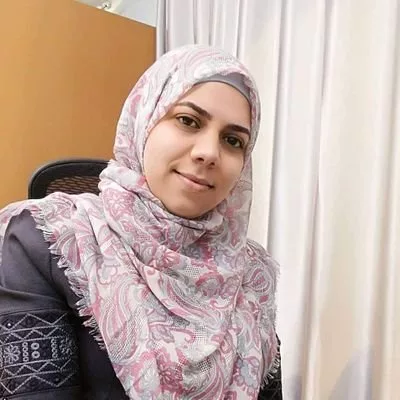
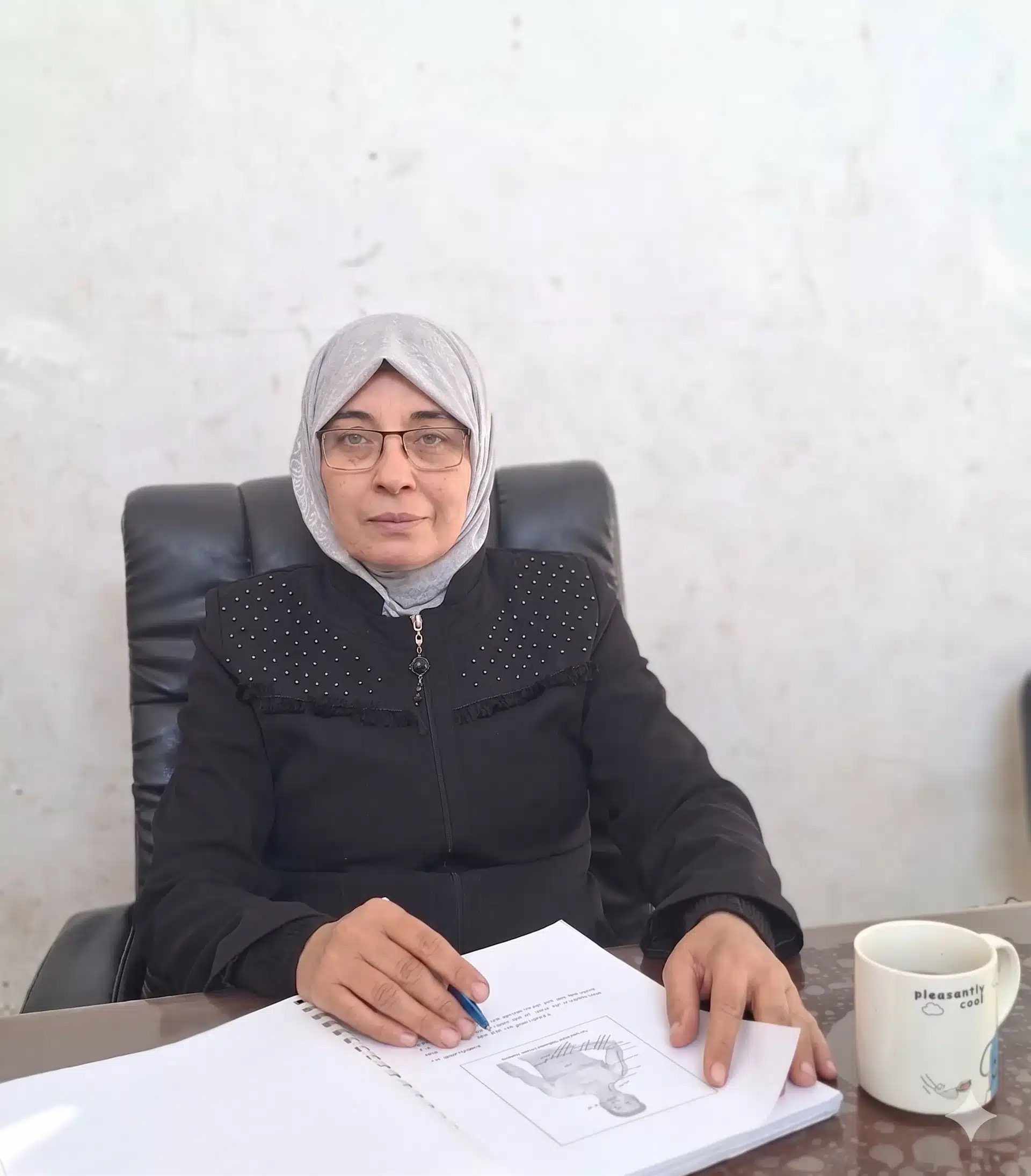
Answers to these questions and more come in this exclusive interview with NoonPost and psychiatrist Nawal Asqoul, who was among those who lost their own work environment before returning and starting over from a small room in her home, where she receives those seeking help and holds therapy sessions for children.
Ground Zero
Asqoul sums up her account of psychological treatment in the Strip with the phrase: “Everything has changed.” She says: “We have lost all capabilities. We work with our bare hands. Equipment is unavailable, and even if it is available, there is no electricity to run it. Lab tests are not always accessible, and even medications—although I never prescribe psychiatric drugs to my patients at all—treatment sometimes requires certain items, such as supplements.”
She adds, having lost her private center with all its equipment: “If a patient needs an EEG, I send them to the hospital, where they wait until their turn comes, which delays treatment. And if I want to know the level of certain hormones in the body, laboratories are unable to conduct many tests, not to mention the high prices of everything, even transportation costs to treatment centers. All of this creates obstacles to psychological treatment, and the examples are many. The simplest is that I do not even have a bed for the patient to lie on.”
As for the lack of privacy, it is, in her words, “a pain in itself.” She explains: “The absence of privacy stems from the lack of designated spaces for treatment. We sometimes practice therapy inside tents, which prevents the patient from revealing everything inside them to the therapist, and they find no space to cry.
Repression then turns into chronic pain, especially when treatment is field-based in the place where they live. The group most harmed by this is the ‘sole survivor,’ because it is difficult for them to speak in front of those sheltering them, for fear that their words will be interpreted as an accusation of negligence.”
She explains: “The continuation of the war worsens the problem. We are practicing therapy under fire. For example, when a patient begins to recover from a loss, they lose another loved one, and we return to treating them from scratch,” pointing to another obstacle: the shortage of therapists compared with the enormous need for psychological treatment.
Not to mention the sheer number of cases and their severity, which means the therapist listens to a vast amount of tragedy and is forced to deal with cases more complex than those seen before the war. After a sigh, Asqoul asks: “What do I say to a child with suicidal tendencies because he is convinced that life is not worth living? And how do I console a girl who has lost dozens of family members?”
Asqoul stresses: “As a result of these changes, psychological treatment has become more difficult than it was before the war, and the likelihood of the therapist being psychologically affected has also grown—unless they possess the necessary mechanisms for survival.”
Among the difficulties she points to is “the emergence of new symptoms that were previously unknown, such as a gap between children’s actual age and mental age. Their minds seem younger by a time span equal to the duration of the war, as if they stopped developing from that moment. This is a clear observation, and I am currently conducting research on it.”
She believes that “the world bears responsibility for the dysfunction resulting from these obstacles. For example, vitamin D deficiency causes depressive symptoms, but in Gaza it has, in many cases, developed into chronic depression because treatment is unavailable. This is not the patient’s fault or the therapist’s fault, but the fault of a world that sacrifices human beings.”
The Therapist Is Both Survivor and Victim
Amid this harsh reality, another truth emerges: the psychotherapist is both a survivor and a victim at the same time. They live through the genocide in all its details, fear, displacement, and loss, then force themselves to mend the souls of others, listening to their tragic stories, which add another layer of pain to their own.
On this, Asqoul says: “We survived death many times during the war, and we understand that as a message we must carry and believe in. We must be rescuers, not victims, and continue providing support to people.”
She adds: “If the therapist does not treat themselves from the very first moment, and does not commit to self-care, they may collapse. They must know how to deal with pain as part of survival.”
She stresses that sharing the painful experience represents a point of strength in treatment and in the relationship between patient and therapist. The patient feels that the therapist shares their pain and understands their suffering, while the therapist becomes more capable of understanding the case, grasping the scale of its pain, and choosing the most appropriate ways to deal with it. She expresses her belief that “any therapist who has not lived through the genocide will find it difficult to imagine the scale of the catastrophe and choose suitable solutions.”
The Guilt That Does Not Subside
Beyond the pain of genocide, the therapist listens daily to the harsh stories of their patients. And because the therapist is human too, neglecting self-care and survival mechanisms, and failing to separate work from the rest of life’s details, leaves its mark on them and affects their family and all their relationships, Asqoul says.
Among the forms of impact she mentions are the continued replaying of stories and their details, being affected by the emotions associated with them, as well as insomnia, nightmares, and feelings of helplessness and guilt. The feeling of helplessness in particular is the effect that poses a real problem for our guest, as it overtakes her in certain cases, and she sometimes resorts to costly ways of dealing with it. What matters most to her is getting rid of this feeling.
She says: “I treat the patient until they recover, whatever their problem may be. But when a child stops treatment, I fear they will relapse, and I feel guilty because I am unable to give them their full right to treatment, so I contact their family to follow up on their condition.”
She adds: “This keeps happening because of constant displacement. I follow up with the child by phone, and if necessary, I pay the transportation costs both ways so they can come to the center and receive the appropriate service. Transportation today is very expensive, and the center has no funding. I also do not have a stable personal income, yet I still bear these costs in order to free myself from the feeling of guilt.”
While she was directing a child to separate pasta grains from lentils during a session to treat poor concentration, she told us: “Making children our goal and helping them gives us a shield that protects us from collapse. We do not surrender, because giving is the fuel of survival, and the smiles we draw on people’s faces heal our wounds.”
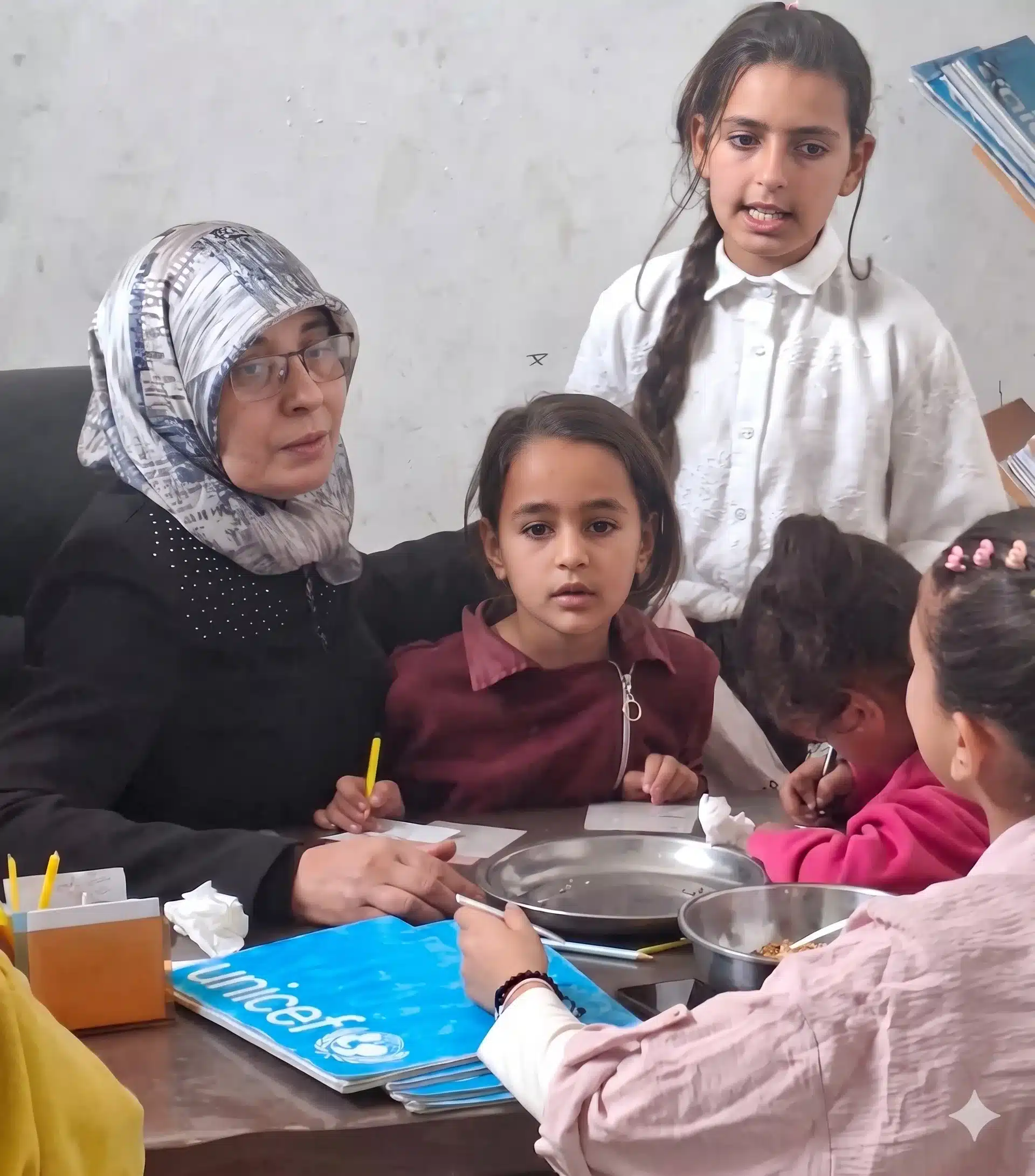
Asqoul also speaks about the group she believes is most affected by working in the field of psychological treatment: recent graduates of psychology faculties. She recalls an incident in which she found a young therapist crying alongside her patients.
She says of them that they entered the field, with all its many painful cases, before receiving adequate training, adding: “They have neither psychological immunity nor experience. They lived the trauma as victims, then began working without training and without an organized field. They first need to release the pain inside them, and to receive good and sufficient self-care, so that they can give to others.”
She explains that people’s stories are not the only reason they are affected, but also the shocks they receive during work, such as their contracts ending after they have become immersed in them, since most current job opportunities are tied to temporary, fixed-term projects.
She notes that some of these graduates tell her they are “about to explode from the stories they hear,” while others avert their eyes while speaking, and some young women resort to heavy makeup to hide the effects of lack of sleep, along with many other symptoms.
She confirms that she has treated many therapists who turned to her after being exhausted by psychological pressure and haunted by images of victims. They would ask her in astonishment how she did not see her patients in her dreams, and she would answer: “The solution lies in psychological resilience. It does not mean not feeling pain, but dealing with it properly and continuing afterward.”
As for survival mechanisms, she says: “The therapist must take care of themselves and realize that they deserve to be well, giving themselves self-care before helping others.”
What should the therapist do if they feel they are in danger? Asqoul explains: “If their condition worsens, they should look for a solution, but they must not give pain the chance to control them. Rather, they must rid themselves of their pain and continue performing their duty. And even if they need to stop working for a little while, there is no harm in a short warrior’s rest.”
No Time to Collapse
Asqoul speaks of a state of neglect toward psychological treatment in the Gaza Strip, explaining: “There is no entity that gives this matter any real attention. The focus is only on physical injuries, even though psychological injuries are extremely brutal and extend to harm every organ in the body. For example, I treated a 13-year-old child whose lungs had filled with fluid, and when I went back through his story, I discovered that he was suffering from multiple traumas due to the martyrdom of his brothers and father at different times.”
She points out that there is even less attention paid to the therapists themselves, adding: “There are not enough training and qualification courses, especially for recent graduates, despite their need for real support, self-care, and activities that separate them a little from this reality, even if it is just a trip to the beach.”
Outside the clinic, the therapist remains a therapist, bound by a social responsibility toward people, weighing every word and every movement in order to be a source of strength and optimism. That is what people expect from them, according to Asqoul.
She says: “There is no time to collapse, and no time for weakness. We must care for people, listen to their pain, and help them even during our own private rest time. Sometimes it reaches the point of exhaustion, but for me this is one form of work.”
At the end of the conversation, when asked what the tragedies she sees and hears every day have changed in her, Asqoul replies: “They have made me more humane, more compassionate and merciful. I try to provide every child with what they need. How can I bear seeing a child whose body has been eaten away by the cold without making sure they have enough clothes? Sometimes I endure embarrassment as I ask some acquaintances to help cases that come to me.”
She explains: “At the level of ideas and temperament, I have become deeper in my understanding of life, and I deal with hardships as a phase that will pass and end. I have also gained more balance and psychological steadiness so that I do not shake in the worst circumstances, but I reached this stage after a long struggle.”