




هذا التقرير متاح أيضًا بـ العربية
The Tunisian Business Network Abroad, an independent organization, revealed that a number of Tunisian investors living overseas have been subjected to pressure and financial extortion, naming two prominent figures: Nawfel Saied, brother of Tunisian President Kais Saied, and Atika Chiboub, the sister of the president’s wife. It accused them of abusing their influence and professional standing and of using certain state institutions to target and pressure Tunisian businessmen.
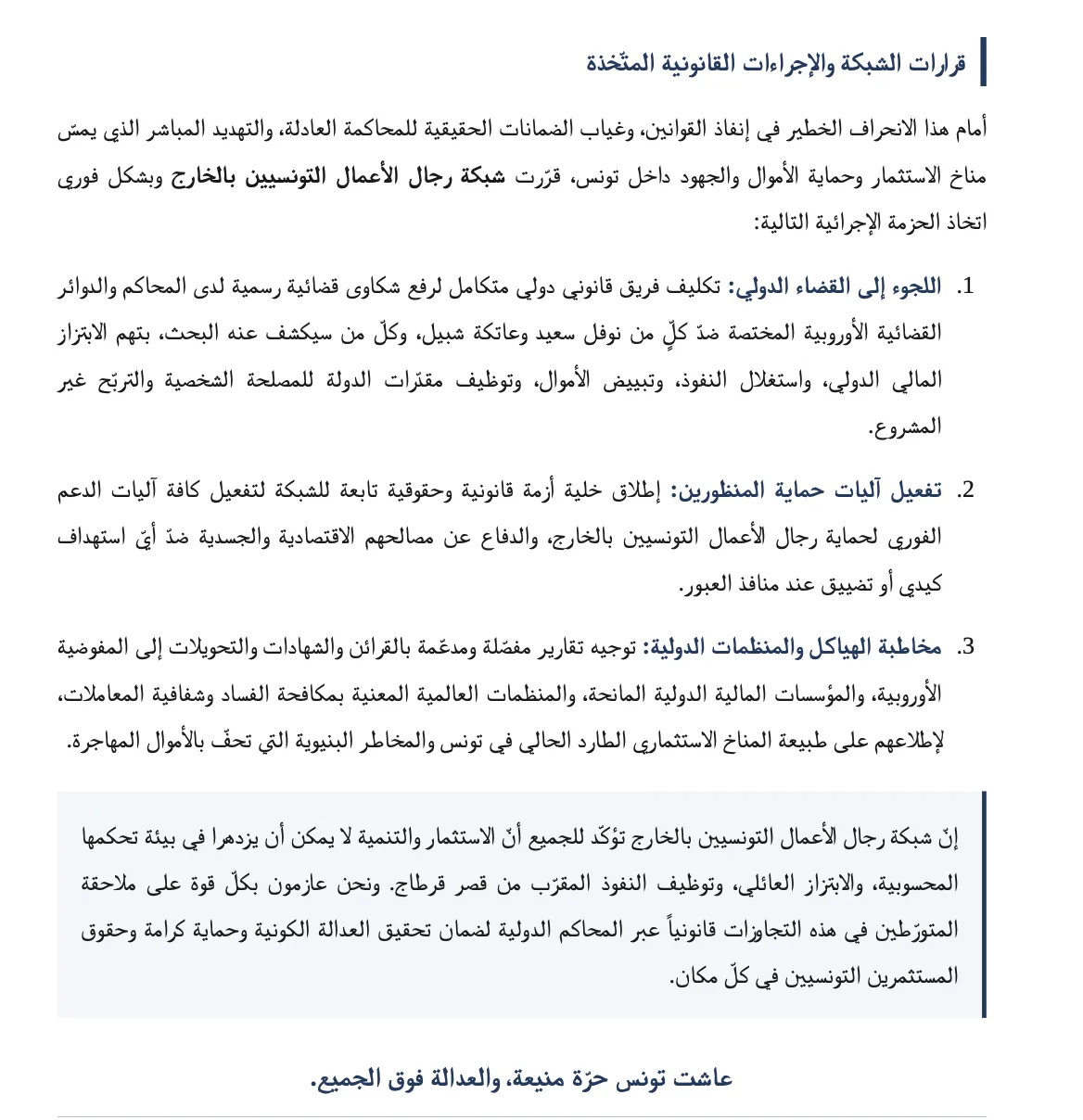
The network warned in its statement of the seriousness of this course, announcing that it had tasked a legal team with preparing and filing complaints before European judicial bodies over those pressures, in addition to contacting the European Commission and a number of international institutions concerned with combating corruption and protecting investment, in what may be the first step of its kind along these lines in the Tunisian scene.
This statement draws its gravity from the sensitivity of the figures named in it, given that both belong to the family circle closest to the president. That once again brings to the fore the issue of the ruling family’s influence in Tunisia, a file tied in Tunisia’s political memory to the era of former President Zine El Abidine Ben Ali, when networks of kinship and marriage dominated the state’s resources and public influence was used to secure the greatest possible personal gain at the expense of the national interest.
From individual corruption to institutional corruption
According to the network’s statement, the extortion faced by Tunisian investors abroad was not limited to direct demands for money. It went further, involving threatening language to the effect that refusing to comply with those demands could expose them to judicial and security prosecution inside Tunisia.
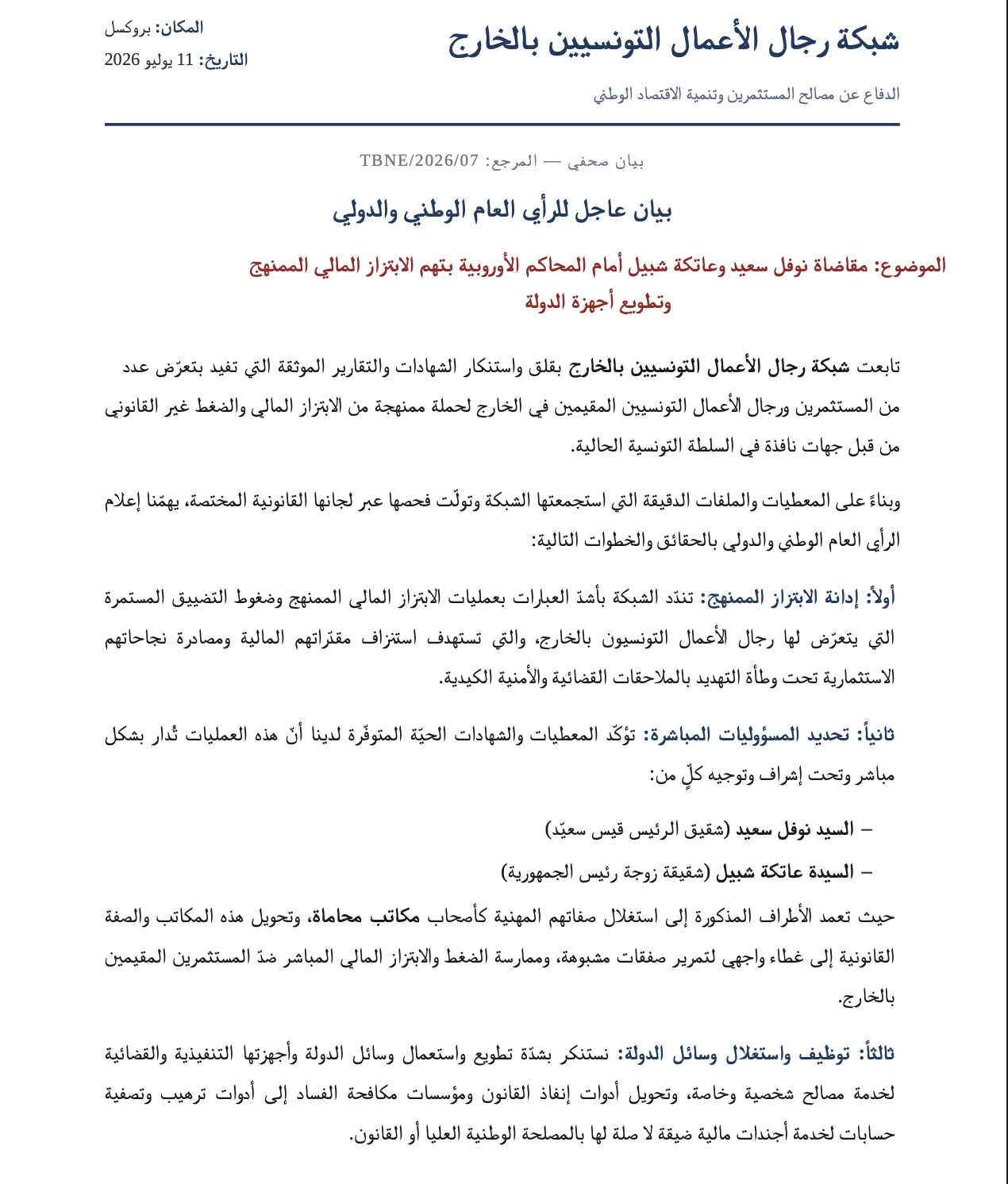
The network also laid out the main avenues that could potentially be used against businessmen who refuse to submit to this financial extortion, foremost among them opening judicial files against them, including their names in corruption or money laundering cases, restricting them upon entering or leaving Tunisian territory, in addition to targeting their property and economic interests, and using oversight and anti-corruption institutions as tools to pressure them and force them to comply.
In this sense, the accusation is no longer confined to the realm of personal or individual corruption, based on one person exploiting influence to pressure another. Rather, it rises to a more dangerous level: institutional corruption, based on using the state’s executive, judicial and security apparatuses to serve extortion and pressure operations, and turning institutions that are supposed to protect the law and the public interest into tools for achieving private interests.
The specter of the ruling family
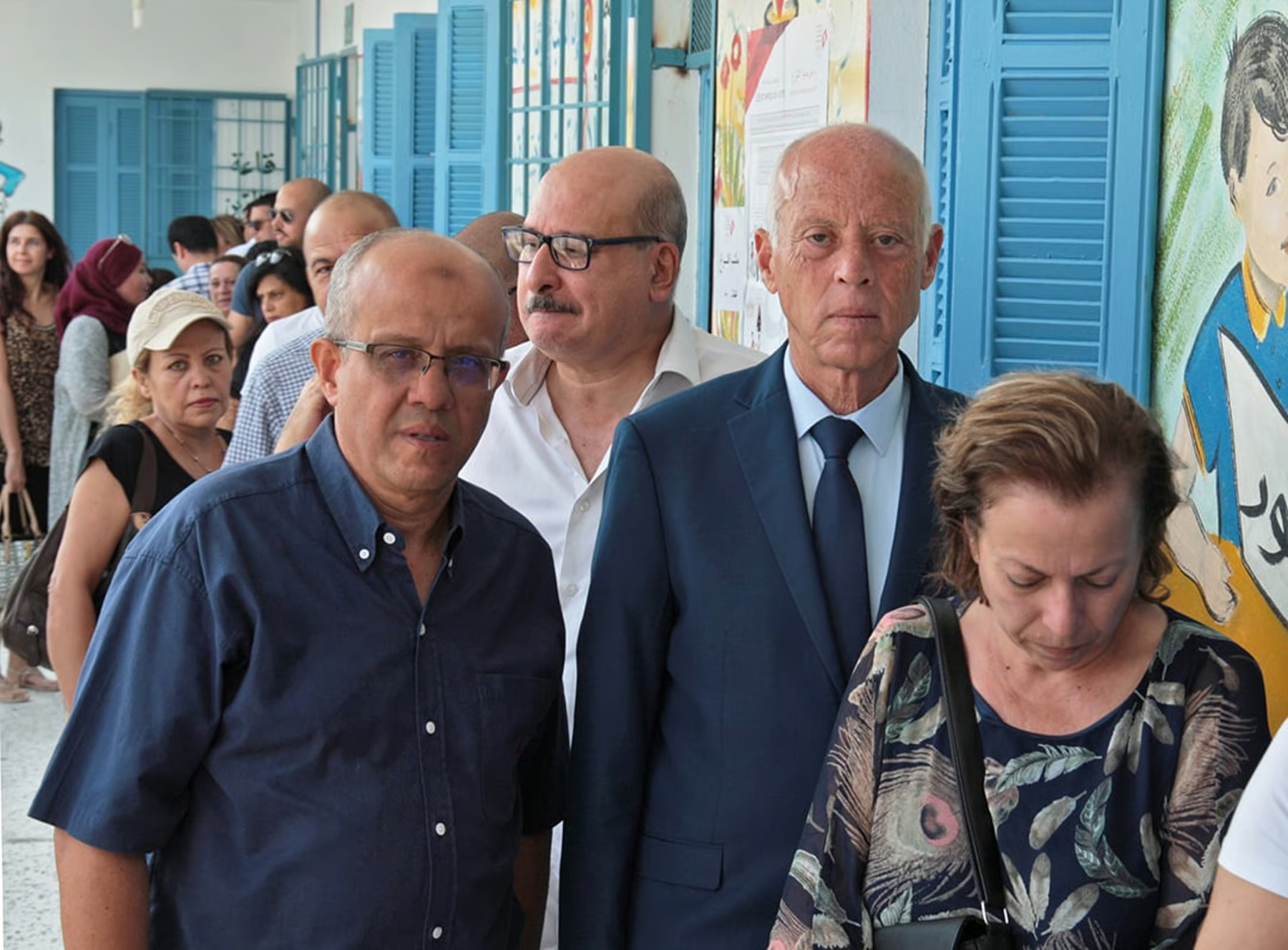
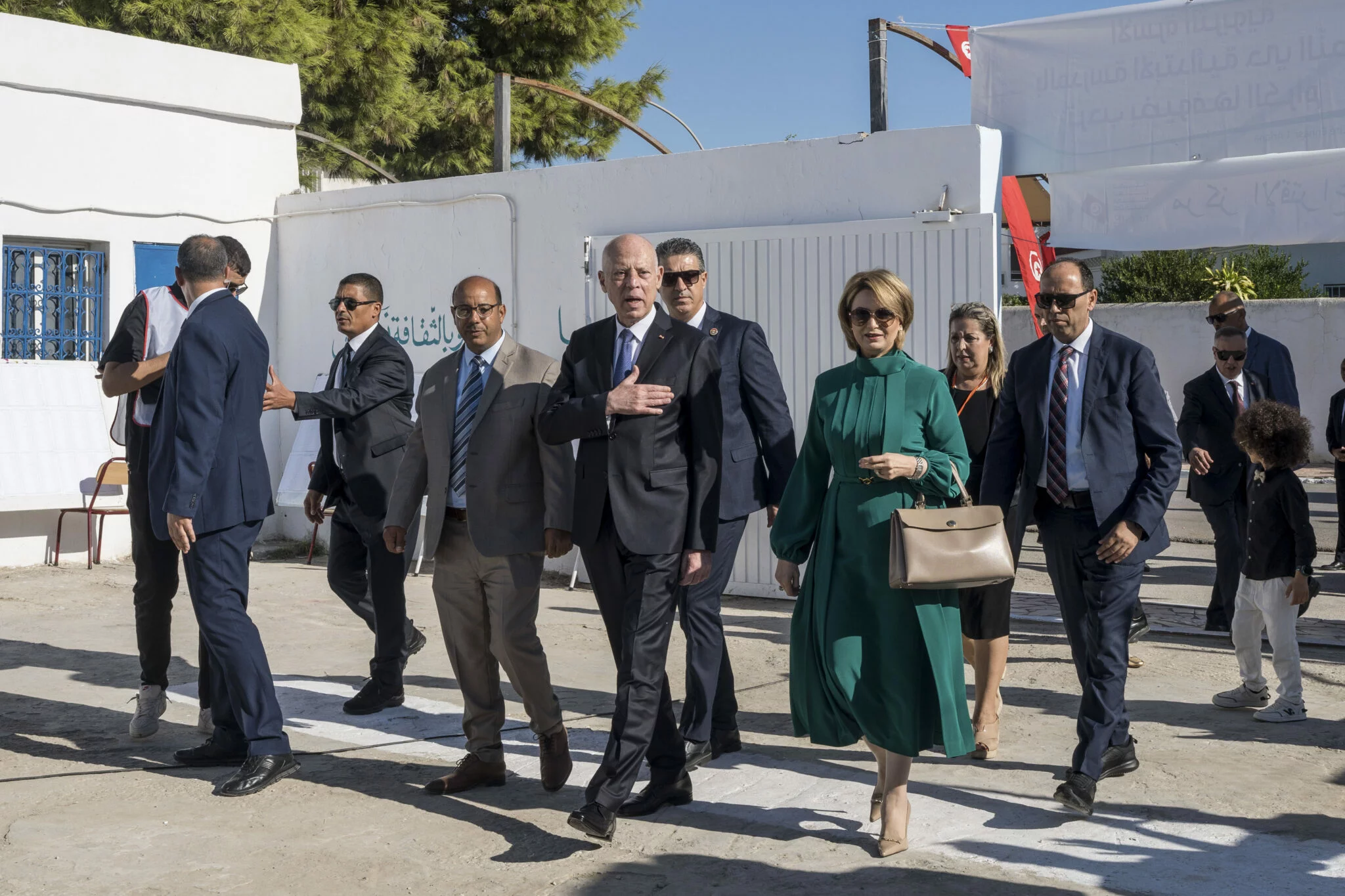
The names cited in the statement, specifically the president’s brother and his wife’s sister, added a greater degree of political sensitivity to its content, especially since both had a prominent presence in President Kais Saied’s election campaign. That makes them part of the family and political circle close to the center of power and once again raises questions about the limits of family members’ presence and influence in the political sphere surrounding Carthage Palace.
The language used in the statement was not spontaneous or detached from the Tunisian political context. The choice of expressions such as “family extortion” and “influence close to Carthage Palace” appears to be a deliberate attempt to invoke the collective memory associated with former President Zine El Abidine Ben Ali and his in-laws, especially the Trabelsi family model, whose name in Tunisian consciousness became associated with monopolizing influence, deals and privileges, and using proximity to power to achieve private interests.
From this perspective, the statement points to an even more dangerous political implication by warning of the possibility that Tunisia could shift from a state based on institutions, law and the constitution, as the authorities affirm from time to time, to a state governed by family networks, influence and control over the state’s resources. It is a scenario that evokes one of the most haunting nightmares in Tunisia’s political memory, given the deep effects the previous experience of family rule left on the state, the economy and society.
The Tunisian judiciary: A crisis of confidence
The statement revealed a deep crisis of confidence in the Tunisian judiciary. The announcement that the group would turn to European and international courts to file complaints over what it described as extortion and systematic pressure targeting Tunisian businessmen at the hands of figures from the president’s family does not appear to be a random choice, but rather one laden with highly sensitive political and judicial implications.
Such accusations, in principle, are supposed to be brought before Tunisian courts for adjudication, given that the parties involved are Tunisian and the alleged facts are tied to institutions within the state, especially since the network says it possesses evidence and documents supporting its account. Yet the decision to take the file to European courts reflects, as the statement suggests, deep doubts about the local judiciary’s ability to investigate independently, restore rights to their owners and hold those involved accountable, especially if they belong to circles close to the center of power.
Under President Kais Saied, the Tunisian judiciary has faced mounting criticism and accusations of politicization and declining independence and integrity, amid harsh rulings issued against a number of opposition figures and political and intellectual symbols, along with accusations that judicial prosecutions are being used to manage political conflict. This climate has widened the trust gap between segments of Tunisians and the judicial system and reinforced the belief among some parties that turning abroad may be more capable of ensuring an impartial investigation, especially when the accusations concern figures close to the circles of power.
Striking at the authority’s political discourse
Since taking power in October 2019, Kais Saied has adopted a public discourse that many considered the main pillar of his political legitimacy, based on parallel tracks that began with calls to purge state institutions, pursue the corrupt politically and economically, recover the people’s money, and ended with pledges to eliminate the networks of influential families that had dominated the state’s resources, in an attempt to dismantle the old systems that were among the most prominent causes of the 2011 revolution and that, in turn, paved the way for his own rise to power.
Against this backdrop, the statement by the Tunisian Business Network Abroad collides with that discourse at its core and turns its image upside down. It shifts the authority from the position of one presumed to wield the sword of anti-corruption against businessmen and networks of interest to that of the accused sitting in the dock.
According to the statement, some circles close to power are no longer part of a system that protects against extortion, but have instead become a cog in the corruption machine, so that the authority itself, rather than protecting investors, has become a tool for practicing systematic pressure and extortion against them.
This framing represents a direct blow to the essence of the moral discourse on which the authorities built their political project, placing them before an extremely sensitive dilemma on both the popular and political levels. If these accusations are proven, they would not merely undermine the regime’s image as an opponent of corruption, but would raise deeper questions about its legitimacy and ability to endure, turning the slogan of integrity that it raised from the outset from a banner for confronting corruption into a possible cover for reproducing it in a new form.
A message of fear and warning
Ultimately, this statement represents a stark warning to anyone considering investing in Tunisia. The network says it speaks on behalf of Tunisian businessmen and investors living abroad, which could prompt foreign capital to reassess the risks of entering the Tunisian market. If the allegations that investors are being subjected to pressure and extortion are true, they paint a picture of a hostile investment environment lacking legal guarantees and economic security, which could deepen Tunisia’s economic crises and weaken its ability to attract the financing and investment it needs.
In a related context, the statement reveals a deeper problem tied to the nature of Tunisia’s governing structure, amid accusations of the overreach of one-man rule and the widening circles of family influence surrounding the center of decision-making. The more power is concentrated in the president’s hands, or within the scope of his family and those close to him, the more institutions’ ability to perform their functions independently declines, and the more the rule of law and justice are shaken, striking at the very structure of the state, undermining the stability of its political and economic course, and opening the door to more dangerous repercussions in the future.
Despite the slogans Saied’s regime raises about integrity, justice and fighting corruption, those slogans alone are not enough to build trust or dispel suspicion. A strong state does not merely declare its integrity; it proves it through transparency, declarations of interests and financial assets, independent investigations, publishing decisions and the reasons behind them, and ensuring that all officials are subject to accountability without exception.
Accordingly, confronting these accusations, if there is a genuine desire to do so, cannot be done through silence or political denial, but through opening fair and public investigations, presenting the facts to public opinion, and purging state institutions of any suspicions of corruption or conflicts of interest, including the presidency itself and the circles close to it.