







هذا التقرير متاح أيضًا بـ العربية
Germany is one of the preferred destinations for Arab migrants and Muslims, particularly because of the welcoming policy it once adopted though its features later changed to bolster its minority landscape. This was encapsulated in former German Chancellor Angela Merkel’s famous 2015 remark, “We can do this,” signaling her country’s readiness to receive the largest possible number of refugees from Syria and the Middle East.
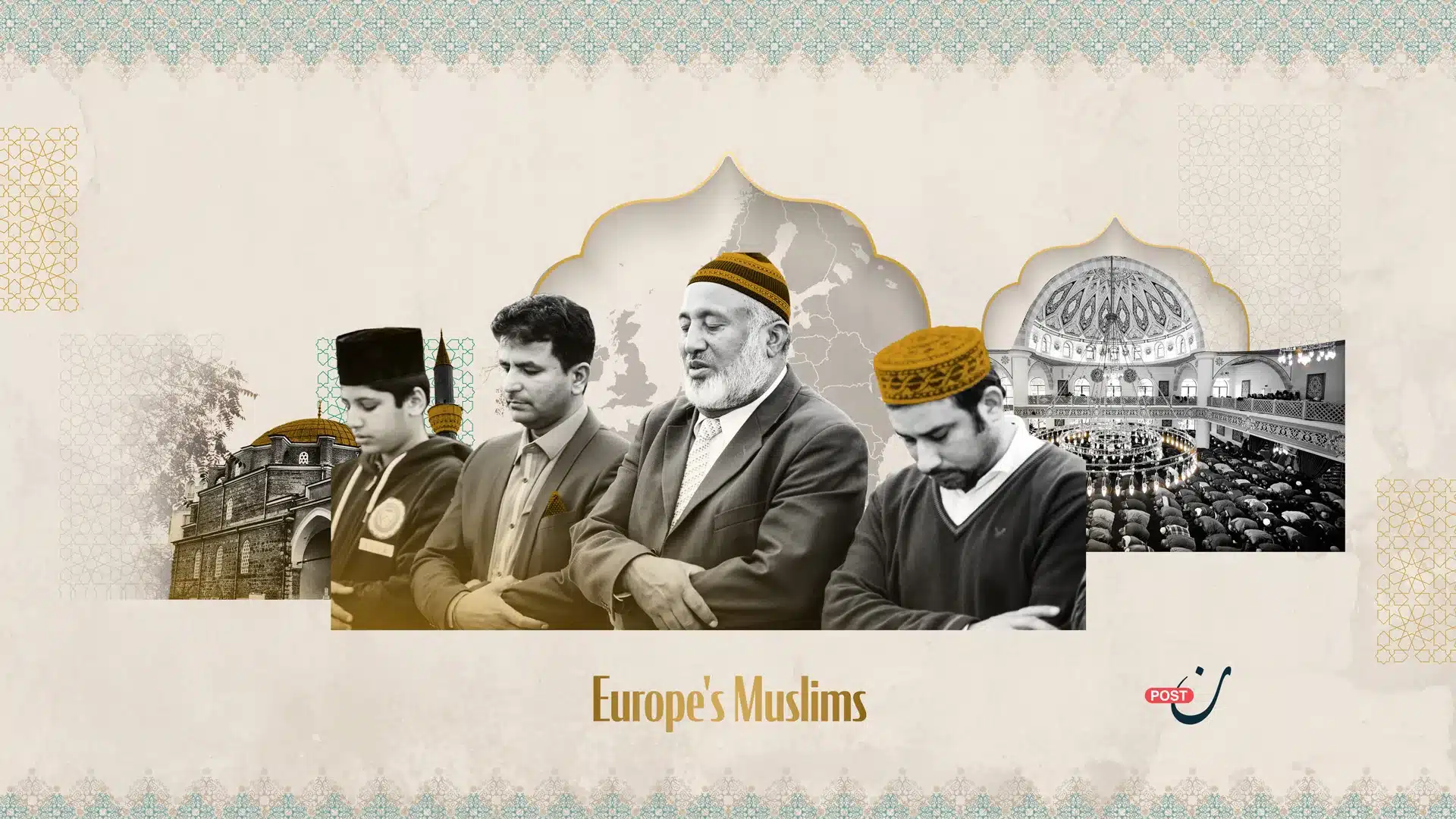
Muslims in Germany
Germany’s Muslim community has managed to achieve many successes amid a rapid pace of integration compared with other countries. Still, the situation has been affected to some extent by the rise of the far right, which has tried as much as possible to demonize Muslims and tighten the screws on them because of Islamophobia.
Leaving aside the controversy over minority numbers a debate that dominates most European countries’ systems the number of Muslims in Germany ranges between 5.3 million and 5.6 million people, representing 6.4 to 6.7 percent of the total population, according to the German Federal Office for Migration and Refugees. Estimates by the Pew Research Center, meanwhile, suggest that figure could rise to at least 8.7 percent by 2050.
Historical background
The 1960s, which saw Arab and Muslim migration to Germany and Europe more broadly, represent the practical historical foundation of the German state’s relationship with Islam and Muslims. Historical awareness of that relationship, however, goes back to the Crusades (1096-1291), when the German army was one of the pillars of the European armies against the East at the time, in addition to the diplomatic ties that existed then between the kings of Andalusia and the Germans.
That period was followed by a major wave of German Orientalists who were keen to study Arabic and the teachings of Islam, led by Jacob Christmann, who wrote a book on Arabic and established a chair for it at Heidelberg University in 1590, in addition to the famous thinker and reformer, theology professor, and initiator of the Reformation era in Europe, Martin Luther.
With World War I (1914-1918), Germany allied itself with the Ottoman Empire, marking the first official contact between the German people and their Muslim Turkish counterparts. This helped change the distorted image of Islam in the German mindset. At the end of the war, when Ottoman Muslim prisoners were released, some chose to remain in Germany and continue their lives there, becoming the first nucleus of the Muslim community.
After World War II (1939-1945), waves of migration by Muslims from the Soviet Union, as well as Turks, Moroccans and Yugoslavs, began heading to Germany. These migrations included workers, politicians, refugees and students. The country opened its doors to these arrivals, then estimated in the tens of thousands, as Germans relied on them to build their industrial revival, which had been badly affected by the war.
A growing Muslim population
Over the past seven years, Germany has seen successive increases in the number of Muslims. According to a study conducted by the Federal Office for Migration and Refugees (BAMF), at the request of the German Islam Conference and the Federal Ministry of the Interior, the community grew by 900,000 people between 2015 and 2021, bringing its total to between 5.3 million and 5.6 million people, or 6.4 to 6.7 percent of Germany’s population last year.
As for the sectarian makeup of the Muslim community, the largest share are Sunnis, estimated at about 2.5 million people, alongside followers of other sects, foremost among them the Alawite community, which numbers 500,000 people, most of them from Turkey, in addition to about 200,000 Shiites, most of whom trace their roots to Lebanon, as well as some adherents of Sufi orders and Ismailis.
Muslims are concentrated in the major industrial cities in the western part of the country, led by the capital, Berlin, which alone is home to about 220,000 Muslims. Some, especially older people and families, prefer to live in rural areas bordering Switzerland and Austria.
High fertility rates and the fact that Muslims in Germany outnumber Germans themselves in youth demographics have been the main drivers behind the increase in the Muslim population there, amid fears among far-right currents over this growth, which they see as threatening their country’s demographic map. Hence the campaigns of systematic targeting against Muslims in recent years and the escalation of hate speech despite international condemnation.
The ability to integrate
The BAMF study concluded, based on a number of indicators, that most Muslims 79% are integrated into German society. Most young people born in Germany have good language skills, are proficient in German, possess a strong educational background, and are fully familiar with the characteristics of the Germans’ value system and culture.
Religion did not have the expected impact on the study’s findings, which were compiled during 2019 and 2020. A comparison between people of migrant background who are Muslim on the one hand and Christians on the other showed that religion was not an influential factor when it came to integration and qualification.
About 65 percent of the Muslims included in the study also said they had good contacts and relationships with people in their circle of friends from other ethnic backgrounds who do not have migrant roots, and that those relationships were proceeding positively, with nothing to disrupt them for doctrinal or ethnic reasons.
Notably, the study indicated that 70 percent of Muslim women do not wear the hijab, while 62 percent of those over 65 said they do wear it, alongside 26 percent of those between 16 and 25. This may be an indicator of the speed of integration in the absence of visible Islamic markers, which are one of the axes of racism and abuses faced by Muslims in Europe in general.
Ahmed al-Shazly, an Islamic preacher living in Germany, says that despite the accusations often raised about it, German society is among the most accepting in Europe of members of foreign communities, especially Muslims. He noted that over more than 10 years in the country, neither he nor his hijab-wearing wife had faced any harassment.
The Egyptian preacher, who moved to Germany in 2010, told Noon Post that conditions in rural Germany may be much calmer than in the cities. He noted that most abuses against Muslims result from incitement by supporters of the right-wing populist Alternative for Germany party, or from reactions to incidents that occur here and there and are then amplified within the climate of “Islamophobia” that populists have succeeded in spreading widely.
Al-Shazly suggests that the biggest threat facing Muslims in Germany is the lack of coordination, understanding and harmony among the civil associations that are supposed to represent Muslims and serve their interests. Some suffer from sectarianism and factionalism, which undermines their influence, in addition to the absence of a unified vision that should place the community’s interests first.
He concluded by saying that the growth of hate speech in recent years does not reflect the direction of the German street as much as it reflects the influence of the far-right current and its control over media and culture in pursuit of political goals and agendas entirely removed from the country’s higher interests.
Freedom to practice religious rites
Germany tops the list of European countries — after Bosnia — in terms of the number of mosques and the freedom to practice religious rites, with about 2,866 mosques. The Grand Mosque in Duisburg-Marxloh, built in 2008, is the largest mosque in the country by far. Its construction took three years, and its dome stands 23 meters high while its minaret rises 34 meters.
Over the past years, about 180 projects to build new mosques in different states were expected to be completed, in addition to Islamic centers and prayer halls spread across all German regions and provinces, serving a range of purposes including prayer, seminars and lectures, as well as celebrations and private social occasions.
Germany was among the European countries that objected to the decision to ban the construction of minarets in Switzerland and Austria. The government and some parties denounced the move, while the share of those opposing a ban on mosque construction in one of the opinion polls conducted there in 2009 reached about 48 percent of the population, compared with 38 percent who supported the decision, while 14 percent declined to express an opinion.
It is worth noting that there is an event called “Open Mosque Day,” an annual tradition observed by the Muslim community since 1997. It falls on Oct. 3 each year, the same day as German Unity Day, when mosques open their doors to non-Muslim visitors to learn about Islam and promote cultural exchange.
For his part, Sheikh Abdelsalam Atefi, imam and preacher at Chemnitz Mosque in the eastern German state of Saxony, told DW Arabic that this day is a good and important occasion to send a clear message to the far right and its sympathizers: that Islam is a religion of peace, inclusion and acceptance of others, and that attempts to distort its image are malicious efforts driven by other agendas, entirely removed from the reality of Islam and the role played by the Muslim community in the country.
Muslims and political parties
There are more than 400 public Islamic bodies and institutions, and dozens of subsidiary Islamic centers, that handle the affairs of serving the Muslim community. Yet Muslims there also have a notable political presence, strengthened by the weight of their voting bloc, which can be used as an important card in the electoral marathons Germany witnesses, making it a prime target for the country’s major parties.
The community’s political presence dates back to 1997, when the German-Turkish Forum was established within the Christian Democratic Union. Through it, the country’s largest party sought to strengthen communication with people of migrant origin, focusing on educational and economic issues as well as migration and integration.
In late 2006, the Green Party, one of the giants of German politics, established what was called the “Green Muslims Working Group” in the state of North Rhine-Westphalia, with the aim of creating a base through which Muslims could communicate with the party and deepen discussion of issues that concern the Muslim community.
There are more than 400 public Islamic bodies and institutions, and dozens of subsidiary Islamic centers, that handle the affairs of serving the Muslim community.
In February 2010, the first party made up of Muslims in Germany was founded: the Alliance for Innovation and Justice. The party succeeded in expanding its popular base to include more than 40 branches in 10 major states, and it is considered one of the important political platforms concerned with Muslim issues and their internal and external problems alike. This entity is also seen as the most diverse among all other parties in Germany.
That presence was further strengthened with the establishment of the first Muslim working group within the Social Democratic Party of Germany, through which the party aimed to open up explicitly to Muslims across the country and deal with them as one of the main components of the German political landscape.
The first fruit of this approach was the selection of the Muslim Aydan Ozoguz, of Turkish origin, as minister for migration and population in the German federal government for the Social Democratic Party, making her the first Muslim woman to hold the post in 2013. Her Muslim friend Sawsan Chebli, of Palestinian origin, also became the new deputy spokesperson for German Foreign Minister Frank-Walter Steinmeier.
Racism and Germany’s historical complex
Statistics released by the German Interior Ministry last year revealed 450 attacks against Muslims in 2021, roughly half the number of crimes recorded in 2020. Most of these violations involved verbal abuse and insults because of Islamic dress and appearance, in addition to obstructing Muslims from performing their religious rites, damaging Muslim property, and recording some physical assaults.
Looking a little further back, a decline in racist violations against the Muslim minority in Germany can be observed, according to the same Interior Ministry data, which indicated that the number of cases in 2017, for example, reached 1,075, including 239 attacks on mosques and places of worship.
Anyone following German affairs will find a clear adoption of a strategy targeting political Islam in general within the country. This is an approach that France and Austria began after certain crimes occurred on their soil, opening the door to strengthening the presence of the far right, which treats Muslims as a primary target that must be eradicated.
Racist rhetoric has become common in various German institutions, not just on the street.
The right-wing populist Alternative for Germany party, one of the most prominent anti-Islam parties in Germany, has in recent years begun focusing on a hard-line political discourse, warning against what it calls the “Islamization of Europe.” This slogan is used from time to time primarily to achieve political propaganda goals and win as much of the populist voting bloc as possible. That has had a temporary impact on the reality of Muslims in Germany, whether in terms of how the public views them or the opportunities afforded to them to live freely and naturally without disturbance.
Taqadom al-Khatib, an Egyptian researcher living in Germany, believes there is a clear rise in racist rhetoric against Muslims in the European state that claims to champion freedom, and that this rhetoric has become common in various German institutions, not only among the public.
He pointed out, for example, that when any person with an Arabic name, or identified as Muslim, submits an application, the process can take months and may extend to a full year, compared with the situation if the applicant is not Arab or Muslim. Housing, too, if granted, will be based on identity meaning you will not be given any property in a first-class German neighborhood, but rather in an area where most residents are Arabs or Turks, something akin, in his words, to an identity-based “ghetto.”
In an article, al-Khatib notes that Germany does not have the historical experience of a colonial power like France and Britain, and therefore its integration map is relatively muddled. This is compounded by the right wing’s dominance of the political scene amid the weakness of the left, in addition to the events the country went through in World War II.
All of this has created ripples in the German mindset toward Muslims, who over time have become “the space in which Germany’s historical complex and other concepts, such as racism and hate speech, are practiced,” as the Egyptian researcher put it.
Overall, despite the success Muslims in Germany have achieved and their rapid integration compared with other countries, the most prominent challenge facing the Muslim minority in this European country remains the rising hate speech, coupled with the growing influence of the far right and the absence of coordination and a unified vision among the different strands of the community.