






هذا التقرير متاح أيضًا بـ العربية
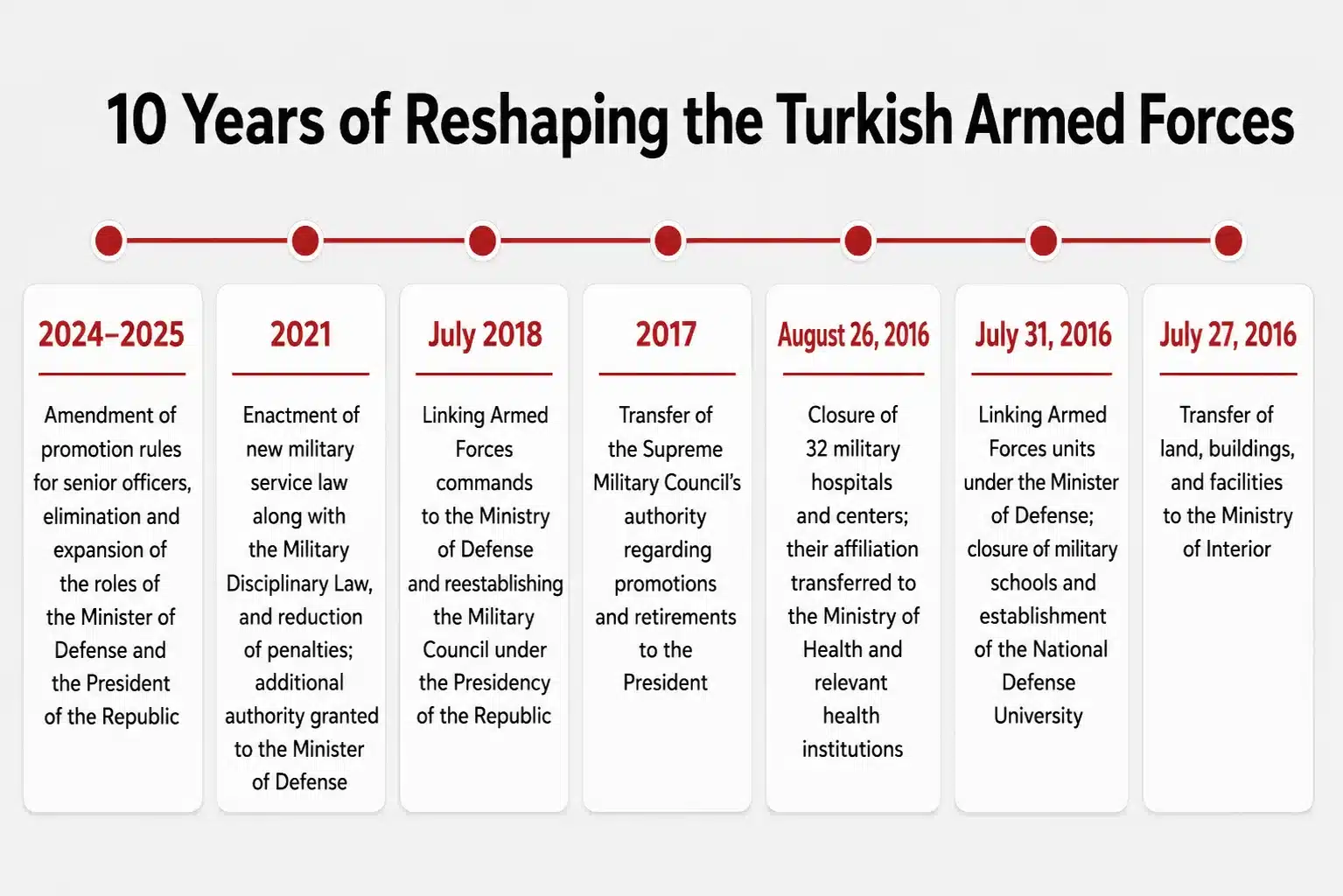
Türkiye spent the decade following the July 15, 2016 coup attempt reorganizing its armed forces at the levels of command, administration, education, health care, the judiciary, and promotions.
The General Staff and the service commands were placed under the direct authority of the defense minister, while the president came to sit at the top of the constitutional and executive chain. Security and health institutions were also moved from the military structure to the Interior and Health ministries.
The old military schools and academies were shut down, a unified National Defense University was established, and the composition of the Supreme Military Council and the mechanisms governing the continued service and retirement of senior commanders were changed.
These transformations unfolded in stages, beginning with emergency decrees issued in July 2016, followed by the entrenchment of their core provisions in permanent laws, the adoption of the 2017 constitutional amendment, and finally the abolition of the prime ministry and the entry into force of the presidential system in July 2018.
The process of alignment continued through 2025 via legal amendments and new proposals affecting the chain of command, promotions, and extensions of service for senior officers, allowing the current structure to gradually take shape over 10 years.
A new chain of command for the armed forces
Before it was amended in 2017, the 1982 Constitution made the Council of Ministers accountable to parliament for national security and the preparation of the armed forces. The president appointed the chief of the General Staff based on a proposal from the Council of Ministers, while the chief of staff was accountable to the prime minister in the exercise of his powers.
Article 117 left the regulation of the relationship between the General Staff, the service commands, and the Defense Ministry to the law, within a structure that gave the top military leadership a more institutionally independent position from the ministry than in the current setup.
That position was also reflected in the National Security Council, which included the prime minister, the chief of the General Staff, the service commanders, and the gendarmerie commander alongside civilian members.
After the shift to the presidential system, the prime minister and the gendarmerie commander were removed from its composition, vice presidents were added, and the council began submitting its recommendations to the president.
The first shift began on July 31, 2016, with Decree Law No. 669, and its main provisions were later codified in Law No. 6756, passed by the Grand National Assembly of Türkiye on Nov. 9, 2016.
The law placed the land, naval, and air force commands under the defense minister, giving each command a direct ministerial link in addition to its military relationship with the General Staff. The period from 2016 to 2018 was a transitional phase, as the new structure began operating under old constitutional provisions that remained in force until the shift to the presidential system was completed.
Constitutional Amendment No. 6771 was approved in the April 16, 2017 referendum, with its main implementing provisions set to take effect after the next presidential and parliamentary elections.
After the June 24, 2018 elections, the president took the oath of office on July 9, bringing the presidential system into force, ending the office of prime minister and the Council of Ministers, and transferring executive authority to the president. The president then became accountable to parliament for national security and the preparation of the armed forces, and held the authority to appoint the chief of the General Staff.
At this stage, Decree Law No. 703 repealed the old legislation governing the General Staff and the Supreme Military Council, after which presidential decrees were issued to define the place of both institutions within the new executive branch.
Article 338 of Presidential Decree No. 1, issued on July 10, 2018, defines the command structure in force through 2026: the General Staff and the land, naval, and air force commands are subordinate to the minister of national defense, and the chief of the General Staff and the service commanders are each individually accountable to the minister.
The article gives the president the right to obtain information directly from the chief of the General Staff and the service commanders, and to issue direct orders to them that must be carried out immediately without waiting for approval from any other authority.
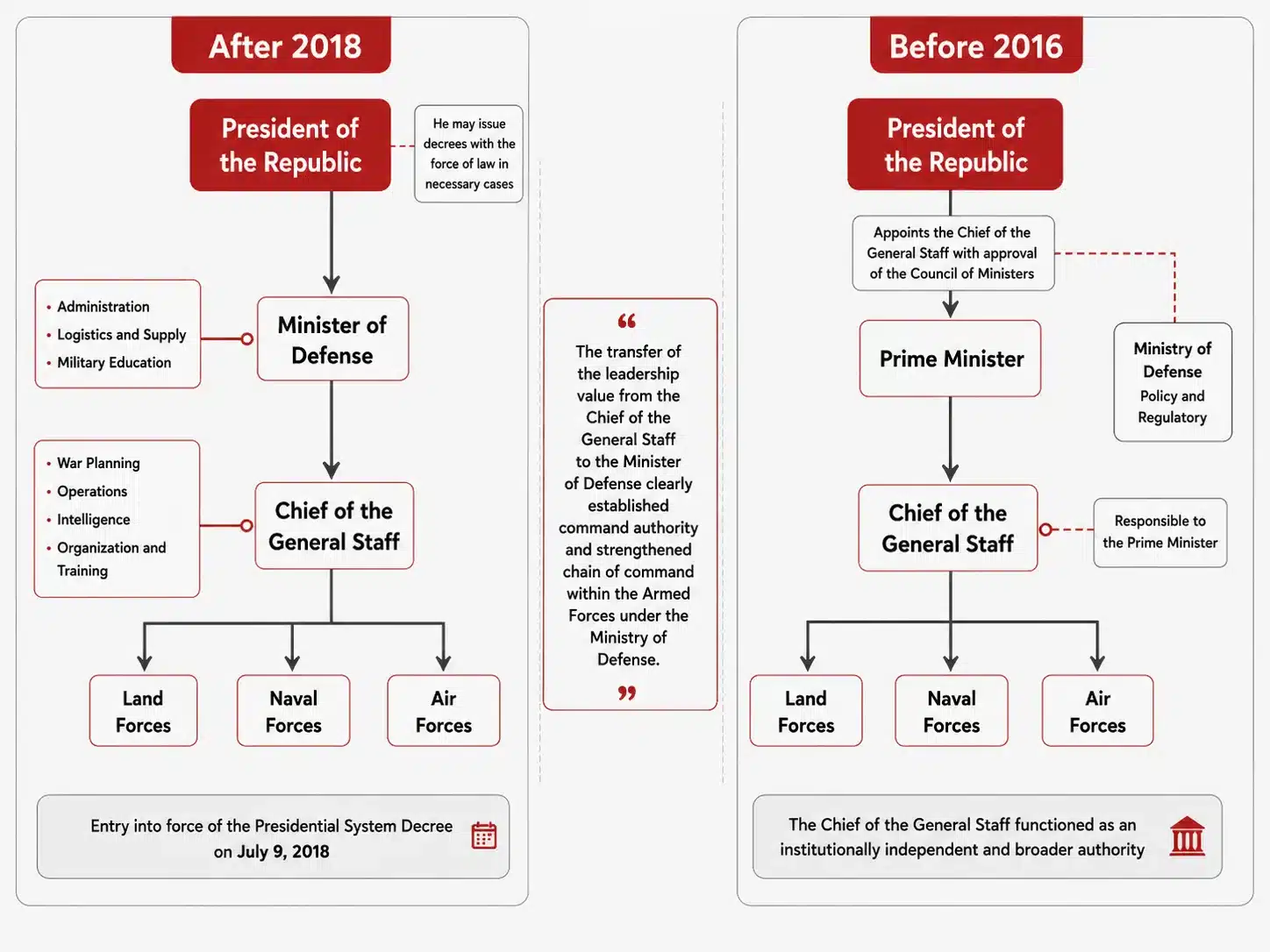
The General Staff remained the center of specialized military command, as the chief of the General Staff assumes supreme command of the armed forces in wartime in the name of the president, and prepares the core principles and programs related to war readiness, intelligence, operations, organization, and training, before submitting them to the defense minister for approval.
The ministry is responsible for implementing logistics, procurement, and military education after receiving professional principles and priorities from the General Staff.
The chain of command thus settled into a structure with the president at the top of constitutional and executive authority, the defense minister in direct ministerial administration, and the General Staff in military planning and operational command. Today, the General Staff, the land, naval, and air force commands, and the National Defense University all appear within the organizational chart of the Defense Ministry.
Reorganizing the military’s institutions
The restructuring covered the institutions surrounding the military’s combat role, from internal security, health care, and the judiciary to the education of officers and noncommissioned officers. Some of these institutions were transferred to other ministries, existing institutions were abolished, and military education was rebuilt within universities and academies divided between the Defense and Interior ministries.
The Gendarmerie General Command and the Coast Guard Command were transferred to the Interior Ministry after both bodies, before 2016, combined internal security duties with organizational and military ties to the armed forces, before new legislation confirmed their subordination to the ministry.
The ministry’s current organizational map places them among its affiliated bodies, while the training of their personnel was transferred to an independent academy under the same ministry.
The change also extended to the military medical system. In a statement issued on Aug. 26, 2016, the Health Ministry announced the transfer of 32 military hospitals and one rehabilitation center to its administration.
The shift also included the Gulhane Military Medical Academy. The Health Ministry took over the management of its hospitals, while its academic units were transferred to the state-run University of Health Sciences, which specializes in health education.
Before the 2017 amendment, the military judiciary was an independent branch comprising military courts, the Military Court of Cassation, and the High Military Administrative Court.
The amendment abolished these institutions and limited the Constitution’s provision for military courts to disciplinary courts, with an exception allowing them in wartime for certain crimes related to military duties.
Pending cases were transferred to the competent civil and administrative courts depending on the type and stage of each case, bringing the existence of an independent military judicial branch to an end.
For its part, military education before 2016 began in military high schools and preparatory schools for noncommissioned officers, then extended to military colleges and war and staff academies affiliated with the different services.
Decree No. 669 closed the old high schools, preparatory schools, and academies, and established the National Defense University, which brought together the military colleges, war institutes, and vocational institutes for noncommissioned officers within a unified university structure under the Defense Ministry.
In 2026, applicants to military colleges and vocational institutes for noncommissioned officers go through the National Defense University entrance exam, organized by the Measurement, Selection and Placement Center, the government body responsible for centralized exams and placing students in higher education institutions.
Successful candidates then submit their preferences through the Defense Ministry’s personnel recruitment portal, before undergoing physical and medical tests, interviews, and specialized assessments. This national track replaced the early socialization once provided through the now-closed military schools.
In parallel, the Gendarmerie and Coast Guard Academy was established as the successor to the old Gendarmerie Schools Command, taking charge of training officers and noncommissioned officers for both bodies as well as university and graduate education programs.
The education system thus settled into two tracks: the first is run by the National Defense University for personnel of the forces under the Defense Ministry, while the second is handled by the academy for personnel of the gendarmerie and coast guard under the Interior Ministry.
The Supreme Military Council and commanders’ promotions
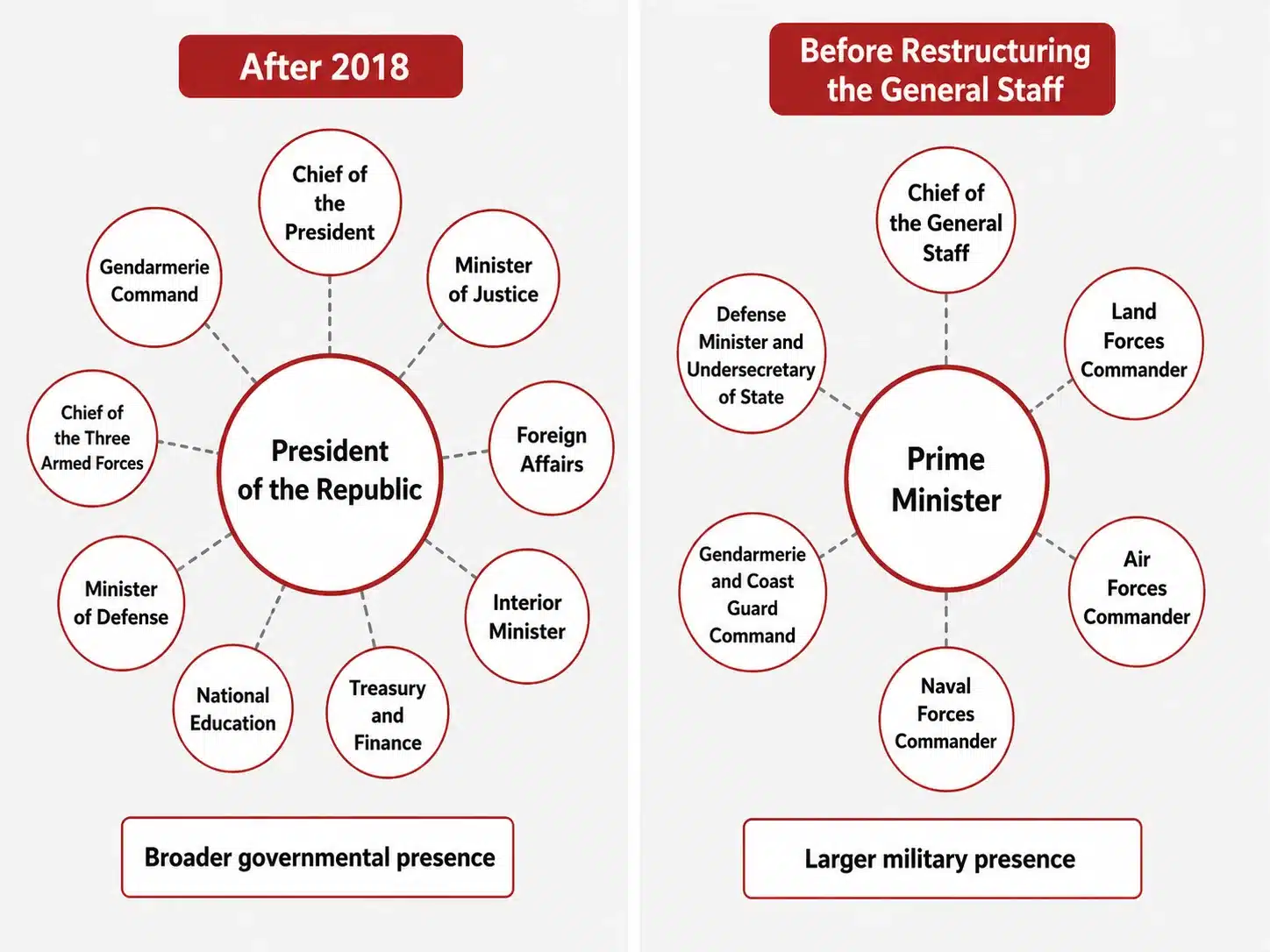
The Supreme Military Council is responsible for reviewing the promotion of senior officers, extending their service, and referring them to retirement. Before the restructuring, the council met under the chairmanship of the prime minister, and its composition included the chief of the General Staff, the service and army commanders, the gendarmerie commander, and senior generals and admirals, alongside the defense minister and government members linked to the security file.
The council’s composition began to change after 2016. During its 2017 meeting, the Ministry of National Defense announced the participation of the justice and interior ministers for the first time, in a step that expanded the government’s presence within the institution responsible for military promotions. Presidential Decree No. 8, issued on July 15, 2018, then rewrote the council’s composition under the presidential system.
The president became the council’s chair, and its membership came to include the vice presidents and the ministers of justice, foreign affairs, interior, treasury and finance, national education, and defense, in addition to the chief of the General Staff and the commanders of the land, naval, and air forces.
This composition increased the number of government officials on the council relative to military commanders and tied its meetings directly to the presidency.
Defense Ministry data on the council’s 2024 and 2025 meetings show that it reviews the promotion of senior officers, extensions of service, and retirements due to a lack of vacancies, after which its decisions take effect once approved by the president.
On June 30, 2025, a bill was submitted to parliament to raise the number of generals and admirals whose service can be extended from 36 to 60, with the possibility of increasing that number to 75 in necessary cases.
The bill also stipulates raising the retirement age for service commanders to 67 and granting the president the authority to extend it annually up to age 72. It also preserved the role of the General Staff’s opinion, the defense minister’s proposal, and the Supreme Military Council’s decision in the process for some extension cases.
These rules affect the composition of the military’s top echelon and the length of time its members remain in place. The defense minister now plays a larger role in proposing some promotions and extensions, while the Supreme Military Council reviews them within its presidential-governmental composition before they are approved by the presidency. This mechanism operates alongside the president’s authority to appoint the chief of the General Staff and issue direct orders to the military leadership.
In sum, after 10 years, the Turkish armed forces have settled into an executive structure headed by the presidency, with the Defense Ministry handling ministerial administration while the General Staff retains military planning and operational command.
The gendarmerie and coast guard were transferred to the Interior Ministry, military hospitals to the Health Ministry, the independent military judiciary was abolished, military education was rebuilt, and government participation in the Supreme Military Council and the promotions process expanded.
The military thus moved from a structure in which the General Staff enjoyed relatively broad institutional independence to a presidential and ministerial framework that distributes command, administration, education, and services among the presidency, the Defense Ministry, and other state institutions.