














هذا التقرير متاح أيضًا بـ العربية
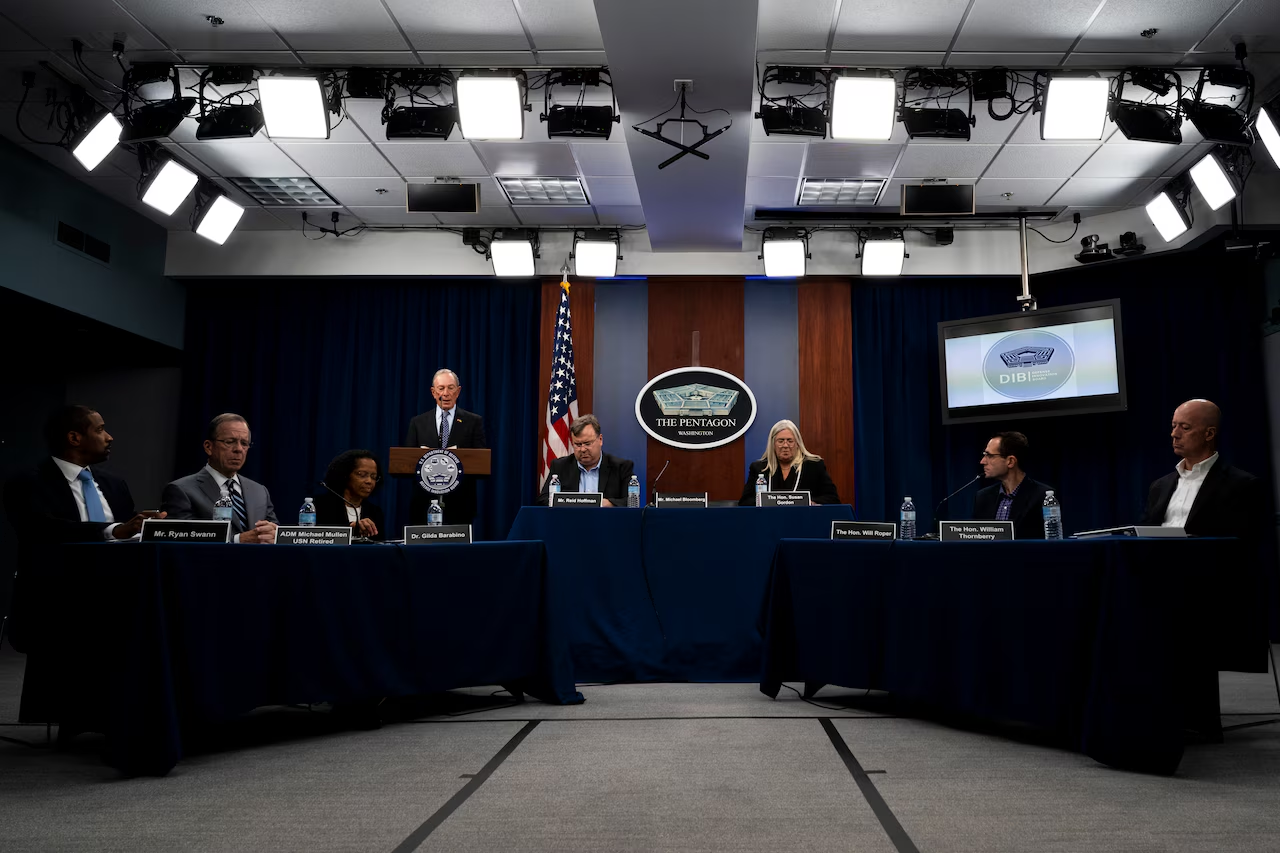
The new composition of the US Defense Policy Board reveals a shift in the kind of expertise the War Department is bringing into its highest advisory circle. The 15 seats bring together investors in military technology, advisers working inside companies contracted by the government, figures from conservative right-wing institutions, as well as former officials and military officers.
Among them are the board’s vice chair, Norm Coleman who works at a law firm representing Saudi entities; Marc Andreessen, the general partner at a venture capital firm investing in defense startups; and Theo Wold, an adviser at Palantir, a Pentagon contractor.
The board submits its recommendations to the secretary of defense and the deputy secretary through the undersecretary for policy. Its remit includes strategic planning, force structure, military modernization, and regional defense policies. That role gives it influence at the stage when threats are defined, priorities are ranked, and the options presented to Pentagon leadership are shaped.
The new lineup came after a political and institutional review that began on March 7, 2025, when the ministry’s advisory committees were temporarily suspended to examine how closely they aligned with the new administration’s priorities. On April 24, the Pentagon ended the service of their members, before announcing on June 29, 2026, a new 15-member board chaired by Robert Lighthizer with Norm Coleman as vice chair.
The map of the 15 seats
The board is chaired by Robert Lighthizer the former US trade representative, who is affiliated with the America First Policy Institute, a conservative center working to develop policies and cadres close to President Donald Trump’s administration.
Coleman serves as vice chair, alongside his work as senior counsel at Hogan Lovells Cadwalader, an international law firm active in government relations, regulatory matters, and the representation of states and governments.
The investment circle includes Marc Andreessen, co-founder and general partner at the venture capital firm Andreessen Horowitz, as well as Kenneth Jones, founder of the family investment office Keyhole Partners, and Blake Masters, the investor and former executive within billionaire Peter Thiel’s network.
Tom Vilsack brings experience in investment security and oversight of foreign capital, having led the Treasury Department’s Office of Investment Security and worked with the Committee on Foreign Investment in the United States. He now holds positions at consulting and investment firms.
Conservative institutions are represented through Michael Anton director of policy planning staff at the State Department, and Rachel Bovard of the Conservative Partnership Institute, a center focused on building networks of conservative personnel in Washington.
Also prominent are Daniel McCarthy and Theo Wold both linked to the Heritage Foundation, a conservative think tank influential in Trump administration programs. They are joined by China specialist Michael Pillsbury and Francis Sempa a writer on geopolitical issues.
Military and industrial expertise is represented by retired Adm. Chas Richard, the former commander of Strategic Command and head of the Institute for Defense Analyses, a federally funded research and development center that provides technical studies to the Pentagon, and Mike Garcia, the naval aviator and former congressman who spent 11 years at Raytheon and now works at the strategic consulting firm WestExec Advisors.
The lineup also includes Christopher Williams, who runs a national security consulting firm and sits on the executive advisory board of cybersecurity company Everfox.
The comparison between the 2024 and 2026 boards shows the scale of the shift. The previous board included seven diplomats and senior national security officials, four academics, and two military officers, compared with one diplomat, two academics, and one military officer in the new lineup.
In the opposite direction, the number of people working in consulting and government relations rose from two to four, and the number of investors from one to two. The new lineup also introduced a direct professional link to a defense technology company through Wold and Palantir. The presence of figures tied to conservative right-wing institutions also rose from three to four.
This classification reflects a shift from a board dominated by the traditional security and academic establishment to a circle closer to tech capital, consulting, and “America First” networks.
Money, contracts, and foreign representation
Norm Coleman’s file carries the most sensitive foreign ties. His official page at Hogan Lovells Cadwalader identifies him as senior counsel in the global regulatory sector, and the firm says he uses his experience and relationships inside Congress, business circles, and foreign consulates to help clients navigate Washington’s political and regulatory environment.
Documents under the US Foreign Agents Registration Act, kept by the Justice Department and known as FARA, show an agreement dated Oct. 5, 2023, between Hogan Lovells and the Saudi Embassy in Washington.
The agreement covered legal and strategic advice on the US-Saudi relationship and outreach to Congress and the administration, in exchange for a fixed monthly fee of $200,000 plus expenses. Coleman’s name, title, and contact details also appear on the contract signature page alongside Ambassador Reema bint Bandar.
FARA records show the firm’s continued connection to Saudi files and the appearance of Coleman’s name in them, while the most recent personal registration form he submitted on May 29, 2026, concerns Venezuela and addresses outreach to the administration and Congress on the US-Venezuela relationship and debt restructuring.
The documents thus confirm Coleman’s involvement in the Saudi Embassy file during 2023, alongside his continued work at the firm, while the available records do not reveal the nature of his personal role in the Saudi account during 2026.
Marc Andreessen’s connection takes an investment route. Andreessen Horowitz presents Andreessen as a co-founder and general partner, and runs an investment track called “American Dynamism” focused on defense, space, manufacturing, and public safety.
Its portfolio includes Anduril Industries, which develops autonomous weapons and surveillance systems; Saronic, which specializes in unmanned military vessels; and Shield AI, which develops autonomy software and military drones.
The USAspending database, the official federal spending registry, shows a specific Defense Department contract with Shield AI with an obligated value of about $10.54 million, according to data reviewed through July 15, 2026.
Andreessen’s relationship to that money runs through the fund invested in the company, placing his participation in discussions on military innovation, autonomous systems, and technology procurement under the scrutiny of Pentagon ethics officials.
A more direct link appears in Theo Wold’s case. The Heritage Foundation announced in early July 2025 that it had appointed him a visiting fellow in law and technology, identifying him as a senior adviser at Palantir Technologies, a software and artificial intelligence company that provides data analysis platforms to military and intelligence institutions.
Federal spending data show a defense contract with Palantir with an obligated value of about $103.4 million. The Defense Department is also the largest federal entity in the company’s spending profile. That makes Wold’s job directly relevant to any discussion involving military AI, data integration, and technology procurement.
A second layer of ties comes through Williams, Garcia, and Vought. Williams works through a consulting firm that serves defense and technology companies, and sits on an advisory body for Everfox, which deals with government entities in cybersecurity.
Garcia brings long executive experience at Raytheon, one of the largest US arms contractors, alongside his current role at WestExec, which provides strategic advice and does not publish a full list of its clients.
Vought, meanwhile, moves among consulting and investment firms and business councils tied to investment security, sanctions, and security-use technology. These three sets of ties give the board broad market expertise, while linking the assessment of interests to the nature of each file presented to members.
Influence behind the Pentagon’s doors
The Defense Policy Board’s powers end at providing advice and recommendations, while arms deals, contracts, and executive approvals pass through other institutions within the Defense and State departments and Congress.
But the board operates at a stage that precedes those procedures, when regional priorities are set, threats are assessed, force structure and the industrial base are discussed, and resources are distributed among competing defense and technology systems.
At this stage, a recommendation to expand the air defense network in the Gulf, accelerate the introduction of artificial intelligence into the force, or increase munitions production could affect the markets and companies operating in those sectors.
Members’ professional and financial ties become important when the discussion intersects with a company where a member works, a fund in which they invest, or a foreign client represented by their institution.
The sensitivity of these ties varies depending on the nature of the matter before the board and the extent of its impact on the companies, funds, or clients connected to its members.
Members coming from outside government are usually subject to “special government employee” rules, which bar participation in a specific matter that has a direct and predictable effect on their financial interests or the interests of the entities for which they work.

The rules allow the Defense Department to request recusal from a specific file or issue a written waiver after review by an ethics official. Members are also required to submit financial disclosures covering their jobs, investments, and outside positions.
A broad part of that oversight remains out of public view, however, because the financial disclosures submitted to the Pentagon are usually confidential, and public records through July 15, 2026, did not show recusal memos or ethics waivers concerning the new board members.
As a result, companies, contracts, and foreign agent registrations can be tracked, while it remains difficult to know which files each member withdrew from or was permitted to participate in.
The new lineup reveals a board where the “America First” current meets defense venture capital, military software companies, private consulting, and legal lobbying networks.
In a board that helps define threats and rank options before a decision is issued, confidence in its recommendations depends on how disclosure and recusal rules are applied, especially in files that bring together Saudi Arabia, the Gulf, arms deals, and military artificial intelligence.