












هذا التقرير متاح أيضًا بـ العربية
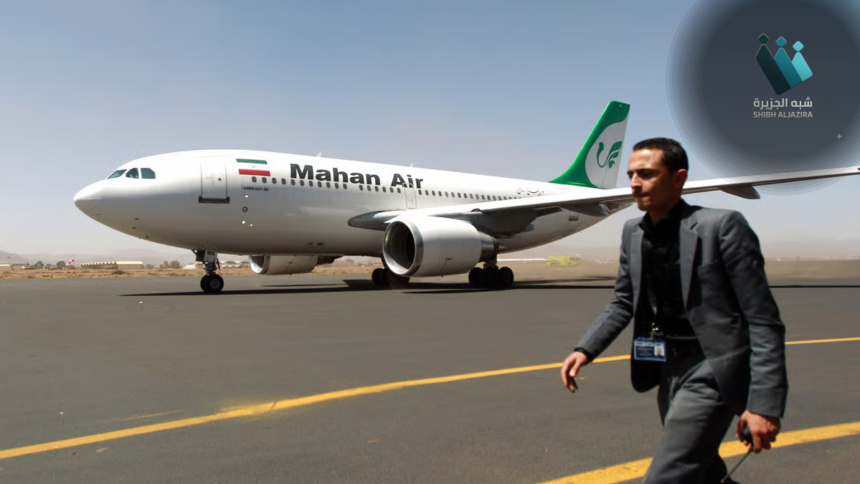
The landing of an Iranian “Mahan Air” plane at Sanaa airport was not merely the resumption of an air route. It brought back to the forefront the debate over which party has the authority to manage one of Yemen’s most important sovereign gateways, amid the continuing political and institutional split between the internationally recognized Yemeni government and the Houthi group, which has controlled the capital since 2014.
While the authorities in Sanaa view the operation of international flights as part of their right to administer the areas under their control and ease humanitarian suffering, the Yemeni government considers any air operations outside official institutions to be an overreach of the state’s authority and an attempt to entrench a new political reality.
Sanaa airport: From civilian gateway to political bargaining chip
Before the war, Sanaa airport was one of Yemen’s most important air gateways, serving the capital and the densely populated northern regions, and operating within the civil aviation system of Yemen’s internationally recognized state institutions.
But the Houthi group’s takeover of the capital in 2014, followed by the outbreak of war in 2015, changed the nature of the airport’s administration, as Sanaa came under de facto rule while the Yemeni government moved to operate from outside the capital.
In 2016, regular commercial flights to and from Sanaa airport were suspended, ushering the airport into a new phase in which it became one of the most prominent negotiating files in the Yemeni war because of its direct connection to the movement of millions of residents in the northern regions.

In 2022, understandings linked to the truce allowed the resumption of limited flights, most notably flights to the Jordanian capital, Amman, in a step seen as a humanitarian breakthrough. But it did not end the dispute over which party is authorized to manage the airport, issue permits, and regulate international flights.
With the political split persisting, Sanaa airport has come to reflect a broader crisis related to the multiplicity of decision-making centers within state institutions, as bodies linked to Sanaa operate in parallel with institutions affiliated with the internationally recognized Yemeni government.
Why was Sanaa airport suspended?
According to an informed source who spoke to NoonPost on condition of anonymity, the Iranian side informed the Saudi authorities in advance of the timing of the flight bound for Sanaa, but the delay in a response prompted it to proceed.
The source added that the plane’s landing coincided with Saudi military air movements, noting that warning shots were exchanged between the two sides, according to the source’s account.
The source also said the Yemeni Embassy in Amman lodged an objection with the Omani authorities over the plane’s passage through Omani airspace, explaining that the Omani response indicated that the permit for the aircraft to enter Yemeni airspace had been issued by the Yemeni Meteorology and Civil Aviation Authority, and that handling the matter fell within Yemeni jurisdiction.
According to the Yemeni state news agency Saba, the Presidential Leadership Council discussed the Iranian request concerning the operation of a “Mahan Air” flight from Tehran to Sanaa and considered operating flights outside official frameworks to be a violation of Yemeni sovereignty and a breach of the governing references regulating this file.
The council stressed that the government had previously proposed arrangements for the continuation of civilian flights through Yemenia Airways, particularly between Sanaa and Amman, with the aim of easing travelers’ suffering, accusing the Houthi group of disrupting the national carrier’s operations after seizing a number of Yemenia aircraft in 2024.
It also said that choosing “Mahan Air” instead of the national carrier carries, in its view, political dimensions that go beyond the humanitarian aspect, affirming that the government will take whatever measures it deems appropriate to prevent flights to Sanaa airport from operating outside official channels.
NoonPost sought comment from Yemen’s Ministry of Transport on the developments related to the flight and the measures taken, but the minister declined to comment.
Iranian flights carry security dimensions beyond the humanitarian aspect
Saudi military expert Amr Al-Ameri believes that the resumption of direct flights between Tehran and Sanaa cannot be separated from the political and security context of the Yemeni conflict, arguing that they carry dimensions that go beyond the humanitarian aspect.
Al-Ameri told NoonPost that operating flights between the two sides represents, in his estimation, an expansion of Iranian influence in Yemen, arguing that the Houthi group’s ties to Iran make this route part of the regional struggle for influence.
He added that using “Mahan Air” instead of Yemenia Airways sends a political message, warning of the possibility that the flights could be exploited for non-civilian purposes, though he did not provide specific evidence for that.
By contrast, Saeed Shavardi, a researcher in Iranian political and economic affairs, believes the resumption of flights is a response to humanitarian needs, particularly the travel of patients seeking treatment abroad.
Shavardi said the authorities in Sanaa view operating flights with Iran as part of their right to establish relations with different countries, arguing that continued restrictions on air traffic only deepen Yemenis’ suffering.
He said Iran supports any political settlement agreed upon by Yemenis, including the unification of state institutions, the holding of elections, and the formation of a government that enjoys domestic acceptance and international recognition.

Political analyst and prominent tribal sheikh Saleh Al-Bukhaiti also believes that the resumption of Iran-linked flights to Sanaa airport represents a unilateral step that could affect the course of political understandings in Yemen.
Al-Bukhaiti told NoonPost that operating direct air links with Iran goes beyond the humanitarian aspect and carries political messages tied to the status of the Houthi group and the future of a settlement, arguing that this step could be used to strengthen the group’s position as a de facto authority in Sanaa.
He added that the issue of the air link between Sanaa and Tehran is not new, and that reactivating this route revives debate over the nature of the relationship between the two sides and whether the flights represent a purely civilian measure or part of broader political calculations.
Who controls Yemen’s airspace?
Under the 1944 International Civil Aviation Convention, known as the “Chicago Convention,” every state enjoys complete and exclusive sovereignty over its airspace, including the regulation of civil aviation, the management of airports, and the issuance of overflight and landing permits.
But the Yemeni case presents a complex problem, as state institutions have become divided between authorities operating from Sanaa and others running their institutions from Aden, creating a gap between effective control on the ground and international legal recognition.
Experts in international law say that control over a civilian facility such as an airport does not grant the controlling party recognition of sovereignty, though it may give it operational capacity as a matter of fact. Operating international flights from an airport controlled by a party not internationally recognized also raises questions about which authority is responsible for air navigation safety and the extent of compliance with international standards.
Mansour Ali Al-Qadi, a researcher in international and Yemeni affairs, believes that operating international flights to Sanaa airport cannot be read solely from a technical or humanitarian angle, but is tied to political and security arrangements imposed by the nature of the Yemeni conflict.
Al-Qadi told NoonPost that operating an international airport in a conflict zone reflects the existence of administrative and security arrangements that have allowed air traffic to continue, but it does not necessarily settle the issue of legitimacy or sovereignty from a legal standpoint.
He explained that assessing the nature of any flight requires multiple indicators, including the type of aircraft, operating data, the level of oversight and inspection, and the documented information available, stressing that the existence of a direct flight between two countries alone is not enough to prove uses beyond a civilian character.