







Syria’s electricity crisis has reshaped daily life. At the start of the revolution, the Assad regime used power cuts to punish cities and neighbourhoods that opposed it. Over the years, damaged infrastructure and falling generation capacity made electricity increasingly scarce. Syrians had to fit cooking, laundry, food storage, study, work and leisure around the few hours when power was available.
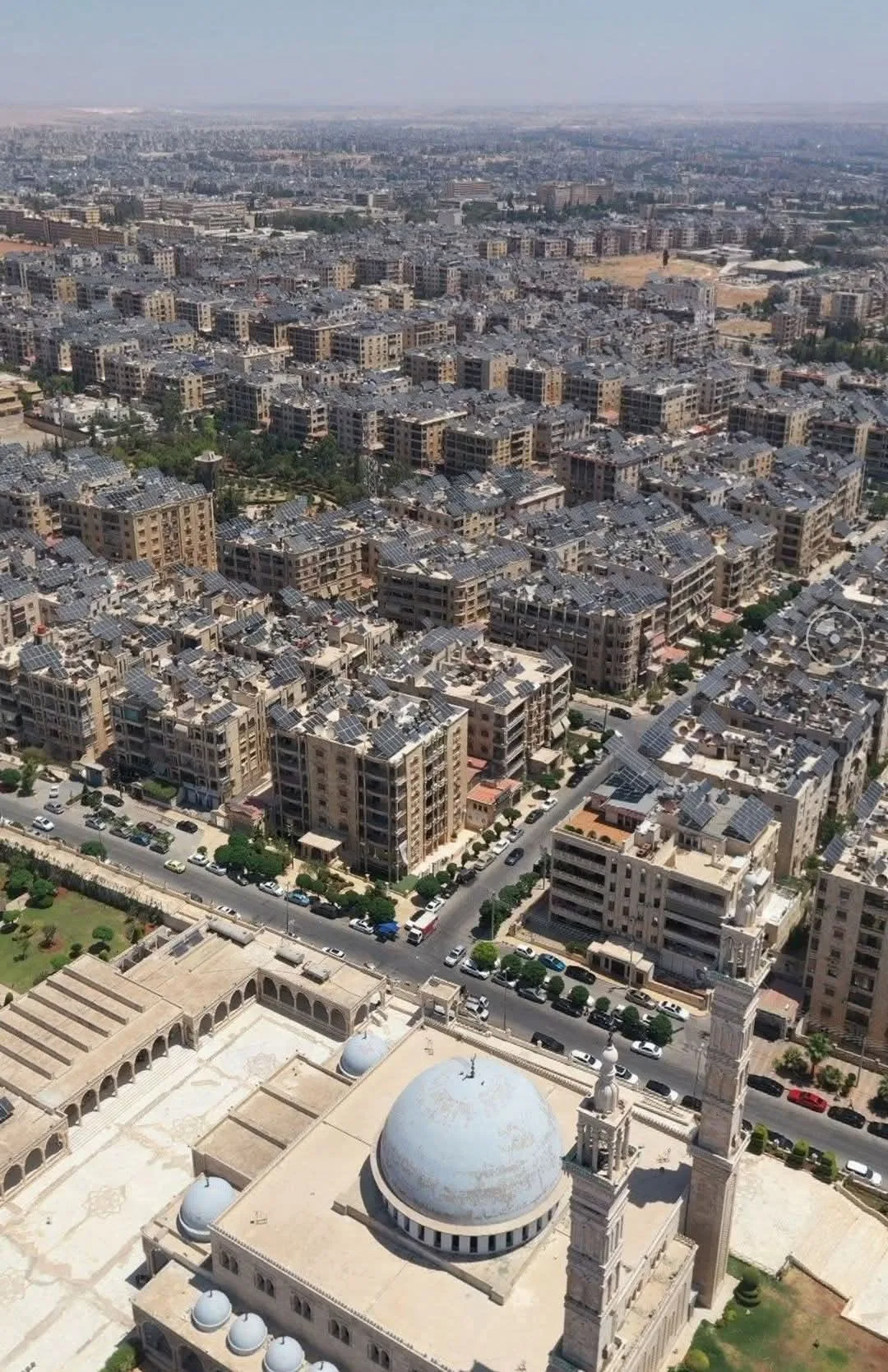
The crisis changed homes, too. People first used car batteries for lighting and charging devices, then turned to diesel generators. When fuel became scarce, household solar systems spread across cities, covering rooftop after rooftop.
Hospitals came to rely almost entirely on backup generators, raising costs and making fuel supplies a constant concern. Workshops and small factories cut their hours. For roughly a decade, unreliable electricity also hampered Syrians’ access to developments in technology, education and work, partly by limiting their connection to the outside world. While much of the world moved more of its life and work online, people in areas still controlled by the Assad regime struggled to secure basic services. The shortage shaped their economic, social and educational choices, as well as their daily routines.
Syria’s electricity system before 2011
Until 2011, Syria generated most of its own electricity and had limited connections to neighbouring grids. Its national network was extensive, and around 99 per cent of the population had access to electricity. The distribution establishment had approximately 4.6 million subscribers. Even so, the system struggled to keep pace with rising demand or maintain its efficiency.
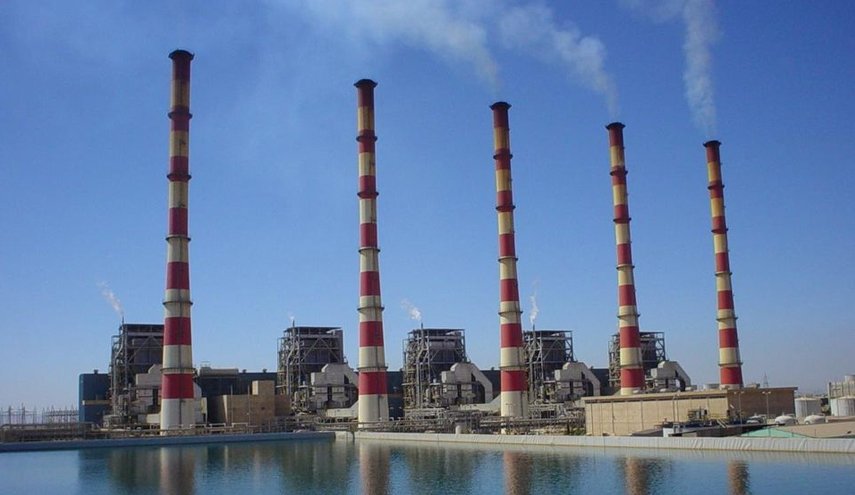
Most electricity came from thermal plants burning natural gas, heavy fuel oil and, in smaller quantities, diesel. Hydropower made a much smaller contribution, particularly from dams on the Euphrates. Solar and wind power remained plans for future diversification.
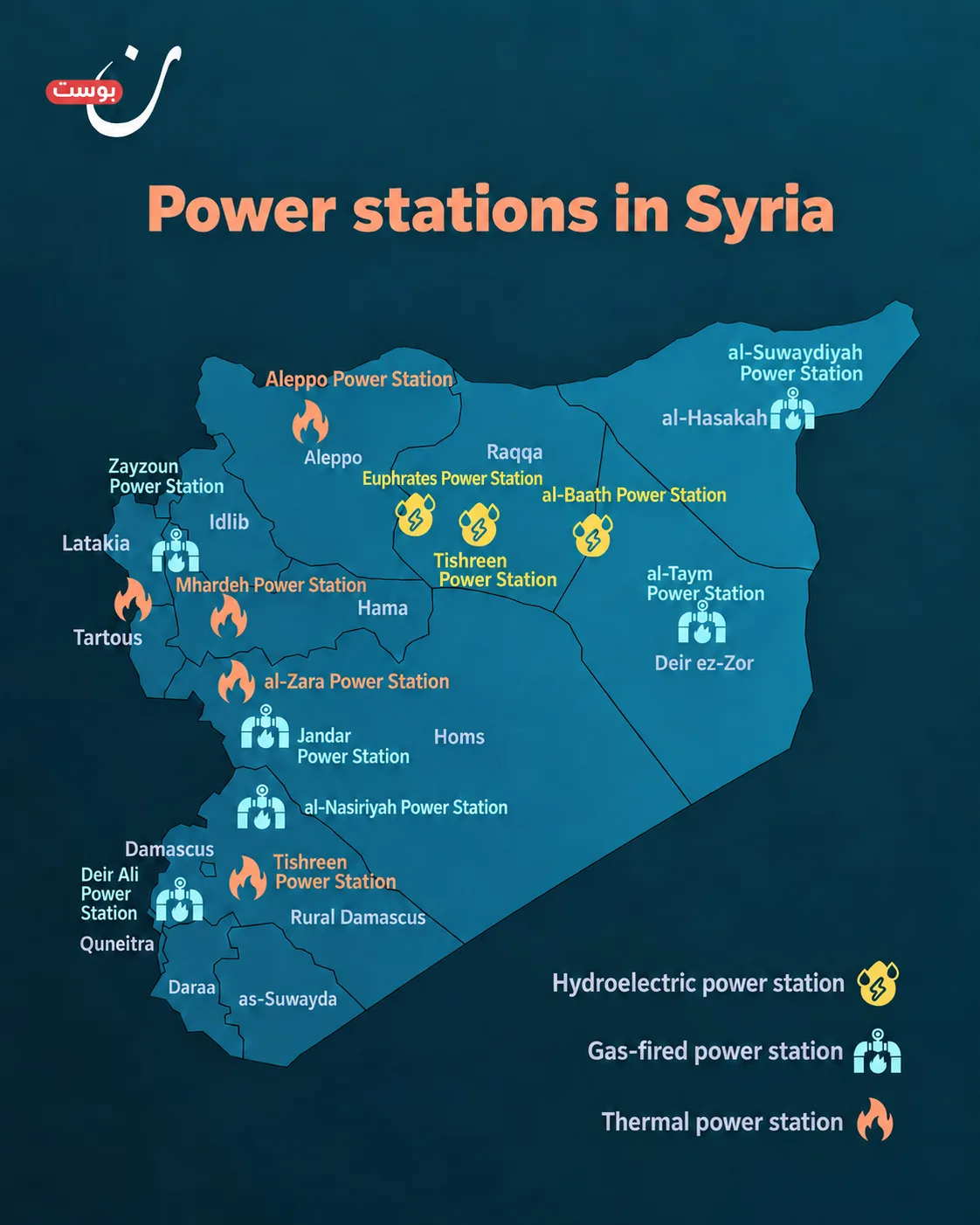
Major thermal plants included Aleppo, Baniyas, Mhardeh, al-Zara, Tishreen Thermal, Jandar and Zeyzoun. Hydropower came from facilities associated with the Euphrates/Thawra, al-Baath and Tishreen dams. In 2010, Syria generated about 44 billion kilowatt-hours of electricity: roughly 94 per cent from thermal plants and 6 per cent from hydropower. Output from the dams depended on water levels and how they were managed for irrigation and other purposes.
State subsidies kept consumer prices below the full cost of generation, operation and investment. The average residential tariff in 2009 was about 2.73 cents per kilowatt-hour. Losses were also high, both from technical problems on the grid and from unpaid bills and illegal connections.
Before the war, the World Bank recommended improving efficiency, expanding generation capacity and strengthening the sector’s finances by reducing losses, adjusting tariffs and attracting investment. It estimated that Syria would need another 7,000 megawatts of capacity by 2020 and nearly $10.5 billion in investment: $7 billion for generation and $3.5 billion for transmission and distribution.
Those prewar estimates help put today’s challenge in perspective. Meeting demand already required substantial investment before the destruction of the war. In 2026, Syria must repair and rebuild damaged facilities while also making upgrades that were delayed for years.
How electricity reaches consumers
Power plants convert fuel, water flow or other energy sources into electricity. Transformers at or near a plant then raise its voltage so it can travel long distances along high-voltage transmission lines with less energy lost along the way. These lines, which run between provinces and across large areas, form the backbone of the grid.
At major substations, the voltage is reduced. Electricity then passes through distribution networks serving cities, towns and villages. Medium-voltage lines carry it to smaller substations, including the transformers seen in neighbourhoods and near buildings, where the voltage is lowered again for homes and businesses.
Homes and small businesses generally receive low-voltage electricity suitable for everyday appliances. Large industrial and service facilities may receive power at medium voltage and reduce it through their own transformers.
Electricity in areas outside regime control
From the start of the Syrian revolution, the Assad regime used electricity cuts to punish and pressure residents of areas that opposed it. Assaults on towns were accompanied by cuts to public services, including power. Over the years, shelling by the regime and its allies damaged or destroyed power plants, transformers and high-voltage lines in areas outside its control in northwestern Syria. Theft and looting during waves of displacement caused further losses.
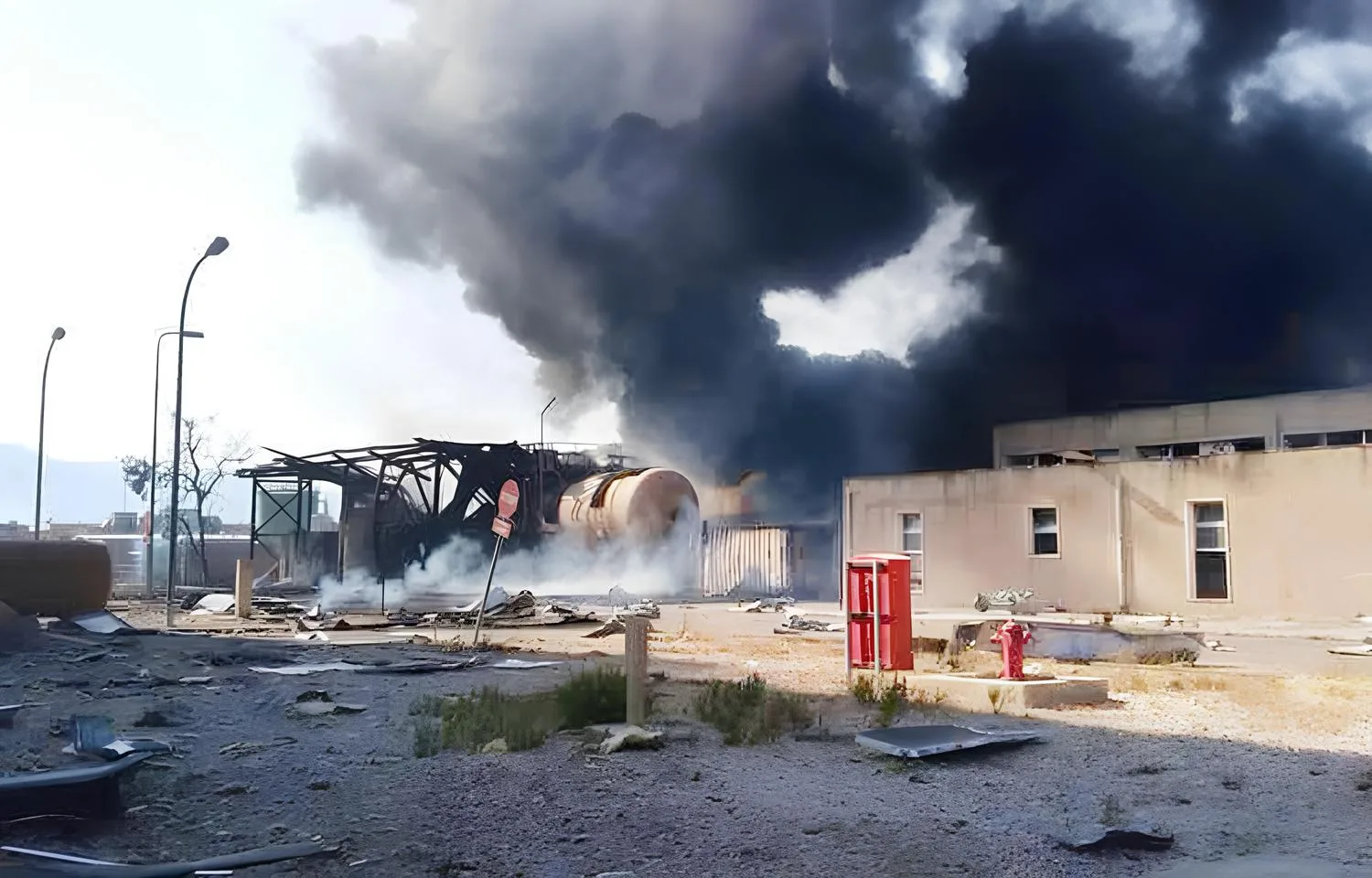
Idlib province was particularly badly affected. Zeyzoun, one of its most important sources of electricity, was effectively put out of service after intensive regime air strikes when the government failed to retake the plant from rebel forces. Most of its generators, transformers, central control panels, cables and fuel tanks were destroyed.
Before Turkish electricity became widely available, residents relied on private generators, solar panels and batteries. These provided limited hours of power at high cost, generally enough only for lighting and some basic appliances.
A larger change began with agreements to connect local networks to Turkish suppliers. Arrangements made in Idlib in 2020 provided for a private company to supply electricity from Turkey through a system of meters and prepaid cards. In May 2021, after seven months of repairs to war-damaged lines and substations, neighbourhoods in Idlib city received round-the-clock electricity for the first time in years. Coverage did not initially extend across the province, but the connection marked a move from intermittent generator power towards an organised grid supplied by a more stable external source.
In the Aleppo countryside and Afrin, several companies signed contracts with local councils in the Euphrates Shield, Olive Branch and Peace Spring areas, with mediation or oversight from Turkish provinces. Three principal suppliers emerged:
- AK Energy expanded from Azaz, al-Bab and its countryside, al-Rai and Jarabulus to Tal Abyad and Ras al-Ain.
- STE Enerji began in Suran, then moved into Akhtarin and later Afrin.
- Al-Shamal for Electrical Energy Distribution operated in Marea.
Researcher Karam Shaar says the Salvation Government, which administered Idlib province, was able to provide near-continuous electricity through Green Energy. The company’s director, Omar Shaqrouq, said its supply reached more than 70 per cent of the liberated areas and that it had 160,000 subscribers in 2023. President Ahmed al-Sharaa appointed him to lead the General Electricity Company in early June 2026.
As the model expanded, electricity increasingly became a sector for investment as well as an essential service. Green Energy allowed investors to develop solar projects and connect them to the grid under specified technical and regulatory conditions, buying their surplus output. This encouraged businesspeople and facility owners to invest.
Demand also pushed some transformers to full capacity while further projects remained under study. Electricity in the north had moved beyond emergency provision, but expansion still depended on investment in the network.
Rebuilding the sector after the fall of the Assad regime
After the regime fell, the new authorities made electricity a priority. Restoring power was central to their stated aim of reviving an economy whose industrial and commercial activity had been constrained by years of unreliable supply.
According to official statements carried by SANA, Syria’s generation capacity exceeded 3,000 megawatts at the start of 2026 for the first time in more than six years, after the Nasiriyah plant began operating on gas imported through Jordan. Ministry of Energy posts put that figure more than 114 per cent above the approximately 1,400 megawatts recorded in January 2025.
The response developed in overlapping stages: an emergency effort to take charge of facilities and secure supplies, plans for financing and new generation, and changes to the institutions managing the sector.
Emergency management and fuel supplies
In December 2024, Omar Shaqrouq was put in charge of the Electricity Ministry in Mohammed al-Bashir’s transitional government. His initial work centred on assessing the sector and taking over its administration. He visited generation plants, met administrative and technical staff, and discussed work plans, operational problems and employees’ demands.
The authorities also sought emergency help with fuel and electricity imports. Twenty days after the regime’s fall, Turkey announced that it intended to supply electricity to Syria and cooperate on infrastructure, with oil and gas supplies also under consideration.
At the start of 2025, plans were announced to send two power-generation ships from Turkey and Qatar with a combined capacity of 800 megawatts. Later accounts said the ships never arrived. The plan was postponed indefinitely because there was no clear agreement for its implementation and insufficient equipment to connect the ships to the grid. It remained a “pledge/initial proposal”, rather than an operational measure.
The first external fuel supply to materialise came on 13 March 2025. Under a Qatari initiative, natural gas was sent to the Deir Ali plant through Jordan at a rate of about two million cubic metres a day for 50 days, enabling around 400 megawatts of electricity generation.
Financing and investment
The effort to attract investment began while emergency measures were still under way. In February 2025, the authorities launched a project for a 100-megawatt solar plant in Wadiyan al-Rabie, rural Damascus, using a build, own and operate model. The investor would finance, construct and run the plant, along with a substation and grid connection.
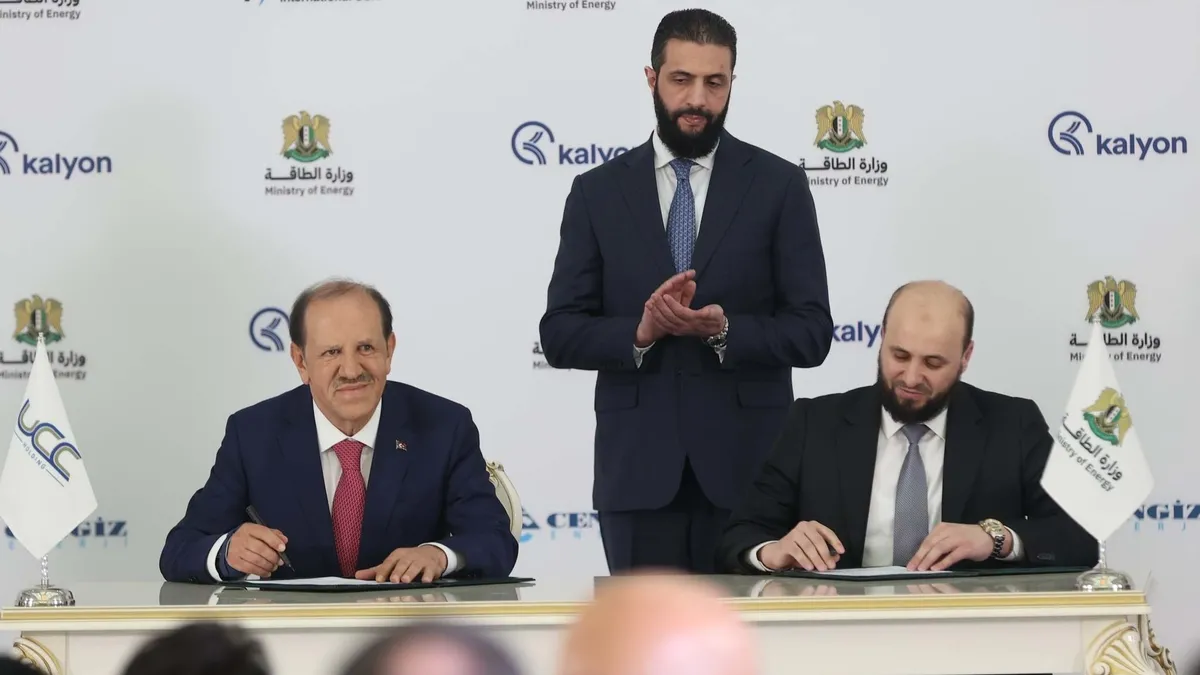
On 29 May 2025, the ministry signed a memorandum of understanding with an international consortium led by Qatar’s UCC/UrbaCon. The proposal, valued at about $7 billion, covered four combined-cycle gas plants with a total capacity of 4,000 megawatts and a 1,000-megawatt solar plant. It signalled a turn towards large generation projects involving foreign companies and consortia.
Also in May, Energy Minister Mohammed al-Bashir and his Turkish counterpart, Alparslan Bayraktar, signed a series of understandings on electricity and energy. Al-Bashir said their discussions included completing procedures to connect a 400-kilovolt line between the two countries, which was expected to allow Syria to import about 500 megawatts at the beginning of the following year.
They also discussed a line from Turkey’s Reyhanli to Harim in rural Idlib. It was to connect to a substation being built on the Syrian side and was then scheduled to enter service in early September 2025.
In June, the World Bank approved a $146 million grant for the Syria Emergency Electricity Project. The project was intended to rehabilitate transmission lines and substations while supporting sector development and building institutional capacity. It also set out arrangements for implementation: the Public Establishment for Transmission and Distribution of Electricity (PETDE) would carry out the project, supported by a management team, a steering committee, an operations manual and a procurement tool. An engineer would supervise technical work and monitor compliance with environmental, social, health and safety requirements. Workshops in July presented the project to potential market participants, moving it from financing approval towards administrative and practical preparation.
The ministry issued a prequalification request in June for a wind farm with a capacity of 100 to 200 megawatts. This was intended to identify companies with the technical and financial capacity to develop the project before contracts were awarded.
June also brought initial discussions with Azerbaijan. Al-Bashir met the chargé d’affaires of the Azerbaijani embassy in Damascus to discuss electricity, renewable energy, technical cooperation and potential joint investments.
In July, Bayraktar said Turkey planned to raise electricity exports to Syria to around 280 megawatts through existing lines. He said work was under way to reactivate the Birecik–Aleppo line, previously used to carry electricity and capable of transmitting about 500 megawatts.
Syria and Azerbaijan signed an energy memorandum that month. It included plans to supply Azerbaijani natural gas to Syria through Turkey, with Qatari financing, for use in Syrian power plants.
In August, PETDE signed a contract with the Syrian-Turkish company STE to build a 100-megawatt solar plant in Kafr Buhm, Hama province. The contract specified a site and capacity for one of the proposed investments.
Azerbaijani gas began reaching Syria through Turkey in August, less than a month after the memorandum was signed. Ministers and officials from Syria, Turkey and Azerbaijan attended the launch alongside representatives of the Qatar Fund for Development, which financed the project. Syria’s energy minister said the first phase envisaged about 3.4 million cubic metres a day, enough to increase generation by around 750 megawatts and add approximately four hours of daily supply. The director of the Syrian Gas Company said deliveries began at the Harjalah border station north of Aleppo at 745,000 cubic metres a day and would gradually rise to 3.4 million.
Restructuring, contracts and tariffs
The government also changed the institutions responsible for electricity while pursuing generation contracts and new tariffs. Decree No 150 of 2025 established the Ministry of Energy by merging the ministries of electricity, oil and mineral resources, and water resources. Al-Sharaa had appointed al-Bashir energy minister several months before the merger decree.
On 28 August 2025, the ministry signed an agreement and six memorandums of understanding with Saudi companies covering petroleum, electricity, and transmission and distribution facilities. The package included an agreement with Saudi Arabia’s ACWA Power concerning electricity generation, solar and wind plants, and possible energy storage.
On 1 October, PETDE signed two memorandums of understanding with the Saudi companies Al-Harbi and Skelec. Together with the STE contract, the package had a stated capacity of up to 600 megawatts and an estimated investment cost of $400 million. It included a 200-megawatt solar plant at Wadiyan al-Rabie and a 200-megawatt wind project with Al-Harbi, as well as a 100-megawatt solar project at Deir Ali with Skelec.
On 30 October, Decisions 686 and 687 set new electricity tariffs. The ministry linked the changes to its plans to reform the sector, reduce its deficit and encourage investment.
Protests in the city of Salamiyah in the Hama countryside over the Ministry of Energy’s decision to raise electricity prices. pic.twitter.com/qvolgOtVOW
— Noon Syria (@NoonPostSY) November 3, 2025
On 6 November, the UCC/UrbaCon memorandum became final agreements for eight power plants with a total capacity of 5,000 megawatts. They comprised four gas plants in northern Aleppo, Deir Ezzor, Zeyzoun and Mhardeh, and four solar plants with a combined capacity of 1,000 megawatts in Wadiyan al-Rabie, Deir Ezzor, Aleppo and Homs. The announced implementation period was three and a half years.
On 18 November, Ahmad al-Sulaiman, the ministry’s director of government communications, said the electricity institution had recently tested the grid by supplying Damascus, Homs, Hama, Tartous and Latakia continuously for 48 hours. The test was intended to assess its capacity and readiness. In December, the foundation stone was laid for the Deir Ezzor gas plant at the al-Taym field, part of the UrbaCon project.
Other work in 2025 included a study for a 750-megawatt Deir Ali 3 project; a study on rehabilitating units 2, 3 and 4 at the Aleppo thermal plant, with a capacity of 600 megawatts; the re-establishment of the General Electricity Generation Company in Deir Ali; and an approximately $95 million agreement with Super Genius to rehabilitate steam units 1 and 2 at a plant in rural Damascus. Two 230-kilovolt lines were also built towards the coast in preparation for future connections to floating power plants, while privately developed solar projects were connected to the grid.
In January 2026, the Syrian Petroleum Company signed an agreement with Jordan’s National Electric Power Company to buy about four million cubic metres of natural gas a day for delivery through Jordan. The gas was used to run power plants, notably Nasiriyah.
As government forces took control of the Jazira region, the Ministry of Energy announced on 18 January that it had regained the Euphrates Dam and returned management of its water and hydroelectric facilities to government personnel. The dam contains Syria’s largest hydroelectric plant, with a nominal capacity of about 880 megawatts.
The ministry said the same day that government institutions had begun taking over strategic facilities following the military advance, including oil fields, pumping stations and infrastructure used to produce and transport fuel. The Syrian Petroleum Company said it had taken over the Rusafa and Safyan fields with the aim of returning them to service.
On 25 January, the company announced that oil extraction had begun at recovered fields and raw gas was being pumped from the Jbessa fields in Hasakah. It also reported that oil was being sent to the Homs and Baniyas refineries and that technical teams had been formed to rehabilitate facilities and restore production.
On 31 January, the ministry announced that the electrical connection to Tishreen Dam had been restored after an outage of about a year. Workers had maintained the 230-kilovolt Babiri–Tishreen Dam transmission line and cleared mines from its route. The ministry said the turbines were returning to operation under approved technical programmes.
In February, the ministry signed an agreement with Marv Energy for a 700-megawatt wind project. Rather than assigning it to one province, the ministry said it would connect the project to the national grid and select turbine sites according to wind conditions. The company is to build it in phases over five to seven years, using turbines manufactured at its factory in Hisya, Homs. According to the newspaper al-Thawra, the project involves about 140 turbines. The electricity institution was still working on power-purchase agreements, grid connections and land-use arrangements before construction could begin.
The Reyhanli–Harim connection also began operating at an initial capacity in February 2026. Green Energy said power had arrived from Turkey and that all feeders had entered service after the new line was energised with a capacity of 80 megawatts on the Turkish side.
In April, Decree No 45 established the Syrian Electricity Company (SEC) as a wholly state-owned public holding company with financial and administrative independence, linked to the Ministry of Energy. It succeeded the separate generation, transmission and distribution institutions and their affiliated companies in their rights, obligations, contracts and agreements, bringing their functions into one entity.
Also in April, UrbaCon signed an agreement with Siemens Energy to reserve turbine manufacturing slots and components with long production lead times for the Zeyzoun and Deir Ezzor plants. Decree No 96, issued on 18 May 2026, appointed Omar Shaqrouq chief executive of the SEC.
Why discuss exports to Lebanon while Syrian neighbourhoods remain dark?
Reports that Lebanon was considering buying electricity from Syria prompted a question among Syrians: how could the country have power to export when many of its own areas still had little or none?
Generation capacity and the fuel needed to run and maintain plants are part of the problem. So is the grid’s ability to carry electricity to consumers. Transmission and distribution networks remain damaged or unready across large areas. In some places, deteriorating transformers or illegal connections add to the strain.
Since the regime’s fall, the authorities appear to have kept plants operating, repaired some of them and secured fuel. But electricity still cannot be delivered reliably everywhere, particularly in areas whose infrastructure suffered extensive destruction. One possible explanation for talk of a limited exportable surplus is that the grid cannot yet carry all available power to Syrian homes.
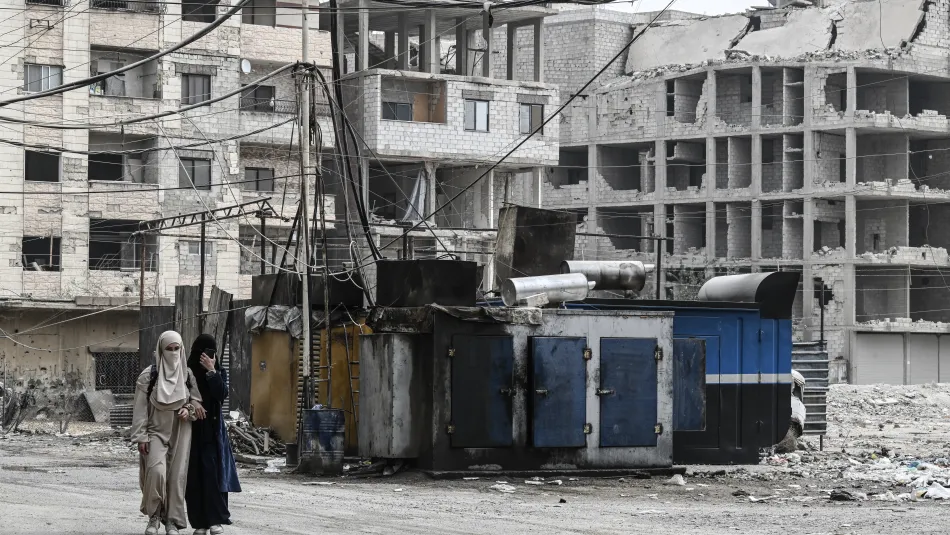
The new state inherited an electricity system worn down by more than 14 years of war, sanctions, declining investment, lost fuel sources and the shutdown of large parts of its infrastructure.
The authorities have since combined several ministries in a new Ministry of Energy and created the SEC to oversee generation, transmission and distribution. They have opened projects to local and foreign investors, signing agreements worth billions of dollars for power plants, renewable energy and grid development. They have also revised tariffs as part of a financial reform programme intended to reduce the deficit and fund expansion and modernisation.
Fuel imports and restored connections have increased supply in some areas. Reliable electricity around the clock throughout Syria, however, will require years of investment and repairs to transmission and distribution networks. It will also depend on finding a way to cover the cost of power that consumers can afford.
The work so far marks the beginning of a long rebuilding effort, rather than the end of Syria’s electricity crisis. Its success will matter to the country’s wider economic recovery and reconstruction.
