







هذا التقرير متاح أيضًا بـ العربية
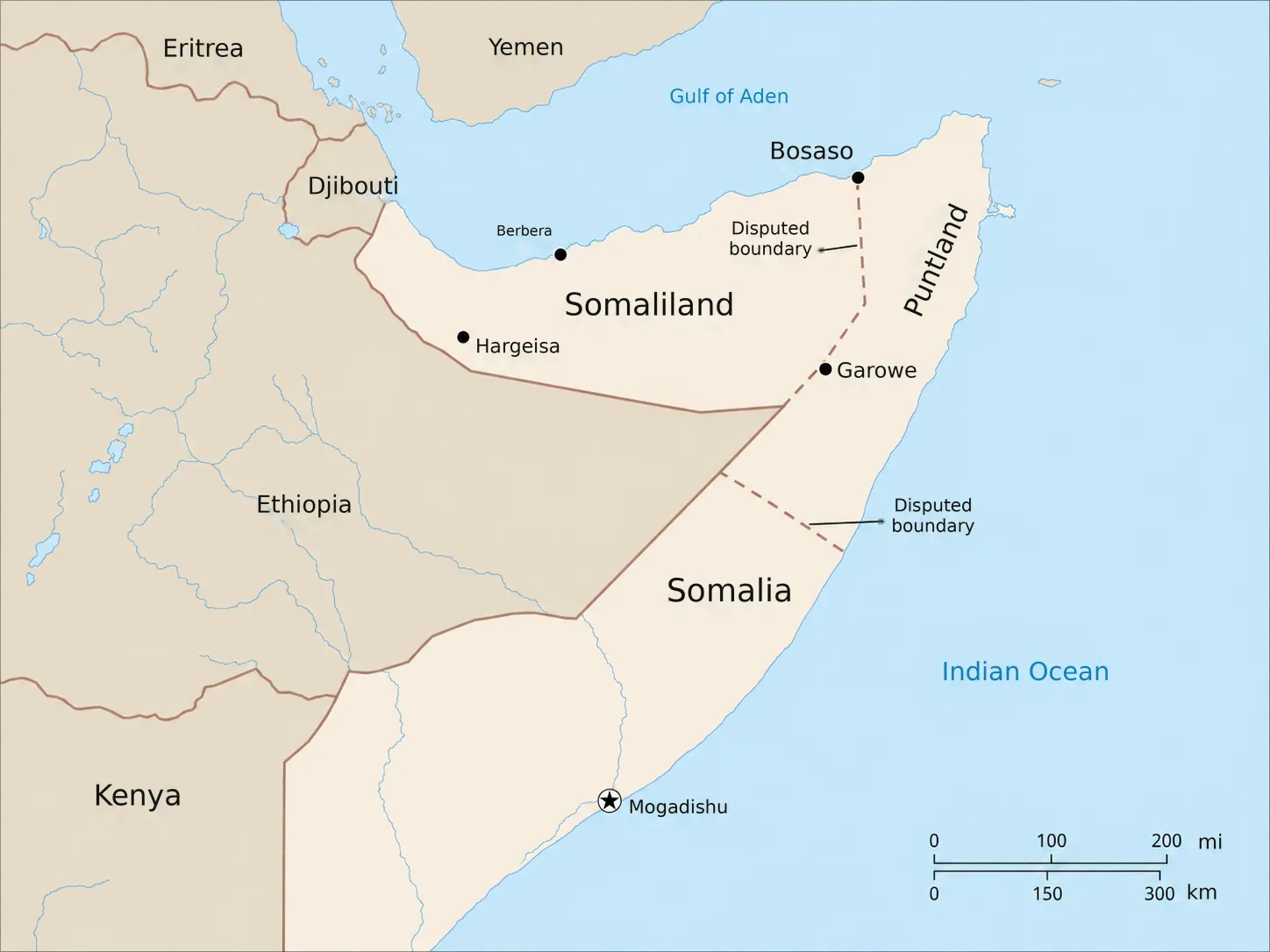
Puntland’s administration in northeastern Somalia has announced a security cooperation agreement with the US to expand their partnership against armed groups and strengthen maritime security in the Gulf of Aden and the Red Sea. The agreement allows Washington to expand a military facility in Bosaso.
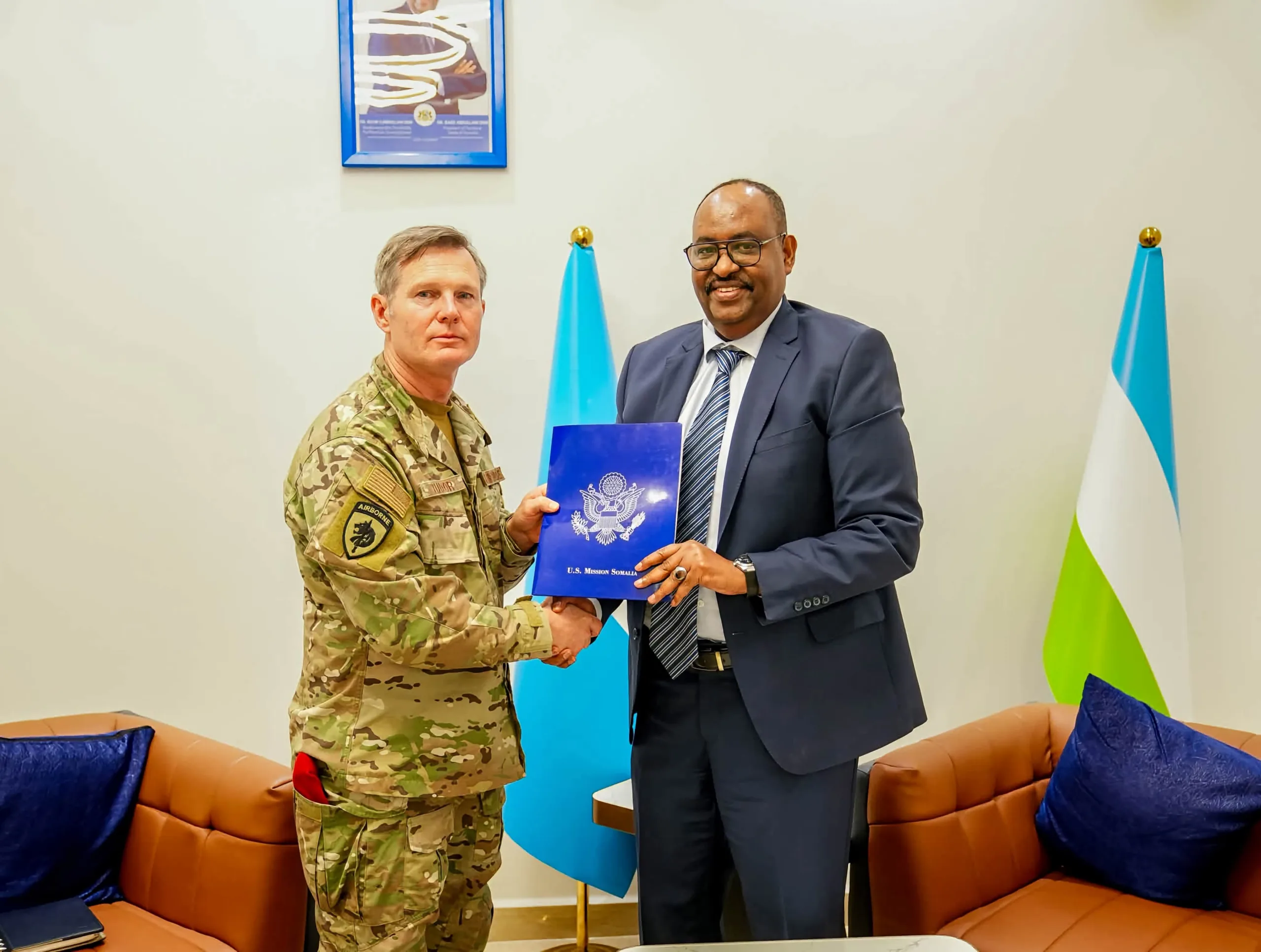
The agreement was signed after the region’s president, Said Abdullahi Deni, met a US military delegation in the coastal city on Sunday, 2 August. The delegation was led by Major General Claude K. Tudor Jr., special operations commander at US Africa Command (AFRICOM). Puntland ministers, military officials and advisers also attended.
On the surface, this may look like a security arrangement between a superpower and a regional administration fighting extremist groups. At its core, however, it marks a transfer of ownership. The UAE paid for the base’s construction and managed it for 10 years, using it for purposes ranging from fighting ISIS to transporting weapons and mercenaries to the Rapid Support Forces militia in Sudan. Now the American flag is being raised over it, after Mogadishu dismantled Emirati influence in the country. The agreement also points to a US strategy that treats Somalia as a theatre of operations with multiple points of access, rather than a unified state with a single capital.
Significant timing
A statement from the Puntland presidency, published on X and carried on 3 August by several Somali websites, notably Somali Guardian and Hiiraan Online, spoke of “expanding the military base in Bosaso to improve counterterrorism operations and help protect maritime security.” It did not disclose the size of the existing facility, the area the expansion would cover, the number of troops or amount of equipment that could be deployed there, or a timetable for the project.
So far, however, the account has come entirely from one side. At the time of writing, AFRICOM, the US embassy in Mogadishu and the US defence and state departments had issued no statements. The scope and timetable of the expansion, and the size of the accompanying force, remain unknown.
The timing says what the statement does not. Two weeks earlier, on 20 July, the Houthis announced a naval blockade of Saudi ports in the Red Sea, then said they had targeted two Saudi oil tankers. The US Navy-led Joint Maritime Information Center warned of missiles and drones deployed near the Bab al-Mandab Strait.
Bosaso sits on the opposite shore: a port and airport on the Gulf of Aden, about 200 miles from the strait through which nearly 12 per cent of the world’s seaborne oil passes. Washington did not go to Bosaso merely to fight ISIS in the Bari mountains. It went because the sea off its coast has become a battlefield.
From Abu Dhabi to Washington
The base the US is now expanding was not originally American. From 2010, the UAE financed and oversaw its construction. It became the headquarters where the Puntland Maritime Police Force was formed and trained. The force was created to combat piracy before taking on a counterterrorism role. A study published last year in the journal Defense & Security Analysis described the UAE’s pivotal role in establishing the base, financing the force and supervising it, helping it become one of Somalia’s most disciplined formations and among the least beholden to clan loyalties, with an estimated strength of about 2,000 personnel.
The UAE’s involvement extended beyond security. In 2017, DP World obtained a 30-year concession to manage Bosaso’s port. The airport infrastructure and adjoining base became part of the UAE’s regional operations network. Journalistic investigations, most notably by Middle East Eye, linked Bosaso to supply routes for the Rapid Support Forces militia in Sudan and the transfer of Colombian mercenaries there. Puntland’s authorities have repeatedly denied these allegations, despite the evidence, investigations and satellite imagery.
That arrangement collapsed on 12 January 2026, when Somalia’s federal government cancelled all its agreements with the UAE concerning the ports of Berbera, Bosaso and Kismayo, as well as security and defence cooperation, accusing Abu Dhabi of undermining the country’s sovereignty. Acting Foreign Minister Ali Omar said in remarks to the press that Southern Transitional Council leader Aidarous al-Zubaidi’s entry into Somali territory through Somaliland was “the straw that broke the camel’s back.” Anger had been building for weeks, following Israel’s recognition of Somaliland in December 2025, a move Mogadishu believed the UAE had facilitated.
The decision was followed by a withdrawal. Numerous media outlets reported that the UAE had begun removing its equipment. Middle East Eye said Abu Dhabi had moved its security personnel and materiel towards Ethiopia, while Mareeg Media reported that most of those evacuated from Bosaso were Colombians employed by Abu Dhabi. On 13 January, open-source intelligence analyst Rich Tedd also tracked the arrival of an Emirati ship to collect the remaining military equipment belonging to UAE forces stationed at Bosaso airport and the Puntland Maritime Police Force headquarters.
A direct agreement that bypasses Mogadishu
The Bosaso agreement was signed directly between Washington and a regional government. Somali Guardian described it as the clearest evidence yet that America’s two-track policy towards Somalia was becoming entrenched.
Puntland withdrew its recognition of the federal government on 31 March 2024 in protest against constitutional amendments approved by the Somali parliament. It declared that it would exercise the powers of an independent state until a constitution was approved in a public referendum. Relations have since deteriorated to the point of armed clashes around Galkayo and on the outskirts of Bosaso during 2025 and 2026. These tensions overlap with other disputes, including the crisis over the CIA-trained and funded Puntland Security Force. Mogadishu announced that it was integrating the force into the national army, while Puntland stripped it of its legal status.
Mogadishu has so far issued no official response to the Bosaso agreement, whether from the presidency, the foreign ministry or the defence ministry. Its silence may be partly explained by its preoccupation with an internal political and electoral crisis and renewed military confrontation with Puntland near Galkayo at the beginning of August. Alternatively, there may have been undisclosed understandings with Washington: Somali President Hassan Sheikh Mohamud received AFRICOM commander General Dagvin R.M. Anderson in late July, just two days before the Puntland agreement was signed.
According to the official Somali News Agency, SONNA, the meeting covered regional security developments, accelerating joint counterterrorism efforts, strengthening the capabilities of the Somali armed forces and continued US support for the Somali government’s efforts to achieve security and stability.
Tensions between Mogadishu and the regional administrations nevertheless persist. In January 2026, the Somali cabinet approved a “sovereignty protection” bill that would bar regional administrations from concluding agreements with foreign parties without prior authorisation. In an earlier statement on Somaliland, the foreign ministry stressed that any political or diplomatic dealings that bypass the federal government “carry no legal or political standing whatsoever.”
US pragmatism
The Bosaso agreement captures the US approach to Somalia: military pragmatism that involves working simultaneously with actors at odds with one another, securing from each what Washington needs for its security objectives in that region.
Washington remains Mogadishu’s foremost military partner in its war against al-Shabab in central and southern Somalia. It carries out air strikes in coordination with the federal government and Somali armed forces, as AFRICOM routinely states, while supporting the Danab Special Forces Brigade. At the same time, it backs Puntland’s war against ISIS, which is based in the Al-Miskad Mountains in Bari region. According to AFRICOM’s own estimates, the group grew from about 300 fighters in 2019 to nearly 1,500 by May 2025, about 60 per cent of them foreigners. By June 2025, Puntland President Deni had announced that about 98 per cent of the Al-Miskad mountain range had been retaken and more than 700 militants killed since “Operation Hilaac” began in late November 2024.
The figures show both the scale of US involvement and how it has changed. US forces carried out 124 strikes in Somalia in 2025, compared with just 10 in 2024, according to an AFRICOM spokesperson. The 100th strike took place near the Golis Mountains in November 2025. The total surpassed the previous annual record of 63 strikes in 2019, marking the highest annual rate since the command’s creation, according to Stars and Stripes.
The distribution of targets is even more telling. In 2025, the majority of strikes targeted ISIS in support of Puntland’s offensive: 22 of the 38 strikes carried out by 10 June, compared with just one against the group in all of 2024, according to the Combating Terrorism Center. In 2026, the focus shifted back to al-Shabab. In July 2025, Long War Journal documented a cumulative total of at least 74 strikes. Analysts link that pace to US Defence Secretary Pete Hegseth’s decision to ease restrictions on strikes and give field commanders greater authority.
US engagement extended beyond Puntland. Two days before the agreement, the same delegation had been in Hargeisa, where it met Somaliland President Abdirahman Mohamed Abdullahi. Maritime security dominated the discussion. Hargeisa had offered Washington basing rights at Berbera’s port and airport, whose runway is among the longest in Africa, in exchange for recognition of the region’s independence, according to several reports, notably one published by Military.com in March 2026.
This expansion has faced criticism in Washington itself. The think tank Defense Priorities warned of plans to build up to four bases in Somaliland and additional facilities in Puntland, arguing that they were strategically unnecessary and not worth the cost. Its report said the existing military infrastructure in neighbouring Djibouti was entirely sufficient and warned that a direct military presence risked drawing the US into complex local conflicts in the Horn of Africa. In an interview published by the US embassy in Mogadishu on 31 July, AFRICOM commander General Dagvin Anderson again denied that there were any plans for a US base in Somaliland, reaffirming Washington’s support for Somalia’s sovereignty and territorial integrity. That explicit denial came just two days before the Bosaso agreement was signed, and is difficult to reconcile with what followed.
The UAE and a return through the back door
Is the UAE an indirect beneficiary of the US expansion?
It is a plausible hypothesis. Following its expulsion from Somalia, a direct Emirati military presence was no longer possible. Washington’s move to fill the vacuum serves the same core Emirati interests: securing the Gulf of Aden, fighting armed groups and protecting the UAE’s investment in the port, without Abu Dhabi having to bear the cost of confrontation with Mogadishu.
There is a basis for this hypothesis. The US-UAE defence partnership has deepened since the signing of a “letter of intent” to establish a major defence partnership in May 2025. The local ally Abu Dhabi trained in Puntland is the same force now supporting operations against ISIS and benefiting from US backing. Preserving the infrastructure the UAE built and the stability of the forces it created serves both countries, even if the flag over the base has changed.
Not far from Bosaso, the UAE once had a base in the Eritrean city of Assab, overlooking the Red Sea. Abu Dhabi established the air and naval base in 2015 to support its operations in Yemen, moving heavy weapons and troops through it, according to an Associated Press analysis of satellite imagery. It began dismantling the base in early 2021 as relations between Abu Dhabi and Asmara began to deteriorate. Satellite images at the time showed facilities being removed and equipment shipped out.
Biden will witness further retrenchment and a decline in the influence and impact of the UAE at both the regional and international levels. The withdrawal from the Assab base in Eritrea is not the final scene.
A report by @Moh_Gamea https://t.co/WyKIA9S3tx
— NoonPost (@NoonPost) February 21, 2021
Today, Washington is moving towards Asmara. The Wall Street Journal reported in April, followed by other outlets including Reuters, that the Trump administration was considering resetting relations with Eritrea and lifting some sanctions, driven by the need to confront Iranian threats to Red Sea shipping lanes. The reports also placed the move in the context of Eritrea’s strategically important Red Sea coastline and said Trump’s Africa envoy, Massad Boulos, had met President Isaias Afwerki in talks mediated by Egypt.
Competition over Assab’s legacy is no longer confined to two parties. The Cradle reported that Saudi Arabia had pledged about $1 billion to rehabilitate the port, which Abu Dhabi previously dominated as a military base. It said Riyadh’s move would bolster Eritrea’s stability and help curb Ethiopian maritime ambitions in the region, noting that Afwerki had come to describe the UAE as the primary destabilising actor in Sudan.
A single thread links Bosaso, Assab and Berbera: the US is not building from scratch in the Horn of Africa. It is inheriting runways, ports and camps built by others for their own purposes, then repurposing them to meet its own needs. It is doing so as threats escalate in the Red Sea, Bab al-Mandab and the Gulf of Aden, and as it seeks a flexible network of footholds to reduce its dependence on its overburdened base in Djibouti.
But that inheritance comes with liabilities. The strategy deepens US involvement in a fragmented Somalia, divided between a federal government in the capital and regions that no longer consider themselves bound by Mogadishu’s authority. Through its agreement with Puntland, the US is betting on actors whose alliances may change overnight — a lesson the UAE paid for in both Assab and Bosaso.
Three questions will shape the picture in the coming months. Will AFRICOM officially confirm the agreement and define its scope? Will Mogadishu accept it on the basis of undisclosed understandings with Washington, or respond by pursuing the restrictions set out in its sovereignty protection bill? And is the expansion a narrowly defined operation to suppress ISIS, or a platform for operations in the Red Sea with a mandate that goes far beyond counterterrorism? The answers will distinguish a temporary security arrangement from a lasting redistribution of influence in the Horn of Africa.
Whatever the answers, the changes that have already taken place do not depend on official confirmation. The Somali state is no longer the sole point of access to the country’s territory and coasts. Negotiations over the port take place in Bosaso, those over the runway in Berbera, and those over air cover in the capital, Mogadishu. As the Red Sea becomes more turbulent, the Somali coast becomes more valuable, even as the central government’s ability to retain control weakens. Each regional administration finds that what it controls gives it a bargaining chip of its own.
One final question remains: what will the UAE do? Will it accept the loss of what it built in Bosaso and settle for having its American ally protect the same interests, returning through the back door without a flag or soldiers? Or will it seek a new foothold in the region, as it did when it moved on from Assab? And will Washington accept its move into Bosaso being seen as a rescue of Emirati influence while it seeks to preserve its relationship with Mogadishu, which expelled Abu Dhabi months ago? The answer will reveal whether two allies are dividing responsibilities or a great power is truly replacing its ally.
