










Two well-informed sources—one Egyptian and one Qatari—closely involved in Gaza mediation efforts have revealed that the United Arab Emirates has recently ramped up its push to resettle Gaza’s population in various regional countries, including the Republic of Sudan.
The move aligns with a controversial plan previously proposed by former U.S. President Donald Trump in February, which called for depopulating the Gaza Strip to transform it into the “Middle East Riviera”—a plan categorically rejected by the Arab world.
According to the sources, who spoke to the Egyptian news outlet Al-Manassa, the Emirati proposal involves relocating hundreds of thousands of Gazans to areas in Sudan controlled by the Rapid Support Forces (RSF) militia.
In exchange, RSF commander Mohamed Hamdan Dagalo—better known as Hemedti—would receive international legitimacy and be reintegrated into Sudan’s political landscape. Hemedti’s position has weakened in recent months due to significant military losses inflicted by the Sudanese army since March.
The U.S. administration, along with Israeli Prime Minister Benjamin Netanyahu’s government, has been actively pursuing secret diplomatic channels to convince regional states to accept displaced Gazans as part of a so-called “voluntary relocation” scheme.
Egypt and Jordan have firmly rejected the proposal, citing it as both a threat to Arab national security and an outright liquidation of the Palestinian cause.
Emirati-Facilitated Talks Between Hemedti and Washington
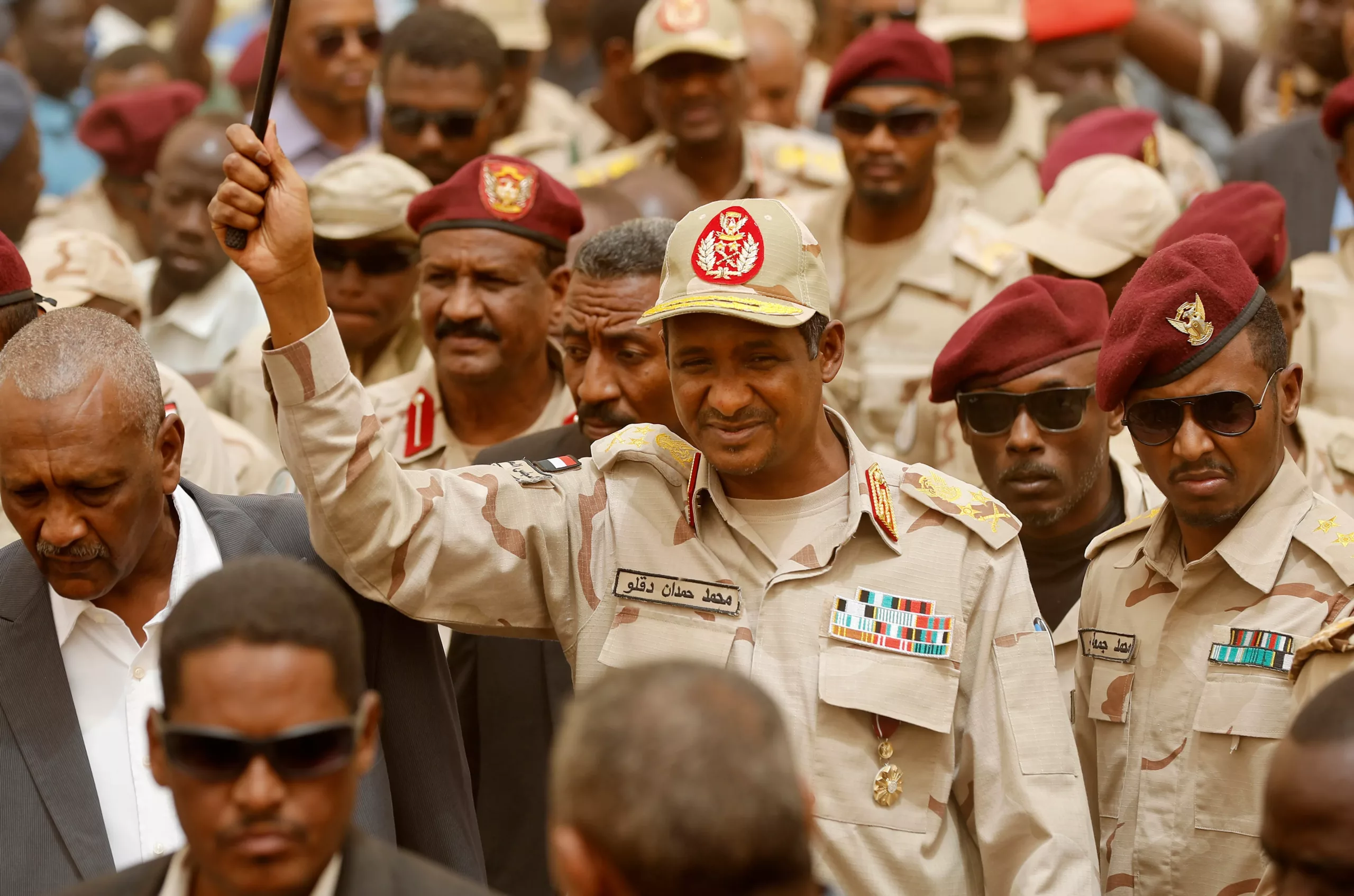
According to the Egyptian source familiar with negotiations to end the Gaza war, the UAE recently facilitated contact between Hemedti and senior U.S. officials, aiming to secure American support for the RSF and recognition of the group as a legitimate armed entity with a role in Sudan’s future.
Abu Dhabi is leveraging Hemedti’s political ambitions to score diplomatic points with Washington and Tel Aviv. In return for accepting displaced Gazans into RSF-controlled territories, Hemedti hopes to gain Western backing. This maneuver is backed by significant Emirati military, political, and financial support for the RSF.
This proposal serves dual Emirati objectives: strengthening ties with the U.S. and Israel, and expanding its influence in Sudan to advance its broader regional agenda. Meanwhile, Sudan’s army and Transitional Sovereignty Council have refused to engage in backchannel talks with U.S. and Israeli officials over the Gaza resettlement plan, which has been met with widespread rejection from Sudanese political, military, and public circles.
Abu Dhabi Moves Against the Arab Consensus
In February, Donald Trump explicitly expressed his administration’s interest in depopulating Gaza and relocating its residents to neighboring countries under the guise of redevelopment. This plan was summarily rejected by Egypt and Jordan, which viewed it as a threat to regional stability.
At the Arab Summit in March, and during the smaller Riyadh Summit a month earlier, Arab states endorsed an Egyptian counter-proposal centered on Gaza’s reconstruction without displacing its people. The Egyptian plan envisions a five-year rebuilding process costing $53 billion, including a six-month transitional period managed by an Arab support committee to clear rubble and build temporary housing for 1.5 million people in seven designated areas.
Despite this unified Arab stance, Abu Dhabi is moving in the opposite direction. It is using its influence in Sudan to push Hemedti to accept the resettlement plan, disregarding regional consensus and nationalist principles.
From a pragmatic standpoint, Hemedti may find the offer appealing—especially after his recent military setbacks, which threaten to marginalize him entirely. The UAE seeks to exploit his vulnerability and leverage his relationships with countries like Chad, southern Libya, and figures like Libyan warlord Khalifa Haftar to facilitate the plan. These areas may also become potential sites for resettlement.
Abu Dhabi’s divergence from the Arab consensus is not limited to Palestine. It reflects a broader pattern stretching from Libya to Yemen, passing through Sudan, Ethiopia, and the Horn of Africa. In these arenas, the UAE has pursued a self-serving foreign policy, often at odds with Arab collective interests, and one that potentially endangers regional security.
Sudan Not Alone in U.S. Resettlement Efforts
Sudan is not the only country approached by the U.S. regarding the resettlement of Gazans. According to reports by the Associated Press and CBS News, Washington held talks with Somalia two months ago to explore the possibility of using Somali territory for this purpose.
Somali Foreign Minister Ahmed Moalim firmly rejected the proposal, stating, “We reject any plan involving the use of Somali land to resettle foreign populations.” He added, “We reject any attempt, by any party, to undermine the Palestinian people’s right to live peacefully on their historical land.”
Sudanese Pushback Against Emirati Interference
Since the outbreak of Sudan’s war in April 2023, the UAE has attempted to impose its agenda on the country, seeking to expand its influence over Sudanese ports and resources by heavily supporting the RSF through military aid and financial backing.
For over a year, this support helped balance the battlefield in the RSF’s favor. However, the Sudanese army has recently achieved significant victories, shifting momentum and reclaiming territory. These losses prompted Abu Dhabi to reassess its position and devise new strategies to retain influence in Sudan.
Diplomatic sources revealed that Hemedti recently traveled to Abu Dhabi for high-level meetings with senior Emirati security officials, including Maj. Gen. Rashid Al-Ketbi and Brig. Gen. Salem Al-Neyadi—key figures in the UAE’s Sudan and African Horn portfolios under National Security Advisor Tahnoun bin Zayed.
The multi-day meetings focused on military support, including drones, leadership restructuring, and plans to establish an externally-managed “transitional military council” to effectively partition Sudan.
Following his return, Hemedti began relocating RSF leadership remnants to southern Libya and Chad, laying the groundwork for reorganizing his forces under the guise of “border security mercenaries.”
He is also recruiting new fighters from Darfur and Central Africa, in coordination with smugglers from Niger and Mali. This effort is being financed by Emirati firm Noor Capital and through gold smuggling operations that funnel revenues back to the UAE.
The same sources disclosed a UAE-funded international media campaign aimed at rehabilitating Hemedti’s image—portraying him as a tribal leader fighting for justice and the rights of marginalized Sudanese communities, rather than the war criminal many international organizations regard him to be.
In March, Sudan filed a lawsuit against the UAE at the International Court of Justice, accusing it of complicity in genocide by supporting RSF attacks in West Darfur. The Sudanese government also severed diplomatic ties with the UAE, declaring it a hostile state.
Despite growing regional outrage, the UAE continues to pursue its expansionist agenda with what many see as Machiavellian pragmatism—undermining ethical, national, and humanitarian values, even as it cynically promotes its supposed support for the Palestinian cause.


