









هذا التقرير متاح أيضًا بـ العربية
The system established by the United States in Iraq after 2003 marked a complete break with the country’s previous political experiences in its modern history, in terms of form, structure, hierarchy and the foundation on which it was built.
The new system adopted sectarian and ethnic power-sharing as a mutually agreed convention among the “founding fathers” of the political process, under US supervision and with Iranian backing, based on unofficial and inaccurate estimates of population numbers and the proportions of sectarian and ethnic components. As a result, the post of prime minister went to Arab Shiites, the speakership of parliament to Arab Sunnis, and the presidency to the Kurds.
Amid the chaos that swept the country in the wake of the US invasion, Iraq’s new constitution was put to a vote in 2005, amid strong opposition from Sunni Arabs to it. It enshrined a federal parliamentary system, recognizing federalism as a right for Iraqis who wanted to expand the powers of their provinces and reduce central government interference something opponents at the time saw as an entrenchment of sectarianism and a prelude to the country’s partition.
The constitution also stipulated the establishment of the “Iraqi Federation Council” as a second legislative chamber to balance the work of the Council of Representatives. Yet its formation has remained ink on paper for more than two decades, because of calculations of influence, fears, and the struggle for power among the country’s political and partisan components.
Over the years, the council remained confined to the pages of the constitution, though it was invoked several times in the context of promises aimed at appeasing Sunni Arabs, especially after they lost the battle to form the Iraqi government following the 2010 elections and the premiership went to Nouri al-Maliki’s State of Law Coalition.
The constitution and the council’s missing powers
Article 48 of the Iraqi Constitution states that the federal legislative authority consists of the Council of Representatives and the Federation Council. Article 65 requires parliament to form this council and define its conditions and powers through a law passed by a two-thirds majority.
According to constitutional experts, the philosophy behind forming the council is based on representing geography rather than sects or political blocs. It closely resembles “senates” and “upper houses” in other countries, representing self-governing regions and provinces not incorporated into a region equally, regardless of each province’s population density.
Based on draft laws discussed in the corridors of the Iraqi Parliament during previous terms, the council’s powers are centered on protecting the federal system and preventing any one side from dominating legislation.
Its most prominent powers are summarized in reviewing and overturning legislation, as it would hold a “legislative veto” requiring the Council of Representatives to send draft laws to it for comments and ratification, especially strategic laws related to resources, borders and regions.
In the event of a legislative dispute, the council would form a “binding conciliation committee” to resolve the conflict. It would also discuss and decide on international, security and defense treaties, border demarcation, clarify Cabinet policies, work to settle ongoing financial and political disputes between the federal government in Baghdad and the regions and provinces, and offer opinions and amend financial plans to ensure the fair distribution of wealth.

The impossible majority and the roots of obstruction
According to political and legal experts, the delay in approving the council and its continued confinement to parliament’s drawers is due to several reasons, foremost among them the requirement of a two-thirds majority. The constitution stipulates that the law must pass with the approval of two-thirds of parliament’s members, making that threshold difficult to achieve amid Iraq’s sharp political divisions.
The lack of agreement on the mechanism for its formation was another reason for the delay. The constitution did not specify how its members should be chosen — whether through direct election or appointment — or whether it should include governors and former heads of provincial councils.
Added to this is the concern of the forces dominating the Council of Representatives that its existence could paralyze the legislative process or pull the rug out from under the current parliament.
According to Dr. Ali Mahdi, deputy head of the Baghdad Center for Legal and Economic Development, parliament has monopolized most powers, making it difficult for lawmakers to give up their influence in favor of a second legislative chamber.
Mahdi adds that one of the flaws of the current legislative authority is that it has departed from the principle of bicameralism found in many countries around the world by dealing unevenly with the two wings of legislative power. He noted that it adopted a detailed approach to the provisions governing the Council of Representatives while overlooking detailed provisions for the Federation Council, leaving its formation to a law issued by the Council of Representatives which is supposed to stand alongside it as an equal creating many problems and difficulties for lawmakers when drafting the law.
The dilemma of the constitutional text
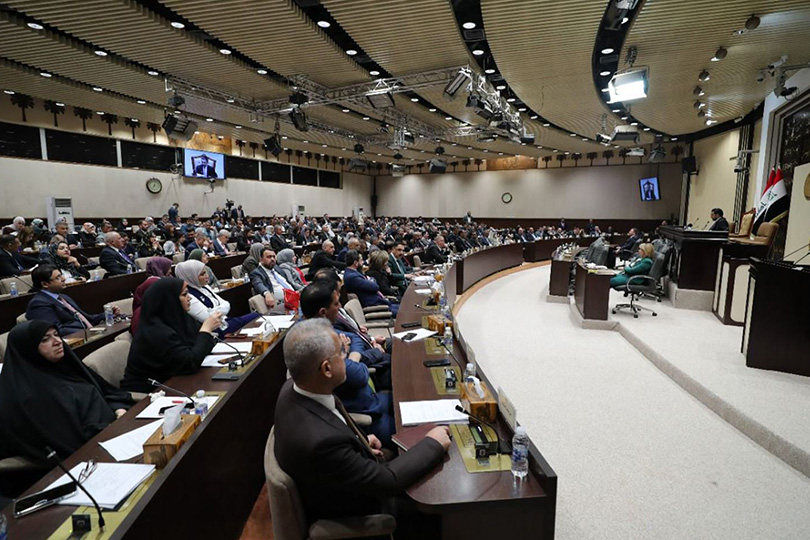
Scholars of constitutional law point out that the Iraqi Constitution has shackled the enactment of this law by requiring the approval of two-thirds of the members of the Council of Representatives to pass it. In a political landscape that is divided and built on quota-sharing, securing a two-thirds quorum to pass a sovereign law that curbs parliament’s powers is nearly impossible without a comprehensive deal that satisfies all parties.
The late legal expert Tariq Harb described this condition before his death as an “impossible obstacle” in light of political division, noting that the constitution did not grant the Federation Council legislative authority, having assigned the task of legislation exclusively to the Council of Representatives.
Harb explained that the constitution deprived the Federation Council of legislative jurisdiction, even though Article 48 states that the federal legislative authority consists of the Council of Representatives and the Federation Council, and Article 65 mandates its creation. But the constitution then went back and vested the power to enact federal laws solely in the Council of Representatives, with no other body sharing that authority, making the Federation Council merely an advisory body on matters concerning regions and provinces not incorporated into a region, with no authority over federal issues.
Anxiety over partnership and the desire for dominance
Observers say the blocs that have controlled the Council of Representatives since 2005 have grown accustomed to monopolizing legislative and oversight authority. Enacting the Federation Council law would automatically reduce the powers of the Council of Representatives and force it to share them with another chamber — something those forces reject, as they do not want a constitutional partner competing with them for influence.
In this context, legal expert Mohammed al-Sharif says the constitution created components for every authority in Iraq: the executive authority consists of the president and the Council of Ministers, while the judicial authority consists of the Supreme Judicial Council, the Federal Supreme Court, the Federal Court of Cassation, the Public Prosecution and the Judicial Oversight Commission. He explained that this division also included the legislative authority, for which it created two components: the Council of Representatives and the Federation Council.
Al-Sharif added that all components of the authorities are currently functioning except for the second component of the legislative authority, the Federation Council, “which constitutes a clear violation of the constitution, an overstepping of the structure it imposed on its authorities, and a formal defect that should be remedied,” attributing
the delay in enacting the council’s law to the Council of Representatives’ fear for its powers and its desire to seize all levers of legislation while taking advantage of the political silence surrounding the matter.
Reviving the monarchy-era experience
The philosophy of the Federation Council is to make it similar to senates in many democratic systems, and Iraq has a previous experience in this regard, as it once had a “House of Notables” during the monarchy, which included former ministers, dignitaries, tribal sheikhs, clerics, former officers and major merchants.
The king selected its members, and its legislative powers were roughly equal to those of the “National Assembly,” or parliament, at the time. No law could be issued without the approval of both chambers and the king’s ratification. It also reviewed, amended and sometimes rejected laws, and prevented the passage of legislation that could harm public stability.
In addition, it had the right to form a “High Court” to try ministers on charges of high treason or dereliction of duty, interpret the constitution, and rule on the constitutionality of laws in force.
This experience is invoked from time to time by current Iraqi politicians, as former Speaker of Parliament Mahmoud al-Mashhadani did, when he stressed in a television interview the need to activate the Federation Council so that it would include traditional leaders, former prime ministers, presidents and parliament speakers, economic experts, and influential tribal sheikhs. He proposed benefiting from their minds and long experience instead of leaving them idle at home, especially since they already receive salaries and security details.
Al-Mashhadani accused unnamed parties of “deliberately obstructing” the enactment of the Federation Council law, saying they “do not want Iraq’s unity” but rather seek to divide it, because the existence of this council represents a safety valve for the country’s unity, in his words.

Between Sunni calculations and Shiite fears
Although the council was not constitutionally designated for the benefit of any particular component, Shiite forces used it as an inducement for Sunni blocs in order to persuade them to pass governments they formed on more than one occasion, especially after the 2010 elections. This made it implicitly part of the Sunni Arab share, without that being stipulated in any written agreement.
It can be said that, in the eyes of some influential Sunni forces, the Federation Council represents a legal umbrella that protects their areas from the marginalization of certain federal laws and a guarantee against Shiite parliamentary forces monopolizing decision-making inside parliament. This has often left Sunni blocs unable to pass decisive laws, such as a general amnesty and balance within the security institutions.
The council would also give its members real authority to monitor budget provisions and prevent injustice against provinces harmed by wars or lacking development projects. Instead of Sunni forces relying on fragile alliances or a political custom subject to changing moods, the council would give them a firm and stable constitutional weight that could not be bypassed with changes in government.
By contrast, key parties within the Shiite political camp see the Federation Council as potentially turning into “a tool for obstructing the state” or a platform for hindering laws that serve federal orientations. They also fear it could be used to entrench “sectarian regionalization” and help pass a Sunni region or regions based on provincial administrative borders something those parties regard as an existential threat to the political system established in the country after 2003.
Sunni fragmentation and private calculations
Over the past years, the Federal Supreme Court in Iraq has effectively played the role of a body that strikes down unconstitutional laws and settles disputes between the center and the regions — tasks that originally belonged to the Federation Council.
Some believe that the ruling “Coordination Framework” prefers to keep legislative decision-making subject to the Council of Representatives and the Federal Supreme Court, rather than create a new political front representing the provinces.

Although fingers are pointed at the ruling Shiite parties as having an interest in preserving parliament’s absolute authority on the legislative side, the fragmentation of Sunni political forces and their competition over sovereign state positions has also contributed to their inability to impose the council law as a serious and essential condition in negotiations to form successive governments.
Some of these forces have even come to prefer not to use the council as a bargaining chip, contenting themselves with focusing on their shares in government ministries and independent bodies, for fear that its presidency might go to their rivals within the Sunni arena.
Thus, the absence of the Federation Council has become a structural gap in the architecture of Iraq’s legislative authority, turning the theoretically designed federal system into a practical centralism controlled by the parliamentary majority, while Shiite forces continue from time to time to dangle it before Sunni blocs in order to pass their candidates or secure votes for the laws they want enacted under parliament’s dome.