







هذا التقرير متاح أيضًا بـ العربية
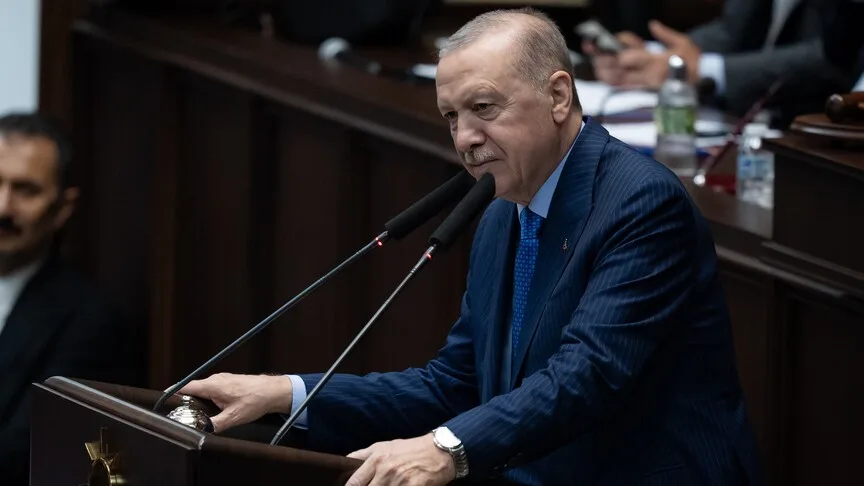
In an exceptional escalation of Turkish political rhetoric, President Recep Tayyip Erdogan raised the stakes in his confrontation with “Israel,” as his country’s relations with it have seen mounting tension in recent weeks, laying down what appeared to be Turkish red lines against the Israeli expansionist project, when he stressed that “Türkiye’s security does not begin only in Hatay; it begins in Aleppo, in Damascus, and in Beirut.”
Erdogan’s remarks, delivered during his address to the parliamentary bloc meeting of the Justice and Development Party in the Turkish Parliament, came at an extremely sensitive regional moment, as Israeli operations continue across three interconnected arenas — Gaza, southern Lebanon, and southern Syria — in a practical translation of violations of the ceasefire agreements in the Strip and Lebanon, in addition to the 1974 disengagement agreement in the Golan.
These remarks cannot be read narrowly as merely a position of solidarity with Syria and Lebanon. They carry deeper messages and implications, revealing a notable shift in Turkish security and political discourse: from defending the state’s immediate borders to defending the vital sphere surrounding it. If this shift is translated into practice, it could mark a watershed in the future of regional balances and in the limits of Israeli maneuverability in the Arab Mashreq and the eastern Mediterranean.
The Turkish president did not stop at condemning Israeli policies; he sought to offer a new definition of the threat map as Ankara sees it, at a turbulent and highly complex regional moment that appears open to pivotal geopolitical transformations.
A shift in Türkiye’s security doctrine
A first reading of these remarks reflects a clear qualitative shift in Ankara’s approach to its national security. The threats facing Türkiye are no longer confined to the Kurdistan Workers’ Party, or the Syrian Democratic Forces, nor merely to recurring unrest along its southern border — the traditional approach that for many years formed one of the core pillars of Türkiye’s security outlook.
Today, Türkiye appears more inclined to present its national security as a path directly linked to the stability of the Mashreq belt surrounding it: from northern Syria to Damascus, and from Lebanon to the eastern Mediterranean. Under this conception, Turkish national security moves from the concept of direct border security to that of deep security within arenas that are geographically farther away, but still capable of generating threats that reverberate inside Türkiye and affect its vital interests.
Ankara is therefore trying to say that protecting its security does not begin when danger reaches its borders, but rather at the stage when a hostile or unstable regional environment takes shape and may later turn into a direct source of threat.
Yet the central issue that must be noted here is that this shift does not mean Türkiye’s security doctrine has fully and completely moved from the border to the Syrian and Lebanese depth. A security doctrine requires clear tools, military positioning, alliances, rules of engagement, and implementation mechanisms that remain incomplete so far.
What can be said with confidence, however, is that these remarks reveal the contours of a Turkish security doctrine in the making, one based on broadening the definition of Türkiye’s national security sphere and linking it to regional arenas beyond its immediate borders. That in itself represents a pivotal development in Türkiye’s orientation and in the way Ankara views its national security, its extensions, and its arenas of influence.
A new approach toward Syria and Lebanon
What stands out in Erdogan’s remarks is that they placed Syria and Lebanon within a single security equation, after Türkiye’s security approach had for many years remained centered primarily on the Syrian arena, by virtue of geography, the length of the shared border, the refugee file, and Kurdish threats — motives that are understandable from a security standpoint and politically acceptable in Turkish calculations.
But bringing Beirut into this equation opens the door to a broader Turkish approach that extends beyond northern Syria to the Mashreq and the eastern Mediterranean. Ankara is indirectly trying to say here that, despite its centrality, the Syrian arena is no longer the sole determinant of its security movement; Lebanon has become part of a broader regional environment whose instability, Türkiye believes, could affect its interests, security, and regional positioning.
From this angle, Erdogan’s remarks carried multiple messages to more than one party. The first concerns the Syrian arena and is directed primarily at “Israel”: southern Syria, Damascus, and Aleppo are no longer open arenas for imposing new security realities, and any future formulation of arrangements inside Syria cannot take place in isolation from Turkish interests and calculations.
The second message concerns the Lebanese arena. Although Turkish influence in Lebanon does not compare with its influence in Syria, Ankara is trying through this rhetoric to present itself as a regional power with a stake in the Lebanese scene, and one that rejects turning Lebanon into an open space for Israeli bullying or attempts to reshape its internal and regional balances.
From this perspective, the mention of Beirut in Erdogan’s speech cannot be treated as an expression of moral or political solidarity. Rather, it is a signal that Türkiye is seeking to broaden the definition of its security sphere from the immediate Syrian border to a wider Mashreq arc, in which it sees Syria, Lebanon, and the eastern Mediterranean as interconnected arenas within a single equation.
Red lines political, not military
Some readings of Erdogan’s remarks described them as Turkish red lines in the face of Israeli incursions. But while that description comes close to the essence of the scene, it requires further unpacking, given the multiple connotations and differing interpretations carried by the term “red lines” in political and military contexts.
In the political sense, a red line refers to a strategic warning aimed at raising the cost of the rival state’s behavior here, “Israel” by sending the message that any Israeli expansion in the Syrian and Lebanese arenas is no longer viewed by Türkiye as a distant or separate file, but as something directly connected to Turkish national security.
In the military sense, however, the matter is fundamentally different. Here, a red line entails a practical warning coupled with the possibility of a direct response, meaning that if the other side crosses these declared boundaries, it could trigger a clear military move, specific rules of engagement, or field positioning that translates the warning into action.
From this angle, Erdogan’s remarks appear closer to flexible political red lines than to hard military red lines. So far, there are not enough indications that this escalation will be translated into direct military arrangements in either the Syrian or Lebanese arenas, whether through redeployment, the establishment of rules of engagement, or the announcement of specific response mechanisms.
Even so, the importance of these remarks lies in the fact that they raise the political and strategic cost of any broad Israeli move in these two arenas, and affirm that Ankara will not treat Israeli expansion as a matter detached from its calculations. At the very least, it is declaring that it will not remain politically silent in the face of any attempt to impose a new fait accompli in Syria or Lebanon, relying on the pressure tools it possesses and its influence within regional and international decision-making circles.
Repositioning
In light of the geopolitical shifts imposed by recent developments from the war in Gaza to the US-Israeli war against Iran the region appears to be facing a moment of broad repositioning, in which regional and international powers are seeking to revise their calculations according to new equations that traditional approaches are no longer capable of absorbing.
Türkiye is one of the most prominent powers that moved quickly to engage with these developments, through rhetoric, strategy, and practical steps aimed at reasserting its presence as an active regional power at the heart of Middle East equations, not merely on their margins.
From this standpoint, Erdogan’s remarks can be read as a declaration of a Turkish shift from the position of cautious observer to that of an actor directly concerned with the fate of the conflict. Through this rhetoric, Ankara is saying that it will not be content to follow developments from afar, nor will it remain captive to the limits of its traditional geographic approaches, which long focused on the Balkans, the Black Sea, and the Caucasus. Rather, it now sees Syria, Lebanon, and the eastern Mediterranean as a direct extension of its vital sphere and national security.
If translated into practice, this shift could give Türkiye additional cards of influence and pressure, enhancing its regional weight and opening the door to broader possibilities for shaping significant regional alignments or understandings capable of balancing Israeli expansionist plans and curbing its bullying in the Mashreq arenas, especially if read alongside another parallel track Ankara is pursuing at full speed, including discussions on forming Arab-Islamic alliances.
Accordingly, Erdogan’s speech cannot be read as passing remarks or as an emotional and political expression of solidarity with Syria and Lebanon in the face of “Israel.” At the same time, it cannot be treated as a declaration of a complete and radical transformation in Türkiye’s security doctrine, or the imposition of strict military red lines.
Most likely, we are facing an intermediate stage between the two: a stage that does not yet rise to the level of a fully formed security doctrine, but reveals the contours of one in the making; and one that does not establish hard red lines in the military sense, but draws flexible political boundaries capable of constraining Israel’s room for maneuver and disrupting its sense of ease in the Syrian and Lebanese arenas.
Perhaps the most prominent message carried by these remarks is what Ankara wanted to convey to Tel Aviv, as well as to regional and international powers: that Syria, Lebanon, and the eastern Mediterranean are not strategic vacuums that can be reshaped by force without taking Turkish interests into account. Only the coming days will test the effectiveness of this message, the extent of its impact on Israeli calculations, and Ankara’s ability to turn it from high-pitched political rhetoric into a more coherent regional deterrence equation.