












Despite the intensity of U.S. and Israeli airstrikes on Iran, Washington continues to approach the question of a ground war with caution, sending mixed signals about the possibility. President Donald Trump has not entirely ruled it out, saying: “I’m not saying there won’t be ground troops. We may not need them or if necessary.”
Amid an open-ended air campaign and unresolved hints about a possible shift toward ground operations, an old question has resurfaced: can Iran be penetrated by land as it was during earlier moments in its modern history, or has the cost of such an operation today become immeasurably higher?
A look back at Iran’s modern history reveals two notable cases in which its borders were breached: the swift Anglo-Soviet invasion of 1941 and Iraq’s large-scale assault at the start of the 1980 war. But what has changed today in geography, military structure, state capacity, and deterrence tools that could make any ground invasion an extraordinarily costly gamble?
The Anglo-Soviet Invasion of Iran, 1941
On the eve of World War II, Reza Shah Pahlavi the founder and ruler of the Pahlavi state sought to keep Iran neutral between the competing powers. Britain and the Soviet Union, however, feared the growing influence of Germany in Tehran and its potential impact on oil supplies and transport routes to the Soviet Union.
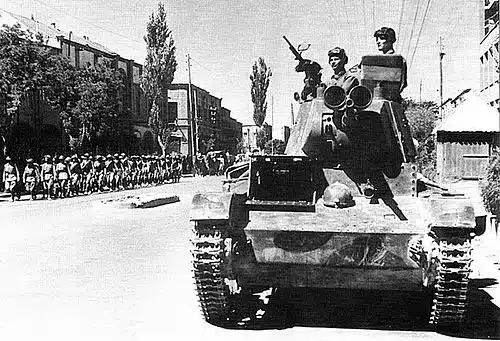
At dawn on August 25, 1941, the Anglo-Soviet alliance launched Operation Countenance. Units from the British Army and the 8th Indian Division crossed the Shatt al-Arab River from Basra toward the city of Abadan in southwestern Iran, quickly seizing its oil refineries with the support of a small naval force.
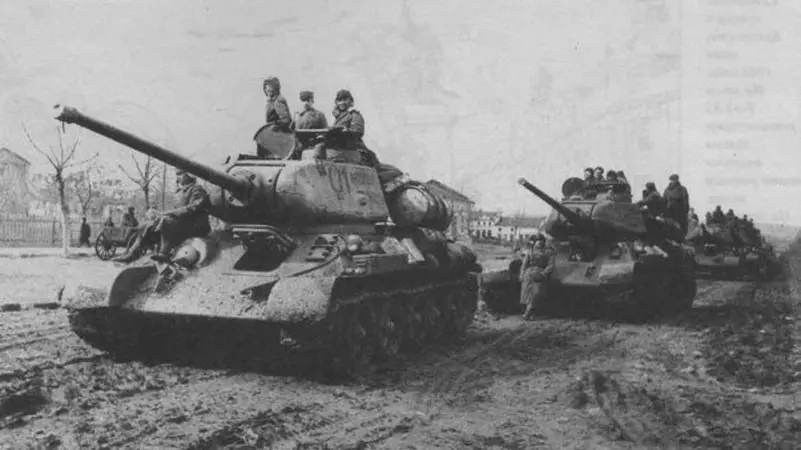
At the same time, other British units advanced from Khanaqin on the Iraqi border, pushing into the Naft Shah oil field (Naft Shahr) and then crossing the Pai Tak Pass toward Kermanshah in the northwest after Iranian defenders withdrew.
From the north, three Soviet armies attacked Iran through the Caucasus, while amphibious landings took place at Bandar Pahlavi on the Caspian Sea coast. Soviet forces advanced toward Maku and then toward Sanandaj the capital of Kurdistan province in western Iran as well as Qazvin.
Iranian forces were poorly trained and lacked tanks and air power. Reza Shah also refused to destroy roads and railway lines to slow the invading armies, which facilitated the rapid advance.
By August 30, British and Soviet forces had linked up in Sanandaj and Qazvin. Iranian defenses collapsed, and the Shah agreed to surrender. On September 16, he was forced to abdicate the throne in favor of his son, Mohammad Reza.
The occupation proved a decisive turning point. After the signing of a tripartite treaty in January 1942, the Allies were allowed to keep their troops in Iran until the war ended, turning the country into the so-called “Persian Corridor” used to supply the Soviet Union with weapons and aid.
The success of the invasion was not due solely to numerical superiority Anglo-Soviet forces mobilized around 200,000 troops against nine relatively weak Iranian divisions but also to the weakness of Iran’s leadership and its failure to mobilize the population or exploit the country’s mountainous terrain. Allied reliance on amphibious units and modern airpower, which quickly secured control of the skies, also played a decisive role.
These factors made the invasion swift and relatively low-cost for the Allies, leaving a bitter memory in Iranian political consciousness about the monarchy’s rapid collapse in the face of an easy foreign advance.
The Iraqi Invasion of Iran, 1980
Eighteen months after the Islamic Revolution, Iraqi President Saddam Hussein believed he had a strategic opportunity to seize territory in oil-rich Khuzestan and weaken the new Iranian regime.
On the morning of September 22, 1980, the Iraqi Air Force launched strikes on ten Iranian air bases, followed by a ground invasion along three main axes.
On the northern front, Iraqi forces quickly captured Qasr-e Shirin, cutting the strategic road linking Baghdad and Tehran.
In the central sector, the Iraqi army seized the city of Mehran in Ilam province.
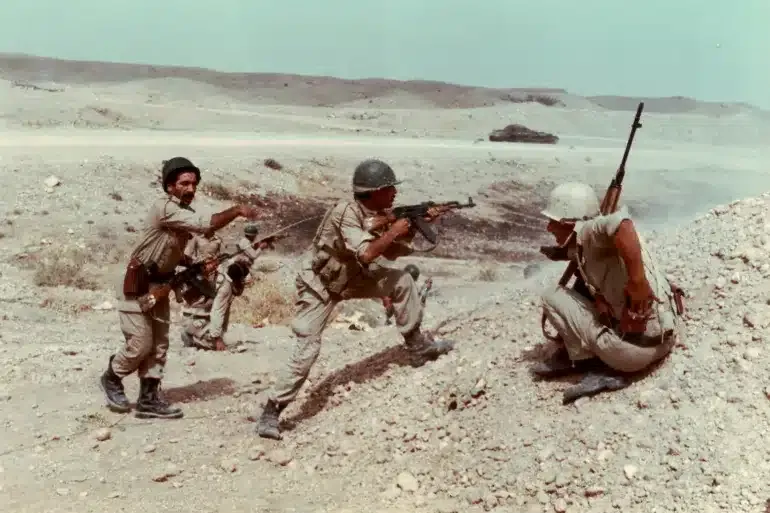
In the south, three armored divisions and two mechanized divisions crossed the Shatt al-Arab River toward Khorramshahr, Abadan, and Ahvaz.
Within the first days, Iraqi troops advanced nearly 80 kilometers into Khuzestan and nearly isolated Khorramshahr and Abadan from Ahvaz. Yet Baghdad’s calculations proved flawed.
The initial air campaign failed to destroy Iran’s air force. Iraqi strikes targeted runways rather than aircraft themselves, allowing Iran to retain its F-4 bombers and launch counterattacks.
On the ground, Iraqi troops encountered fierce resistance in southern cities. Abadan held out despite being besieged, while Khorramshahr fell only after two months of urban combat that cost Iraq roughly 6,000 casualties.
Although Iraqi forces achieved early gains in the north and center, they stalled near Dezful and Ahvaz and failed to penetrate deeper into Iranian territory.
The invasion faltered due to several interconnected factors:
-
Iran released detained pilots and integrated the regular army with the Islamic Revolutionary Guard Corps and volunteer Basij forces, creating a broad defensive mobilization.
-
Many Arab residents of Khuzestan joined the resistance rather than siding with Baghdad, depriving Iraq of a potential local “Trojan horse.”
-
Iraqi forces committed tactical mistakes, dispersing their efforts across multiple objectives and failing to prioritize the advance toward Ahvaz or the destruction of the Dezful air base. The command structure was also ill-prepared for large-scale urban warfare.
As a result, what began as a rapid incursion turned into a long war of attrition. Iran eventually recaptured the occupied territories in 1981–1982. While Baghdad succeeded in surprising Tehran, the invasion neither toppled the Iranian state nor forced it into surrender. Instead, it strengthened the revolutionary narrative of the “Sacred Defense” and triggered widespread popular mobilization.
Why a Ground Invasion Appears Far More Complex Today
The current conflict has largely unfolded in the air and at sea, with Washington repeatedly signaling that it does not intend to repeat the experiences of Iraq or Afghanistan wars that drained U.S. resources for years.
U.S. Defense Secretary Pete Hegseth has stated that the campaign’s objectives are to destroy missile capabilities and nuclear infrastructure rather than “nation-building,” stressing that “you don’t need to send 200,000 troops there and stay for 20 years.” Trump himself has framed a ground option as a last resort, suggesting it may not be necessary.
This caution reflects an assessment of several factors that make a ground invasion far more costly than in the past:
1. Geography:
Iran is a vast country covering more than 1.6 million square kilometers, with complex and rugged terrain. The Zagros Mountains line the Iraqi border, the Alborz Mountains dominate the north, and vast deserts stretch across the interior features that collectively provide significant defensive advantages.
2. Population Density:
With around 85 million people living across large cities and rural areas, any invading force would face the challenge of occupying densely populated urban centers while confronting ideologically driven resistance shaped by the experience of the Iran-Iraq War and later asymmetric conflicts.
3. Military and Security Experience:
Over four decades, Iran has accumulated significant operational experience. The Islamic Revolutionary Guard Corps and Basij forces have evolved from a popular militia into an ideological institution with land, air, and naval units, as well as a broad volunteer network something demonstrated during the June 2025 confrontation and the current war.
According to a report by the Center for Strategic and International Studies, Iran possesses “the largest and most diverse missile arsenal in the Middle East,” with thousands of ballistic and cruise missiles, some capable of reaching Israel and Eastern Europe. Over the past decade, Tehran has invested heavily in improving the precision of these systems.
Iran also fields long-range drones and maintains missile capabilities among its regional allies in Iraq, Lebanon, and Yemen meaning any invading force would face constant threats to supply lines and rear bases.
4. Combat Experience:
Iran has become highly practiced in asymmetric warfare. Its defense doctrine based on centralized planning and decentralized execution has enabled it to absorb the initial shock of the current war and continue launching missiles despite heavy electronic warfare strikes.
Its long history of supporting militia movements across the Middle East and deploying advisory units regionally also provides Tehran with the ability to open multiple fronts against adversaries.
Taken together, recreating the scenarios of 1941 or 1980 in a contemporary context would likely be an extremely risky political and military venture particularly given divisions within American public opinion. Recent polls show that support for the strikes stands at only about 27 percent.


