









On January 5, 2026, negotiations between Syria and Israel resumed in Paris under US sponsorship, marking the first round of talks after a months-long hiatus.
The revival of dialogue came just days after US President Donald Trump predicted that Damascus and Tel Aviv were close to reaching an agreement, revealing the existence of an “understanding” between himself and Israeli Prime Minister Benjamin Netanyahu on the Syrian file though he refrained from elaborating on its nature.
Failed Attempts and Setbacks
Following the collapse of Bashar al-Assad’s regime in late 2024, the new Syrian leadership cautiously opened indirect communication channels with Israel under Washington’s auspices. This came in response to an exceptional reality: Israeli forces had penetrated deep into southern Syria. Preliminary exploratory talks soon followed, facilitated by international mediators.
-
In July 2025, a secret face-to-face meeting between Syrian and Israeli representatives took place in Baku, Azerbaijan.
-
By mid-September, the talks went public, with negotiations moving to Paris. The Syrian delegation was led by Foreign Minister Asad Hassan al-Shaybani and General Intelligence Director Hussein al-Salama. Across the table sat Israeli Strategic Affairs Minister Ron Dermer.
-
A second round was held days later in London between Shaybani and Dermer, focusing on de-escalation measures based on the 1974 Disengagement Agreement.
Later that same month, Damascus publicly acknowledged the existence of negotiations for the first time an indication of mounting US pressure to demonstrate goodwill. Still, the meetings were marred by tension and deep mutual distrust.
Despite the fraught atmosphere, sources told Reuters the two sides came close to agreeing on a framework for border security after months of shuttle diplomacy in Baku, Paris, and London leading up to the UN General Assembly in late September.
According to leaks, the proposed framework included:
-
The establishment of a demilitarized buffer zone covering the restive Suwayda province;
-
An end to Israeli airstrikes and ground incursions into Syrian territory;
-
A Syrian commitment not to deploy heavy military equipment near the Golan border.

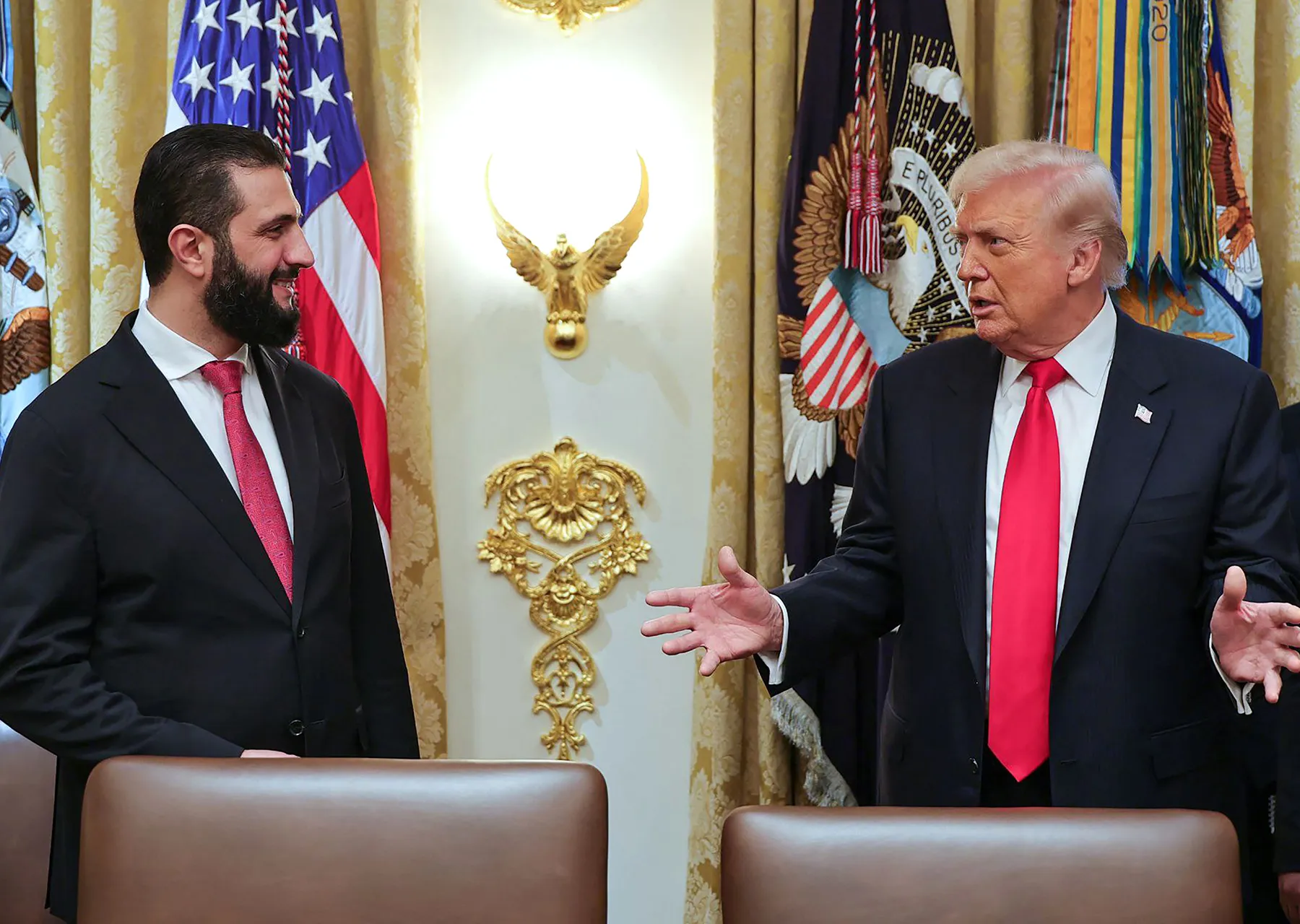
Trump told al-Sharaa that “Syria must work towards peace and normalization with Israel.”
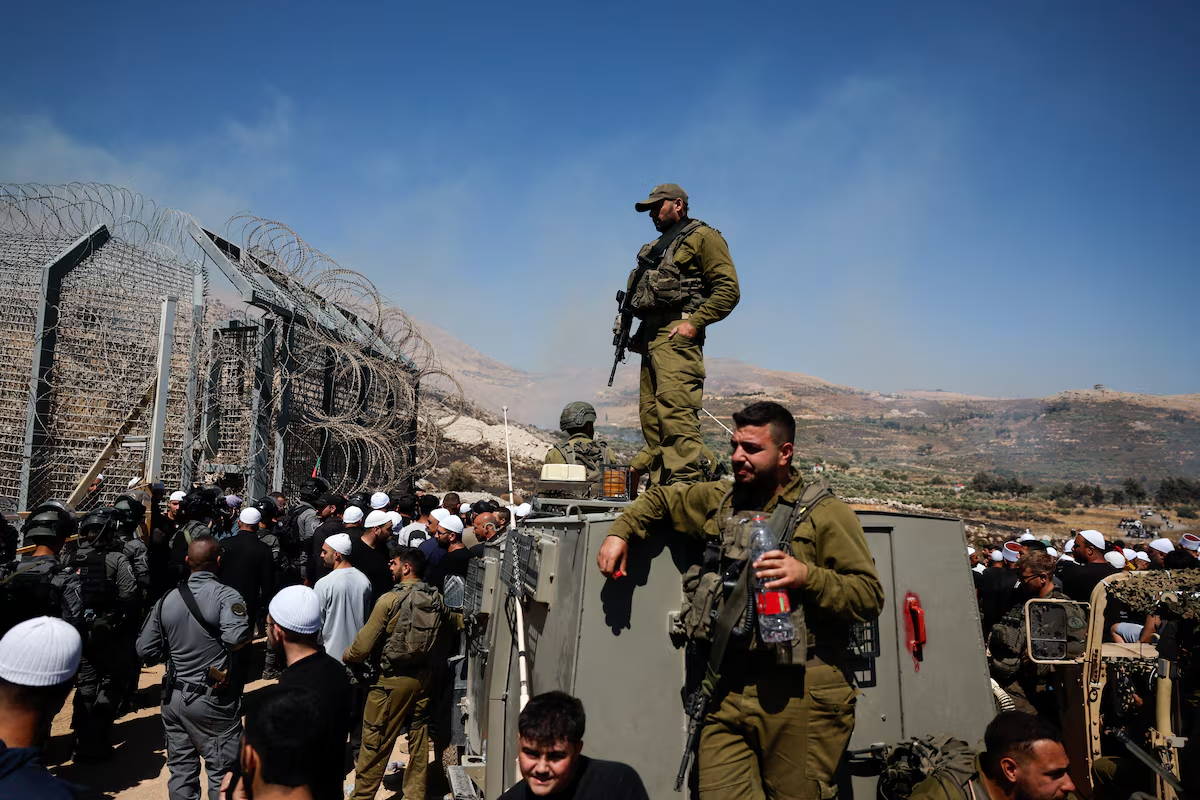
But a last-minute hurdle derailed the anticipated announcement in New York. Israel reintroduced a demand for the creation of what it termed a “humanitarian corridor” to Suwayda as part of the agreement. Damascus had previously and unequivocally rejected this proposal, viewing it as a violation of sovereignty and a deliberate stalling tactic by Tel Aviv.
In his UN speech, Netanyahu sought to ease tensions, expressing confidence in the possibility of reaching an agreement, while stressing that continued negotiations depended on safeguarding what he called Israeli interests chief among them, preventing Syrian or Iranian military entrenchment in southern Syria and “protecting the Druze.”
From Damascus’s perspective, the message was mixed, particularly as it coincided with the sudden resignation of Ron Dermer in October 2025. Talks were then completely frozen for the next two months amid a quiet exchange of blame between the two sides for missing a window of de-escalation.
What Does Each Side Want?
As talks resumed in January 2026, the divergent priorities of each party became increasingly clear, reflecting competing visions of sovereignty and security.
Syria’s Demands:
-
Full withdrawal of Israeli forces from Syrian territory seized after Assad’s fall—returning to the 1974 lines;
-
A complete halt to Israeli attacks on Syrian soil, which in 2025 alone resulted in significant civilian and material losses;
-
Rejection of the “phased withdrawal” concept reportedly floated by Tel Aviv.
Israel’s Demands:
-
The creation of a completely demilitarized zone in southern Syria;
-
Special security arrangements, citing the need to protect the Druze population;
-
Inclusion of a “humanitarian corridor” from the Golan to Suwayda under the pretext of aid delivery;
-
A future political normalization agreement with Damascus as part of any final deal—something Syria has firmly refused to discuss at this stage, insisting it is off the table.
In a related development, Israeli sources revealed that Netanyahu hinted to US officials at a controversial trade-off: Israel might consider pulling out from parts of southern Syria in exchange for Syria abandoning its claim to the occupied Golan Heights.
That proposal was flatly rejected by Damascus. Reuters quoted a Syrian official as saying President Ahmad al-Sharaa told US envoy Tom Barrack that “any compromise on the Golan would mean the end of his presidency.”
Power Politics and Strategic Timing
The latest round of talks in Paris cannot be separated from the shifting landscape of regional and international influence following the Assad regime’s downfall.
The United States has re-emerged as a central actor in Syria, capitalizing on the diminished roles of Russia and Iran Assad’s former allies. Washington sees in the new Syrian leadership under al-Sharaa a strategic opportunity to draw Damascus away from Tehran and reintegrate it into the US-led regional order.
For the Trump administration, even a limited security agreement between Syria and Israel is viewed as part of a broader regional vision an extension of the Abraham Accords that normalized ties between Israel and several Arab and Muslim countries.
Having brokered those deals during his first term, Trump is now seeking another diplomatic win by tackling one of the region’s most intractable disputes: the Israeli-Syrian border.
An Israeli security official told the press that Trump is personally invested in the issue and wants to secure a breakthrough for political leverage. To that end, he has applied pressure not only on Netanyahu but has also engaged directly with Syria’s new leadership.
At a summit in Riyadh in May 2025, Trump met with al-Sharaa and told him outright that “Syria must pursue peace and normalization with Israel and its neighbors” if it hopes to win Washington’s support.
Following a clash between Israeli forces and local residents in southern Syria, Trump even issued a rare warning to Tel Aviv, cautioning against “destabilizing Damascus and its new leadership,” according to the Times of Israel.
Ceasefire or Path to Normalization?
All of this raises a fundamental question: Are the Paris negotiations a serious attempt to lay the groundwork for normalization between Syria and Israel or merely a tactical agreement to manage an ongoing conflict?
The White House portrays the talks as a strategic starting point that could one day lead to “full normalization akin to the Egypt-Israel peace deal.” Trump and his team believe that simply bringing the two sides to the table and achieving basic security arrangements would pave the way for broader steps down the line.
Yet, current indicators point more toward a limited tactical agreement than a comprehensive peace deal. The core disputes remain unresolved.
The status of the occupied Golan Heights, though not immediately addressed, looms large as a potential deal-breaker. Israel refuses to fully withdraw even to the current 2024 boundaries without strict conditions, while Syria refuses to grant any legitimacy to either the old or the new occupation.
Trust is also in short supply. Syrians fear that Israel won’t honor any commitments just as they accuse it of violating the 1974 agreement when the opportunity arose. Israelis, in turn, question whether Syria’s new leadership can—or will—curb what they call “hostile intent” toward the Jewish state.
For now, the most realistic outcome of these negotiations appears to be a de-escalation agreement: security arrangements to cool tensions and prevent direct conflict, without resolving the deeper political rifts.


